
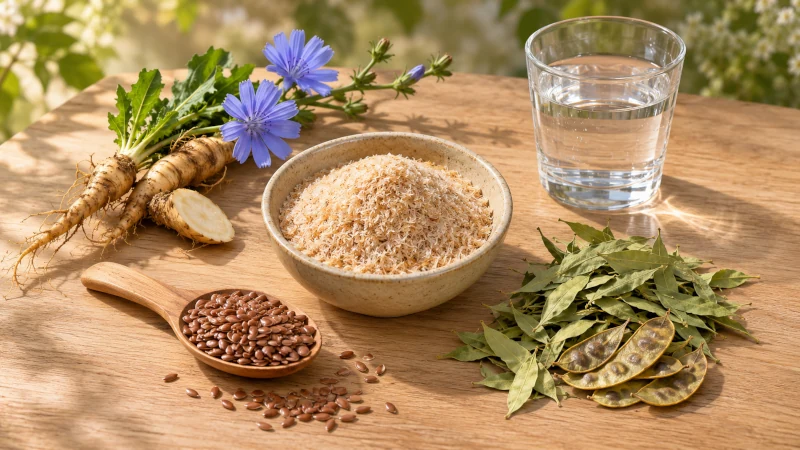
If you want one plant that reliably helps, start with psyllium. Among the herbs for constipation, it has the strongest evidence, it’s gentle enough for daily use, and U.S. gastroenterology guidelines list fiber supplements, psyllium in particular, as a reasonable first step [Chang et al., 2023]. Senna works too, faster and more forcefully, but it’s meant for short stretches. Most of the other herbs you’ll see on long lists have little human research behind them for this use, and a couple carry real risks.
Constipation usually means fewer than three bowel movements a week, or stools that are hard, dry, lumpy, or painful to pass [NIDDK, n.d.]. If that’s you, and it’s recent and comes without the warning signs listed near the end of this article, trying a plant-based option first is reasonable.
Herbs for constipation at a glance
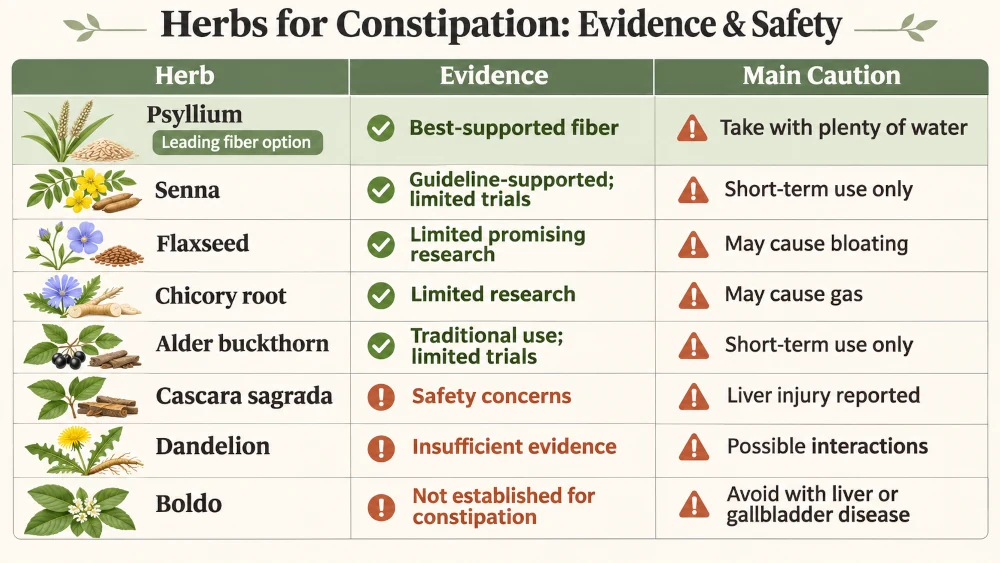
| Herb | Type | Evidence for constipation | Main caution |
| Psyllium husk | Bulk-forming fiber | Best of the herbs: guideline-supported (low certainty) and backed by a meta-analysis | Take with a full glass of water; keep 2 hours away from other medicines |
| Senna | Stimulant | Guideline-supported for constipation; based on one small trial | Cramping; limit to about a week without medical advice |
| Flaxseed | Fiber and mucilage | One small trial in adults with type 2 diabetes | Bloating at higher doses; never eat raw or unripe seeds |
| Chicory root (inulin) | Fermentable fiber | Small, industry-linked trials; guideline calls the data limited | Gas |
| Alder buckthorn | Stimulant | Long use in Europe; no recent trials of it alone | One week maximum; not under 12 or in pregnancy |
| Cascara sagrada | Stimulant | FDA removed it from OTC laxatives in 2002 | Rare but serious liver injury |
| Dandelion | Traditional | No compelling evidence | Allergy; drug interactions |
| Boldo | Traditional | Not recognized for constipation | Avoid with liver or gallbladder disease |
How herbal laxatives work
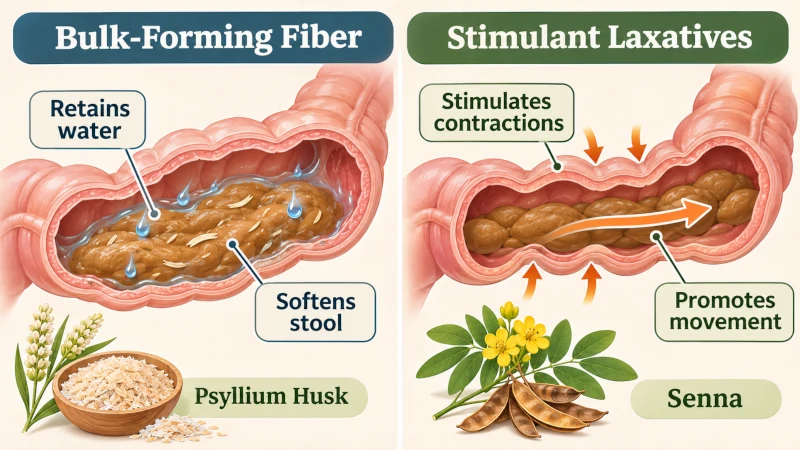
Plant laxatives fall into two groups, and the difference matters more than the plant’s name. Bulk-forming herbs such as psyllium and flaxseed hold water in the gut, so stool becomes larger and softer and moves more easily. They work slowly and are suited to regular use. Stimulant herbs such as senna, alder buckthorn, and cascara contain anthraquinone compounds that push the colon to contract and reduce how much water it pulls back out of stool [LiverTox, 2020]. They work faster, cramp more, and aren’t meant for daily use.
The herbs with the best evidence
Psyllium
Psyllium husk comes from the seeds of Plantago ovata. It soaks up water and forms a soft gel that bulks and softens stool.
In 2023 the American Gastroenterological Association and the American College of Gastroenterology reviewed constipation treatments and suggested fiber supplements for adults with chronic constipation. Psyllium was the only fiber with evidence of benefit; data on bran and inulin were too thin to judge [Chang et al., 2023]. That recommendation is conditional and rests on low-certainty evidence: useful, not definitive. A 2022 meta-analysis of 16 randomized trials with 1,251 participants landed in the same place. Fiber helped, and psyllium, doses above 10 g a day, and at least four weeks of use looked best, though the trials varied a lot [van der Schoot et al., 2022].
Don’t expect it overnight. A bowel movement typically follows within 12 to 72 hours [Michigan Medicine, n.d.], and the fuller effect builds over weeks. Gas is the most common side effect, and bloating or belly discomfort can happen [Chang et al., 2023], so start with a small dose and work up over a week or two.
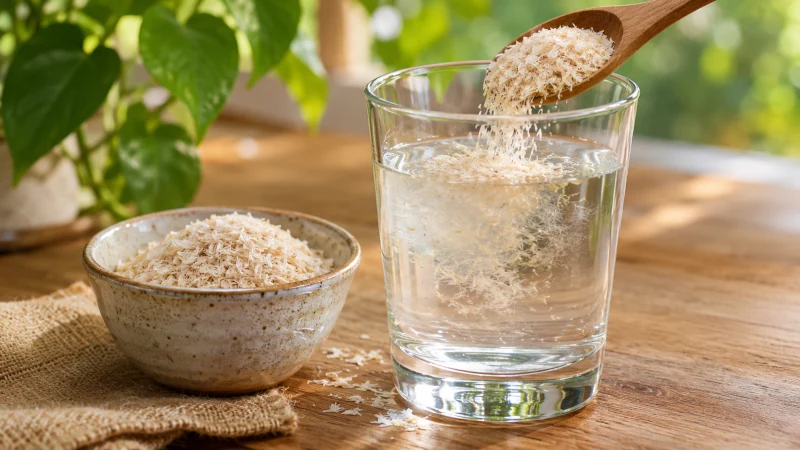
Two rules are not optional:
- Drink at least 8 ounces of water or other fluid with every dose. Without enough liquid, psyllium can swell and block the throat or esophagus, which is why U.S. labels must carry a choking warning. Don’t use it if you have trouble swallowing [FDA, 21 CFR 201.319].
- Keep it 2 hours away from other oral medicines, before or after, because it can reduce how well they’re absorbed [Michigan Medicine, n.d.].
Our guide to the psyllium plant covers forms, doses, and preparation in more detail.
Senna
Senna leaves and pods (Senna alexandrina, which includes the Indian type sold as Tinnevelly senna) contain sennosides. It’s the active ingredient in familiar over-the-counter products such as Senokot and Ex-Lax [LiverTox, 2020].
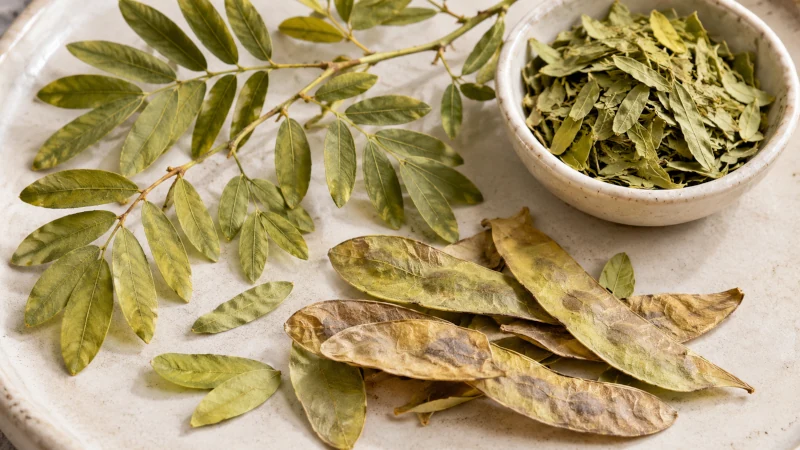
The 2023 guideline also suggests senna, but the support is narrow: a single small four-week trial at a higher dose than people usually take, in which 83% of the senna group cut back their dose. Cramping, belly pain, and diarrhea were more common than with placebo [Chang et al., 2023]. So start at the low end of the label dose and go up only if you need to.
European regulators accept senna leaf for short-term relief of occasional constipation in adults and teens over 12, for no longer than a week, and note that two or three doses a week is usually enough. Regular long-term use can upset fluid and salt balance, darken the lining of the colon, and leave you reliant on laxatives [EMA, n.d.-a]. Liver injury is rare and has mostly followed large amounts taken for months, such as large amounts of senna tea drunk daily for years [LiverTox, 2020].
Skip senna if you have a bowel obstruction, inflammatory bowel disease, appendicitis, unexplained belly pain, or severe dehydration [EMA, n.d.-a]. If you prefer it as a tea, our roundup of the best teas for constipation compares senna with gentler options.
Fiber-based herbs with smaller studies

Flaxseed
Flaxseed adds fiber plus mucilage, a gel-forming material similar to what makes psyllium work. In a 12-week, single-blind trial in constipated adults with type 2 diabetes, people who ate 10 g of flaxseed baked into cookies twice a day had better constipation symptoms and softer stools than the placebo group; a psyllium group improved too [Soltanian & Janghorbani, 2019]. That’s one small trial in a specific group of people, so call it promising.
Never eat raw or unripe flaxseed, which may contain potentially toxic compounds. Larger amounts can cause bloating, fullness, and diarrhea, and flaxseed might, in theory, interact with blood thinners [NCCIH, 2025]. Drink plenty of fluid with it, as with any fiber.
Chicory root (inulin)
Chicory root is the main commercial source of inulin, a fiber your gut bacteria ferment. In a randomized, double-blind crossover trial of 44 adults with mild constipation, 12 g of chicory inulin a day for four weeks raised median stool frequency from three to four a week compared with placebo, and softened stools [Micka et al., 2017]. Two of the five authors worked for the ingredient’s manufacturer, and the 2023 guideline judged the overall inulin evidence too limited and uncertain to draw firm conclusions [Chang et al., 2023]. Like other fiber supplements, it can cause gas.
A cup of chicory tea isn’t the same as a measured inulin supplement, and it hasn’t been tested the same way. Our chicory plant guide separates what’s known about the root fiber from traditional uses.
Stimulant barks: short-term use only
Alder buckthorn (frangula)
Alder buckthorn bark (Frangula alnus) is a stimulant laxative in the same chemical family as senna. European regulators accept it for short-term relief of occasional constipation, but on the strength of long use rather than modern research: there are no recent studies of frangula on its own [EMA, n.d.-b].
The limits are firm. Adults and teens over 12 only, no more than one week, and not during pregnancy or breastfeeding. Cramps and watery stools mostly come with too high a dose. Your urine may turn yellow or reddish-brown, which is harmless. Longer use can upset fluid and salt balance [EMA, n.d.-b]. Some herbal sources say alder buckthorn can be taken for years without losing its effect; regulators’ one-week limit points the other way. More in our alder buckthorn safety guide.
Cascara sagrada
Cascara sagrada bark is a stronger stimulant laxative. In 2002 the FDA ruled that cascara and aloe were no longer generally recognized as safe and effective in over-the-counter laxatives, after no manufacturer submitted the safety data the agency had asked for [FDA, 2002]. It’s still sold as a dietary supplement.
Liver injury from cascara is rare, but it has been reported, mostly with high doses taken longer than recommended. A few cases were severe, and taking cascara again after a liver injury has caused the injury to come back. Long-term use can also cause cramping, electrolyte imbalance, and weight loss [LiverTox, 2017]. You’ll still read that cascara is gentle enough for long-term use in older adults. The evidence doesn’t support that. If you need something ongoing, psyllium or a laxative your doctor recommends is the safer path. Our cascara sagrada page goes into the details.
Traditional herbs with little evidence for constipation
Dandelion
Dandelion leaf and root are old digestive remedies, but there’s no compelling scientific evidence for dandelion in any health condition, constipation included [NCCIH, 2024]. Amounts eaten as food are likely safe. Larger amounts are less studied, and there are theoretical interactions with diabetes medicines, blood thinners, and water pills. People allergic to ragweed, chrysanthemums, marigolds, or daisies may react, though the evidence on that is conflicting [NCCIH, 2024].
Boldo
Boldo leaf is traditionally used to increase bile flow, and lab studies show its compound boldine can do that. European regulators, though, recognize boldo only for indigestion and mild gut spasms, not constipation, and note that no studies in patients have been done. It’s for adults only, and it shouldn’t be used at all if you have gallstones, a blocked bile duct, cholangitis, or liver disease [EMA, n.d.-c].
Older herbal references list dozens of other “laxative plants,” from hemp agrimony and high mallow to purging cassia and fumitory. We didn’t find the kind of human research that would justify recommending any of them over the options above.
How to use herbs for constipation safely
- Start with food, fluids, and fiber. Many people improve by adding fiber-rich foods and enough water before reaching for any supplement.
- Choose a bulk-forming herb first. Psyllium (or flaxseed) for regular use; save stimulant herbs for occasional, short-term relief.
- Keep stimulants short. About a week at most without medical advice [EMA, n.d.-a]. Stop if you get bad cramping or diarrhea.
- Don’t stack stimulants. Many “detox” and weight-loss teas already contain senna [LiverTox, 2020]. Check labels before combining a tea with a senna or cascara product.
- Ask a pharmacist about your medicines. Stimulant laxatives can cause fluid and salt (electrolyte) losses [EMA, n.d.-a], which matters more if you take water pills or heart medicines. Psyllium needs 2-hour spacing from other drugs [Michigan Medicine, n.d.]. Flaxseed and dandelion have theoretical interactions with blood thinners [NCCIH, 2025].
- Know the next step. If herbs aren’t enough, the 2023 guideline strongly recommends polyethylene glycol and several other proven options [Chang et al., 2023]. Your doctor or pharmacist can help you choose.
Pregnancy, breastfeeding, and children
Talk to your clinician before using any herbal laxative while pregnant or breastfeeding. The guidance isn’t uniform:
- Senna: European regulators advise against it during pregnancy and breastfeeding [EMA, n.d.-a], while the U.S. LactMed database says usual doses are acceptable while breastfeeding, based on controlled studies of modern products [LactMed, 2024]. Your clinician can help you weigh that.
- Alder buckthorn: not for use in pregnancy or breastfeeding [EMA, n.d.-b].
- Cascara: we didn’t find safety data that would support it during pregnancy or breastfeeding; avoid it unless your clinician says otherwise.
- Flaxseed and dandelion: some studies suggest flaxseed may be unsafe in pregnancy, though the evidence isn’t conclusive [NCCIH, 2025]; little is known about medicinal amounts of dandelion [NCCIH, 2024].
- Children: senna leaf and alder buckthorn preparations shouldn’t be given to children under 12 [EMA, n.d.-a]. Check with a pediatrician before giving any herbal laxative to a child.
When constipation needs a doctor

See a doctor if self-care isn’t working or you have a family history of colon or rectal cancer. Get care right away if constipation comes with any of these [NIDDK, n.d.]:
- Bleeding from the rectum or blood in your stool
- Constant belly pain
- Being unable to pass gas
- Vomiting or fever
- Lower back pain
- Losing weight without trying
After taking psyllium, stop and call your doctor if you develop chest pain, vomiting, or trouble swallowing or breathing [FDA, 21 CFR 201.319], or if constipation lasts longer than seven days [Michigan Medicine, n.d.].
| HEALTH DISCLAIMER: This article is for general education and isn’t a substitute for advice from a doctor, pharmacist, or other qualified professional. Herbal laxatives can interact with medicines and aren’t right for everyone, including some people who are pregnant, breastfeeding, older, or managing heart, kidney, liver, or bowel conditions. Supplements aren’t held to the same standards as medicines, so strength and purity can vary between products. If constipation is new, severe, or lasts more than a week, or if you have any warning signs listed above, talk to a healthcare professional. |
Frequently Asked Questions
What is the best herb for constipation?
Psyllium. It’s the only plant fiber the 2023 U.S. guideline found evidence for, and it’s gentle enough for regular use [Chang et al., 2023]. Senna also works but is better suited to occasional, short-term use.
Is it safe to take senna every day?
Not for long. European regulators set a one-week limit without medical advice and warn that long-term use can upset electrolytes and lead to laxative dependence [EMA, n.d.-a]. If you need something most days, talk to your doctor about a fiber supplement or a guideline-recommended laxative.
Can I take psyllium every day?
Fiber supplements were studied as daily treatment over at least four weeks [van der Schoot et al., 2022]. Product guidance still advises checking with a doctor before using psyllium for constipation more than seven days in a row [Michigan Medicine, n.d.], mainly so an underlying cause isn’t missed.
Are herbal laxative teas safe?
Senna teas work, but many “detox” and slimming teas contain senna too [LiverTox, 2020], and heavy daily use over months has been linked to liver injury. Use them occasionally, at label strength, and never combine several stimulant teas.
What should I do if herbs don’t help?
See a doctor, especially if constipation lasts beyond a week or comes with warning signs. Proven non-herbal options, such as polyethylene glycol, carry strong guideline recommendations [Chang et al., 2023].
References
- Chang L, Chey WD, Imdad A, et al. American Gastroenterological Association–American College of Gastroenterology Clinical Practice Guideline: Pharmacological Management of Chronic Idiopathic Constipation. View source
- European Medicines Agency, HMPC. Sennae folium – herbal medicinal product. View source
- European Medicines Agency, HMPC. Frangulae cortex – herbal medicinal product. View source
- European Medicines Agency, HMPC. Boldi folium – herbal medicinal product. View source
- U.S. Food and Drug Administration. Status of certain additional over-the-counter drug category II and III active ingredients. Final rule. View source
- U.S. Food and Drug Administration. 21 CFR 201.319 — Water-soluble gums, hydrophilic gums, and hydrophilic mucilloids; required warning. View source
- LactMed. Senna. Drugs and Lactation Database. View source
- LiverTox. Cascara. NIDDK; View source
- LiverTox. Senna. NIDDK; View source
- Michigan Medicine Health Library. View source
- Micka A, Siepelmeyer A, Holz A, Theis S, Schön C. Effect of consumption of chicory inulin on bowel function in healthy subjects with constipation: a randomized, double-blind, placebo-controlled trial. View source
- National Center for Complementary and Integrative Health. Dandelion. View source
- National Center for Complementary and Integrative Health. Flaxseed and Flaxseed Oil. View source
- National Institute of Diabetes and Digestive and Kidney Diseases. View source
- Soltanian N, Janghorbani M. Effect of flaxseed or psyllium vs. placebo on management of constipation, weight, glycemia, and lipids: a randomized trial in constipated patients with type 2 diabetes. View source
- van der Schoot A, Drysdale C, Whelan K, Dimidi E. The effect of fiber supplementation on chronic constipation in adults: an updated systematic review and meta-analysis of randomized controlled trials. View source


