
A few plant-based treatments can modestly calm mild breakouts. None of them clears acne the way a dermatologist’s plan can. The herbs for acne with the most support are topical — tea tree oil, green tea extract, and aloe vera used alongside a proven treatment — and even for those, the research is small and mostly low quality [NCCIH, 2021], [Cao et al., 2015].
Know that before you spend money. The American Academy of Dermatology’s acne guidelines say there are too few data on herbal and complementary therapies to recommend them [NCCIH, 2021]. If your acne is deep, painful, or leaving scars, skip the experiments and see a dermatologist. Over-the-counter products, botanical or not, are unlikely to treat those types [AAD, 2023].
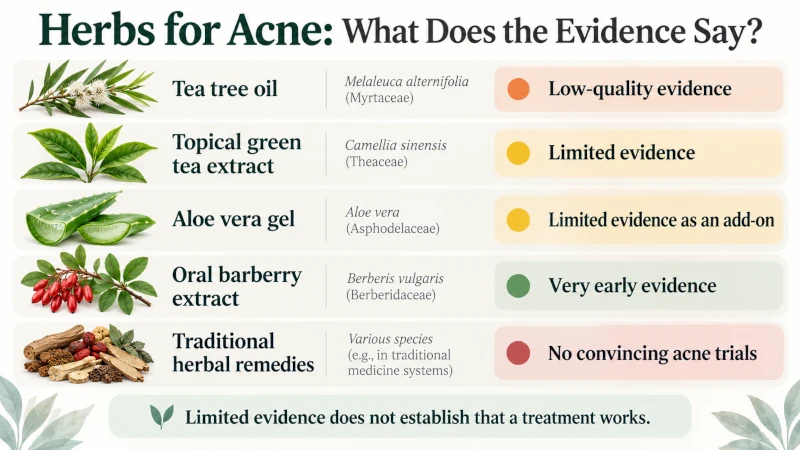
Herbs for acne at a glance
| Remedy | How it’s used | Evidence | Main caution |
| Tea tree oil | Topical gel or skin product | Low quality; a few small trials | Irritation, contact allergy; never swallow |
| Green tea extract | Topical cream or lotion | Limited; meta-analysis of 5 small trials | Drinking it showed minimal effect |
| Aloe vera gel | Topical, alongside a proven treatment | Limited; two small studies | Occasional burning, itching, rash |
| Barberry (oral) | Capsule or extract | Very early; one small trial | Berberine side effects and drug interactions |
| Evening primrose, burdock, pansy; onion, cabbage or carrot poultices | Folk remedies | No convincing acne trials | Homemade applications can irritate skin |
Why one herb rarely fixes acne
Acne starts in the pore, and several things happen at once: extra oil, dead skin cells plugging the follicle, acne-related bacteria, and inflammation, often with hormones setting the pace. Dermatologists usually combine treatments for exactly that reason [AAD, 2024]. A plant oil that kills bacteria in a lab dish is aimed at one piece of the puzzle.
Hormones are a big piece for adults. Shifts around periods, pregnancy, perimenopause, and starting or stopping birth control can all trigger breakouts. So can stress, some medicines, and pore-clogging hair and skin products [AAD, n.d.-a]. No herb has been shown to correct those drivers. For a wider look at plant remedies across skin conditions, see our guide to herbs for skin issues and what the evidence supports.
Which herbs for acne have the best evidence?
Tea tree oil
Tea tree oil has the longest research record of any acne botanical, and it’s still thin. A 2015 Cochrane review of 35 trials of complementary therapies found low-quality evidence, from a single 60-person trial, that tea tree oil gel reduced total lesion counts compared with placebo [Cao et al., 2015]. NCCIH’s current summary: a small amount of research suggests it might help, but more studies are needed before anyone can draw firm conclusions [NCCIH, 2025a]. A 2019 review of studies in children and teens also rated the evidence as low quality [NCCIH, 2021].
If you want to try it, choose a product made for skin rather than pure essential oil. Tea tree oil contains 1,8-cineole, a skin irritant, and old or oxidized oil is more likely to trigger an allergic reaction than fresh oil [NCCIH, 2021]. People in trials reported itching, dryness, and flaking [Cao et al., 2015]. And never swallow it. Taken by mouth, tea tree oil can cause confusion, loss of coordination, and coma [NCCIH, 2025a].
Topical green tea extract
Green tea has a small but encouraging data set, as long as it goes on your skin. A 2021 meta-analysis pooled five randomized trials with about 250 participants. Green tea extract applied to the skin cut inflammatory lesion counts; taking it by mouth made little difference [Kim et al., 2021]. The authors saw no significant side effects and called for larger, better trials.
So a green tea cream or lotion is a reasonable thing to test on mild acne if your skin tolerates it. A cup of green tea is a fine drink. Don’t expect it to show up on your face.
Aloe vera as an add-on
Aloe’s best case is as a sidekick. NCCIH notes that two small studies found aloe gel improved acne when combined with other treatment [NCCIH, 2025b]. In one 8-week trial of 60 people with mild to moderate acne, adding aloe gel to prescription tretinoin worked better than tretinoin alone [Hajheydari et al., 2014]. No one has shown that aloe works as a stand-alone acne treatment.
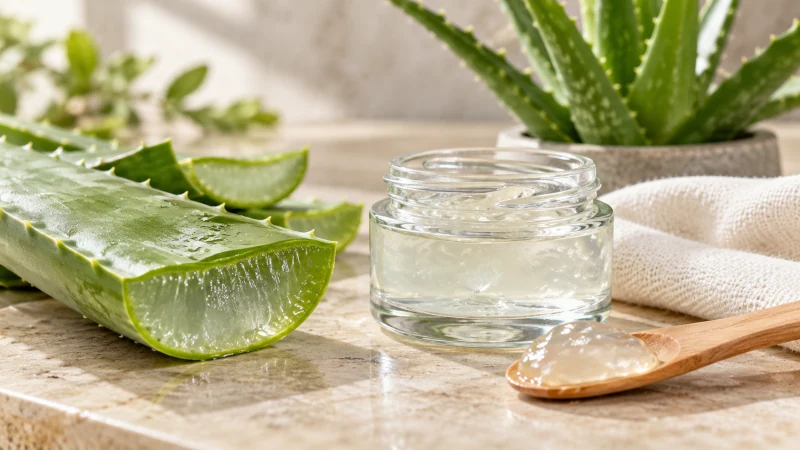
Keep it on the outside. Topical aloe gel is generally well tolerated, though burning, itching, and rash do happen occasionally. Oral aloe is a different matter: aloe latex taken by mouth can cause cramps and diarrhea, and aloe leaf extracts have been linked to cases of acute hepatitis [NCCIH, 2025b].
Herbs with weak or unproven acne evidence
Barberry and berberine
Barberry turns up in acne roundups because of a 2012 trial in which 49 teenagers with moderate to severe acne took an oral barberry extract and improved [NCCIH, 2021]. One small trial is a starting point, not a recommendation.
The bigger issue is safety. Berberine, the active compound in barberry, commonly causes nausea, diarrhea, bloating, and constipation. It may interact with medicines, and it should not be used during pregnancy or breastfeeding or given to infants [NCCIH, 2023].
Evening primrose oil, burdock, pansy, and kitchen poultices
These show up on older herb lists without acne trials worth the name. The Cochrane review found no reliable support for herbal medicine in general beyond the single tea tree oil trial [Cao et al., 2015]. Evening primrose oil taken by mouth has also failed a large review for eczema, another skin condition where it was once popular [NCCIH, 2021].
Homemade poultices of onion, cabbage, or carrot carry a different risk: irritation. Anything that stings, dries, or burns your face can make acne worse [AAD, n.d.-b]. Eating carrots won’t clear acne either. Carrots are a good source of vitamin A, but that’s a different claim. If you suspect food plays a part in your breakouts, our look at which foods may worsen acne sorts the stronger links from the myths.
How to try a botanical acne product safely
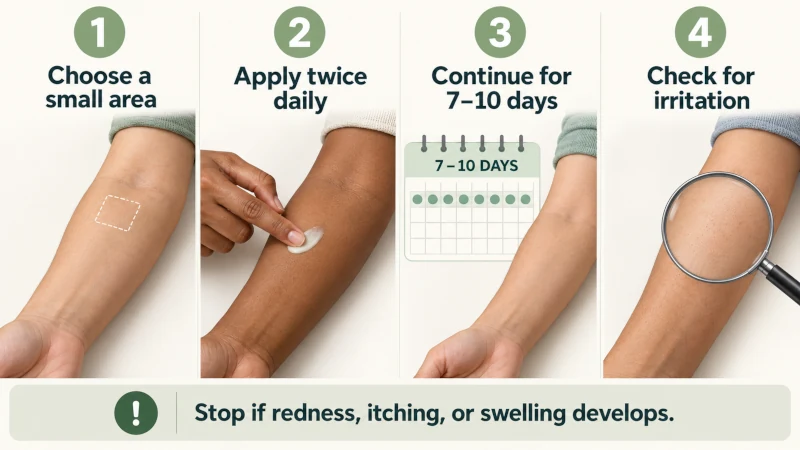
If you want to give a plant-based product a fair shot, set it up so you can tell whether it works.
- Test it first. Apply a quarter-sized amount twice a day to the inside of your arm or the bend of your elbow for 7 to 10 days. If you get redness, itching, or swelling, wash it off and don’t use it again [AAD, 2021]. Our guide to patch testing explains how this differs from the allergy test a dermatologist does.
- Don’t assume “natural” means fragrance-free. Products labeled “unscented” or made with botanical ingredients can still contain fragrance-related ingredients that irritate skin [AAD, 2021].
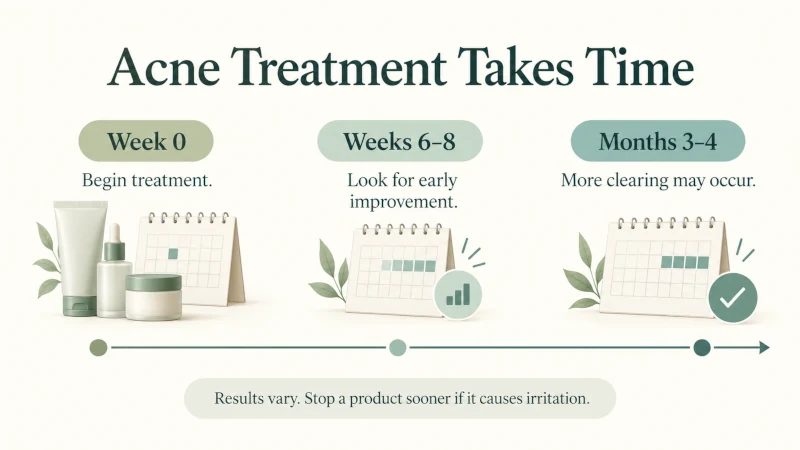
- Add one new product at a time and give it 6 to 8 weeks. That’s how long improvement takes to show; complete clearing generally takes 3 to 4 months [AAD, n.d.-b].
- Wash gently twice a day and after sweating. Scrubbing and washing all day irritate skin and can trigger more breakouts [AAD, n.d.-b].
- Use non-comedogenic moisturizer, sunscreen, and makeup [AAD, n.d.-b].
- Stop right away if a product burns, swells, or causes a rash.
Keep the alternatives in view, too. For mild acne, dermatologists recommend over-the-counter adapalene, benzoyl peroxide, azelaic acid, or salicylic acid, applied in a thin layer over all your acne-prone skin rather than only on the spots [AAD, 2023]. Those have far stronger evidence than any herb. A botanical can sit alongside them. It shouldn’t replace them if they’re working.
Side effects, interactions, and pregnancy
Natural doesn’t automatically mean gentle. The main concerns:
- Skin irritation and allergy. Redness, stinging, dryness, and peeling are the most common reactions, especially with essential oils or when a botanical is layered on top of acne medication [NCCIH, 2021], [Cao et al., 2015].
- Swallowing the wrong thing. Tea tree oil is for skin only [NCCIH, 2025a]. Oral aloe latex and leaf extracts carry real risks [NCCIH, 2025b].
- Drug interactions. Berberine can interact with some medicines [NCCIH, 2023]. If you take any medicine, talk with your health care provider before using an herbal product [NCCIH, 2025a].
- Pregnancy and breastfeeding. Topical tea tree oil products may be safe in pregnancy and while breastfeeding, but oral aloe may be unsafe and berberine should be avoided [NCCIH, 2025a], [NCCIH, 2025b], [NCCIH, 2023]. Several acne medicines, including isotretinoin, tazarotene, and spironolactone, can cause serious birth defects [AAD, n.d.-c]. If you’re pregnant or trying to be, check with your obstetrician or dermatologist before treating acne on your own [AAD, 2023].
When to skip herbs and see a dermatologist
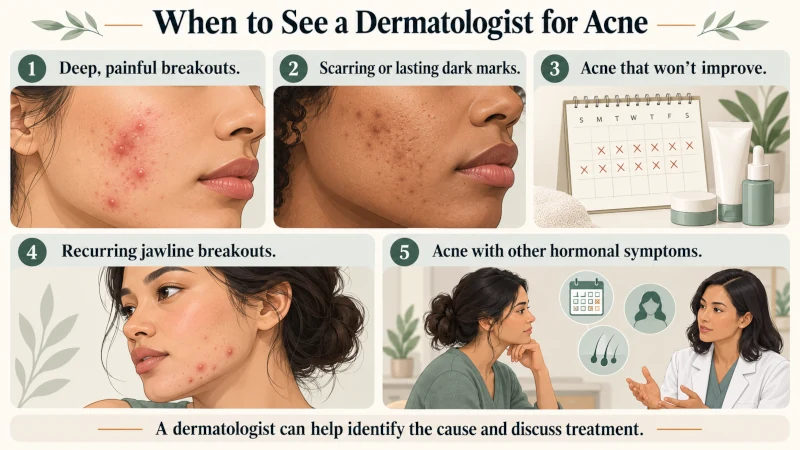
Self-care, with or without herbs, isn’t the right path if:
- You have large, painful pimples deep in the skin, or acne that leaves scars [AAD, 2023].
- Dark spots linger after breakouts clear, a sign of significant inflammation [AAD, 2023].
- A few months of consistent over-the-counter care haven’t cleared your skin [AAD, 2023].
- Breakouts sit on your chin and jawline or arrive predictably with your period. Those are signs of hormonal acne, which prescription treatments can target [AAD, 2024].
- Acne comes with irregular periods, extra hair on the face or body, or thinning hair. These can point to polyendocrine metabolic ovarian syndrome (PMOS, also known as polycystic ovary syndrome or PCOS), a hormone condition that needs medical care [MedlinePlus, 2026].
- You think a medicine is causing breakouts. Keep taking it, but ask the prescriber [AAD, n.d.-a].
Get urgent care if you develop facial swelling, trouble breathing, blistering, or rapidly spreading redness after applying a product. A reaction that severe needs medical attention, not another home remedy [AAD, 2021].
| HEALTH DISCLAIMER: This article is for general education and is not a substitute for medical advice, diagnosis, or treatment. Not every breakout is acne, and acne has several causes. Herbs, essential oils, and supplements can irritate skin or interact with medicines. If you are pregnant or breastfeeding, take prescription medicines, have an ongoing medical condition, or have moderate to severe acne, talk with a doctor, dermatologist, or pharmacist before starting a new treatment. |
Frequently Asked Questions
Can tea tree oil replace benzoyl peroxide or adapalene?
Not on current evidence. The tea tree oil data come from a handful of small, low-quality trials [Cao et al., 2015], while over-the-counter benzoyl peroxide, adapalene, salicylic acid, and azelaic acid are what dermatologists recommend for mild acne [AAD, 2023]. Treat tea tree oil as an optional add-on.
Do herbs work for hormonal acne?
None has been shown to. Hormonal acne, which tends to cluster on the chin and jawline or flare with your period, responds to prescription options such as certain birth control pills or spironolactone that a dermatologist can discuss with you [AAD, 2024].
Is drinking green tea good for acne?
Probably not in a way you’d notice. In the 2021 meta-analysis, oral green tea extract had minimal effect on lesions; the benefit showed up with extract applied to the skin [Kim et al., 2021].
How long should I try a botanical acne product?
If your skin tolerates it, about 6 to 8 weeks before deciding it isn’t helping. Stop sooner if it burns, swells, or causes a rash [AAD, n.d.-b].
Are herbal acne remedies safe during pregnancy?
It depends on the remedy. Topical tea tree oil products may be safe, but oral aloe may be unsafe and berberine should be avoided [NCCIH, 2025a], [NCCIH, 2025b], [NCCIH, 2023]. Ask your obstetrician or dermatologist before treating acne during pregnancy [AAD, n.d.-c].
References
- American Academy of Dermatology. Acne: Diagnosis and treatment. View source
- American Academy of Dermatology. Adult acne treatment dermatologists recommend. View source
- American Academy of Dermatology. Adult acne: Why it happens and what you can do for it. View source
- American Academy of Dermatology. 10 skin care habits that can worsen acne. View source
- American Academy of Dermatology. Is any acne treatment safe to use during pregnancy? View source
- American Academy of Dermatology. How to test skin care products. View source
- National Center for Complementary and Integrative Health. Tea Tree Oil: Usefulness and Safety. View source
- National Center for Complementary and Integrative Health. Aloe Vera: Usefulness and Safety. View source
- National Center for Complementary and Integrative Health. Skin Conditions and Complementary Health Approaches: What the Science Says. View source
- National Center for Complementary and Integrative Health. Diabetes and Dietary Supplements: What You Need To Know. View source
- MedlinePlus Medical Encyclopedia. Polyendocrine metabolic ovarian syndrome. U.S. National Library of Medicine. View source
- Cao H, Yang G, Wang Y, Liu JP, Smith CA, Luo H, Liu Y. Complementary therapies for acne vulgaris. View source
- Kim S, Park TH, Kim WI, Park S, Kim JH, Cho MK. The effects of green tea on acne vulgaris: a systematic review and meta-analysis of randomized clinical trials. Phytotherapy Research. View source
- Hajheydari Z, Saeedi M, Morteza-Semnani K, Soltani A. Effect of Aloe vera topical gel combined with tretinoin in treatment of mild and moderate acne vulgaris: a randomized, double-blind, prospective trial. Journal of Dermatological Treatment. View source


