Your thyroid gland can’t make thyroid hormone without iodine. That’s really one of the main iodine benefits and adds to the story of why this mineral matters — but the details of how much you need, where to get it, and when it becomes risky are where most of the confusion online comes from.
Iodine is a trace mineral your body can’t make on its own. Every atom of it has to come from food, iodized salt, or a supplement. Once it’s absorbed, your thyroid gland uses it to build thyroxine (T4) and triiodothyronine (T3), the two hormones that control your metabolism, body temperature, and — during pregnancy and infancy — a developing brain and skeleton [NIH Office of Dietary Supplements, 2024].
Iodine deficiency is uncommon in the United States today, mostly because of iodized salt, but it hasn’t disappeared, and getting too much iodine causes its own set of problems. Here’s what the evidence actually supports.
What Iodine Actually Does in Your Body
Thyroid-stimulating hormone (TSH), released by your pituitary gland, tells your thyroid how much hormone to produce. Iodine is the raw material it needs to do that. Without enough of it, thyroid hormone production drops, TSH rises to compensate, and — if the shortfall continues — the thyroid gland enlarges into a goiter as it tries to capture more iodine from the blood [NIH Office of Dietary Supplements, 2024].
Thyroid hormone affects nearly every system in the body: metabolic rate, heart rate, digestion, muscle function, and brain development. That last one is why iodine gets special attention during pregnancy and infancy — a fetus depends entirely on maternal thyroid hormone in early pregnancy, before its own thyroid gland is functional [NIH Office of Dietary Supplements, 2024].
How Much Iodine You Need, by Life Stage
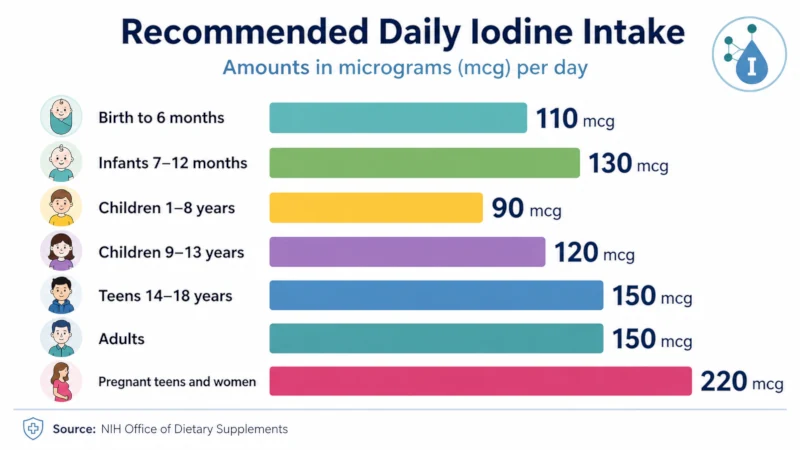
These are the U.S. recommended daily amounts, covering iodine from all sources — food, iodized salt, and supplements combined.
| Life stage | Recommended amount |
| Birth to 6 months | 110 mcg |
| Infants 7–12 months | 130 mcg |
| Children 1–8 years | 90 mcg |
| Children 9–13 years | 120 mcg |
| Teens 14–18 years | 150 mcg |
| Adults | 150 mcg |
| Pregnant | 220 mcg |
| Breastfeeding | 290 mcg |
The jump for pregnancy and breastfeeding is real — about 50% more than a non-pregnant adult needs — because the fetus and then the nursing infant rely on the mother’s iodine intake [NIH Office of Dietary Supplements, 2024].
The Best Food Sources of Iodine
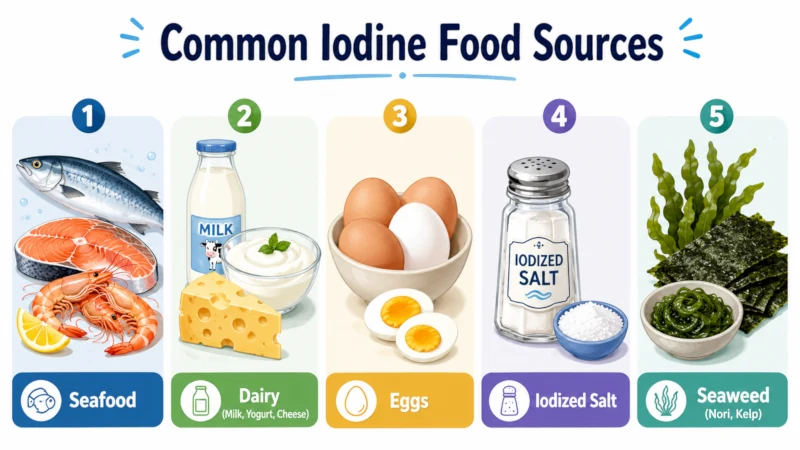
You can meet your iodine needs through ordinary food. The most reliable sources are:
| Food category | Examples |
| Seafood | Cod, tuna, shrimp, other seafood |
| Seaweed | Kelp, dulse, nori — but see the caution below |
| Dairy | Milk, yogurt, cheese |
| Eggs | Especially the yolk |
| Iodized salt | Table salt labeled “iodized” |
A few things trip people up here. Processed and canned foods almost never use iodized salt, even if the product itself contains salt. And “sea salt,” kosher salt, Himalayan salt, and fleur de sel are typically not iodized — the name “sea salt” refers to how it’s harvested, not its iodine content [NIH Office of Dietary Supplements, 2024].
Seaweed is a wild card
Seaweed is genuinely iodine-dense, but the amount varies enormously by species, region, and preparation — commercially sold seaweed products range from about 16 micrograms per gram to nearly 3,000 micrograms per gram [NIH Office of Dietary Supplements, 2024]. That’s roughly a 180-fold spread. A serving that’s harmless from one product could deliver several times the adult upper limit from another. If you eat seaweed like kelp or bladderwrack (fucus vesiculosus) regularly, treat it as a concentrated iodine source, not a garnish, and don’t assume that because you enjoyed a serving without symptoms yesterday, a larger one is safe today.
What Happens When You Don’t Get Enough
Iodine deficiency is uncommon in the United States and Canada today, largely because of iodized salt [NIH Office of Dietary Supplements, 2024]. When it does happen, the pattern is fairly predictable:
- Goiter — an enlarged thyroid gland — is often the first visible sign. It can cause a feeling of tightness in the neck and, if it grows large enough, choking, difficulty swallowing, or trouble breathing
- Hypothyroidism follows, with fatigue, weight gain, cold intolerance, dry or puffy skin, hoarseness, and thinning hair.
- In children, even mild iodine deficiency has been linked to subtler problems with reasoning and cognitive development, and supplementation in deficient children has been shown to improve both.
[Cleveland Clinic, 2022] [NIH Office of Dietary Supplements, 2024]
Who is most likely to fall short
- People who don’t use iodized salt
- People eating a vegan diet, or who eat little to no dairy, seafood, or eggs
- People living in regions with iodine-poor soil (the Himalayas, the Alps, the Andes, and river valleys of South and Southeast Asia are examples)
- Pregnant women, who need about 50% more iodine and, per U.S. surveys, sometimes fall short
- People with marginal iodine intake who also eat a lot of goitrogen-containing foods
Iodine deficiency in pregnancy is the bigger concern
This is where the stakes are highest. Severe iodine deficiency during pregnancy can cause stillbirth, spontaneous abortion, and congenital abnormalities, including cretinism — a severe and irreversible form of intellectual disability seen in iodine-deficient regions of Africa and Asia [World Health Organization]. Less severe deficiency is linked to lower-than-average IQ in children. Because of this, the American Thyroid Association and the American Academy of Pediatrics recommend that women who are pregnant, trying to conceive, or breastfeeding take a daily supplement with 150 mcg of iodine as potassium iodide — worth checking for specifically, since only about half of prenatal multivitamins sold in the U.S. actually contain iodine [NIH Office of Dietary Supplements, 2024].
Goitrogens: Foods That Can Interfere With Iodine Use
Goitrogens are naturally occurring substances in some plant foods — soy and cruciferous vegetables like cabbage, broccoli, cauliflower, and Brussels sprouts — that interfere with how the thyroid uses iodine. This sounds alarming out of context, but for most people getting adequate iodine in the U.S., eating reasonable amounts of these foods isn’t a concern [NIH Office of Dietary Supplements, 2024]. It matters more for people whose iodine intake is already marginal.
Cooking helps: in laboratory testing on cabbage and Chinese kale, both blanching and steaming reduced the goitrogenic compound goitrin, though the exact effect depended on the vegetable, method, and cooking time [Panduang et al., Foods, 2023]. If you eat a lot of raw cruciferous vegetables and have a marginal iodine intake, cooking them is a reasonable, low-effort adjustment — it’s not a requirement for most people.
Iodine Benefits the Evidence Actually Supports
Brain development in babies and young children
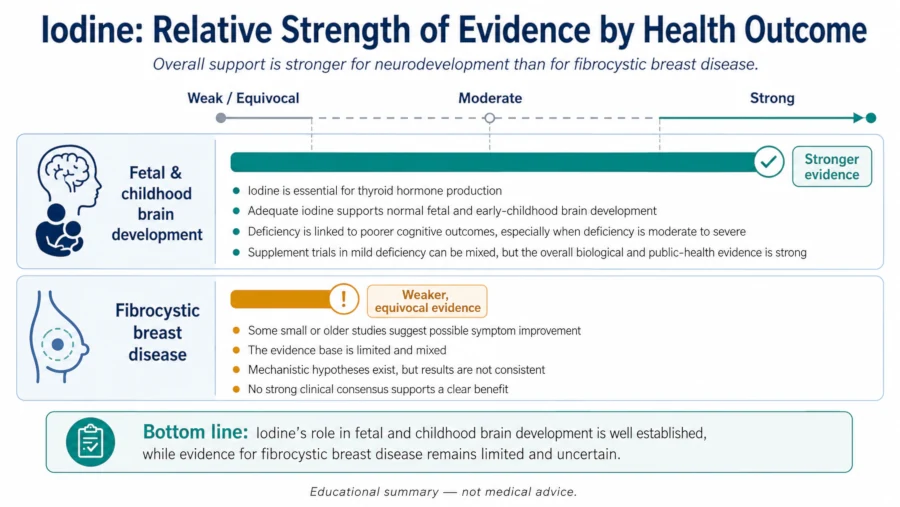
This is the strongest, best-established benefit. Adequate maternal iodine intake supports normal fetal brain and skeletal development, and correcting mild deficiency in children has been shown to improve reasoning and overall cognitive function [NIH Office of Dietary Supplements, 2024]. This isn’t a claim about iodine as a general “brain booster” for people who are already getting enough — it’s specifically about correcting a real shortfall.
Fibrocystic breast disease (equivocal evidence)
Some research has looked at whether very high-dose iodine supplements ease the lumpiness and pain of fibrocystic breast disease. The NIH’s own framing is that this “might” reduce symptoms but that more study is needed — and it specifically warns that iodine can be unsafe at the doses studied, so this isn’t something to try without medical supervision [NIH Office of Dietary Supplements, 2024]. The American Thyroid Association similarly describes the evidence here as “equivocal” [American Thyroid Association, 2013]. If you’re considering this, it’s a conversation for your doctor, not a self-directed supplement decision.
Can You Get Too Much Iodine?
Yes — and this is where a lot of well-intentioned iodine use goes wrong. Too much iodine can cause the same symptoms as too little, including goiter, plus thyroid gland inflammation and, in rare cases involving very large doses, burning of the mouth and throat, fever, stomach pain, and a weak pulse [NIH Office of Dietary Supplements, 2024].
The daily upper limit — combining food, salt, and supplements — is:
| Life stage | Upper limit |
| Birth to 12 months | Not established |
| Children 1–3 years | 200 mcg |
| Children 4–8 years | 300 mcg |
| Children 9–13 years | 600 mcg |
| Teens 14–18 years | 900 mcg |
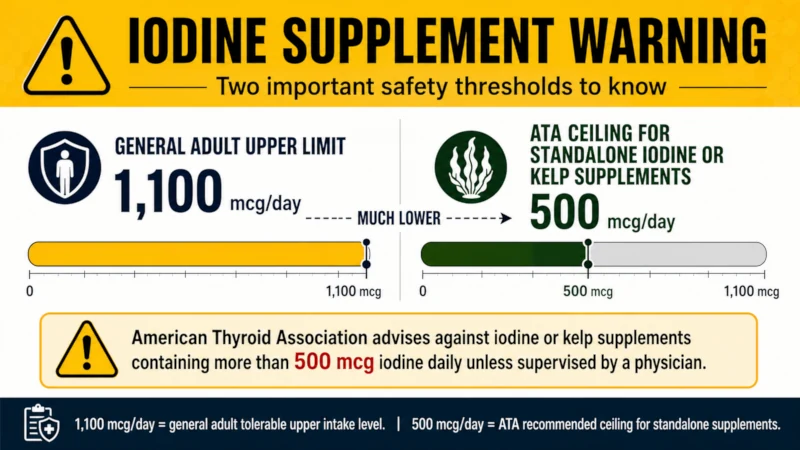
| Adults | 1,100 mcg |
Kelp and iodine supplements need extra caution
The American Thyroid Association goes further than the general upper limit for people considering a standalone iodine or kelp supplement: it advises against exceeding 500 mcg of iodine per day from a supplement unless a healthcare professional is directing otherwise, and notes that some iodine and kelp products on the market contain amounts far above the tolerable upper limit [American Thyroid Association, 2013]. Given how much iodine content can vary between seaweed products, “one capsule” doesn’t tell you much without checking the label.
Iodine and Radiation Emergencies: What Potassium Iodide Can (and Can’t) Do
You may have heard that eating iodine-rich foods can protect your thyroid during a nuclear or radiation emergency by “crowding out” radioactive iodine. This isn’t accurate, and it’s worth being precise about, since it’s the kind of thing people remember at exactly the wrong moment.
Potassium iodide (KI) — a specific, non-radioactive form of iodine, FDA-approved and taken only on the advice of medical or public health officials — works by filling the thyroid gland with stable iodine so it has no room left to absorb radioactive iodine during the 24 hours after a dose [CDC, 2024]. The CDC is direct about this: table salt and iodine-rich foods do not contain enough iodine to provide this protection, and dietary supplements should not be used as a substitute for KI [CDC, 2024]. If you’re ever in a situation where this matters, follow instructions from public health or emergency officials rather than relying on diet.
Medication and Supplement Interactions
Iodine supplements can interact with several medications, even at moderate doses — this isn’t limited to extreme, high-dose use:
- Antithyroid medications such as methimazole (Tapazole), used for hyperthyroidism: high-dose iodine combined with these drugs can push thyroid hormone production too low.
- ACE inhibitors for blood pressure (benazepril, lisinopril, fosinopril, and others): taking potassium iodide alongside these can raise blood potassium to unsafe levels.
- Potassium-sparing diuretics, such as spironolactone or amiloride: the same potassium-related risk applies.
Tell your doctor and pharmacist about any iodine-containing supplement you take, including multivitamins and kelp products. [NIH Office of Dietary Supplements, 2024]
Who Should Be Extra Careful With Iodine
Infants, older adults, pregnant and breastfeeding women, and anyone with existing thyroid disease — including Hashimoto’s, Graves’ disease, or thyroid nodules — are more susceptible to problems from excess iodine and should not start a high-dose iodine or kelp supplement without medical guidance [American Thyroid Association, 2013]. There are legitimate medical uses for short-term, high-dose iodine (Lugol’s solution or SSKI before thyroid surgery, for example), but these are prescribed and monitored by a physician, not self-administered.
When to Talk to a Healthcare Professional
Get medical advice rather than guessing if you notice:
- A visibly enlarged thyroid, or new choking, difficulty swallowing, or trouble breathing
- Persistent fatigue, unexplained weight change, or cold intolerance that doesn’t resolve
- Signs of overactive thyroid — rapid heartbeat, unexplained weight loss, anxiety, or heat intolerance — especially after starting an iodine or kelp supplement
- You’re pregnant, trying to conceive, or breastfeeding and aren’t sure whether your prenatal vitamin contains iodine
A simple blood test (TSH and thyroid hormone levels) is the standard way to check thyroid function — not a home skin test. You may see instructions online for painting iodine tincture on your skin and watching how fast the color fades as a way to “diagnose” deficiency; this method isn’t considered a reliable way to assess iodine status and shouldn’t be used to decide whether to start supplementing.
| HEALTH DISCLAIMER: This article is for general educational purposes and isn’t a substitute for professional medical advice, diagnosis, or treatment. Iodine needs and risks vary by individual, especially during pregnancy, breastfeeding, or with existing thyroid disease. Always talk with a qualified healthcare provider before starting an iodine or kelp supplement, changing your diet to treat a suspected deficiency, or using high-dose iodine for any purpose. If you have symptoms of a thyroid problem, seek medical evaluation rather than self-treating. |
Frequently Asked Questions
What’s the best natural source of iodine?
Seafood, dairy products, eggs, and iodized salt are the most consistent sources. Seaweed is iodine-rich but so variable between products that it’s harder to dose predictably.
Is sea salt a good source of iodine?
No. Despite the name, sea salt is not reliably iodized, and neither is kosher salt, Himalayan salt, or fleur de sel. Check the label for “iodized” specifically.
Can you get too much iodine from food alone?
It’s uncommon from ordinary food and iodized salt, but possible with regular seaweed consumption, given how much iodine content varies between products.
Do I need an iodine supplement if I eat a balanced diet?
Most people in the U.S. who eat dairy, eggs, or seafood and use iodized salt get enough iodine without a supplement. Vegans, people avoiding iodized salt, and pregnant or breastfeeding women are the groups most likely to need one — and pregnancy specifically warrants checking your prenatal vitamin’s label.
How do I know if I have an iodine deficiency?
A blood test for thyroid function (TSH and thyroid hormones) is the standard approach a healthcare provider would use. Home skin tests that involve painting iodine on the skin and timing how fast it fades are not a reliable diagnostic method.
Is kelp safe to take every day?
Not necessarily, and not without checking the dose. Because kelp’s iodine content varies so widely by product, daily use can put you over the upper limit without you realizing it. The American Thyroid Association recommends not exceeding 500 mcg of iodine per day from a supplement unless directed by a healthcare professional [American Thyroid Association, 2013].
References
- National Institutes of Health, Office of Dietary Supplements. “Iodine: Fact Sheet for Consumers.” Updated May 1, 2024. https://ods.od.nih.gov/factsheets/Iodine-Consumer/
- National Institutes of Health, Office of Dietary Supplements. “Iodine: Fact Sheet for Health Professionals.” https://ods.od.nih.gov/factsheets/Iodine-HealthProfessional/
- American Thyroid Association. “ATA Statement on the Potential Risks of Excess Iodine Ingestion and Exposure.” June 5, 2013. https://www.thyroid.org/ata-statement-on-the-potential-risks-of-excess-iodine-ingestion-and-exposure/
- Centers for Disease Control and Prevention. “How Potassium Iodide (KI) Works.” Radiation Emergencies. Reviewed April 17, 2024. https://www.cdc.gov/radiation-emergencies/infographic/potassium-iodide.html
- World Health Organization. “Iodine Deficiency.” WHO Global Nutrition Database. https://www.who.int/data/nutrition/nlis/info/iodine-deficiency
- Cleveland Clinic. “Iodine Deficiency: Symptoms, Causes, Treatment & Prevention.” Medically reviewed July 7, 2022. https://my.clevelandclinic.org/health/diseases/23417-iodine-deficiency
- Panduang, T., Phucharoenrak, P., Karnpanit, W., Trachootham, D. “Cooking Methods for Preserving Isothiocyanates and Reducing Goitrin in Brassica Vegetables.” Foods, 2023;12(19):3647. DOI: 10.3390/foods12193647. https://www.ncbi.nlm.nih.gov/pmc/articles/PMC10573036/
