
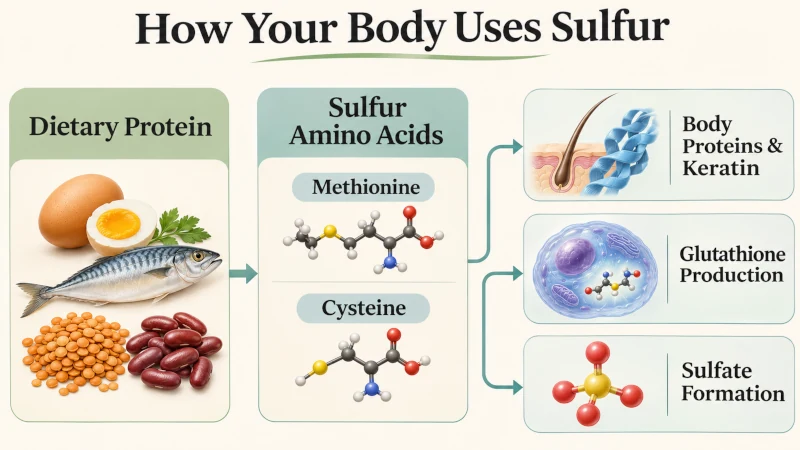
Sulfur’s biggest benefit is one you already get without trying: it comes built into the protein you eat. Two amino acids, methionine and cysteine, supply almost all of the sulfur your body uses [Nimni et al., 2007]. It’s the third most abundant mineral in your body, after calcium and phosphorus [Nimni et al., 2007]. If you eat enough protein, you’re almost certainly getting enough, which is why no official daily requirement exists [IOM, 2005].
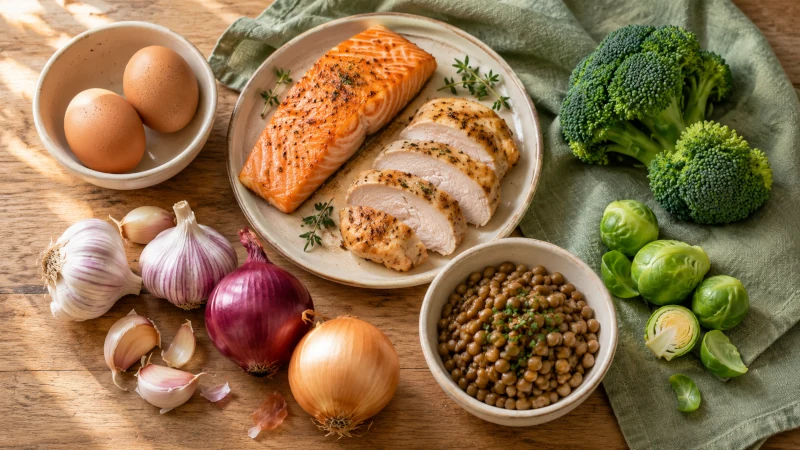
So the real questions about sulfur benefits are narrower. Which foods supply it? Do supplements like MSM do anything? And what’s worth avoiding? Here’s what the evidence supports, and where it runs out.
What sulfur does in your body
Building protein, including keratin
Sulfur is part of the structure of proteins throughout your body, including keratin in hair [Human Nutrition OER]. That’s the reason sulfur is sold for hair, skin, and nails. The chemistry is real. What’s missing is proof that extra sulfur makes hair or nails stronger in people who already eat enough protein — none of the sources reviewed for this article show that.
Making glutathione
Your cells use cysteine to make glutathione, one of the body’s main antioxidants, and the supply of cysteine appears to be what limits how fast glutathione gets made [Nimni et al., 2007]. This is the strongest mechanistic link between sulfur and health. It’s also why researchers care about sulfur intake in groups who eat little protein.
Sulfur in vitamins and other compounds
Thiamin (vitamin B1) and biotin both contain sulfur [Human Nutrition OER]. Your body also turns sulfur amino acids into sulfate, which it uses to build compounds such as chondroitin sulfate [IOM, 2005].
You may also see claims that sulfur “disinfects the blood” or protects against radiation and pollution. Those come from older herbal writing, not from human research, and they aren’t a reason to take anything.
How much sulfur do you need?
There’s no RDA, Adequate Intake, or upper limit for sulfur or sulfate. The Institute of Medicine concluded that sulfate needs are met when you eat recommended amounts of the sulfur amino acids, and that there wasn’t enough information to set a Tolerable Upper Intake Level [IOM, 2005]. For a sense of scale, an average U.S. intake of about 100 grams of protein a day supplies roughly 4 grams of sulfur amino acids [IOM, 2005].
You may run into figures like 500 mg as an “optimal” daily amount or 1,000 mg as a “therapeutic” dose. Neither comes from any official reference value. The practical target is protein from a mix of foods, not milligrams of sulfur.
Foods high in sulfur
Most of your sulfur arrives as protein. Animal proteins are the most concentrated sources, and egg white tops the list [Nimni et al., 2007]:
| Food group | Sulfur amino acids in the protein | Examples |
| Eggs (egg nutrition guide) | About 8% (egg white) | Whole eggs, egg whites |
| Meat, poultry, fish | About 5% on average | Chicken, fish, beef |
| Dairy | About 4% | Milk, yogurt, cheese |
| Plant proteins | Generally below 4% | Beans, lentils, grains, nuts, wheat germ |
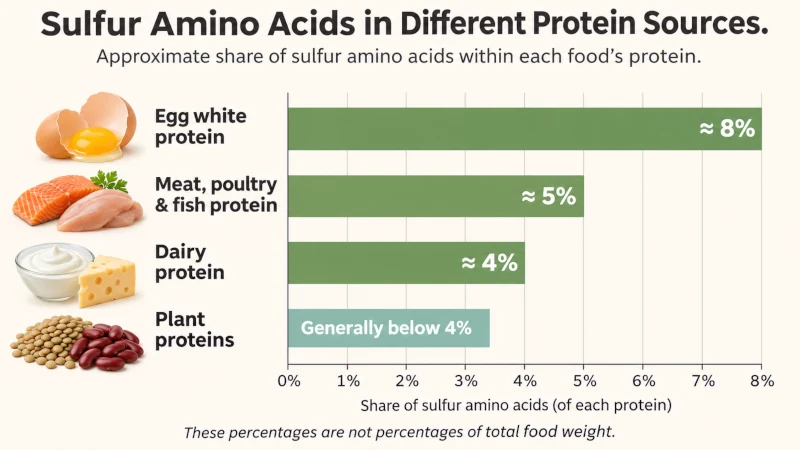
Source: [Nimni et al., 2007]
A smaller share comes from organic sulfur compounds in vegetables. Garlic, onions, and Brussels sprouts contain meaningful amounts [Nimni et al., 2007]. Cruciferous vegetables such as cabbage, kale, broccoli, and Brussels sprouts carry glucosinolates, sulfur-containing chemicals that give them their sharp smell and bitter edge [NCI, 2012]. Researchers study glucosinolates for possible anticancer effects, but results in people have been mixed [NCI, 2012].
Asparagus has its own sulfur compound, which is behind the distinctive urine smell some people notice — our asparagus guide explains why it’s harmless. Tap water adds some sulfate too, in amounts that vary by location [Human Nutrition OER].
Can you be low in sulfur?
Not in any recognized way if you meet your protein needs [Human Nutrition OER]. One research group has argued that older adults, people eating little protein, and people on restrictive diets with little animal protein may take in less sulfur than ideal. The authors called their estimates preliminary and said firm conclusions weren’t yet possible [Nimni et al., 2007].
Dull hair and brittle nails often show up online as “sulfur deficiency symptoms.” They’re nonspecific, and none of the sources here treat them as signs of low sulfur. If your hair or nails change and it doesn’t settle, see a clinician. Many conditions cause these changes, and a sulfur supplement won’t fix most of them.
Sulfur supplements and skin products: what the evidence shows
MSM for joint pain
Methylsulfonylmethane, or MSM, is a sulfur compound sold mainly for joint pain. It occurs naturally in fruits, vegetables, grains, coffee, tea, and milk, but in tiny amounts [Butawan et al., 2017]. Calling it a “source of sulfur” misses the point. People take it for possible effects on pain, not to fill a gap.

The trials are small. In a 12-week pilot study of 50 adults with knee osteoarthritis, 3 g of MSM twice a day was compared with placebo; the authors said the benefits and long-term safety couldn’t be confirmed from a trial that size [Kim et al., 2006]. A second 12-week trial using 3.375 g a day found better physical function and total symptom scores than placebo, while the change on its WOMAC pain scale fell just short of significance. Its authors described the gains as small and of uncertain clinical importance [Debbi et al., 2011]. A 2017 review called the joint-pain evidence limited, noting most studies relied on questionnaires [Butawan et al., 2017].
Realistic expectation: possibly a modest drop in knee pain over two to three months. There’s no good evidence MSM rebuilds cartilage or changes the course of arthritis.
Sulfur baths for arthritis
Soaking in mineral or sulfur springs (balneotherapy) is an old arthritis treatment. A Cochrane review of seven trials with 498 people found no significant difference in pain or function at one or three months between sulfur baths and no treatment. Sulfur combined with Dead Sea baths helped at the end of treatment, but the effect didn’t last to three months. The reviewers rated the evidence weak, and side effects weren’t measured [Verhagen et al., 2007]. A sulfur soak may feel good; just don’t expect lasting change.
Sulfur on the skin: acne and scabies
Topical sulfur is where the mineral has its clearest medical use. The FDA allows sulfur as an over-the-counter acne ingredient at 3% to 10% on its own, or 3% to 8% combined with resorcinol [21 CFR 333.310]. That makes it an accepted acne ingredient. It doesn’t tell you how it compares with other options, so ask a pharmacist or dermatologist if one product isn’t working after several weeks.
For scabies, the CDC lists sulfur ointment (5% to 10%) as an alternative prescription treatment. In the U.S. it has to be compounded by a pharmacy, it’s considered safe on the skin even for infants under 2 months, and its smell puts some people off [CDC, 2023]. No over-the-counter product is approved to treat scabies, so you’ll need a clinician either way [CDC, 2023].
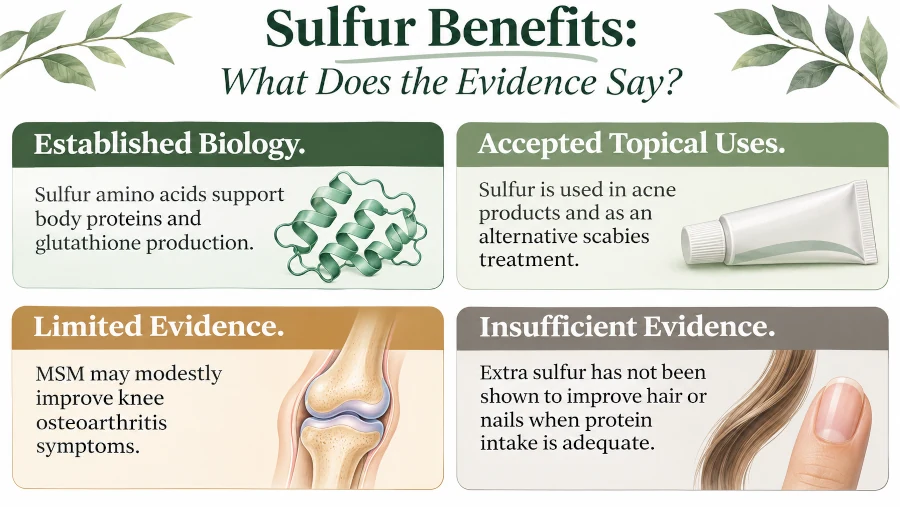
Sulfur benefits at a glance
| Claim | What the evidence shows | Strength |
| Sulfur is essential, obtained mostly from protein | Basis of the IOM conclusion that sulfate needs are met by sulfur amino acids [IOM, 2005] | Strong (established) |
| Cysteine supply limits glutathione production | Described in nutrition research [Nimni et al., 2007] | Established mechanism |
| Extra sulfur improves hair, skin, or nails in people who eat enough protein | No human evidence found | Insufficient |
| MSM eases knee osteoarthritis pain | Two small 12-week trials; small effects [Kim et al., 2006] [Debbi et al., 2011] | Limited |
| Sulfur baths ease osteoarthritis | No lasting difference vs. no treatment; weak evidence [Verhagen et al., 2007] | Limited / mixed |
| Topical sulfur for acne | Permitted OTC acne ingredient [21 CFR 333.310] | Accepted use |
| Sulfur ointment for scabies | CDC alternative treatment [CDC, 2023] | Accepted alternative |
| Cruciferous vegetables lower cancer risk | Human studies mixed [NCI, 2012] | Mixed |
| Sulfur “disinfects blood,” protects against radiation | No supporting human research found | Traditional claim only |
Safety: side effects, interactions, and who should be careful
Sulfur from food is safe for virtually everyone. The cautions below apply to supplements, herbs, and unusual exposures.
MSM
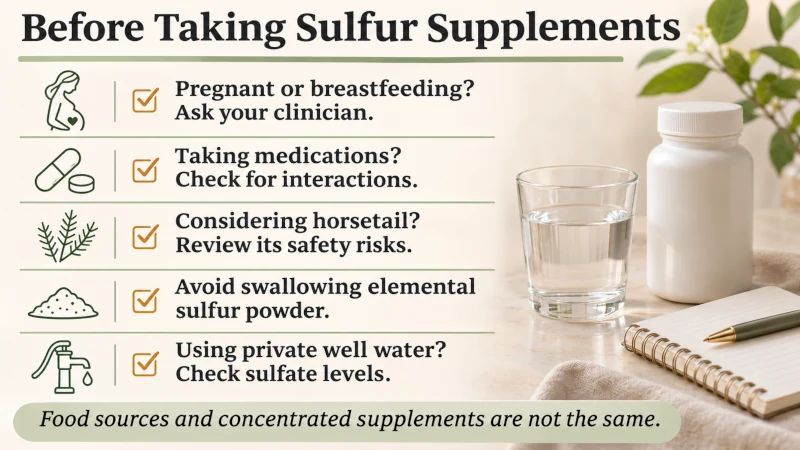
MSM is well tolerated by most people at doses up to about 4 g a day, with few and mild side effects; applied to the skin, it has caused mild skin and eye irritation [Butawan et al., 2017]. In the 6 g-a-day knee trial, people reported stomach upset, headaches, and trouble sleeping, at rates similar to the placebo group [Debbi et al., 2011]. Two gaps matter: no studies have looked at MSM with alcohol [Butawan et al., 2017], and the safety review offers no data on pregnancy or breastfeeding. If you’re pregnant, breastfeeding, or take regular medication, check with a pharmacist or doctor before starting it.
Horsetail
Horsetail is often sold alongside sulfur for hair and nails, but no source here shows it’s a meaningful source of sulfur, and it carries real cautions. Taken by mouth long-term it’s rated possibly unsafe, because crude horsetail contains thiaminase, an enzyme that breaks down vitamin B1 [MedlinePlus, 2012]. The same monograph advises avoiding it during pregnancy and breastfeeding, warns it may lower potassium and blood sugar, and says it may slow how the body clears lithium [MedlinePlus, 2012]. It’s also a probable rare cause of liver injury, possibly linked to contamination with other, more toxic horsetail species [LiverTox, 2022].
Skip horsetail if you: are pregnant or breastfeeding, have low potassium or take water pills, take lithium or diabetes medication, have liver disease, or drink heavily (which already raises the risk of low thiamine).
Sulfur powder and high-sulfate water
Don’t swallow powdered or garden sulfur as a tonic. Your body gets usable sulfur from protein [IOM, 2005], and no reviewed source supports eating elemental sulfur.
Too much sulfate does have a known effect: high levels in drinking water can cause osmotic diarrhea, and infants are more vulnerable [IOM, 2005]. The EPA flags infants and travelers who switch abruptly from low- to high-sulfate water as most at risk, and recommends 250 mg/L as a taste-and-odor guideline for public systems [EPA]. If you use private well water to mix infant formula, have it tested.
A “sulfa” allergy is not a sulfur allergy
Sulfa drugs are antibiotics and other medicines that contain a sulfonamide molecule. Sulfites are food preservatives, and sulfates are salts found in many medicines and supplements. They’re different substances [AAAAI]. Sulfur itself is essential for life and isn’t what causes reactions to these compounds [AAAAI]. A sulfa drug allergy doesn’t mean you need to avoid sulfur-rich foods — but tell your clinician about any past reaction before trying a new product.
When to see a healthcare professional
- Call 911 or go to the emergency room if you develop hives, swelling of the lips, face, or throat, or trouble breathing after using any new product.
- Get urgent care for an infant with diarrhea who has fewer wet diapers, unusual sleepiness, or a dry mouth.
- See a clinician for a joint that’s hot, red, and swollen, joint pain with fever, or knee pain that keeps you from normal activity — self-care with supplements isn’t enough here.
- Get a diagnosis for intense itching that’s worse at night or a spreading rash; scabies needs prescription treatment.
- Talk to your doctor or pharmacist first if you’re pregnant, breastfeeding, or take lithium, diuretics, diabetes medication, or several daily medicines and want to try MSM or horsetail.
| HEALTH DISCLAIMER: This article is for general education and is not a substitute for advice from a qualified healthcare professional. It does not diagnose, treat, cure, or prevent any disease. Talk with your doctor or pharmacist before starting a supplement or herbal product, especially if you are pregnant, breastfeeding, managing a health condition, or taking medication. If you think you’re having a medical emergency, call 911 or your local emergency number. |
Frequently Asked Questions
Is sulfur good for hair growth?
Sulfur is part of keratin, the protein in hair [Human Nutrition OER], so you need it — but you get it from dietary protein. No human research reviewed here shows that extra sulfur or MSM grows hair in people who already eat enough protein. New hair loss is worth a visit to a doctor or dermatologist.
Is MSM the same as sulfur?
No. MSM is one sulfur-containing compound. It’s found naturally in foods only in very small amounts and is mostly taken as a supplement for joint pain [Butawan et al., 2017]. Your main sulfur supply is still protein.
Do vegetarians or vegans need a sulfur supplement?
There’s no official guidance saying so. Plant proteins contain a lower share of sulfur amino acids than animal proteins [Nimni et al., 2007], so eating enough total protein from varied sources such as beans, lentils, grains, and nuts matters. A registered dietitian can check whether your diet covers your protein needs.
Can you be allergic to sulfur?
Reactions blamed on “sulfur” usually involve sulfa drugs or sulfites, which are different substances. Sulfur itself is essential for life and isn’t responsible for those reactions [AAAAI].
Is sulfate in well water harmful?
At high levels it can cause diarrhea, especially in infants and in people who switch suddenly from low-sulfate water [EPA]. Testing well water is a good idea if you use it to prepare infant formula.
References
- Institute of Medicine. Dietary Reference Intakes for Water, Potassium, Sodium, Chloride, and Sulfate. View source
- Nimni ME, Han B, Cordoba F. Are we getting enough sulfur in our diet? Nutrition & Metabolism. View source
- Butawan M, Benjamin RL, Bloomer RJ. Methylsulfonylmethane: applications and safety of a novel dietary supplement. Nutrients. View source
- Debbi EM, Agar G, Fichman G, et al. Efficacy of methylsulfonylmethane supplementation on osteoarthritis of the knee: a randomized controlled study. View source
- Kim LS, Axelrod LJ, Howard P, Buratovich N, Waters RF. Efficacy of methylsulfonylmethane (MSM) in osteoarthritis pain of the knee: a pilot clinical trial. View source
- Verhagen AP, Bierma-Zeinstra SMA, Boers M, et al. Balneotherapy for osteoarthritis. View source
- Centers for Disease Control and Prevention. Clinical Care of Scabies. View source
- U.S. Food and Drug Administration. 21 CFR 333.310 — Acne active ingredients. View source
- National Cancer Institute. Cruciferous Vegetables and Cancer Prevention. View source
- American Academy of Allergy, Asthma & Immunology. What are Sulfite and Sulfa Drugs? View source
- U.S. Environmental Protection Agency. Sulfate in Drinking Water. View source
- MedlinePlus (Natural Medicines Comprehensive Database consumer monograph). Horsetail. View source
- LiverTox: Clinical and Research Information on Drug-Induced Liver Injury. Horsetail. National Institute of Diabetes and Digestive and Kidney Diseases; View source
- Human Nutrition, 2nd ed. View source


