
Calcium builds your skeleton. That part everyone knows. The more interesting work is done by the sliver of it that is not in your bones — the ionized calcium circulating in your blood and tissues, which drives muscle contraction, blood clotting, nerve transmission, hormone release, and the tightening and relaxing of blood vessels [NIH Office of Dietary Supplements, 2026]. Nearly every one of the calcium benefits worth caring about traces back to one of those two jobs.
The practical question is simpler than the biology: are you getting enough? Most adults need 1,000 to 1,200 mg a day, and roughly 39% of Americans age 4 and older take in less than the estimated average requirement from food and supplements combined [NIH ODS, 2026]. What follows is what calcium does, how much you need by age, which foods deliver it in a form your body can use, when a supplement earns its place, and the safety details — upper limits, drug interactions, and warning signs — worth knowing before you start one.
What calcium actually does in your body
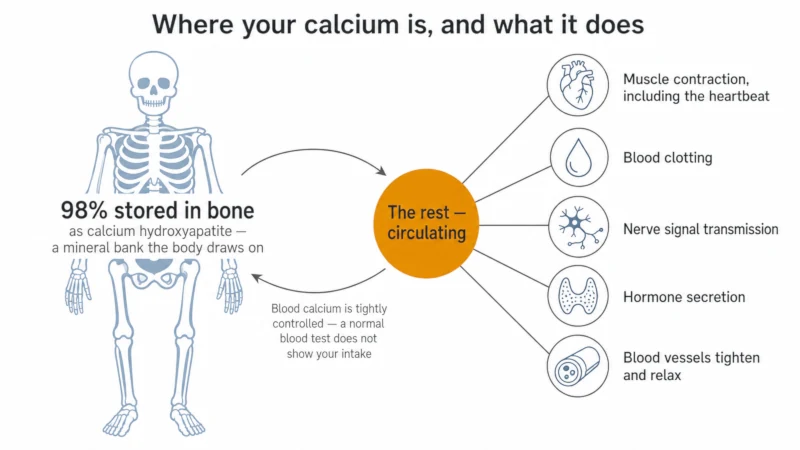
About 98% of your body’s calcium sits in your skeleton as calcium hydroxyapatite, a mineral lattice of calcium and phosphate that gives bone its hardness [NIH ODS, 2026]. Bone is not inert. It is torn down and rebuilt continuously, which lets your body treat the skeleton as a bank — withdrawing calcium when blood levels dip, redepositing it when there is a surplus.
The rest circulates, and it does a lot:
- Muscle contraction, including every heartbeat
- Blood clotting
- Nerve signal transmission
- Hormone secretion
- Constriction and dilation of blood vessels
Here is the part that trips people up. Your body defends blood calcium tightly, so a normal calcium result on a routine blood panel tells you very little about your intake [NIH ODS, 2026]. A long-term shortfall shows up in your skeleton, not your bloodwork, which is why the standard measure of lifetime calcium status is a DXA bone density scan rather than a blood draw.
How much calcium you need each day
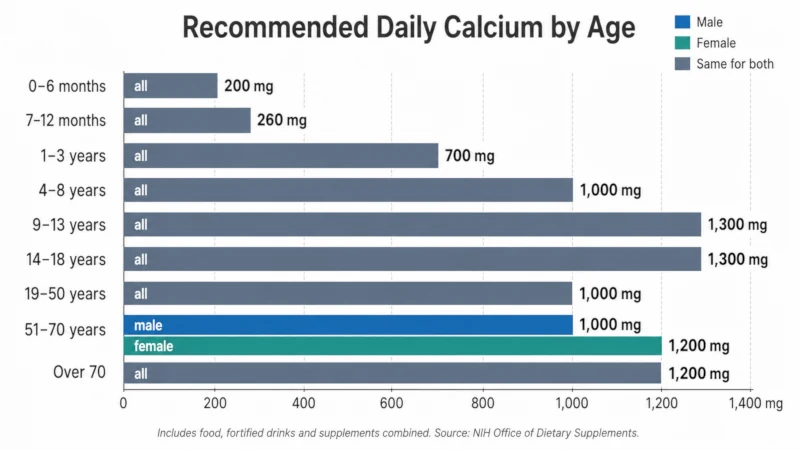
These are the Recommended Dietary Allowances set by the Food and Nutrition Board at the National Academies. They cover everything you take in — food, fortified drinks, and supplements combined [NIH ODS, 2026].
| Age | Male | Female | Pregnant | Breastfeeding |
| 0–6 months | 200 mg* | 200 mg* | — | — |
| 7–12 months | 260 mg* | 260 mg* | — | — |
| 1–3 years | 700 mg | 700 mg | — | — |
| 4–8 years | 1,000 mg | 1,000 mg | — | — |
| 9–13 years | 1,300 mg | 1,300 mg | — | — |
| 14–18 years | 1,300 mg | 1,300 mg | 1,300 mg | 1,300 mg |
| 19–50 years | 1,000 mg | 1,000 mg | 1,000 mg | 1,000 mg |
| 51–70 years | 1,000 mg | 1,200 mg | — | — |
| Over 70 | 1,200 mg | 1,200 mg | — | — |
*Adequate Intake, not an RDA — set from the average intake of healthy breastfed infants.
Two things in that table surprise people. Pregnancy and breastfeeding do not raise the requirement for adult women; it stays at 1,000 mg. And women’s needs jump at 51, not at 65 — menopause reduces calcium absorption and increases the amount lost in urine, and women lose roughly 1% of bone mineral density a year afterward [NIH ODS, 2026].
Food is the better delivery system
Dairy is the most efficient everyday source — in the United States about 72% of calcium intake comes from dairy products and foods containing dairy ingredients — but it is far from the only one. Canned sardines and salmon with the soft bones left in, calcium-set tofu, fortified plant milks and juices, and low-oxalate greens all carry real amounts [NIH ODS, 2026]. Our guide to plant-based foods high in calcium goes deeper on the non-dairy options.
| Food | Serving | Calcium | % Daily Value |
| Plain low-fat yogurt | 8 oz | 415 mg | 32% |
| Calcium-fortified orange juice | 1 cup | 349 mg | 27% |
| Part-skim mozzarella | 1.5 oz | 333 mg | 26% |
| Canned sardines with bones | 3 oz | 325 mg | 25% |
| Nonfat milk | 1 cup | 299 mg | 23% |
| Calcium-fortified soymilk | 1 cup | 299 mg | 23% |
| Firm tofu (calcium sulfate set) | ½ cup | 253 mg | 19% |
| Canned pink salmon with bones | 3 oz | 181 mg | 14% |
| Cottage cheese, 1% fat | 1 cup | 138 mg | 11% |
| Cooked soybeans | ½ cup | 131 mg | 10% |
| Cooked kale | 1 cup | 94 mg | 7% |
| Chia seeds | 1 tbsp | 76 mg | 6% |
| Raw bok choy, shredded | 1 cup | 74 mg | 6% |
Values from the NIH Office of Dietary Supplements. The Daily Value used on US food labels is 1,300 mg.
Why the mg on the label is not the mg you absorb
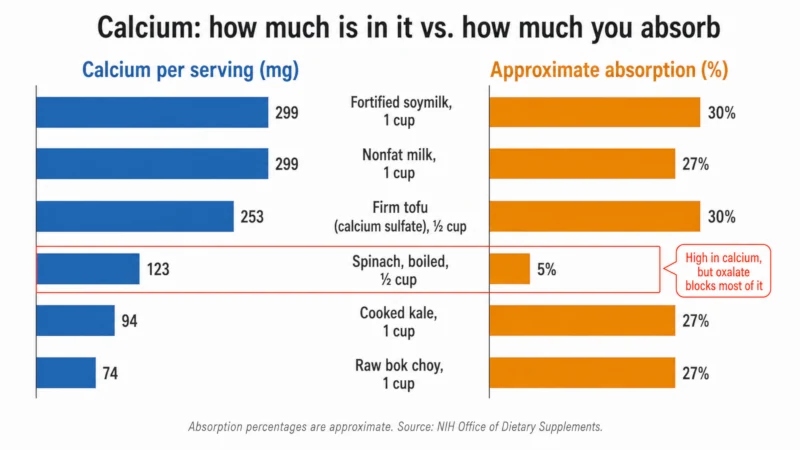
Adults absorb roughly 25% of the calcium they eat, and the percentage falls as intake rises — about 45% at an intake of 200 mg a day, but only 15% above 2,000 mg [NIH ODS, 2026]. The food matters too. Absorption from dairy and fortified foods runs near 30%, and milk specifically about 27%. Spinach is the cautionary case: it is genuinely high in calcium on paper, but oxalic acid binds most of it, and only about 5% gets through.
That is the practical reason kale, broccoli, and bok choy show up on calcium lists while spinach, rhubarb, and beet greens do not. Their calcium is less plentiful per serving but far more available. Phytates in bran and whole grains have a milder version of the same effect. Caffeine and phosphorus reduce net absorption slightly; low vitamin D status reduces it a great deal [NIH ODS, 2026]. If you eat a varied diet, the oxalate and phytate interactions are unlikely to matter nutritionally.
Calcium and vitamin D are a package deal
Vitamin D is required for calcium to be absorbed through active transport in the gut and for blood calcium to stay in range [NIH ODS, 2026]. Without enough of it, a high-calcium diet underdelivers. This is also why rickets in children and osteomalacia in adults — both softening of bone from failed mineralization — are more often caused by vitamin D deficiency than by calcium deficiency, and why the lower your vitamin D level, the more calcium you need to prevent them.
The National Academies recommend 600 IU of vitamin D daily up to age 70 and 800 IU after that. Sunlight, fatty fish, egg yolks, and fortified milk and cereal are the main sources; our overview of vitamin D functions and food sources covers them in more detail. Magnesium also participates in calcium metabolism, and severe magnesium deficiency is one recognized cause of low blood calcium.
Calcium benefits: What the evidence actually supports
Calcium is one of those nutrients where the case for adequacy is airtight and the case for supplementation is not. Those are different questions, and it is worth keeping them apart.
Strong: preventing deficiency disease
Chronic calcium shortfall reduces bone strength and contributes to osteoporosis, which means fragile bones and a higher fracture risk. It can also cause rickets in children and osteomalacia at any age [NIH ODS, 2026]. This is not disputed. Meeting the RDA is a genuine, well-established benefit, and postmenopausal women and people who avoid dairy are the two groups most likely to fall short. If you are managing bone loss already, our guide to the best foods for osteoporosis covers the wider dietary picture.
Mixed: supplements and fracture prevention
Here the evidence gets uncomfortable. Some trials and meta-analyses find calcium with vitamin D increases bone mineral density and reduces fractures; others find no effect on hip, vertebral, or total fracture risk at all [NIH ODS, 2026]. Whether the density gains that do show up are large enough to matter clinically is not clear.
The US Preventive Services Task Force, in its current final statement, recommends against daily supplementation with 400 IU or less of vitamin D and 1,000 mg or less of calcium for preventing fractures in community-dwelling postmenopausal women — a Grade D. For higher doses, and for men and premenopausal women, it concluded the evidence is simply insufficient [USPSTF, 2018]. A draft update circulated in December 2024 goes further, proposing a recommendation against vitamin D with or without calcium for fracture prevention in postmenopausal women and men 60 and older, but that draft is still in progress and is not the operative guidance [USPSTF draft, 2024].
Read that carefully, because it is easy to misread. None of it says calcium is unimportant for bone. It says that handing supplements to people who are not deficient does not reliably prevent fractures. Adequate intake still matters — the USPSTF itself says so. The route matters less than the total.
Mixed: heart health
Observational studies link lower calcium intake to higher rates of hypertension, stroke, and atherosclerosis. But several prospective cohorts and randomized trials suggest calcium supplements may raise cardiovascular risk: one meta-analysis of 14 trials in 28,935 postmenopausal women found supplements of 500 to 2,000 mg a day raised cardiovascular disease risk by 15%.
Other large studies, including the Nurses’ Health Study, found no such association, and an expert panel from the National Osteoporosis Foundation and the American Society for Preventive Cardiology concluded on moderate-quality evidence that calcium intake within the upper limit is safe from a cardiovascular standpoint [NIH ODS, 2026]. The honest summary is that the studies disagree, and nobody should present either direction as settled.
Promising, in one specific group: preeclampsia
A Cochrane review of 27 trials in 18,064 pregnant women found that calcium supplementation of at least 1,000 mg a day reduced the risk of high blood pressure by 35%, and in women whose dietary calcium was under 900 mg a day, reduced preeclampsia risk by 64%. The quality of that evidence was rated low, and many of the trials had a high risk of bias.
The American College of Obstetricians and Gynecologists and the World Health Organization both recommend 1,500 to 2,000 mg a day for pregnant women with genuinely low calcium intakes [NIH ODS, 2026]. This is a targeted recommendation for a specific group, not general pregnancy advice — and it is a conversation to have with your obstetric provider, not a self-prescribed dose.
Small: blood pressure
A Cochrane review of 16 trials in 3,048 adults found calcium supplementation, usually 1,000 to 2,000 mg a day, lowered systolic blood pressure by 1.43 mmHg and diastolic by 0.98 mmHg [NIH ODS, 2026]. That is real but modest — roughly a rounding error on a home monitor. The DASH diet, which is higher in calcium, lowers systolic pressure by around 5.5 mmHg, but it also raises potassium and magnesium, so calcium’s independent share of that cannot be separated out. Calcium is not a blood pressure treatment.
If you take a supplement, take it well
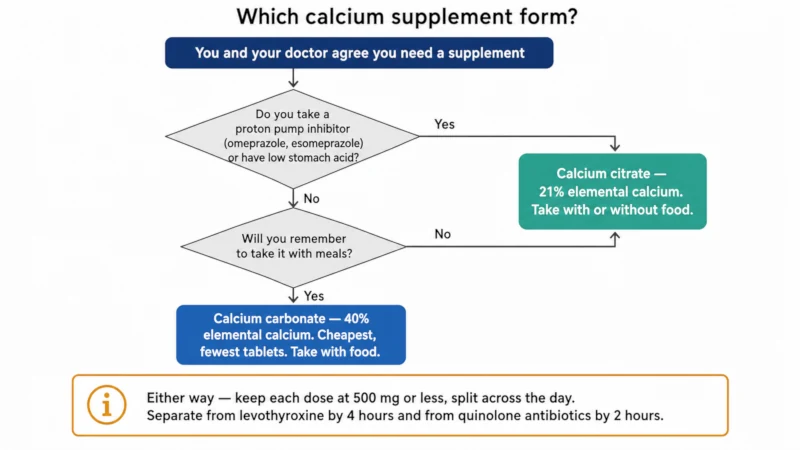
Supplements exist to close a gap, not to replace a diet. If you are short, the two common forms differ in ways worth knowing. Labels list elemental calcium in the Supplement Facts panel, so you do not have to do the percentage math yourself [NIH ODS, 2026].
| Form | Elemental calcium | How to take it | Notes |
| Calcium carbonate | 40% by weight | With food | Cheapest and most concentrated. Needs stomach acid, so it is less well absorbed on an empty stomach or if your acid is low. Causes more gas, bloating, and constipation than citrate, especially in older adults. |
| Calcium citrate | 21% by weight | With or without food | Less dependent on stomach acid. The better choice if you take a proton pump inhibitor or have low stomach acid. You need more tablets for the same dose. |
| Other forms (gluconate, lactate, sulfate, phosphate, hydroxyapatite) | Varies | Follow the label | Less common. Elemental content varies widely — read the panel rather than the front of the bottle. |
Two practical rules. First, split the dose: absorption is highest at 500 mg or less at a time. Your body takes up about 36% of a 300 mg dose but only 28% of a 1,000 mg dose, so 500 mg twice a day beats 1,000 mg once [NIH ODS, 2026]. Second, count what you are already getting. Calcium carbonate antacids like Tums and Rolaids each supply roughly 270 to 400 mg, which is a real contribution people routinely forget to add up.
Safety: upper limits, side effects, and interactions
How much is too much
The tolerable upper intake level counts food plus supplements together [NIH ODS, 2026]:
| Age | Upper limit (all sources) |
| 1–8 years | 2,500 mg/day |
| 9–18 years (including pregnancy) | 3,000 mg/day |
| 19–50 years (including pregnancy and breastfeeding) | 2,500 mg/day |
| 51 and older | 2,000 mg/day |
Note that the ceiling drops at 51, exactly when the recommended intake rises. That narrows the safe window in later life and is a good reason to know your real dietary intake before adding pills on top.
Side effects
Gas, bloating, and constipation are the common complaints, and calcium carbonate causes more of them than citrate [NIH ODS, 2026]. Switching forms, splitting the dose across the day, or taking it with meals usually helps. Genuine hypercalcemia — too much calcium in the blood — is rare in healthy people and is nearly always caused by something else, such as cancer or an overactive parathyroid gland, rather than by diet.
Medications calcium interferes with
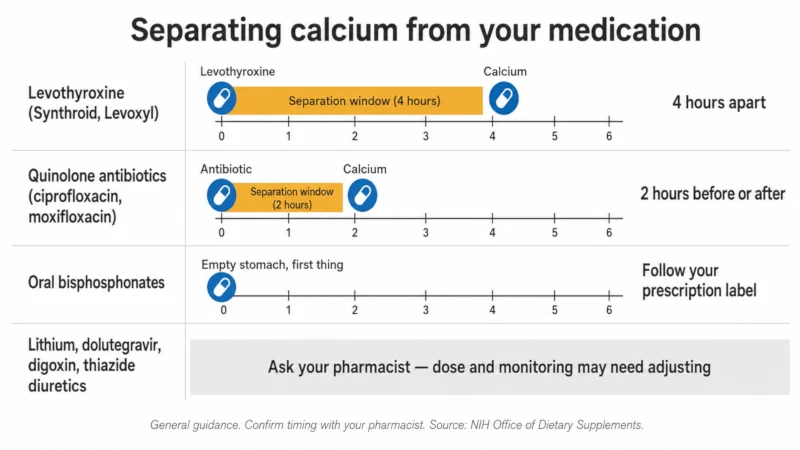
This is the section most calcium articles skip, and it is the one most likely to affect you day to day. Timing, not avoidance, is usually the fix [NIH ODS, 2026].
- Levothyroxine (Synthroid, Levoxyl). Calcium carbonate blocks absorption of thyroid hormone. The FDA-approved label says to keep them at least 4 hours apart.
- Quinolone antibiotics (ciprofloxacin, moxifloxacin, gemifloxacin). Calcium reduces how much antibiotic you absorb. Take the antibiotic 2 hours before or 2 hours after your calcium.
- Dolutegravir (HIV treatment) and lithium (bipolar disorder) also appear on the interaction list; long-term lithium can raise blood calcium, and adding supplements can compound that.
- Oral bisphosphonates for osteoporosis need to be taken on an empty stomach, well separated from calcium — follow the specific instructions on your prescription.
If you take any of these regularly, ask your pharmacist to map out the timing with you. It takes two minutes and it protects the medication you are actually relying on.
Kidney stones: food and pills are not the same
This distinction gets reversed constantly, so it is worth stating plainly. Dietary calcium is not the enemy of kidney stones. The National Institute of Diabetes and Digestive and Kidney Diseases puts it directly: even though calcium sounds like it would cause calcium stones, it does not — in the right amounts, calcium binds oxalate in the digestive tract and blocks substances that can form stones [NIDDK, 2025]. People who have formed calcium-oxalate stones are generally advised to keep their calcium intake up while reducing sodium, animal protein, and high-oxalate foods.
Supplemental calcium is a different story. The upper limits above were set partly on Women’s Health Initiative data linking 1,000 mg a day of supplemental calcium over seven years to more kidney stones, and the USPSTF found adequate evidence that vitamin D plus calcium supplementation increases stone incidence, though it judged the size of that harm small — about 2 more people per 1,000 [USPSTF, 2018]. Two later systematic reviews found no such association [NIH ODS, 2026]. Mixed, in other words — but it tilts the balance toward getting calcium from meals and supplementing only the shortfall.
Who should talk to a doctor before supplementing
- Anyone with a history of kidney stones or kidney disease
- Anyone with hyperparathyroidism, sarcoidosis, or any condition that raises blood calcium
- Anyone taking levothyroxine, quinolone antibiotics, lithium, dolutegravir, digoxin, thiazide diuretics, or oral bisphosphonates
- Anyone already taking a multivitamin, an antacid, or a fortified drink — these add up faster than people expect
- Anyone who is pregnant or breastfeeding, before going above the RDA
Pregnancy and breastfeeding
The RDA does not change during pregnancy or breastfeeding for adult women: 1,000 mg a day for ages 19 to 50, and 1,300 mg for pregnant or breastfeeding teenagers [NIH ODS, 2026]. Food sources are the sensible starting point, and prenatal vitamins vary a lot in how much calcium they contain, so it is worth actually reading yours.
The exception is the preeclampsia guidance above. ACOG suggests 1,500 to 2,000 mg a day may reduce preeclampsia severity in women whose dietary calcium is under 600 mg a day; WHO makes a similar recommendation for pregnant women with low intakes [NIH ODS, 2026]. That is a clinical decision based on your actual intake and risk profile. Bring it to your obstetric provider rather than acting on it alone.
Warning signs that need medical attention
Most calcium questions are slow-moving nutrition questions. A few are not.
Call 911 or go to an emergency room for:
- A seizure, fainting, or an irregular or racing heartbeat alongside muscle spasms, numbness, or tingling
- Sudden confusion or a marked change in alertness in someone known to have high blood calcium
See a doctor promptly for:
- Numbness or tingling around the mouth, in the hands, or in the feet, or muscle cramps and spasms that keep recurring — these are the most common signs of low blood calcium, which usually reflects a vitamin D or magnesium problem, a parathyroid problem, or a medication effect
- A broken bone from a minor fall or bump, which can be the first visible sign of osteoporosis
- Sudden severe back pain, noticeable height loss, or a developing stoop
- Persistent constipation, nausea, unexplained weight loss, excessive thirst, or frequent urination while taking calcium supplements — possible signs of too much calcium in the blood
If you are simply wondering whether your intake is adequate, that is a primary care or registered dietitian conversation, not an urgent one. Bone density screening is generally recommended for women at 65, earlier for those with risk factors.
| Health Disclaimer: This article is for general education and is not medical advice. It is not a substitute for diagnosis or treatment from a qualified healthcare professional, and it should not be used to start, stop, or change any medication or treatment. Calcium supplements interact with several common prescriptions and are not appropriate for everyone. If you are pregnant or breastfeeding, take prescription medication, or have a health condition such as kidney disease, a history of kidney stones, hyperparathyroidism, or sarcoidosis, talk to your doctor, a registered dietitian, or your pharmacist before adding a calcium supplement or making large changes to your diet. |
Frequently Asked Questions
How much calcium do I need per day?
Most adults need 1,000 mg. That rises to 1,200 mg for women 51 and older and for everyone over 70, and it is 1,300 mg for ages 9 to 18 [NIH ODS, 2026]. The number covers food, fortified drinks, and supplements together — not supplements on top of it.
Is calcium carbonate or calcium citrate better?
It depends on your stomach. Carbonate packs 40% elemental calcium into each tablet but needs stomach acid, so take it with food. Citrate is 21% elemental and absorbs fine without acid, which makes it the better pick if you take a proton pump inhibitor or have low stomach acid — at the cost of more pills for the same dose [NIH ODS, 2026].
Do calcium supplements cause kidney stones?
The evidence is mixed. The upper limits were set partly on Women’s Health Initiative data linking supplemental calcium to more stones, and the USPSTF found combined calcium and vitamin D supplementation raises stone incidence by a small margin. Two later systematic reviews found no association. Dietary calcium is a different matter — it actually helps prevent calcium-oxalate stones by binding oxalate in the gut [NIDDK, 2025].
Will a calcium supplement prevent a fracture?
Not reliably, if you are not deficient. The USPSTF recommends against 1,000 mg or less of calcium with 400 IU or less of vitamin D for fracture prevention in postmenopausal women, and calls the evidence for higher doses insufficient [USPSTF, 2018]. Adequate intake still matters for bone; what the evidence does not support is treating supplements as fracture insurance.
Can I get enough calcium without dairy?
Yes, but it takes deliberate planning. Fortified soymilk and orange juice each carry about 300 mg per cup, calcium-set tofu around 253 mg per half cup, and canned sardines with bones about 325 mg per 3 ounces [NIH ODS, 2026]. Greens help but are lower per serving, and spinach barely counts because oxalate blocks most of its calcium. People who avoid dairy usually need fortified foods or a supplement to hit the target.
References
- National Institutes of Health, Office of Dietary Supplements. “Calcium: Fact Sheet for Health Professionals.” NIH ODS, 2026. → View source
- U.S. Preventive Services Task Force. “Vitamin D, Calcium, or Combined Supplementation for the Primary Prevention of Fractures in Community-Dwelling Adults: Preventive Medication.” Final Recommendation Statement, April 17, 2018. → View source
- U.S. Preventive Services Task Force. “Vitamin D, Calcium, or Combined Supplementation for the Primary Prevention of Falls and Fractures in Community-Dwelling Adults.” Draft Recommendation Statement, December 17, 2024. → View source
- National Institute of Diabetes and Digestive and Kidney Diseases. “Eating, Diet, & Nutrition for Kidney Stones.” NIDDK, last reviewed May 2017 (page live 2026). → View source
