
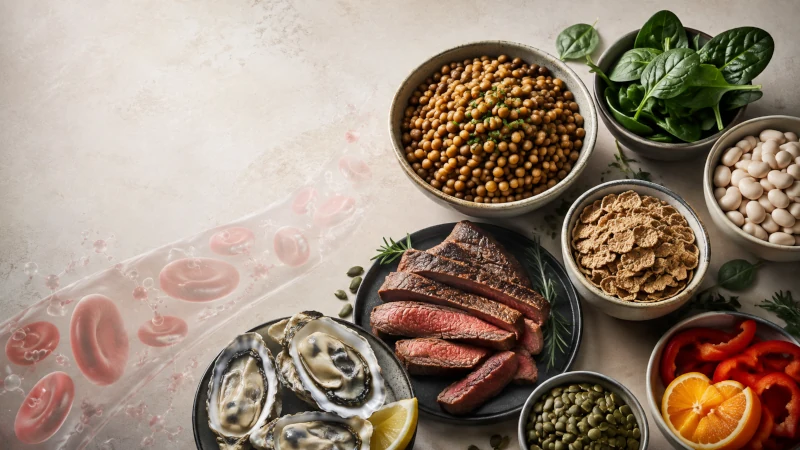
Most of what iron does for you, you never notice — until it goes missing. The mineral’s main job is moving oxygen, and when your stores drop far enough, that shows up as fatigue, breathlessness on a flight of stairs, and a mental fog that sleep doesn’t fix. So the honest framing of iron benefits is this: they are mostly the benefits of not being deficient. Correcting a real shortfall can change how you feel. Adding iron on top of normal stores does not, and it carries risk that most supplement labels don’t advertise.
What iron actually does in your body
Iron sits at the center of hemoglobin, the protein that fills red blood cells and ferries oxygen from your lungs out to every tissue you have. A related protein, myoglobin, holds oxygen inside muscle so it’s available the moment you need it. Your body also uses iron to build certain enzymes and hormones [NIH Office of Dietary Supplements iron fact sheet, 2025].
When iron runs short, the losses track those jobs closely. NIH lists gastrointestinal upset, weakness, fatigue, difficulty concentrating, and impaired immune function, exercise and work performance, and body temperature regulation among the effects of iron deficiency anemia. In infants and young children the concern is sharper — delayed attention and social withdrawal, and NIH notes that some of these effects might be irreversible [NIH Office of Dietary Supplements iron fact sheet, 2025].
Iron benefits, graded honestly
Well established. Iron prevents and treats iron deficiency anemia. That is the claim the evidence supports without qualification, and it’s the reason iron matters at all.
Strong, with good-quality trial evidence — pregnancy. A 2024 Cochrane review of daily oral iron in pregnancy found supplemented women had less anemia at delivery (4.0% versus 7.4%) and less iron deficiency (44.0% versus 66.0%), and were probably less likely to deliver a low-birthweight baby, rated moderate-certainty evidence. The same review found probably little to no difference in preterm birth, neonatal death, or birth defects, and described the evidence on side effects as very uncertain [Cochrane review of daily oral iron in pregnancy, 2024].
Limited. Restless legs syndrome appears on NHLBI’s list of complications of iron deficiency anemia, which suggests correcting the deficiency may help some people — but that is a long way from iron being a treatment for restless legs in general [NHLBI on iron-deficiency anemia, 2022].
Not supported. Iron does not boost energy in someone whose iron is already normal. It is not an immune supplement. It does not treat fatigue of unknown cause. The energy people report on iron is the return of function that deficiency had taken away — which is why the test comes before the pill.
How much iron you need
| Group | Recommended Dietary Allowance |
| Men 19+ | 8 mg/day |
| Women 19–50 | 18 mg/day |
| Women 51+ | 8 mg/day |
| Pregnancy | 27 mg/day |
| Breastfeeding | 9–10 mg/day |
| Tolerable Upper Intake Level, ages 14+ | 45 mg/day |
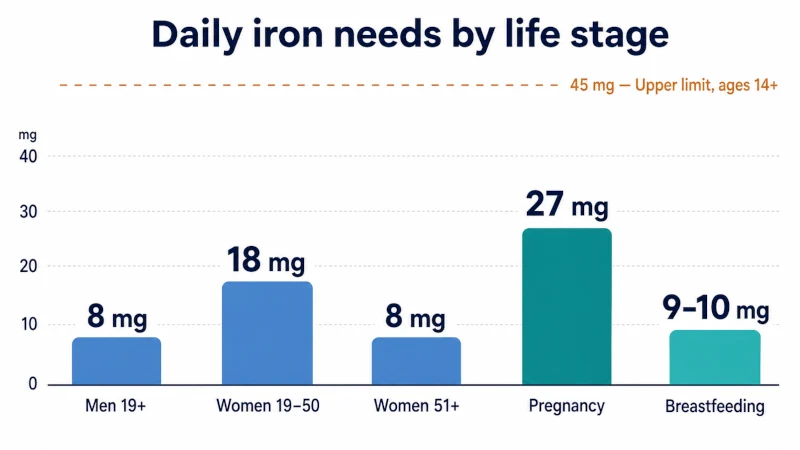
Source: [NIH Office of Dietary Supplements iron fact sheet, 2025]
The 18 mg figure for women under 51 is the one that catches people out. It is more than double the men’s requirement, and it exists because of menstrual blood loss. Vegetarians and vegans need roughly double the listed amounts, since plant iron absorbs less efficiently [NIH Office of Dietary Supplements consumer fact sheet, 2023].
The 45 mg upper limit applies to total daily intake from supplements and fortified foods. It is not a target.
Where iron comes from
Dietary iron arrives in two forms, and they behave differently.
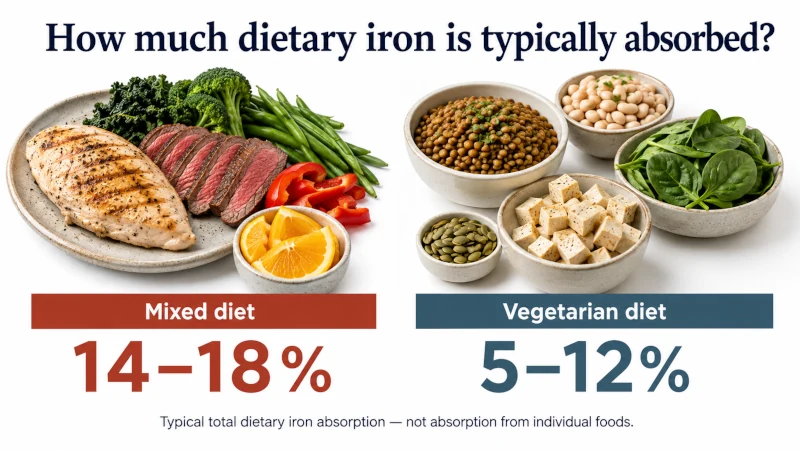
Heme iron comes from meat, seafood, and poultry. It absorbs well, and other things in the meal have relatively little effect on it. It supplies only about 10–15% of total iron intake in Western diets but punches above its weight.
Nonheme iron comes from plants and fortified foods. It absorbs less efficiently and is far more sensitive to what else is on the plate. Overall, people absorb roughly 14–18% of iron from mixed diets containing meat, seafood, and vitamin C, versus 5–12% from vegetarian diets [NIH Office of Dietary Supplements iron fact sheet, 2025].
| Food | Iron per serving | % Daily Value |
| Breakfast cereal fortified to 100% DV, 1 serving | 18 mg | 100% |
| Oysters, cooked, 3 oz | 8 mg | 44% |
| White beans, canned, 1 cup | 8 mg | 44% |
| Beef liver, pan fried, 3 oz | 5 mg | 28% |
| Lentils, boiled, ½ cup | 3 mg | 17% |
| Spinach, boiled, ½ cup | 3 mg | 17% |
Source: [NIH Office of Dietary Supplements iron fact sheet, 2025]
If you eat mostly plants, the practical move is pairing — beans, lentils, tofu, fortified grains, pumpkin seeds and dark leafy greens, eaten alongside something high in vitamin C. Our guide to iron-, B12- and folate-rich foods for anemia goes deeper on which foods actually deliver, and our roundup of plant-based calcium, iron, and protein sources covers the vegetarian side in more detail.
About blackstrap molasses
Molasses has a long reputation as an iron food, and it does contain iron — but the numbers deserve a look. USDA reference data put molasses at about 15.9 mg of iron per cup, which works out to roughly 0.9 mg in a tablespoon [USDA/NIH iron content of foods, Release 28]. A half-teaspoon twice a day, a dose you’ll see repeated in folk-remedy sources, delivers somewhere near 0.3 mg — under 2% of what an adult woman needs in a day.
Blackstrap is the most concentrated grade, so it runs higher than plain molasses. Even so, a spoonful is not a substitute for a serving of white beans, and it is certainly not treatment for anemia. Enjoy it as a food. Don’t count on it as therapy.
Herbal teas fall into the same category, only more so. Dried herbs can be mineral-dense by weight, but you steep a small pinch and drink only the fraction that dissolves into the water. No major US dietary source lists herbal infusions among meaningful iron foods.
What helps and hurts absorption
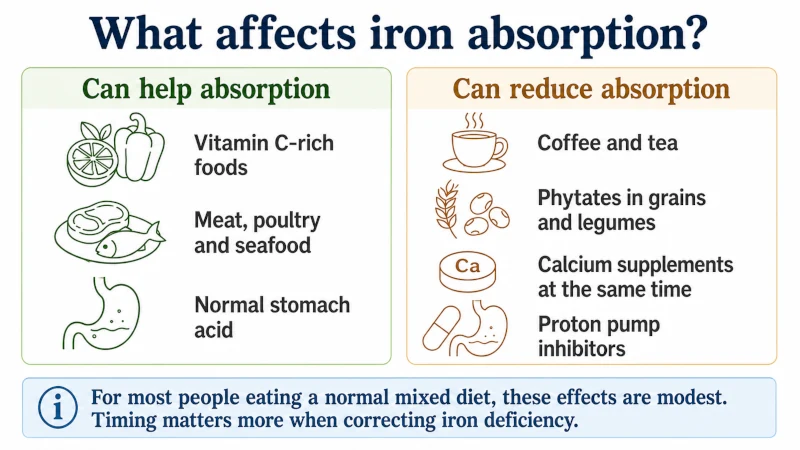
Vitamin C helps — but you probably don’t need a pill. Ascorbic acid enhances nonheme iron absorption, and NIH lists it alongside meat, poultry, and seafood as an absorption enhancer [NIH Office of Dietary Supplements iron fact sheet, 2025]. That’s the reason for the bell-pepper-in-the-lentils advice, and it’s sound.
The supplement version is a different question. A randomized trial of 440 adults with iron deficiency anemia compared iron alone against iron plus 200 mg of vitamin C and found them equivalent: hemoglobin rose 1.84 g/dL on iron alone versus 2.00 g/dL with vitamin C added, a difference well inside the equivalence margin. The authors concluded that oral iron supplements alone were equivalent to oral iron supplements plus vitamin C [Li et al., JAMA Network Open, 2020]. One trial in one population isn’t the last word, but it argues against buying a separate vitamin C product to make your iron work.
Calcium may reduce absorption of both forms. NIH notes that calcium is unusual among inhibitors in that it may reduce heme as well as nonheme absorption, and that experts suggest taking individual calcium and iron supplements at different times of day. If you take both, splitting them is a reasonable, low-cost habit — our guide to calcium timing and absorption covers the other side of that schedule.
Coffee, tea, and whole grains blunt it modestly. Phytates in grains and beans, and polyphenols in coffee, tea, and some legumes, reduce nonheme absorption.
| The context that usually gets left out NIH’s own summary is that the effects of enhancers and inhibitors of iron absorption are attenuated by a typical western diet, so they have little effect on most people’s iron status [NIH Office of Dietary Supplements iron fact sheet, 2025]. Meal-timing tactics are worth doing if you’re actively correcting a deficiency. They are not worth anxiety if you’re just eating normally. |
Stomach acid matters, and so do acid-reducing drugs. Proton pump inhibitors such as omeprazole and lansoprazole lower stomach acidity and can reduce iron absorption [NIH Office of Dietary Supplements iron fact sheet, 2025]. If you take one long-term and your iron is low, mention it to your doctor.
Signs you might be running low
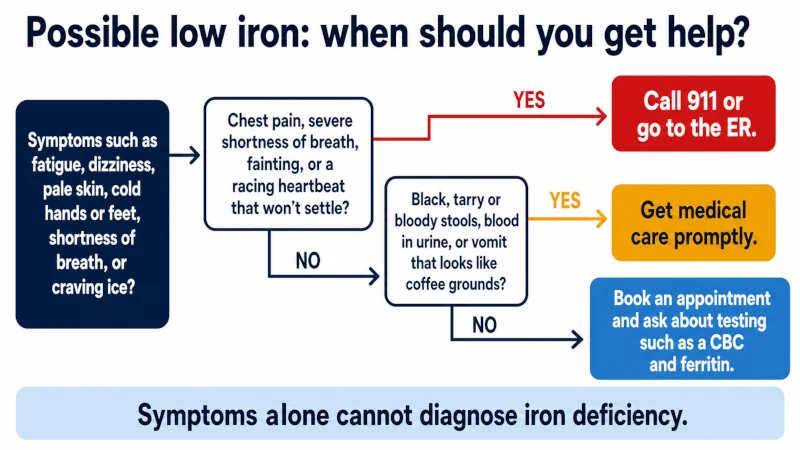
NHLBI names fatigue, dizziness or lightheadedness, cold hands and feet, pale skin, shortness of breath, and chest pain among the symptoms of iron-deficiency anemia [NHLBI on iron-deficiency anemia, 2022]. Some of the more distinctive signs get less coverage: nails that turn soft, brittle, or spoon-shaped; hair shedding; and pica, the urge to chew ice or non-food items. On pica, Cleveland Clinic family medicine physician David Brill, DO, puts it plainly: Pica can have a lot of causes, but low iron levels can be one of them. Researchers still aren’t sure exactly why [Cleveland Clinic on signs of iron deficiency, 2026].
None of these confirm anything on their own. Fatigue and pale skin have dozens of causes, and treating yourself for the wrong one wastes months.
| Red flags — do not wait Call 911 or go to the ER for chest pain, severe shortness of breath, fainting, or a racing heartbeat that won’t settle. Get seen promptly for black, tarry, or bloody stools; blood in your urine; or vomiting that looks like coffee grounds. |
Iron deficiency in a man, or in a woman past menopause, is not usually a diet problem. NHLBI lists gastrointestinal bleeding from ulcers, inflammatory bowel disease, and colon cancer among the causes, and unexplained deficiency in those groups warrants a real workup rather than a supplement [NHLBI on iron-deficiency anemia, 2022].
Test before you treat
The workup is straightforward: a complete blood count, hemoglobin, blood iron level, and ferritin [NHLBI on iron-deficiency anemia, 2022]. Those numbers tell you whether you’re actually deficient and roughly how deep the shortfall runs.
They also separate iron deficiency from a condition that looks similar and is treated differently. In anemia of inflammation, which accompanies chronic conditions including rheumatoid arthritis, cancer, kidney disease, and inflammatory bowel disease, the body stores a normal or even increased amount of iron in tissue while blood iron runs low [NIDDK on anemia of inflammation, 2018]. The iron is present; the body has locked it away. Swallowing more of it doesn’t solve that, and the treatment targets the underlying condition. If you’re managing an inflammatory condition, our rheumatoid arthritis diet guide covers the nutrition side alongside medical treatment.
Iron deficiency also isn’t the only nutritional cause of anemia — shortfalls in B12 or folate produce a different picture, which our guide to foods high in vitamin B12 addresses.
If you do take an iron supplement
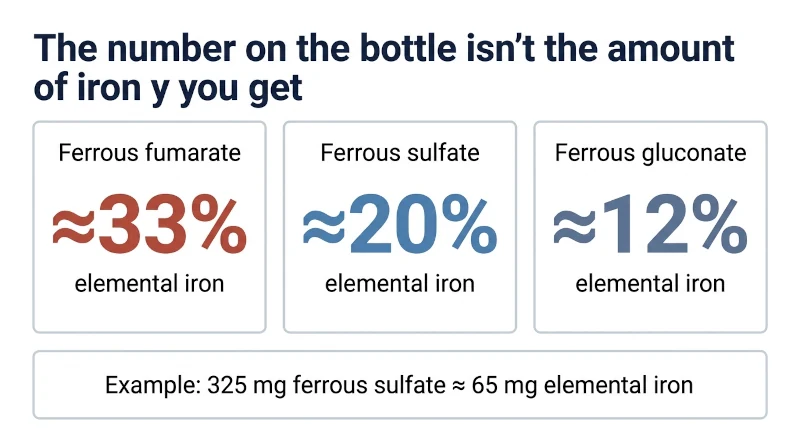
Read the elemental iron, not the compound weight. Supplement labels list a salt, and the amount of usable iron varies: ferrous fumarate is about 33% elemental iron, ferrous sulfate about 20%, and ferrous gluconate about 12% [NIH Office of Dietary Supplements iron fact sheet, 2025]. A 325 mg ferrous sulfate tablet delivers roughly 65 mg of elemental iron. Compare products on that number.
No single form is officially preferred. Ferrous forms are more bioavailable than ferric because they dissolve more readily, and ferrous sulfate is the cheapest and most studied option. NIH also notes that heme iron polypeptides, carbonyl iron, iron amino-acid chelates, and polysaccharide-iron complexes might cause fewer gastrointestinal side effects [NIH Office of Dietary Supplements iron fact sheet, 2025]. If a standard tablet wrecks your stomach, a gentler form is a legitimate conversation to have with your doctor or pharmacist rather than a reason to quit.
Alternate-day dosing is promising but early. A dose of iron raises hepcidin, a hormone that then blocks absorption of the next dose for a day or so. A crossover study in 19 women with iron deficiency anemia found fractional absorption was meaningfully higher when doses were spaced 48 hours apart — 25.0% on the alternate-day schedule versus 17.0% on consecutive days at a 100 mg dose [Stoffel et al., Haematologica, 2020]. That’s a small study measuring absorption rather than how people ultimately feel, and it isn’t yet reflected in the NIH fact sheet. If daily tablets are hard on your stomach, it’s worth raising with your doctor — not worth changing a prescribed schedule on your own.
Practical handling. Iron is usually taken with food or immediately after a meal, or as your doctor directs. Swallow tablets whole rather than splitting, chewing, or crushing them. Liquid iron should be mixed with water or fruit juice to avoid staining teeth, and not with milk [MedlinePlus on iron supplements, 2025].
Expect side effects, and expect it to take a while. Constipation, stomach pain, diarrhea, nausea, and tooth staining are the common ones [MedlinePlus on iron supplements, 2025]. Oral iron typically takes three to six months to restore stores, so a two-week trial tells you nothing [NHLBI on iron-deficiency anemia, 2022].
Medication interactions worth knowing
| Medication | Issue | What to do |
| Levothyroxine | Taking them together can meaningfully reduce levothyroxine’s effect | Separate by 4 hours |
| Levodopa (Sinemet, Stalevo) | Iron reduces levodopa absorption | Ask your doctor about spacing |
| Tetracycline, doxycycline, minocycline | Reduced absorption of the antibiotic | Take the antibiotic 2 hours before or after iron |
| Proton pump inhibitors (omeprazole, lansoprazole) | Reduced stomach acid lowers iron absorption | Discuss timing and monitoring |
| Calcium supplements | May reduce iron absorption | Take at different times of day |
Sources: [NIH Office of Dietary Supplements iron fact sheet, 2025]; [MedlinePlus on iron supplements, 2025]
Bring your full supplement list to appointments. Pharmacists are good at this and it costs nothing to ask.
Iron in pregnancy
Pregnancy raises the requirement to 27 mg a day, and most prenatal vitamins are built around that [NIH Office of Dietary Supplements iron fact sheet, 2025]. The professional guidance here is worth understanding, because major bodies land in genuinely different places.
ACOG recommends universal screening at the first prenatal visit and again at 24–28 weeks, plus universal low-dose iron supplementation with certain exceptions such as hemochromatosis. CDC recommends universal low-dose supplementation at 30 mg a day. In 2024, the US Preventive Services Task Force concluded that current evidence is insufficient to assess the balance of benefits and harms of either screening or routine supplementation in pregnancy, issuing an I statement for both [US Preventive Services Task Force, 2024].
An I statement is easy to misread, and the Task Force said so directly. Responding to public comment, it clarified that it is not making a recommendation for or against screening or supplementation during pregnancy, and that the I statement is a call for more research [US Preventive Services Task Force, 2024]. It is a verdict on the state of the evidence, not advice to skip your prenatal.
For international context, WHO recommends daily supplementation with 30–60 mg of elemental iron plus 400 µg of folic acid during pregnancy — global guidance aimed at populations with far higher anemia rates than the US [WHO guidance on daily iron and folic acid in pregnancy, 2024].
The practical takeaway for a US reader: your prenatal iron is standard care in this country, and starting, stopping, or changing the dose is a decision to make with your obstetric provider rather than on your own.
Who should be cautious
Skip or clear it with a doctor first if you have hereditary hemochromatosis or another iron-overload condition, if you receive repeated blood transfusions, or if you simply haven’t been tested. If you have a chronic inflammatory condition, testing matters even more, because tissue iron may already be normal or high [NIDDK on anemia of inflammation, 2018].
One caution that circulates widely deserves accurate framing. Iron supplementation has been linked to increased malaria risk in high-transmission regions — a 2014 review describes a Zanzibar trial stopped early over safety concerns in children given iron in an area of intense malaria transmission, and notes the risk is tied to endemic settings and limited access to health care [Clark et al., Frontiers in Pharmacology, 2014]. That finding is real and geographically specific. It is not a general instruction to stop iron during an ordinary cold. If you’re traveling to or living in a malaria-endemic area, raise it with a travel medicine doctor.
When too much iron is the problem
Iron is stored, not readily excreted, so excess accumulates.
Hereditary hemochromatosis causes iron to build to harmful levels, damaging the liver, heart, pancreas, endocrine glands, and joints. Symptoms include fatigue, joint pain, sexual dysfunction, abdominal discomfort over the liver, and darkening of skin color. Treatment is regular phlebotomy — drawing about a pint of blood on a schedule [NIDDK on hemochromatosis, 2020]. It is more common than most people assume: roughly 1 in 10 white Americans carries the most common HFE mutation, though only about 4.4 per 1,000 carry two copies [NIH Office of Dietary Supplements iron fact sheet, 2025].
Acute iron poisoning is a genuine emergency, especially in children. Acute intakes above 20 mg/kg — about 1,365 mg for someone weighing 150 pounds — can cause corrosive damage to the intestine. Between 1983 and 2000, at least 43 US children died after ingesting high-dose iron products [NIH Office of Dietary Supplements iron fact sheet, 2025]. Federal law requires this warning on iron-containing supplements for good reason: Accidental overdose of iron-containing products is a leading cause of fatal poisoning in children under 6 [21 CFR 101.17(e)(1)].
| If a child swallows iron tablets: Call Poison Control at 1-800-222-1222 immediately, or 911 if the child is unresponsive or having trouble breathing. Don’t wait for symptoms. Keep iron in its original child-resistant container, out of sight and out of reach. |
| Health Disclaimer: This article is for general education and is not a substitute for personalized medical advice. Iron deficiency and iron overload both require testing to diagnose, and iron supplements can interact with prescription medications. Talk with your doctor, pharmacist, or registered dietitian before starting, stopping, or changing an iron supplement — particularly if you are pregnant, breastfeeding, managing a chronic condition, or giving iron to a child. If you think you are having a medical emergency, call 911. |
Frequently Asked Questions
How long does it take to feel better after starting iron?
Some people notice more energy within a few weeks, but restoring depleted stores with oral iron generally takes three to six months [NHLBI on iron-deficiency anemia, 2022]. Stopping early because your energy improved is a common way to end up deficient again. Follow-up bloodwork, not how you feel, decides when you’re done.
Should I take vitamin C with my iron pill?
Vitamin C-rich foods do help you absorb plant iron, and pairing them is sensible. A separate vitamin C supplement appears less necessary than the advice suggests — a 440-person randomized trial found iron alone worked as well as iron plus 200 mg of vitamin C for raising hemoglobin [Li et al., JAMA Network Open, 2020].
Can I fix low iron with food alone?
Sometimes, if the deficiency is mild and the cause is dietary. Often not — a diagnosed deficiency usually needs supplementation because the shortfall is larger than diet can close quickly, and because something may be causing ongoing loss. Food is how you stay iron-sufficient once you get there; it’s less reliable as the repair.
Is ferrous sulfate a bad choice?
No. Ferrous forms absorb better than ferric ones, and ferrous sulfate is the most studied and least expensive option; NIH does not designate any single form as preferred [NIH Office of Dietary Supplements iron fact sheet, 2025]. Its drawback is tolerability. If it upsets your stomach, gentler alternatives like carbonyl iron or iron amino-acid chelates may cause fewer digestive side effects — worth asking your doctor or pharmacist about.
Why do I need so much more iron than the men in my house?
Menstruation. Women aged 19–50 have an RDA of 18 mg against 8 mg for adult men, and the requirement drops back to 8 mg after age 51 [NIH Office of Dietary Supplements iron fact sheet, 2025]. Heavy or prolonged periods push the losses higher still and are one of the most common reasons for deficiency in this group.
Does black stool on iron mean something is wrong?
Darkened stool is a familiar effect of oral iron. But iron can also mask the appearance of gastrointestinal bleeding, which produces black, tarry stool of its own. If the color change comes with abdominal pain, dizziness, or a tarry texture and strong odor, don’t assume it’s the supplement — get it checked.
References
- National Institutes of Health, Office of Dietary Supplements. Iron — Fact Sheet for Health Professionals. Updated September 4, 2025. View source
- National Institutes of Health, Office of Dietary Supplements. Iron — Fact Sheet for Consumers. Updated August 17, 2023. View source
- National Heart, Lung, and Blood Institute. Iron-Deficiency Anemia. Updated March 24, 2022. View source
- National Institute of Diabetes and Digestive and Kidney Diseases. Anemia of Inflammation or Chronic Disease. Reviewed September 2018. View source
- National Institute of Diabetes and Digestive and Kidney Diseases. Hemochromatosis. Reviewed January 2020. View source
- US Preventive Services Task Force. Iron Deficiency and Iron Deficiency Anemia During Pregnancy: Screening and Supplementation. August 20, 2024. View source
- Finkelstein JL, et al. Daily oral iron supplementation during pregnancy. Cochrane Database of Systematic Reviews, 2024. CD004736.pub6. DOI: 10.1002/14651858.CD004736.pub6. View source
- Li N, Zhao G, Wu W, et al. The Efficacy and Safety of Vitamin C for Iron Supplementation in Adult Patients With Iron Deficiency Anemia: A Randomized Clinical Trial. JAMA Network Open. 2020;3(11):e2023644. DOI: 10.1001/jamanetworkopen.2020.23644. View source
- Stoffel NU, Zeder C, Brittenham GM, Moretti D, Zimmermann MB. Iron absorption from supplements is greater with alternate day than with consecutive day dosing in iron-deficient anemic women. Haematologica. 2020;105(5):1232–1239. DOI: 10.3324/haematol.2019.220830. View source
- Clark MA, Goheen MM, Cerami C. Influence of host iron status on Plasmodium falciparum infection. Frontiers in Pharmacology. 2014;5:84. DOI: 10.3389/fphar.2014.00084. View source
- World Health Organization. Daily iron and folic acid supplementation during pregnancy (eLENA). July 26, 2024. Global guidance, not US-specific. View source
- MedlinePlus, National Library of Medicine. Iron Supplements. Revised April 15, 2025. View source
- US Food and Drug Administration. 21 CFR 101.17(e)(1) — Food labeling warning, notice, and safe handling statements. Current as of August 18, 2026. View source
- Centers for Disease Control and Prevention. Micronutrient Facts. Reviewed March 10, 2025. View source
- US Department of Agriculture / NIH Office of Dietary Supplements. Iron Content of Selected Foods, USDA National Nutrient Database for Standard Reference, Release 28. October 2015. View source
- Cleveland Clinic. 7 Signs That You Could Have an Iron Deficiency. June 17, 2026. View source
