
Contents
- 1 What most people get wrong
- 2 How it works
- 3 How to do it step-by-step
- 4 Safety rules
- 5 Quick checklist
- 6 Comparison table: Handgrip vs wall sit
- 7 Beginner protocol summary
- 8 Tradeoff: Time efficiency vs immediate gratification
- 9 It depends: Should you do this instead of aerobic exercise?
- 10 Frequently Asked Questions
- 11 References
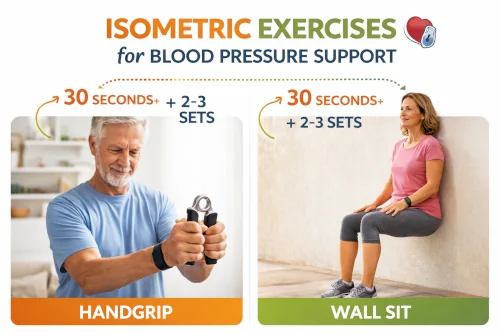
You’re standing in your kitchen, squeezing a tennis ball while the coffee brews. Thirty seconds on, thirty seconds off. Four rounds. Eight minutes total, three days a week. Your doctor mentioned trying exercise for blood pressure, and you found something that doesn’t require running shoes, a gym membership, or an extra hour you don’t have.
That’s isometric exercise. Static holds. No joint movement, just sustained muscle tension. And the research shows it can lower blood pressure more effectively than traditional aerobic exercise—if you do it correctly [1].


This guide covers two proven isometric exercises: handgrip squeezes and wall sits. You’ll learn the actual protocols studied in clinical trials, what most people get wrong, and the safety rules that matter when you’re dealing with blood pressure.
Medical disclaimer: This article about isometric exercise for blood pressure is for educational purposes only and is not medical advice. If you have high blood pressure, heart disease, kidney disease, are pregnant, or take prescription medications, talk with a qualified clinician before changing treatment, diet, exercise, or supplements. Do not stop or adjust blood pressure medication without your prescriber.
What most people get wrong
Mistake #1: Squeezing at maximum effort
The protocols that show blood pressure benefits use moderate effort—typically 30-40% of your maximum squeeze strength, not an all-out grip [2]. Think “firm handshake,” not “crushing a can.” Maximum effort spikes blood pressure dangerously during the hold and defeats the purpose.
Mistake #2: Holding your breath
Breath-holding during isometric holds (called the Valsalva maneuver) shoots blood pressure up immediately. You must breathe normally throughout each hold. Inhale through your nose, exhale through your mouth. Continuous, relaxed breathing.
Mistake #3: Random holds whenever you remember
The documented protocols are specific: typically four 2-minute holds per session, with rest between holds, done 3 times per week [1]. Sporadic squeezing while sitting in traffic won’t produce the same vascular adaptations. Consistency and structure matter.
Mistake #4: Skipping baseline measurements
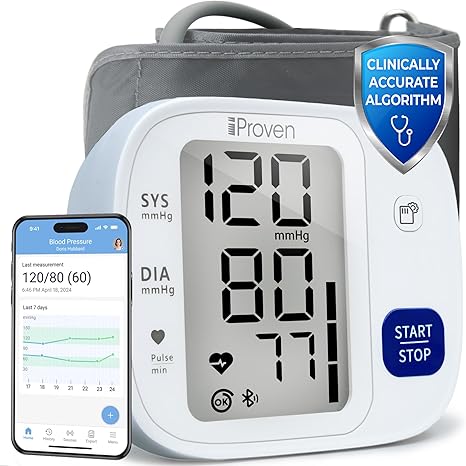
You need a reference point. Use a validated home blood pressure monitor and record your baseline readings for at least a week before starting. Track weekly after that. Without measurements, you’re guessing. (See our guide on home blood pressure monitoring for proper technique.)
Misconception: Isometric exercise is dangerous for everyone with hypertension
It depends. Uncontrolled, severely elevated blood pressure (systolic above 180 mmHg) is a contraindication—your blood pressure rises temporarily during the holds, and starting from an already dangerous level creates risk [3]. But for people with controlled or mildly elevated blood pressure, supervised isometric training has been studied safely in clinical trials. The key word: controlled baseline and gradual progression.
How it works
During an isometric hold, compressed blood vessels trigger a cascade: reduced blood flow signals the endothelium (vessel lining) to produce more nitric oxide after the hold ends [4]. Nitric oxide dilates blood vessels. Over weeks of repeated training, this improves overall vascular function and lowers resting blood pressure.
The effect builds gradually. Most studies show measurable drops after 4-8 weeks of consistent training [1].
For more on the nitric oxide connection, see our nitric oxide page.
How to do it step-by-step
Handgrip protocol
Equipment: A handgrip dynamometer (measures your max squeeze) or a simple handgrip trainer. Budget option: a rolled towel or tennis ball works for learning the pattern, though you can’t measure intensity precisely.
Finding your target intensity:
- Squeeze the device as hard as you can for 3-5 seconds. Note the reading (or the effort level).
- Your training intensity is 30-40% of that maximum.
- With a dynamometer showing 100 lbs max, you’d hold at 30-40 lbs.
- Without measurements, aim for moderate effort—noticeable tension but you could talk normally.
The 4×2 protocol (most-studied format):
- Hold: Squeeze at 30-40% max for 2 minutes
- Rest: Release completely for 2-3 minutes
- Repeat: 4 total holds (alternating hands or same hand, depending on study protocol—both work)
- Frequency: 3 sessions per week
- Duration: Minimum 4 weeks to see effect; 8-12 weeks for more significant changes
What it feels like: Mild muscle fatigue by the end of 2 minutes. Your forearm might feel warm or slightly shaky. You should NOT feel chest pain, dizziness, severe headache, or visual changes. Stop immediately if you do.
Example progression:
Sarah, a 54-year-old with prehypertension (baseline 135/88 mmHg), started with 30-second holds using a foam ball because 2 minutes felt impossible. Week one: four 30-second holds with 90-second rest. Week two: four 45-second holds. Week four: four 90-second holds. Week six: reached the full 2-minute protocol. After 10 weeks, her average home reading dropped to 126/82 mmHg. She continued twice weekly for maintenance.
Wall sit protocol
Setup:
- Stand with your back against a smooth wall
- Walk feet forward and slide down until your thighs are roughly parallel to the floor (or as low as comfortable)
- Knees at 90-degree angles, directly above ankles—not jutting forward past toes
- Back flat against wall, core engaged
- Arms relaxed at sides or crossed over chest
Beginner modifications:
- Start with a higher position (shallower squat angle)
- Use 30-second holds instead of 2 minutes
- Reduce to 3 holds instead of 4
The protocol:
- Hold: 2 minutes per wall sit
- Rest: 2-3 minutes standing or walking
- Repeat: 4 total holds
- Frequency: 3 sessions per week
Common form errors:
- Knees caving inward (push them slightly outward)
- Holding breath (keep breathing steadily)
- Feet too close to wall (knees extend past toes, stressing the joint)
It depends moment: If you have knee issues, wall sits might not be your best choice. Handgrip produces similar blood pressure benefits without joint stress. Conversely, if you have severe hand arthritis, wall sits (or other lower-body isometric holds like plank variations) might work better.
Combination approach
Some studies used handgrip only; others used leg-based isometrics. You can alternate: handgrip Monday/Friday, wall sits Wednesday. Or pick one and stick with it. Both show blood pressure reductions when done consistently [1][2].
The key: don’t try to do both protocols in one session at first. That’s 16 minutes of holds plus rest—feasible, but likely to create fatigue that compromises form and adherence.
Safety rules
Stop immediately if you experience:
- Chest pain or pressure
- Severe headache
- Dizziness or lightheadedness
- Blurred vision or seeing spots
- Shortness of breath beyond normal exercise exertion
- Nausea
Get clinician clearance first if you have:
- Uncontrolled high blood pressure (systolic >160 mmHg or diastolic >100 mmHg)
- History of heart attack, stroke, or heart failure
- Aortic aneurysm or dissection
- Severe aortic stenosis
- Recent eye surgery (increased intraocular pressure during holds can be problematic)
- Are pregnant (isometric training isn’t well-studied in pregnancy)
Blood pressure rises during holds. That’s expected. The therapeutic effect comes from the repeated exposure and recovery, which improves vascular function over time. But you start from a safe baseline, not an already-crisis level.
Monitor your response. Track resting blood pressure weekly using proper technique: seated, rested, same time of day. If readings increase or you feel consistently worse, stop and consult your clinician.
Quick checklist
Use this before each session:
- Baseline blood pressure recorded this week
- No chest pain, severe headache, or dizziness today
- Timer set for holds and rest periods
- Breathing plan clear (no breath-holding)
- Effort level calibrated (moderate, not maximum)
- Stop rules reviewed
- Tracking log ready (date, session completion, any symptoms)
Tracking log example:
| Date | Protocol | Holds completed | BP this week | Notes |
|---|---|---|---|---|
| Jan 8 | Handgrip 4×2 | 4/4 | 134/86 | Felt good |
| Jan 10 | Handgrip 4×2 | 3/4 | — | Stopped early, felt dizzy |
| Jan 12 | Handgrip 4×2 | 4/4 | 132/84 | Back on track |
Comparison table: Handgrip vs wall sit
| Feature | Handgrip | Wall sit |
|---|---|---|
| What it is | Sustained squeeze of a gripper or device at moderate intensity | Static squat position held against a wall |
| Best for | People with limited mobility, knee issues, or seeking equipment-free option (towel/ball) | Those who prefer leg-based exercise or have hand/wrist limitations |
| Caution | Severe hand arthritis or recent wrist/hand surgery | Knee pain, patellar issues, or balance concerns |
Beginner protocol summary
| Parameter | Recommendation |
|---|---|
| Intensity | 30-40% of maximum effort |
| Hold duration | Start at 30-60 seconds; progress to 2 minutes |
| Rest between holds | 2-3 minutes |
| Holds per session | 4 |
| Sessions per week | 3 (non-consecutive days) |
| Program length | Minimum 4 weeks; 8-12 weeks for best results |
Tradeoff: Time efficiency vs immediate gratification
Isometric training takes 12-16 minutes per session. That’s efficient. But you won’t feel different after one session. The blood pressure reduction accumulates over weeks. If you need immediate stress relief or mood improvement, combining this with a short walk might serve you better. Isometrics excel at sustained vascular adaptation, not acute symptom relief.
It depends: Should you do this instead of aerobic exercise?
Not necessarily “instead of.” Current guidelines still emphasize aerobic activity for overall cardiovascular health [5]. Isometric training is a powerful addition—especially if joint issues, time constraints, or mobility limitations make traditional cardio difficult. Some people use isometric training as their primary blood pressure intervention. Others add it to walking or cycling. Both approaches have evidence.
If you’re completely sedentary, start with whichever you’ll actually do consistently. Adherence beats perfection.
Frequently Asked Questions
- How long until I see results? Most studies report measurable blood pressure reductions after 4-8 weeks of 3-times-weekly training. Individual responses vary. Track weekly; if you see no change after 8 weeks, reassess intensity and form, or consult a clinician.
- Can I do this every day? The studied protocols use 3 sessions per week with rest days between. Daily training hasn’t been studied extensively for blood pressure outcomes and might create overuse fatigue without added benefit. Stick with 3 days.
- What if I can’t hold for 2 minutes? Start shorter. Thirty-second holds with the same rest structure. Add 15 seconds per week. The progression matters more than hitting 2 minutes immediately.
- Do I need an expensive handgrip device? For precise intensity measurement, a dynamometer helps (around $25-40). For learning the protocol, a tennis ball or rolled towel works. You sacrifice precision but gain immediate accessibility.
- Will this replace my blood pressure medication? No. Do not stop or adjust medication without your prescriber. Isometric training can support blood pressure management, and some people reduce medication doses under medical supervision as their readings improve. That’s a clinical decision, not a DIY one.
- What if my blood pressure goes up instead of down? Stop the protocol and consult your clinician. Possible causes: too much intensity, breath-holding, starting from too high a baseline, or individual variation. Not everyone responds the same way.
- Can I combine handgrip and wall sits in one session? Possible, but start with one protocol for 4-6 weeks to gauge your response. Adding both means 32 minutes of holds plus rest—doable for some, but newcomers often find it overwhelming and quit.
- Is this safe if I’m on beta-blockers or ACE inhibitors? Generally yes, but confirm with your prescriber. Beta-blockers can blunt heart rate response to exercise, and some medications interact with exercise-induced blood pressure changes. Get clearance first.
Isometric exercise for blood pressure isn’t a hack or a shortcut. It’s a structured intervention with clinical evidence. It requires consistency, proper technique, and patience. The beauty: it fits into small time windows and requires minimal equipment.
Start with one protocol. Track your baseline. Progress gradually. Monitor your response.
For more on exercise approaches to blood pressure, see our exercise page.
References
- [1] Edwards JJ, Deenmamode AHP, Griffiths M, et al. Exercise training and resting blood pressure: a large-scale pairwise and network meta-analysis of randomised controlled trials. British Journal of Sports Medicine. 2023;57(20):1317-1326. doi:10.1136/bjsports-2022-106503
- [2] Wiles JD, Coleman DA, Swaine IL. The effects of performing isometric training at two exercise intensities in healthy young males. European Journal of Applied Physiology. 2010;108(3):419-428. doi:10.1007/s00421-009-1025-6
- [3] Riebe D, Ehrman JK, Liguori G, Magal M, eds. ACSM’s Guidelines for Exercise Testing and Prescription. 10th ed. Wolters Kluwer; 2018.
- [4] Credeur DP, Dobrosielski DA, Arce-Esquivel AA, Welsch MA. Brachial artery flow-mediated dilation following exercise with augmented oscillatory and retrograde shear rate. Cardiovascular Ultrasound. 2010;8:34. doi:10.1186/1476-7120-8-34
- [5] Whelton PK, Carey RM, Aronow WS, et al. 2017 ACC/AHA/AAPA/ABC/ACPM/AGS/APhA/ASH/ASPC/NMA/PCNA Guideline for the Prevention, Detection, Evaluation, and Management of High Blood Pressure in Adults. Journal of the American College of Cardiology. 2018;71(19):e127-e248. doi:10.1016/j.jacc.2017.11.006