
A cooling roll-on will not stop a migraine attack the way a triptan does. What it may do, for some people and some attacks, is take a little of the edge off and give you something to do in the first few minutes while you get somewhere dark and quiet. That is a modest promise, and it is roughly what the research supports. A migraine stick is a reasonable thing to keep in a bag if you want a cheap, low-risk addition to what you already do. It is not a treatment, and buying one is not a plan.
Here is what is in these products, what the studies genuinely found, how to get the most out of one, and the situations where you should leave it in the drawer and call a doctor instead.
What is a migraine stick, exactly?
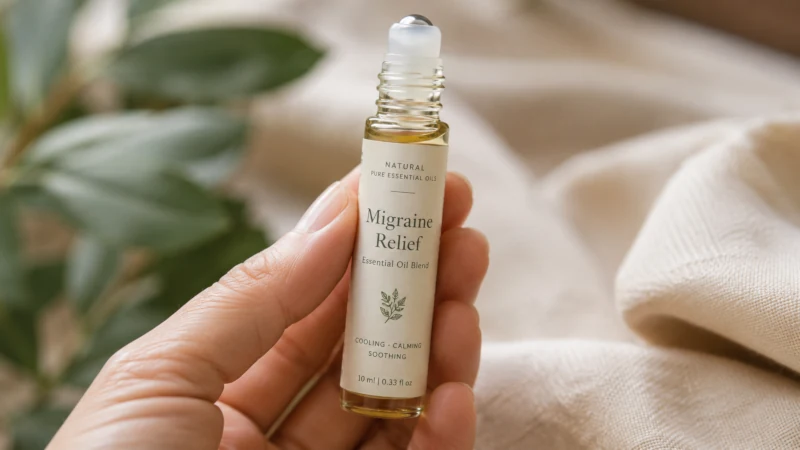
Almost every product sold under this name is the same idea: a 5–10 mL glass tube with a rollerball top, holding a few essential oils diluted in a carrier oil such as fractionated coconut or jojoba. Peppermint is nearly always in the blend, usually alongside spearmint and lavender. Eucalyptus and rosemary turn up often enough. You roll it across your forehead and temples and, if you like, the back of your neck.
The ingredient carrying most of the measurable effect is menthol, the compound that gives peppermint its bite. Menthol triggers the skin’s cold-sensing nerves, which is why the stripe of oil feels cold even though nothing on your face has actually dropped in temperature. That cooling sensation is real and immediate. How much of any pain relief comes from the cooling itself, and how much from stopping, breathing, and expecting to feel better, has not been separated cleanly in the research.
One detail matters more than it should: almost no label tells you the menthol concentration. That gap turns out to be the crux of the evidence question.
Does a migraine stick work? What the evidence actually shows
The short version: there is one encouraging small trial of a menthol solution, one encouraging small trial of inhaled lavender, and a 2024 meta-analysis that pooled seven trials and found no significant benefit over placebo. That is genuinely mixed evidence, and anyone telling you it is settled in either direction is overreaching.
The strongest trial tested menthol, not a stick
The most-cited study is a randomized, blinded, placebo-controlled crossover trial in 35 adults with migraine without aura, covering 118 attacks at a single clinic in Shiraz, Iran. Participants applied a 10% menthol solution in ethanol to the forehead and temples, and, on other attacks, a 0.5% solution as placebo. Menthol beat placebo on being pain-free at two hours and on pain relief at two hours, and also on nausea, vomiting, and sensitivity to light and sound. Side effects did not differ between the two solutions (Borhani Haghighi et al., International Journal of Clinical Practice, 2010).
That is a real result, and it is the best single piece of evidence a roll-on has. It also comes with limits worth holding onto. Thirty-five people is small. One clinic in one country is narrow. And the tested product was a 10% menthol-in-ethanol solution, not a commercial oil blend. If your stick contains, say, 2% peppermint oil in coconut oil, the menthol dose reaching your skin is a fraction of what was studied, and nobody has shown that the smaller dose does the same thing.
The lavender study was about inhaling, not rolling on
The other trial people cite for these products enrolled 47 adults with migraine. Participants put two to three drops of lavender essential oil on the upper lip and inhaled the vapor for 15 minutes. Headache severity fell further in the lavender group than in the paraffin-oil control group, and more attacks responded (Sasannejad et al., European Neurology, 2012). It was not blinded to the treating staff, and 47 people is again a small sample.
Note what was actually tested. A 15-minute deliberate inhalation is not the same intervention as a swipe across the temples, even though both involve lavender. If a product page cites this study as proof that a roll-on works, it is stretching the finding past what the study did.
Pooled together, the benefit mostly disappears
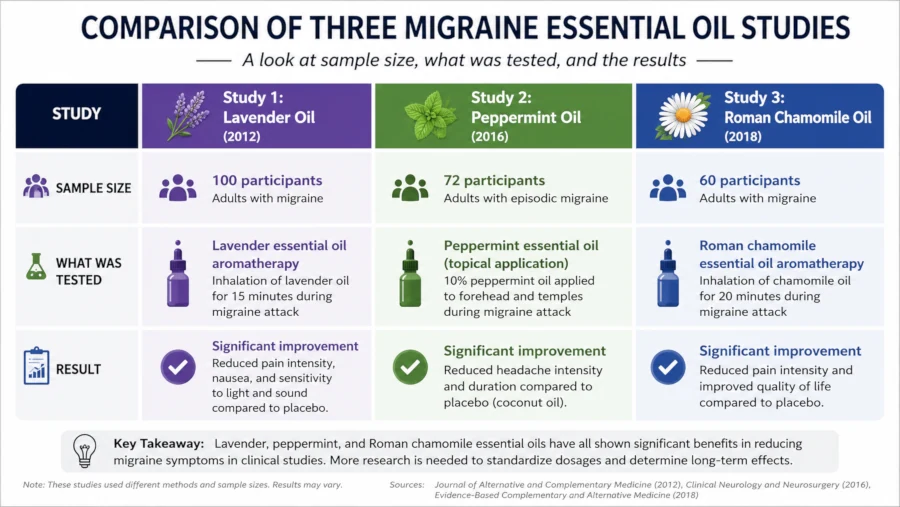
In 2024, researchers at Universiti Sains Malaysia pooled every randomized trial they could find comparing an essential oil against placebo for migraine in adults: seven trials, 558 participants, testing lavender, anise, basil, rose, peppermint, and chamomile. Attack frequency was no different from placebo across four trials. Headache severity was no different across five. Their conclusion was that essential oils did not significantly outperform placebo for managing migraine (Murtey et al., Korean Journal of Family Medicine, 2024).
Two things soften that verdict without overturning it. Individual outcomes did move: sensitivity to sound improved, and people reported fewer days of limited activity, though each of those rested on only two trials at low or moderate certainty. And the menthol 10% trial above was not among the seven included, so the pooled null result does not directly test the strongest menthol finding. All seven included trials were also conducted in Iran, which limits how far the results generalize.
Put the three findings side by side and the honest summary is: promising for concentrated topical menthol, unproven for the commercial blends people actually buy.
“It works for me” and “it works” are different claims
Migraine attacks end on their own. They also respond strongly to expectation, to lying down, to dimming the lights, and to the simple act of doing something instead of waiting. Any of those can make a roll-on look effective when it is not doing the work.
This does not mean the relief is imaginary. If applying something cool and pleasant-smelling at the first twinge helps you feel less trapped by an attack, that is a real benefit and you are allowed to keep doing it. It does mean small, unblinded studies and enthusiastic reviews will always overstate the case, and it is why the pooled analysis matters more than the testimonials.
How to use a migraine stick without wasting an attack
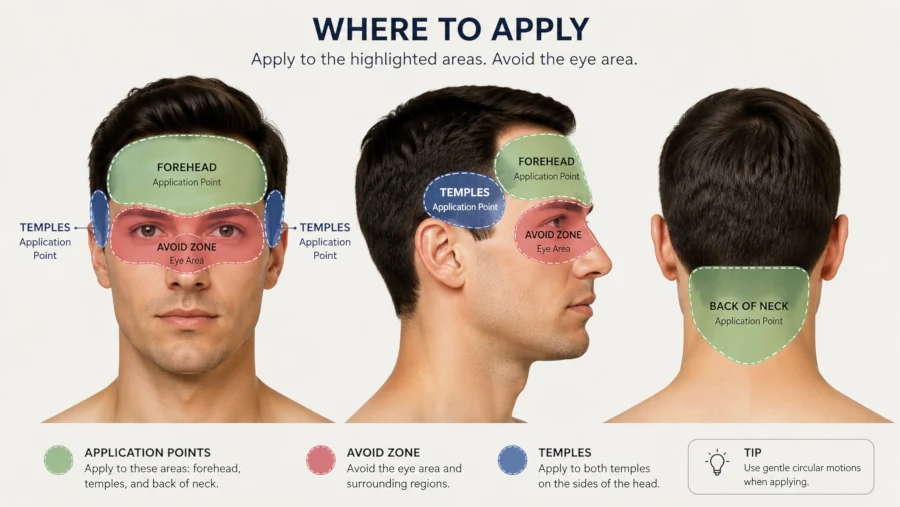
- Patch test before you rely on it. Put a small amount on the inside of your forearm and leave it 24 hours. Redness, itching, or burning means stop.
- Use it early. Apply at the first hint — the visual change, the neck stiffness, the odd mood — rather than an hour into full pain.
- Forehead and temples first. That is where the menthol trial applied its solution. The back of the neck is fine too if that is where your tension sits.
- Keep it well away from your eyes, and wash your hands after. Menthol in the eye is genuinely painful.
- Give it 15 to 30 minutes, then judge. Reapplying repeatedly raises the odds of irritating your skin without adding benefit.
The one rule that matters more than the rest: do not let the roll-on delay your actual medication. Pain relievers and triptans work best taken as soon as symptoms start, and waiting to see whether the stick works can cost you that window. If you already know an attack is going to need medication, take the medication and use the roll-on alongside it.
It also pairs naturally with the self-care steps federal health sources already recommend during an attack: rest in a quiet, darkened room, drink fluids, and put a cool cloth or ice pack on your forehead (NINDS, 2026). If you would rather blend your own roll-on than buy one, the dilution and carrier-oil basics are covered in our guide to making an essential oil roller for headaches.
Side effects, interactions, and who should skip it
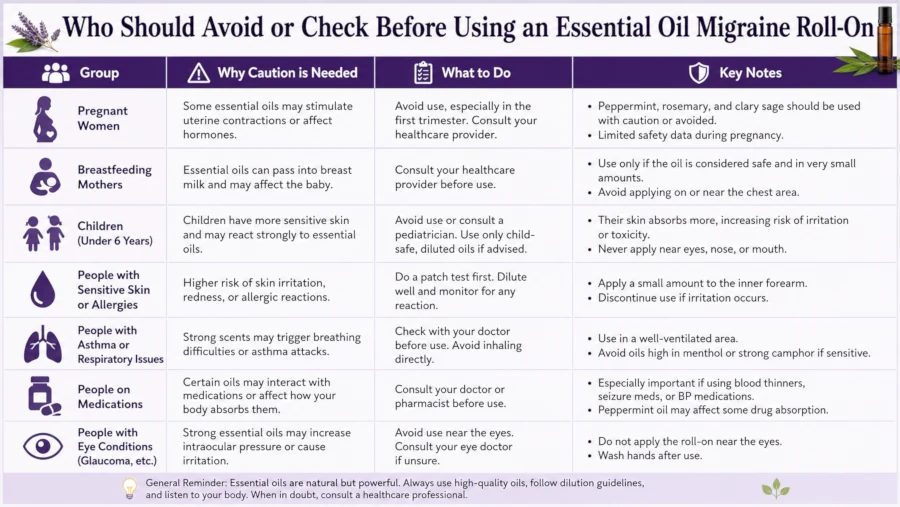
Topical essential oils are low-risk compared with most things you could put in your body for a migraine, which is a fair part of their appeal. Low risk is not no risk.
Skin reactions
Applying peppermint oil to skin can cause rashes and irritation (NCCIH, 2025), and topical lavender products cause allergic skin reactions in some people (NCCIH, 2025). Across the seven pooled trials, one participant reported skin redness and one reported a hypersensitivity reaction — uncommon, but not zero. If you have eczema, broken skin, or a history of reacting to fragranced products, be cautious.
Children and infants
Menthol should not be inhaled by or applied to the face of an infant or small child, because it can affect their breathing (NCCIH, 2025). This is the firmest safety line on the page: do not use a mint-containing roll-on on a young child’s face, and keep it out of reach. NCCIH also notes a small number of reports of breast tissue swelling in children who used topical lavender products, while stating plainly that it is unclear whether the lavender caused it, since the condition has many causes (NCCIH, 2025). Treat that as a reason for caution in children rather than proof of harm.
Pregnancy and breastfeeding
Little is known about whether lavender is safe during pregnancy or breastfeeding (NCCIH, 2025), and the same uncertainty applies to medicinal amounts of peppermint (NCCIH, 2025). “Not known to be harmful” is not the same as “shown to be safe”. Ask your OB-GYN, midwife, or primary care provider before using one regularly. If you are breastfeeding and using peppermint oil anywhere near the nipple area, NCCIH advises applying it only after a feeding and wiping it off before the next one.
Medications
There are theoretical reasons to think lavender might interact with sedative drugs or herbs, which matters most if you have surgery coming up (NCCIH, 2025). Most of what is known about essential oil drug interactions comes from swallowing them, not from a stripe on the forehead, and the topical data are thin — so this is an area where the sources are cautious rather than confident. If you take regular medication, mention the roll-on to your pharmacist or doctor the way you would any other product.
When the scent itself is the problem
Strong smells and fumes are a recognized migraine trigger, and NINDS lists sensitivity to smell among the symptoms people experience during an attack (NINDS, 2026). If that describes you, a heavily fragranced roll-on is the wrong tool no matter what the studies say. A plain cool cloth or ice pack gives you the cooling without the scent.
What has stronger evidence than a migraine stick
If migraine is disrupting your life, the roll-on should be the least important thing you try. NINDS lists triptans, ergot derivatives, CGRP-targeting drugs, over-the-counter pain relievers such as ibuprofen, aspirin, and acetaminophen, and anti-nausea medications for treating attacks. For prevention it lists anticonvulsants, beta-blockers, calcium channel blockers, and antidepressants, alongside non-drug approaches including relaxation techniques, cognitive behavioral therapy, biofeedback, massage, and acupuncture (NINDS, 2026). It also notes that preventive medication is worth considering for anyone taking headache medicine more than about three times a week.
On the supplement side, a joint American Academy of Neurology and American Headache Society guideline rated magnesium, riboflavin (vitamin B2), and a standardized feverfew extract as probably effective for preventing episodic migraine — Level B (Holland et al., Neurology, 2012).
That guideline was formally retired by the AAN in 2015 over safety concerns about butterbur, another herb it had recommended, so treat its ratings as historical rather than current policy. This is also a place where good sources do not fully agree: NINDS still lists butterbur among the supplements some people find helpful, without the liver-safety caveat that drove the AAN’s decision. Magnesium and riboflavin carry none of that baggage and sit on considerably firmer ground than any roll-on. Talk to your doctor about doses rather than guessing, particularly with magnesium if you have kidney problems.
One more thing worth knowing: taking pain medication too often can itself cause headaches that keep coming back — rebound, or medicine overuse, headache. MedlinePlus notes this can develop in people who regularly take pain medicine on more than three days a week (MedlinePlus, 2025). A topical roll-on is not an oral pain reliever and has not been linked to this problem, though it has not been formally studied either. If you are reaching for pills most days, that pattern is the thing to raise with a doctor.
Red flags: when a headache needs a doctor, not a roll-on
Some headaches are not migraine, and a few are emergencies. Call 911 or go to the nearest emergency room if a headache comes on suddenly and explosively, if it is the worst you have ever had even as someone who gets headaches regularly, or if it arrives with slurred speech, vision changes, trouble moving your arms or legs, loss of balance, confusion, or memory loss.
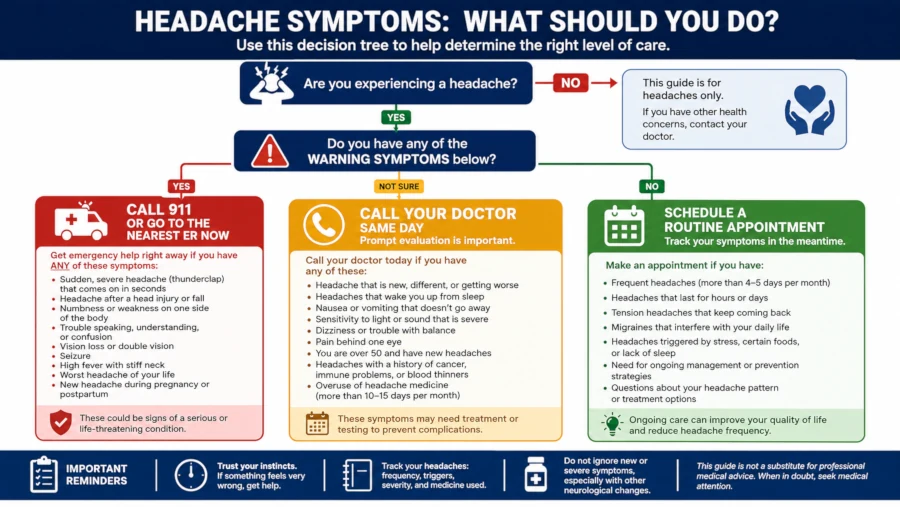
The same applies to a headache that follows a head injury, one that keeps getting worse over 24 hours, one accompanied by fever, stiff neck, nausea, and vomiting, or a severe headache confined to one red eye (MedlinePlus, 2025). A first-ever severe headache that disrupts your day belongs on that list too, as does a new headache pattern that starts after age 50, or a new headache in anyone with a history of cancer or a weakened immune system.
Call your doctor’s office promptly, rather than waiting, if an attack has run past 72 hours — NINDS calls this status migrainosus and notes the pain and nausea can be severe enough to require hospitalization (NINDS, 2026) — or if aura symptoms last longer than an hour, which is longer than they typically should.
Make a routine appointment if headaches wake you from sleep, if they are worse in the morning, if they have changed in pattern or intensity, or if you are getting them often with no clear cause (MedlinePlus, 2025). And if you are not certain what you are dealing with, our guide to the types of headaches worth worrying about walks through the patterns that point somewhere other than migraine.
Self-care stops being enough at the point where you are organizing your life around attacks, missing work or school, or medicating most weeks. A roll-on cannot fix any of that. A proper diagnosis and a preventive plan often can.
| Health Disclaimer: This article is for general education and is not medical advice. It cannot account for your medical history, medications, or circumstances, and it is not a substitute for an assessment by a qualified healthcare professional. Speak to a doctor, pharmacist, or midwife before starting any herbal or natural product, particularly if you are pregnant or breastfeeding, are treating a child, take prescription medication, or have an ongoing health condition. Essential oils are not regulated as medicines and no product described here is claimed to diagnose, treat, cure, or prevent any disease. If your headache is sudden and severe, or comes with any of the emergency symptoms listed above, call 911 or go to the nearest emergency room rather than acting on anything you have read here. |
Frequently Asked Questions
How long does a migraine stick take to work?
The cooling sensation starts within seconds, but that is the menthol on your skin rather than an effect on the headache. In the menthol trial, the pain outcomes were measured at two hours. Give it 15 to 30 minutes before deciding whether it has helped, and do not delay other treatment while you wait.
Can I use a migraine stick with my usual migraine medication?
There is no known reason a topical roll-on would interfere with a triptan or a pain reliever, and many people use both together. Because the interaction data for topical essential oils are thin, mention it to your pharmacist if you take regular medication — and take your medication on its usual schedule rather than holding off to test the roll-on.
Is a migraine stick safe during pregnancy?
Nobody can tell you it is, because it has not been studied properly. NCCIH says little is known about the safety of lavender in pregnancy or breastfeeding, and the picture for medicinal amounts of peppermint is the same. Ask your OB-GYN or midwife first. Migraine in pregnancy also warrants medical input in its own right.
Does it matter which oils are in the blend?
Peppermint is the one with a plausible mechanism and the strongest supporting trial, through its menthol content. Lavender has been tested mainly as an inhalation. Spearmint, eucalyptus, and rosemary appear in blends without migraine-specific trial evidence behind them. A blend heavy on peppermint is the closest match to what has actually been studied.
Why do some people say it works brilliantly and others feel nothing?
Partly because migraine is variable and attacks resolve on their own, partly because expectation and context genuinely shape how pain feels, and partly because the products differ enormously in how much menthol they deliver. All three explanations can be true at once.
Can children use one?
Not on the face, and not if they are very young. Menthol should not be inhaled by or applied to the face of an infant or small child because of the risk to their breathing. For an older child, ask a pharmacist or pediatrician first, and never assume an adult product is fine at a smaller dose.
References
- National Institute of Neurological Disorders and Stroke. Migraine. National Institutes of Health, last reviewed 13 March 2026. View source
- MedlinePlus. Headaches — danger signs. U.S. National Library of Medicine, review date 27 October 2025. View source
- MedlinePlus. Headache. U.S. National Library of Medicine, review date 27 October 2025. View source
- National Center for Complementary and Integrative Health. Peppermint Oil: Usefulness and Safety. National Institutes of Health, updated May 2025. View source
- National Center for Complementary and Integrative Health. Lavender: Usefulness and Safety. National Institutes of Health, updated February 2025. View source
- Murtey P, Mohd Noor N, Ishak A, Idris NS. Essential Oils as an Alternative Treatment for Migraine Headache: A Systematic Review and Meta-Analysis. Korean Journal of Family Medicine, 2024;45(1):18–26. DOI 10.4082/kjfm.23.0106. View source
- Borhani Haghighi A, Motazedian S, Rezaii R, et al. Cutaneous application of menthol 10% solution as an abortive treatment of migraine without aura: a randomised, double-blind, placebo-controlled, crossed-over study. International Journal of Clinical Practice, 2010;64(4):451–456. DOI 10.1111/j.1742-1241.2009.02215.x. PMID 20456191. View source
- Sasannejad P, Saeedi M, Shoeibi A, Gorji A, Abbasi M, Foroughipour M. Lavender essential oil in the treatment of migraine headache: a placebo-controlled clinical trial. European Neurology, 2012;67(5):288–291. DOI 10.1159/000335249. PMID 22517298. View source
- Holland S, Silberstein SD, Freitag F, Dodick DW, Argoff C, Ashman E. Evidence-based guideline update: NSAIDs and other complementary treatments for episodic migraine prevention in adults. Neurology, 2012;78(17):1346–1353. DOI 10.1212/WNL.0b013e3182535d0c. PMID 22529203. Retired by the AAN Board of Directors, 16 September 2015. View source
