
Pistachios have earned a good reputation, though not always for the reasons people repeat. The health benefits of pistachios that hold up best in clinical trials are modest: a small drop in LDL cholesterol, a slight nudge to blood pressure, and a snack that doesn’t seem to cause weight gain when it replaces something less nutritious. The bigger claims, like curing anemia, don’t survive a look at the numbers.
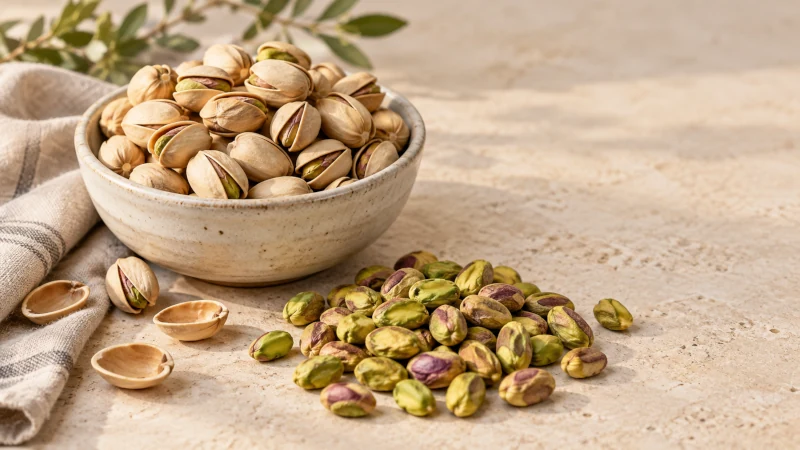
A standard serving is one ounce, about 49 kernels. Most of the studies below used one and a half to two ounces a day, swapped in for other foods rather than added on top.
What’s in a handful of pistachios
One ounce of raw pistachios (28 g) has about 159 calories, 5.7 g of protein, and 12.9 g of fat, and only 1.7 g of that fat is saturated [USDA, via MyFoodData]. It also brings roughly 3 g of fiber [Nutrivore, citing USDA].
| Nutrient (raw, unsalted) | Per 1 oz (28 g, ~49 kernels) | % Daily Value |
| Calories | 159 | — |
| Protein | 5.7 g | — |
| Total fat (saturated) | 12.9 g (1.7 g) | 17% (8%) |
| Carbohydrate | 7.7 g | — |
| Fiber | ~3 g | ~11% |
| Copper | 0.37 mg | 41% |
| Phosphorus | 139 mg | 11% |
| Magnesium | 34 mg | 8% |
| Potassium | 291 mg | 6% |
| Iron | 1.1 mg | 6% |
| Calcium | 30 mg | 2% |
| Sodium | <1 mg | 0% |
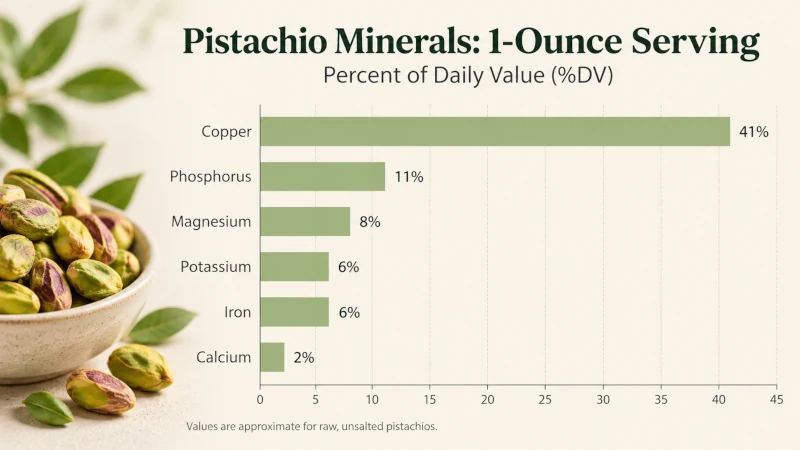
Source: USDA SR Legacy data for raw pistachios, as reproduced by MyFoodData; fiber from Nutrivore. Roasted and salted pistachios differ, mainly in sodium.
Copper is the standout. One ounce covers about two-fifths of a day’s needs, which matters for the iron story below. Pistachios also supply vitamin B6 and thiamin [Nutrivore], and a useful but not exceptional amount of magnesium; seeds, beans, and leafy greens deliver more, as our guide to magnesium-rich foods shows. Calcium is negligible.
Compared with other nuts, pistachios are unusually high in lutein, beta-carotene, and gamma-tocopherol, a form of vitamin E [Kay, 2010].
The health benefits of pistachios, ranked by evidence
Not every benefit rests on the same footing. Below, “strongest” means consistent results across several randomized trials pooled in meta-analyses; “promising” means a few good trials; “early” means small or short studies. Many pistachio trials are funded by industry groups. That doesn’t make them wrong, but it’s a reason to give pooled analyses more weight than any single study.
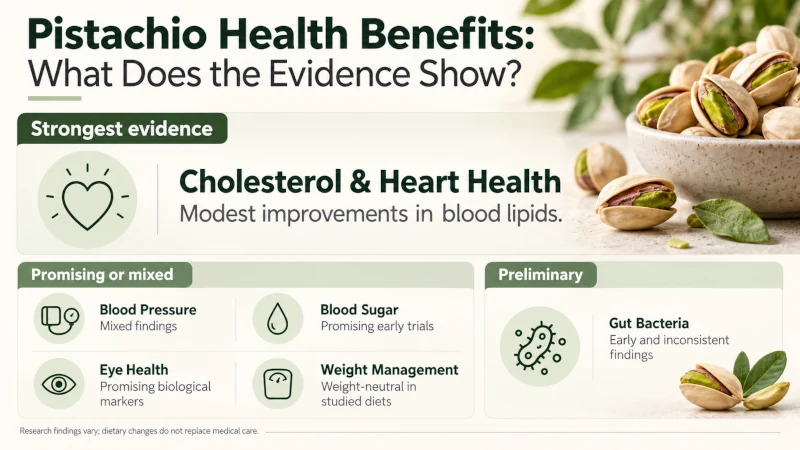
Cholesterol and heart health — the strongest case
This is where pistachios have the best record. A 2023 meta-analysis of 12 randomized trials found that pistachio-containing diets lowered total cholesterol by about 7.5 mg/dL, LDL cholesterol by about 3.8 mg/dL, and triglycerides by about 11 mg/dL, with no meaningful change in HDL [Asbaghi, 2023]. A 2016 systematic review of nine intervention studies found that the total-to-HDL and LDL-to-HDL ratios improved in every study that measured them. None reported a worse lipid profile, as long as pistachios replaced other calories instead of adding to them [Lippi, 2016].
There may be a second effect beyond LDL. In a controlled-feeding trial of 28 adults with high cholesterol, one or two daily servings raised blood levels of lutein and other antioxidants and lowered oxidized LDL, the form tied to artery plaque [Kay, 2010].
Keep the size of the effect in view: a 4 mg/dL drop in LDL is small next to what a statin does. The U.S. Food and Drug Administration takes a similarly measured line. It lets pistachios carry a qualified claim that evidence “suggests but does not prove” eating 1.5 ounces of nuts a day, within a diet low in saturated fat and cholesterol, may reduce heart disease risk [FDA, 2003]. If you’re weighing food changes against pills, our review of supplements that help lower cholesterol explains why food patterns usually come first.
Blood pressure — a small, mixed signal
A 2015 meta-analysis of 21 randomized trials found pistachios were the only single nut that significantly lowered systolic blood pressure, by about 1.8 mmHg, along with a drop of about 0.8 mmHg in diastolic pressure [Mohammadifard, 2015]. Not every analysis agrees. A 2024 pooled analysis of nearly 100 tree nut and peanut trials, presented as a conference abstract, found clear lipid improvements but no overall blood pressure benefit, though it grouped all nuts together [Wong, 2024].
Potassium helps the body shed sodium and eases tension in blood vessel walls [AHA], and unsalted pistachios fit well in a blood pressure–friendly diet. They won’t replace the bigger levers: less sodium, more activity, and medication when it’s needed. Our guide to lowering blood pressure naturally covers those.
Blood sugar — promising, but early
In a Spanish crossover trial, 54 adults with prediabetes ate about 2 ounces (57 g) of pistachios a day for four months within a calorie-matched diet. Compared with the control diet, fasting glucose, insulin, and insulin resistance all fell [Hernández-Alonso, 2014]. The trial was funded by pistachio industry groups [MedicalXpress, 2014], and it’s one study, so call it promising rather than proven.
If you’re managing blood sugar, pistachios are a sensible low-sugar snack alongside the other foods in our list of diabetic-friendly foods. They don’t replace medication or glucose monitoring.
Eye health — a nut with lutein
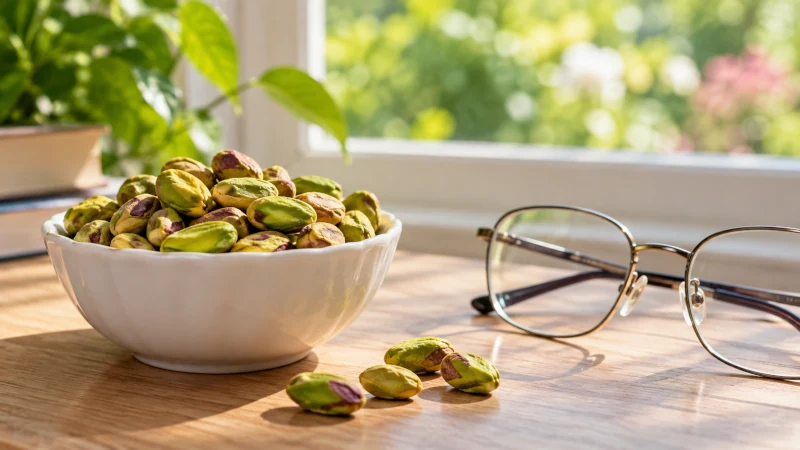
Lutein and zeaxanthin collect in the macula, the small part of the retina responsible for sharp central vision. In a 12-week randomized trial of 36 healthy middle-aged and older adults who started with low levels, eating 2 ounces of pistachios a day raised blood lutein and increased macular pigment optical density, a marker of macular health. The usual-diet group didn’t change [Scott, 2025].
That’s a small trial measuring a marker, not vision loss, and it was funded in part by American Pistachio Growers [FoodIngredientsFirst, 2024]. No study has shown that pistachios prevent macular degeneration.
Weight — no gain, and the shells may help
Nuts are calorie-dense, so the worry is fair. In a four-month behavioral weight-loss program with 100 adults, people told to eat 1.5 ounces of pistachios a day lost about the same share of body weight as those who skipped nuts (roughly 5% in both groups). The pistachio group also ate more fiber and fewer sweets [Rock, 2020].
The shells may help too. In one study, office workers who left their empty shells in sight ate about 48 fewer calories of pistachios over a day than those whose shells were cleared away [Kennedy-Hagan, 2011]. It was small and short, but buying in-shell pistachios for snacking is an easy habit to try.
Gut bacteria — interesting, not settled
In a USDA feeding study, 16 adults who ate pistachios for 18 days showed shifts in their gut bacteria, including more of the potentially beneficial bacteria that produce butyrate [Ukhanova, 2014]. A later systematic review of nut studies found only modest and inconsistent effects on gut bacteria overall [Fitzgerald, 2021]. Worth watching; not yet a reason to eat pistachios.
Protein quality
In a digestibility study run in pigs, the standard model for this test, roasted pistachios scored 81 on the PDCAAS scale and 83 on DIAAS (raw pistachios scored 86 on DIAAS). That rates them a “good” protein source for older children, teens, and adults [Bailey & Stein, 2020]. You’ll see them marketed as a “complete protein.” That’s fair shorthand, but an ounce still provides under 6 g.
Pistachios and iron: what they can and can’t do
Pistachios are sometimes described as an iron powerhouse, even a match for lentils. The numbers say otherwise. An ounce of dry-roasted pistachios gives about 1 mg of iron (6% of the Daily Value); half a cup of boiled lentils gives about 3 mg (17%) [NIH ODS, 2025].
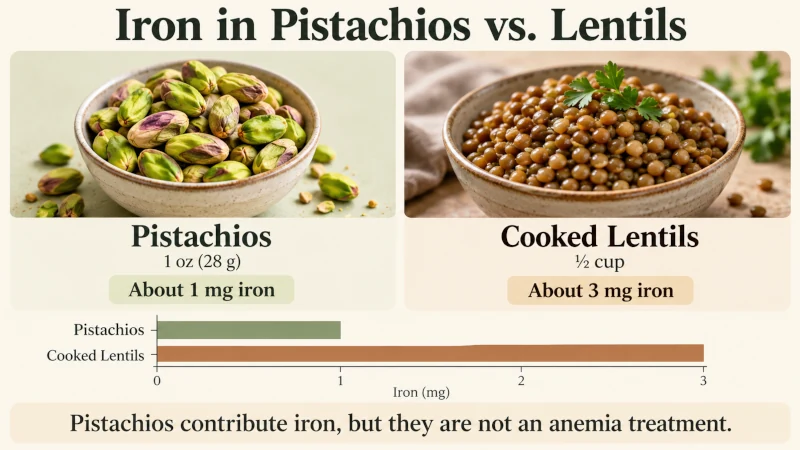
What pistachios do offer is plenty of copper, and copper matters for iron. Copper-containing enzymes help move iron out of storage and into the blood, and copper deficiency can cause an anemia that responds to copper but not iron [Proc Nutr Soc review, 2004]. That’s a good reason pistachios fit an iron-friendly diet. It isn’t evidence that they treat anemia, and some herbal and food-cure sources that claim pistachios outperform iron supplements have no clinical trials behind them.
The iron in pistachios is nonheme (plant) iron. Vitamin C and small amounts of meat, poultry, or seafood in the same meal improve its absorption, and experts suggest taking calcium and iron supplements at different times. In a typical Western diet, these effects are modest [NIH ODS, 2025]. For better iron sources, see our list of foods rich in iron.
If you have fatigue, weakness, trouble concentrating, or digestive upset that won’t go away, these can be signs of iron-deficiency anemia [NIH ODS, 2025]. Ask for a blood test. Anemia has many causes, including blood loss, and it needs a diagnosis, not a snack.
How many pistachios a day, and how to eat them
Trials typically used 1.5 to 2 ounces a day, about 42 to 57 g [Rock, 2020] [Hernández-Alonso, 2014], and the FDA’s nut claim is built around 1.5 ounces [FDA, 2003]. For most people, one ounce, roughly a small handful of 49 kernels, is a sensible daily portion. Go higher only if pistachios are replacing other foods.
- Pick unsalted or lightly salted most of the time, especially if you watch your blood pressure.
- Buy in-shell for snacking if portions tend to run away from you.
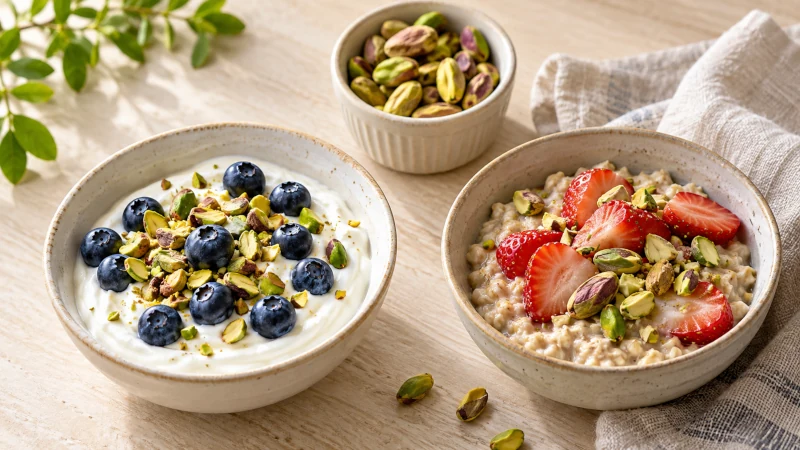
- Use them where you’d use refined crunch: on yogurt or oatmeal, in salads and grain bowls, or crushed as a coating for fish or chicken.
- Treat pistachio desserts as desserts. Ice cream and pastries bring far more sugar and butter than nut.
Safety: allergies, salt, and who should be careful
Tree-nut allergy and the cashew connection
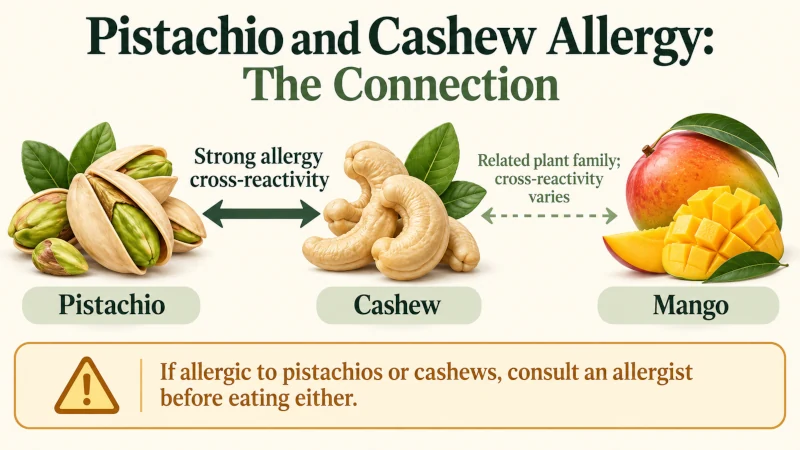
Pistachios are tree nuts, and tree nut and peanut allergies are among the most common causes of anaphylaxis in the United States [ACAAI]. The pistachio (Pistacia vera) belongs to the same plant family as cashew and mango. Pistachio and cashew allergies cross-react more strongly than almost any other nut pair, so if you react to one, treat the other as a risk until an allergist says otherwise [AAAAI]. Cross-reactivity with mango is less predictable [AAAAI]. Allergists often advise people with one tree-nut allergy to avoid all nuts [ACAAI]. Our guide to cashew benefits and risks covers cashew allergy in more detail.
Sodium and calories
Salted pistachios can add a lot of sodium, which works against blood pressure [AHA]. Check the label. And at about 159 calories an ounce [USDA, via MyFoodData], mindless snacking adds up fast.
Kidney disease and potassium
Pistachios contain potassium and phosphorus. The National Kidney Foundation says most people with chronic kidney disease or a kidney transplant don’t need to limit nuts, but if your blood potassium runs high, a kidney dietitian may adjust how much you eat [National Kidney Foundation, 2022]. The American Heart Association adds that extra potassium can be harmful with kidney disease and with certain medications, naming ACE inhibitors [AHA]. If your potassium has been high, ask your care team how pistachios fit. We found no documented interactions between pistachios eaten as food and medications beyond this potassium question.
Pregnancy, breastfeeding, and young children
As a food, pistachios aren’t on the usual lists of things to avoid during pregnancy or breastfeeding, and we found no health authority advising against them. The allergy and salt cautions above still apply. For young children, whole or chopped nuts are a choking hazard; the CDC lists them among foods to avoid [CDC]. Finely ground pistachios mixed into other foods are a safer way to offer them.
Mold and aflatoxin
Like peanuts and other tree nuts, pistachios can carry aflatoxins, toxins made by molds. Regulators set strict limits, and the European Food Safety Authority judged that the permitted levels in nuts have only a minor effect on overall exposure and cancer risk [EFSA, 2007]. Buy from reputable sellers and throw out any nuts that look moldy or damaged [Hong Kong CFS, 2025].
When to get help
Call 911 or your local emergency number if, after eating pistachios or any nut, you or someone else has trouble breathing, swelling of the face, lips, mouth, or throat, widespread hives with vomiting, or signs of shock such as fainting [Health library: tree nut allergy] [ACAAI]. If epinephrine has been prescribed, use it as your allergist instructed.
See your doctor if pistachios cause mouth itching or mild hives, if you have symptoms that could mean anemia, or if you have kidney disease and your potassium has been high.
| HEALTH DISCLAIMER This article is for general education and isn’t a substitute for medical advice, diagnosis, or treatment. Pistachios can cause severe allergic reactions in some people. Talk with your doctor, a registered dietitian, or your pharmacist before making big diet changes if you have a nut allergy, kidney disease, diabetes, or high blood pressure, take prescription medication, or are pregnant or breastfeeding. Never use food in place of a diagnosis for anemia or other symptoms. If you think you’re having an allergic reaction, call 911 right away. |
Frequently Asked Questions
How many pistachios should I eat a day?
About one ounce, roughly 49 kernels, is a sensible daily portion. Studies showing benefits mostly used 1.5 to 2 ounces a day, eaten in place of other foods rather than in addition to them [Rock, 2020] [Hernández-Alonso, 2014].
Are pistachios good for your heart?
They can help a little. Pooled trials show modest drops in total and LDL cholesterol and triglycerides [Asbaghi, 2023], and the FDA allows a qualified heart-health claim for nuts including pistachios [FDA, 2003]. They’re a good swap, not a substitute for medical treatment.
Do pistachios help with anemia?
Not on their own. An ounce provides only about 1 mg of iron [NIH ODS, 2025]. Pistachios are rich in copper, which the body needs to use iron, but anemia needs a diagnosis and, often, prescribed treatment.
Are roasted, salted pistachios still healthy?
Roasting changes the nutrition only slightly; in one study it modestly lowered protein digestibility [Bailey & Stein, 2020]. Salt is the bigger issue, so choose unsalted or lightly salted most of the time.
References
- U.S. Department of Agriculture. FoodData Central, SR Legacy: Nuts, pistachio nuts, raw (FDC 170184), as reproduced by MyFoodData. View source
- Nutrivore. Pistachio nutrients (summary of USDA FoodData Central data). View source
- National Institutes of Health, Office of Dietary Supplements. Iron: Fact Sheet for Health Professionals. View source
- Asbaghi O, et al. Consumption of pistachio nuts positively affects lipid profiles: View source
- Lippi G, Cervellin G, Mattiuzzi C. More pistachio nuts for improving the blood lipid profile. Systematic review of epidemiological evidence. View source
- Kay CD, Gebauer SK, West SG, Kris-Etherton PM. Pistachios increase serum antioxidants and lower serum oxidized-LDL in hypercholesterolemic adults. View source
- U.S. Food and Drug Administration, CFSAN. Summary of qualified health claims; nuts and coronary heart disease (Docket 02P-0505, letter of July 14, 2003). View source
- Mohammadifard N, et al. The effect of tree nut, peanut, and soy nut consumption on blood pressure: a systematic review and meta-analysis of randomized controlled clinical trials. View source
- Wong HY, Hill AM, Carter S, Coates AM. Does medication use affect blood pressure and lipid-lowering in tree nut and peanut interventions? A meta-analysis of randomised control trials. View source
- American Heart Association. How Potassium Can Help Control High Blood Pressure. View source
- Hernández-Alonso P, Salas-Salvadó J, Baldrich-Mora M, Juanola-Falgarona M, Bulló M. Beneficial effect of pistachio consumption on glucose metabolism, insulin resistance, inflammation, and related metabolic risk markers: a randomized clinical trial. Diabetes Care. View source
- MedicalXpress (HealthDay). Pistachio-supplemented diet beneficial in prediabetes. View source
- Scott TM, Ogunbodede O, McKay DL, Johnson EJ. Pistachio consumption increases macular pigment optical density in healthy adults: a randomized controlled trial. View source
- FoodIngredientsFirst. Clinical research finds daily pistachio consumption may “significantly improve eye health.” View source
- Rock CL, et al. Effects of pistachio consumption in a behavioral weight loss intervention on weight change, cardiometabolic factors, and dietary intake. View source
- Kennedy-Hagan K, Painter JE, Honselman C, Halvorson A, Rhodes K, Skwir K. The effect of pistachio shells as a visual cue in reducing caloric consumption. Appetite. View source
- Ukhanova M, Wang X, Baer DJ, et al. Effects of almond and pistachio consumption on gut microbiota composition in a randomised cross-over human feeding study. View source
- Fitzgerald E, Lambert K, Stanford J, Neale EP. The effect of nut consumption (tree nuts and peanuts) on the gut microbiota of humans: View source
- Bailey HM, Stein HH. A comparison of PDCAAS with DIAAS to evaluate protein quality of raw and roasted pistachio nuts. View source
- The molecular basis of copper and iron interactions. Proc Nutr Soc. View source
- American College of Allergy, Asthma & Immunology. Tree Nut Allergy. View source
- American Academy of Allergy, Asthma & Immunology. Ask the Expert: Cashew–pistachio. View source
- American Academy of Allergy, Asthma & Immunology. Ask the Expert: Cross-reactivity between papaya, mango and cashew. View source
- National Kidney Foundation. Nuts & Seeds: View source
- Centers for Disease Control and Prevention. Choking Hazards (Infant and Toddler Nutrition). View source
- European Food Safety Authority. Aflatoxins in food: EFSA assesses new proposed maximum levels for almonds, hazelnuts and pistachios. View source
- Hong Kong Centre for Food Safety. Public urged not to consume prepackaged pistachio paste suspected to be contaminated with aflatoxin. View source
- Health Library. Tree Nut Allergy (healthlibrary.wkhs.com). View source


