
Phosphorus is the mineral almost nobody needs to chase. Your body depends on it for bones, teeth, energy, and the membrane around every cell, yet most American adults already eat well above the 700 mg a day they need without trying [NIH ODS, 2023]. So the real phosphorus benefits come from a normal amount eaten in ordinary food. For most people the more useful question is the opposite one: whether they are getting too much, especially from processed foods or with kidneys that are not working as well as they used to.
What phosphorus does in your body
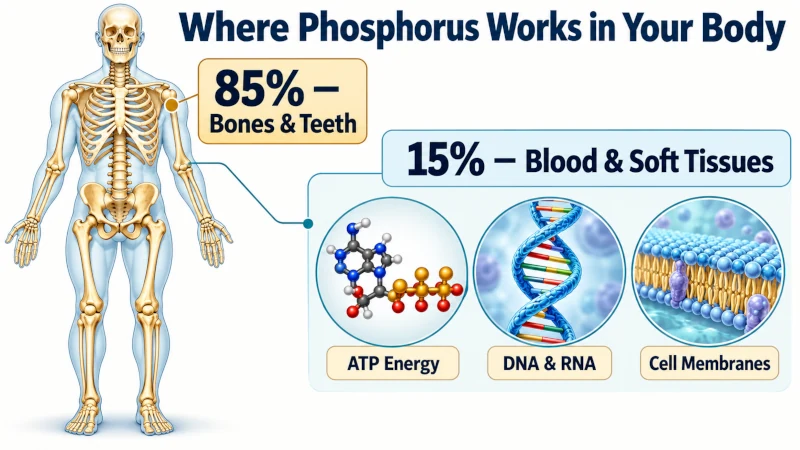
About 85% of your body’s phosphorus is in your bones and teeth. The other 15% is spread through your blood and soft tissues [NIH ODS, 2023]. In bone, phosphorus pairs with calcium to form hydroxyapatite, the mineral crystal that makes your skeleton and tooth enamel hard. That partnership is why the two minerals are almost always discussed together, and why our guide to calcium benefits and how much you need is a natural companion to this one. Magnesium is stored in bone too; our magnesium benefits guide covers that side of the story.
The 15% outside bone is busy. Phosphorus is part of:
- ATP, the molecule your cells use to store and spend energy
- DNA and RNA, your genetic material
- Phospholipids, which make up the outer membrane of every cell
- The chemical “switches” (phosphorylation) that turn many enzymes and proteins on and off
- The systems that keep the fluid outside your cells at a normal pH [NIH ODS, 2023]
You will sometimes read that phosphorus is “needed for nerve function and carbohydrate metabolism.” That is true in a broad sense, because both run on ATP, but its role as the body’s energy currency is the more accurate way to say it.
Your kidneys, gut and bones work together to hold blood phosphate in a narrow range, about 2.5 to 4.5 mg/dL in adults, with help from vitamin D and parathyroid hormone (PTH) [NIH ODS, 2023]. When kidney function declines, this balance is one of the first things to slip.
Phosphorus benefits: what the evidence actually supports
Well established: adequate intake keeps bones, teeth and cells working
There is no question that you need phosphorus. Every job above depends on it, and a true shortage causes bone pain, soft bones (rickets in children, osteomalacia in adults), muscle weakness and confusion [NIH ODS, 2023]. Meeting your daily requirement from food is a real, well-supported benefit.
Not supported: extra phosphorus for healthy people
Going beyond an adequate intake has no demonstrated payoff. The NIH’s fact sheet describes no benefit from extra phosphorus in healthy people; its health sections focus on the risks of too much, not gains from more [NIH ODS, 2023].
Mixed: phosphorus, calcium and bone balance
You may have read that too much phosphorus “locks up” calcium and weakens bone. The real picture is more nuanced. Eating a lot of phosphorus while getting too little calcium does raise PTH, the hormone that draws calcium out of bone, but studies disagree on whether that actually lowers bone density [NIH ODS, 2023].
The binding also runs the other way. Calcium from food and supplements ties up some of the phosphorus in a meal; one analysis estimated that a very high calcium intake of 2,500 mg a day binds roughly 0.6 to 1 gram of phosphorus [NIH ODS, 2023]. The practical move is simply to keep your calcium intake adequate, and our list of the best foods for osteoporosis shows how to do that with food.
Mixed and observational: high intake, heart health and mortality
Several large observational studies link higher blood phosphate with heart disease and earlier death, even in people with healthy kidneys. In one group of nearly 15,000 adults followed for almost 20 years, each 1 mg/dL rise in blood phosphate was tied to a 13% higher risk of atrial fibrillation [NIH ODS, 2023]. Not every study agrees: a four-year analysis of more than 7,000 postmenopausal women with osteoporosis found no link [NIH ODS, 2023].
Diet studies point the same way. Among 9,686 healthy U.S. adults in a national survey, phosphorus intakes above about 1,400 mg a day were associated with higher death rates from any cause, while intakes below that level showed no association [Chang et al., 2014]. These are associations, not proof. Diets very high in phosphorus may be unhealthy in other ways, and no trial has tested whether eating less phosphorus prevents heart disease in healthy adults [NIH ODS, 2023].
How much phosphorus do you need?
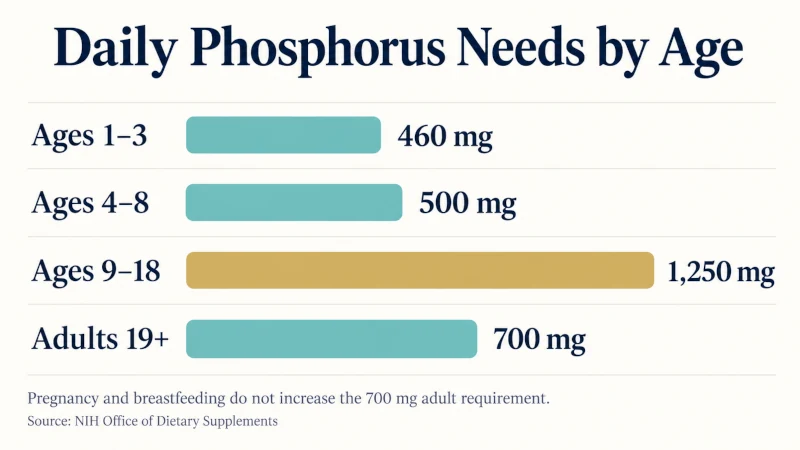
These are the current Recommended Dietary Allowances (RDAs) and Tolerable Upper Intake Levels (ULs). The upper limits count food, drinks and supplements together [NIH ODS, 2023].
| Age | RDA per day | Upper limit per day |
| Birth–6 months | 100 mg* | Not established |
| 7–12 months | 275 mg* | Not established |
| 1–3 years | 460 mg | 3,000 mg |
| 4–8 years | 500 mg | 3,000 mg |
| 9–13 years | 1,250 mg | 4,000 mg |
| 14–18 years | 1,250 mg | 4,000 mg |
| 19–70 years | 700 mg | 4,000 mg |
| 71+ years | 700 mg | 3,000 mg |
| Pregnancy, 14–18 / 19+ | 1,250 mg / 700 mg | 3,500 mg |
| Breastfeeding, 14–18 / 19+ | 1,250 mg / 700 mg | 4,000 mg |
*Adequate Intake, based on healthy breastfed infants. Breast milk, formula and food should be babies’ only phosphorus sources. Upper limits do not apply to phosphorus given under medical supervision. Source: NIH Office of Dietary Supplements.
Two numbers on older charts are now out of date. The adult RDA is 700 mg, not 800 mg, and pregnancy and breastfeeding do not raise it for adults [NIH ODS, 2023]. Teenagers have the highest need, 1,250 mg a day, because their bones are growing fast.
For context, U.S. men average about 1,600 mg a day from food alone, and women about 1,190 mg [NIH ODS, 2023]. The Daily Value on food labels is 1,250 mg, set at the teen requirement, so a food can show a modest %DV while still covering a good share of an adult’s needs.
The best food sources of phosphorus
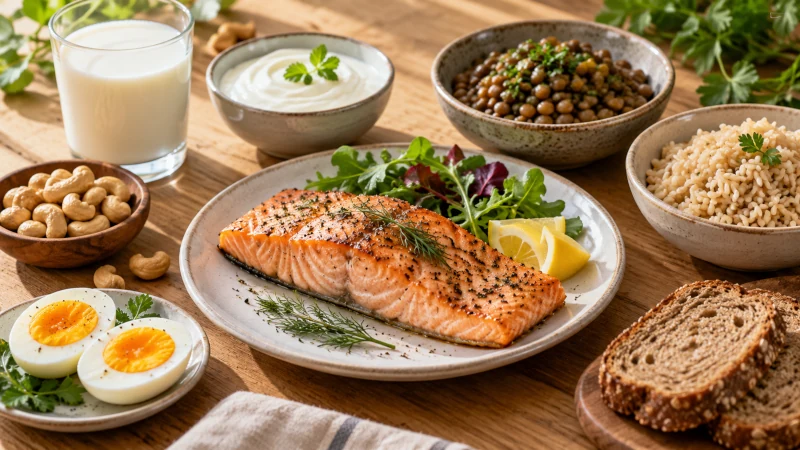
Phosphorus is in nearly every food that has protein. In the U.S., dairy supplies about 20% of total intake and breads and other bakery products about 10% [NIH ODS, 2023].
| Food | Serving | Phosphorus | % Daily Value |
| Yogurt, plain, low fat | 6 oz | 245 mg | 20% |
| Milk, 2% | 1 cup | 226 mg | 18% |
| Salmon, Atlantic, farmed, cooked | 3 oz | 214 mg | 17% |
| Mozzarella, part skim | 1.5 oz | 197 mg | 16% |
| Chicken breast, roasted | 3 oz | 182 mg | 15% |
| Lentils, boiled | ½ cup | 178 mg | 14% |
| Ground beef patty, 90% lean, broiled | 3 oz | 172 mg | 14% |
| Cashews, dry roasted | 1 oz | 139 mg | 11% |
| Potato, russet, baked with skin | 1 medium | 123 mg | 10% |
| Kidney beans, canned | ½ cup | 115 mg | 9% |
| Brown rice, cooked | ½ cup | 102 mg | 8% |
| Oatmeal, cooked with water | ½ cup | 90 mg | 7% |
| Egg, hard boiled | 1 large | 86 mg | 7% |
| Corn tortilla | 1 medium | 82 mg | 7% |
| Whole wheat bread | 1 slice | 60 mg | 5% |
| Sesame seeds | 1 tbsp | 57 mg | 5% |
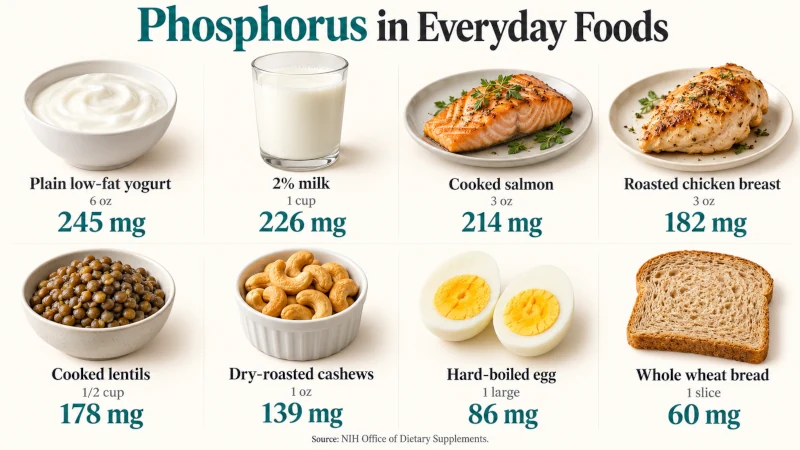
Values from the NIH Office of Dietary Supplements, based on USDA data. Daily Value = 1,250 mg.
Eggs belong on any phosphorus list, and most of an egg’s minerals sit in the yolk; our guide to egg nutrition and safety covers the rest of what an egg delivers.
Not all phosphorus is absorbed equally
You absorb 40% to 70% of the phosphorus naturally present in food, and more from animal foods than plant foods [NIH ODS, 2023]. Seeds, beans and unleavened breads store much of their phosphorus as phytic acid, which you can only partly use because human intestines lack the enzyme (phytase) that breaks it down. Phosphate additives behave differently: about 70% of their phosphorus is absorbed.
Food makers use phosphate additives such as phosphoric acid, sodium phosphate and sodium polyphosphate to hold moisture, keep color and stabilize frozen foods. They are estimated to add 300 to 1,000 mg a day to typical diets, roughly 10% to 50% of the phosphorus in Western diets, and their use is rising [NIH ODS, 2023]. Food labels don’t have to list phosphorus unless it was added, and some researchers think national diet surveys underestimate how much these additives contribute.
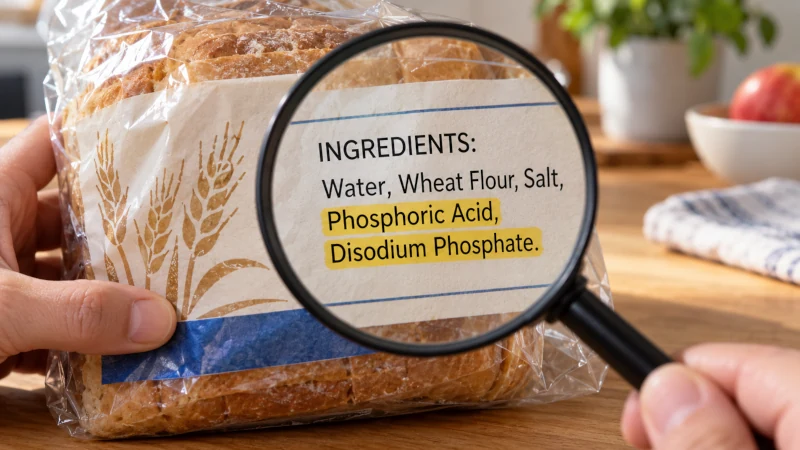
To spot them, scan the ingredient list for any word containing “PHOS,” such as phosphoric acid, disodium phosphate or monosodium phosphate. Deli meats, flavored drinks and some packaged meats are common sources [NIDDK, 2025]. If you are healthy, this is mostly useful awareness. If you have kidney disease, it is one of the most practical skills you can learn.
Phosphorus deficiency: rare, and almost never about diet
Low blood phosphate (hypophosphatemia) is uncommon in the U.S. and is almost never caused by eating too little [NIH ODS, 2023]. It usually traces back to a medical problem, such as an overactive parathyroid gland, a kidney tubule disorder or diabetic ketoacidosis.
When it does happen, symptoms can include loss of appetite, anemia, muscle weakness, poor coordination, bone pain, soft or deformed bones, more infections, a burning or prickling feeling in the skin, and confusion [NIH ODS Consumer, 2021].
The groups genuinely at risk are:
- Preterm babies, who miss the third trimester, when most fetal bone mineral is laid down.
- People with rare inherited disorders such as X-linked hypophosphatemic rickets, which specialists treat with phosphate and vitamin D.
- People with severe malnutrition — from anorexia nervosa, heavy alcohol use, cancer or other chronic illness — who can develop refeeding syndrome within 2 to 5 days of starting nutrition support. It can cause breathing failure, heart problems and death, and hospitals prevent it by giving phosphorus and thiamin with close monitoring [NIH ODS, 2023].
- Long-term users of aluminum-containing antacids (see the interactions table below).
Phosphorus and kidney disease
This is where phosphorus matters most. Healthy kidneys flush out the extra; damaged kidneys can’t keep up, so phosphorus builds up in the blood. Over time that can harm blood vessels, make bones thin and more likely to break, and cause itchy skin and bone and joint pain [NIDDK, 2025]. Among people on dialysis, those with the highest phosphate levels have higher death rates [NIH ODS, 2023].
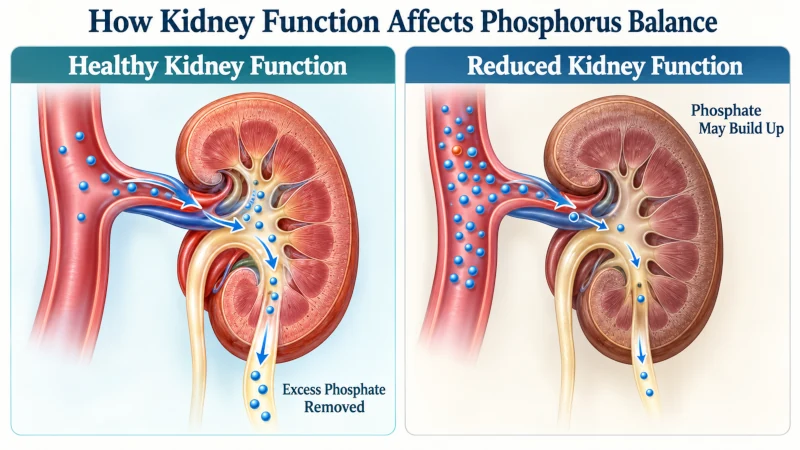
If you have chronic kidney disease (CKD), your care team may ask you to:
- Cut back on packaged and processed foods with added phosphates
- Eat more fruits and vegetables, which are naturally low in phosphorus, and smaller portions of high-phosphorus foods
- Lean on plant proteins, whose phosphorus is absorbed less, for part of your protein
- Take a phosphate binder with meals, a medicine that soaks up phosphorus in the gut so it leaves in the stool [NIDDK, 2025]
The evidence for these diet changes is thinner than many people assume. A Cochrane review of nine trials with 634 participants, each lasting 4 to 24 weeks, found that low-phosphorus diets modestly lowered blood phosphate but rated the evidence low quality and too limited to guide treatment decisions [Liu et al., 2015]. International kidney guidelines still recommend limiting dietary phosphorus in stage 3 to 5 CKD while describing that recommendation as weak [NIH ODS, 2023]. Cutting phosphorus too hard can also cut protein, which brings its own problems. Plan this with a renal dietitian rather than on your own.
Phosphorus supplements: who actually needs them
Most people don’t. Supplements usually contain phosphate salts (dipotassium or disodium phosphate) or phospholipids (phosphatidylcholine or phosphatidylserine). Most products supply 10% of the Daily Value or less, though a few deliver more than 100% [NIH ODS, 2023]. Research hasn’t shown any one form to be better than the others [NIH ODS Consumer, 2021].
Prescribed phosphate is a different matter. Doctors use it for diagnosed low phosphate, inherited phosphate disorders and refeeding, always with blood tests. Outside those situations, a phosphorus supplement adds to an intake that is probably already higher than you need.
Safety: side effects, interactions and who should be careful
Too much phosphorus
In healthy people, high phosphorus intakes from food rarely cause problems, and the upper limits sit well above what most people eat [NIH ODS, 2023]. The danger comes from large, fast doses. Taking a lot over a short time, such as two large doses of a sodium phosphate product in one day, can push blood phosphate dangerously high. That disrupts the hormones that control calcium and can deposit calcium in soft tissues, especially the kidneys.
Sodium phosphate laxatives and enemas
The FDA warns that using more than one dose of an over-the-counter sodium phosphate laxative or enema (sold as Fleet and as store brands) within 24 hours can cause rare but serious harm to the kidneys and heart, and even death. Its review found 54 serious cases, 13 of them fatal, and most involved a single oversized dose or more than one dose in a day [FDA, 2014]. The labeled use is one dose a day for no more than three days.
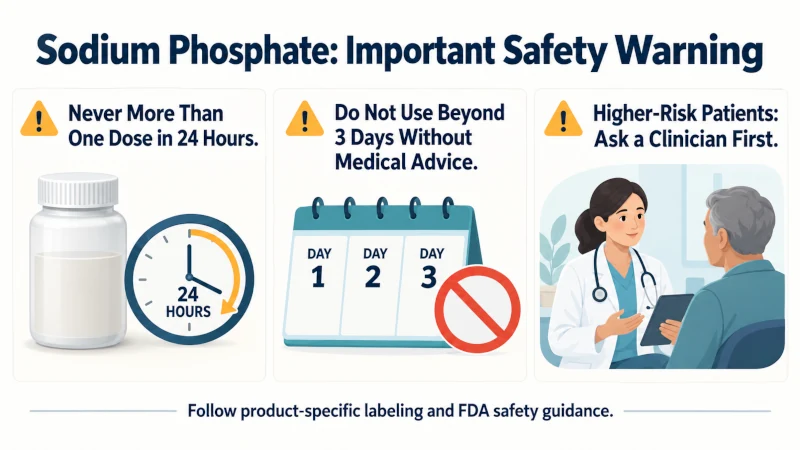
Talk with a clinician before using these products if you are older than 55, dehydrated, or have kidney disease, heart or kidney failure, or bowel blockage or inflammation, or if you take diuretics (water pills), ACE inhibitors, ARBs, or NSAIDs such as aspirin, ibuprofen or naproxen. Don’t give the oral form to children 5 and younger without a clinician’s advice, and never use the rectal form in children younger than 2 [FDA, 2014].
Medications that interact with phosphorus
| Medication | What happens | What to do |
| Aluminum hydroxide antacids | Bind phosphorus in the gut; using them for 3 months or longer can cause low phosphate [NIH ODS, 2023] | Ask your doctor before long-term use |
| Calcium carbonate antacids (e.g., Tums, Rolaids) | Reduce how much dietary phosphorus you absorb [NIH ODS, 2023] | Usually fine short term; mention regular use to your doctor |
| Sodium phosphate laxatives and enemas | Raise blood phosphate; overdose can injure kidneys and heart [FDA, 2014] | Never more than one dose in 24 hours |
| Diuretics, ACE inhibitors, ARBs, NSAIDs | Raise the risk of kidney harm from sodium phosphate products [FDA, 2014] | Check with a clinician before combining |
| Phosphate binders (prescribed in CKD) | Lower phosphorus absorption by design [NIDDK, 2025] | Take with meals as prescribed |
Pregnancy and breastfeeding
Adults’ needs don’t change: 700 mg a day during pregnancy and breastfeeding, the same as other adults. Pregnant and breastfeeding teens need 1,250 mg. The upper limit is 3,500 mg in pregnancy and 4,000 mg while breastfeeding [NIH ODS, 2023]. A normal diet covers this, so there is no reason to add a separate phosphorus supplement unless your provider prescribes one. Ask before using any laxative for pregnancy constipation, including sodium phosphate products.
Who should talk to a professional first
- Anyone with chronic kidney disease or on dialysis, before changing their diet
- Anyone considering a phosphorus supplement, or taking aluminum-containing antacids for months
- Anyone over 55, dehydrated, or with heart or kidney disease, before using a sodium phosphate laxative or enema
- Anyone recovering from severe weight loss, an eating disorder or heavy alcohol use, before quickly increasing how much they eat
- Parents of preterm babies or of children diagnosed with rickets
Warning signs that need medical care
Seek care promptly for any of the following. For a life-threatening emergency, call 911.
- Drowsiness, sluggishness, much less urine than usual, or swelling of the ankles, feet or legs after a sodium phosphate laxative or enema. These are signs of kidney injury: stop the product and get medical attention right away [FDA, 2014].
- Confusion, trouble breathing or an irregular heartbeat after a sodium phosphate product. FDA case reports describe dangerous electrolyte shifts, including low calcium, affecting breathing, mental status and the heart [FDA, 2014].
- Weakness, confusion or breathing trouble in someone who has just started eating again after severe malnutrition, which can signal refeeding syndrome [NIH ODS, 2023].
- New itching, or bone and joint pain, if you have kidney disease. Ask your kidney care team to check your phosphate [NIDDK, 2025].
| HEALTH DISCLAIMER: This article is for general education and is not a substitute for medical advice, diagnosis or treatment from a qualified healthcare professional. Do not start, stop or change any medication, supplement or kidney-disease diet based on this article. Phosphorus needs and limits can differ a great deal if you have kidney disease, are on dialysis, are recovering from severe malnutrition, or take medications that affect your kidneys. If you are pregnant or breastfeeding, have a chronic health condition, or are considering a phosphorus supplement or a sodium phosphate laxative, talk with your doctor, pharmacist or a registered dietitian first. If you have trouble breathing, confusion, fainting or other signs of a medical emergency, call 911. |
Frequently Asked Questions
What are the main benefits of phosphorus?
Phosphorus builds bones and teeth with calcium, forms ATP (your cells’ energy currency), DNA and cell membranes, and helps keep body fluids at a normal pH [NIH ODS, 2023]. Those benefits come from getting enough, which most people already do. Extra phosphorus has no proven benefit for healthy people.
How much phosphorus do I need per day?
Adults 19 and older need 700 mg a day, including during pregnancy and breastfeeding. Children 9 to 18 need 1,250 mg. The adult upper limit is 4,000 mg a day through age 70 and 3,000 mg after that [NIH ODS, 2023].
Can you get too much phosphorus?
From food alone, rarely, if your kidneys are healthy. The risks are real with kidney disease, with overdoses of sodium phosphate laxatives or enemas, and possibly with diets very high in phosphorus, though that last link comes from observational studies [FDA, 2014] [Chang et al., 2014].
Which foods are highest in phosphorus?
Dairy, fish, poultry, meat, lentils and beans, nuts, eggs and whole grains. A 6-ounce cup of plain yogurt has about 245 mg and 3 ounces of farmed salmon about 214 mg [NIH ODS, 2023]. Processed foods with phosphate additives can add a lot more.
Should I take a phosphorus supplement?
Usually not. Most people already get more than they need from food. Phosphate is prescribed for specific medical problems, such as inherited phosphate disorders or refeeding after severe malnutrition, under a doctor’s supervision [NIH ODS, 2023].
Why do people with kidney disease limit phosphorus?
Damaged kidneys can’t remove extra phosphorus, so it builds up and can harm blood vessels and bones and cause itching [NIDDK, 2025]. Diet changes and phosphate binders help keep levels in range; the right plan depends on your stage of kidney disease, so work it out with your care team.
References
- National Institutes of Health, Office of Dietary Supplements. “Phosphorus: Fact Sheet for Health Professionals.” → View source
- National Institutes of Health, Office of Dietary Supplements. “Phosphorus: Fact Sheet for Consumers.” → View source
- National Institute of Diabetes and Digestive and Kidney Diseases. “Healthy Eating for Adults with Chronic Kidney Disease.” → View source
- U.S. Food and Drug Administration. “FDA Drug Safety Communication: FDA warns of possible harm from exceeding recommended dose of over-the-counter sodium phosphate products to treat constipation.” → View source
- Chang AR, Lazo M, Appel LJ, et al. “High dietary phosphorus intake is associated with all-cause mortality: → View source
- Liu Z, Su G, Guo X, Wu Y, Liu X, Zou C, Zhang L, Yang Q, Xu Y, Ma W. “Dietary interventions for mineral and bone disorder in people with chronic kidney disease.” → View source


