
Going meat-free doesn’t mean going without. A well-planned vegetarian diet can meet all of your nutritional needs at every stage of life — pregnancy, childhood and older age included — and that’s not a wellness slogan. It’s the official position of the Academy of Nutrition and Dietetics, the professional body for registered dietitians in the United States [Craig, Melina & Levin, 2016].
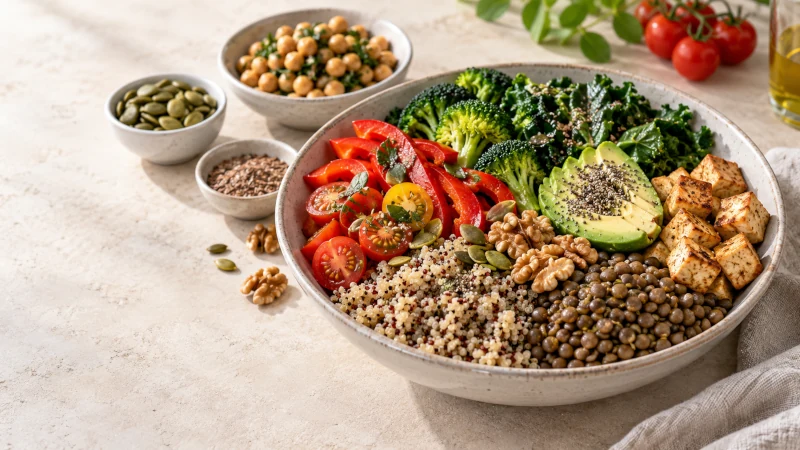
The important word there is planned. A handful of nutrients come easily from meat and fish and take a little more thought on a vegetarian plate. Get those few right and the rest of the diet largely takes care of itself. This guide walks through each one — how much you need, where to find it without meat, and the moments when a supplement or a quick conversation with your doctor is the smarter move.
What counts as a vegetarian diet?
“Vegetarian” covers a range. Lacto-ovo vegetarians eat dairy and eggs but no meat, poultry or fish — the most common pattern, and the easiest to balance. Lacto-vegetarians keep dairy but skip eggs; ovo-vegetarians do the reverse. Vegans leave out all animal products, including dairy, eggs and honey. The more animal foods you remove, the more attention two nutrients in particular — vitamin B12 and iodine — will need, which is why vegans should read those sections closely.
How to switch without overhauling your life
You don’t have to flip a switch overnight. The transition tends to stick better when it’s gradual: ease back on the meat and fish across a few weeks while crowding your plate with more vegetables, beans, whole grains and fruit.
Lean on swaps in meals you already like. Tofu, tempeh, lentils or beans stand in for the chicken, beef or pork in a stir-fry, chili, taco or pasta sauce with very little else changing. Where you can, keep the processed shortcuts to a minimum — plenty of “vegetarian” convenience foods are heavy on refined grains, salt and sugar, and swapping a burger for a beige freezer meal isn’t the upgrade it looks like. Variety is what does the real work here, because no single plant food covers everything.
The nutrients that need your attention
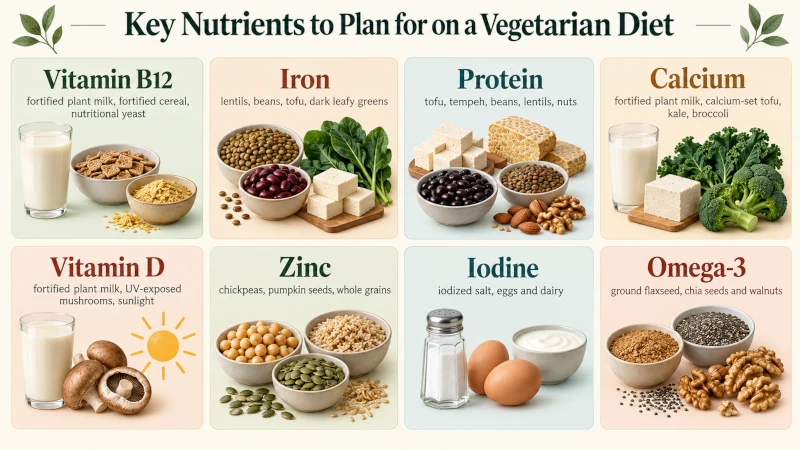
Most of what your body needs is abundant in plants. The nutrients below are the ones worth knowing by name — not because a vegetarian diet can’t supply them, but because they take slightly more intention.
Vitamin B12 — the one you can’t get from plants
This is the single most important nutrient to plan for, and the rules are different from the others. Vitamin B12 keeps your blood and nerve cells healthy and prevents a type of anemia that leaves you drained and weak. Adults need 2.4 micrograms a day [NIH ODS, Vitamin B12]. Left unchecked, a deficiency can cause numbness and tingling in the hands and feet, and those nerve changes can set in before anemia shows up — which is exactly why it’s worth staying ahead of [NIH ODS, Vitamin B12].
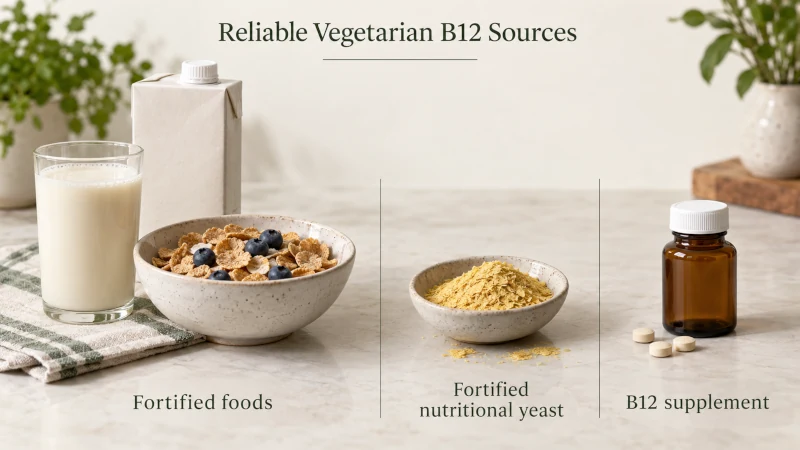
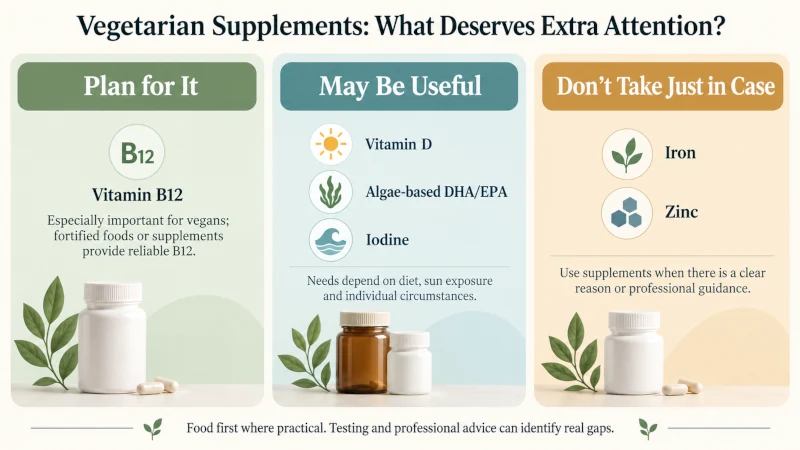
Here’s the part people miss: plant foods contain essentially no vitamin B12 [NIH ODS, Vitamin B12]. If you eat dairy and eggs, you get some. But foods like tempeh, “live” fermented vegetables and unfortified nutritional yeast are not reliable sources, despite what you’ll read. The dependable vegetarian routes are fortified foods — many plant milks, breakfast cereals and fortified nutritional yeast — and a B12 supplement. For most vegans, and for many vegetarians, a supplement is the straightforward answer [NIH ODS, Vitamin B12]. If you’ve been meat-free for a while and feel persistently tired or notice tingling in your hands or feet, ask your doctor for a simple blood test rather than guessing.
Iron — you need more than meat-eaters do
Iron ferries oxygen around your body in your red blood cells, and running low causes iron-deficiency anemia. Plants absolutely contain iron — dark leafy greens, lentils, beans, chickpeas, tofu, dried fruit and fortified cereals all deliver — but the non-heme iron in plants is absorbed less efficiently than the iron in meat. Because of that, the recommendation is that vegetarians aim for roughly 1.8 times the standard target [NIH ODS, Iron]. For reference, the standard is 8 mg a day for adult men and 18 mg for women aged 19–50 [NIH ODS, Iron].
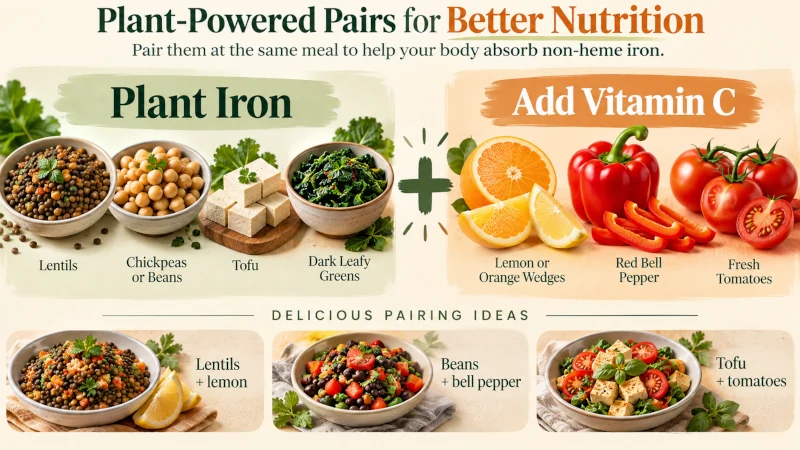
One easy habit closes most of the gap: pair iron-rich foods with a source of vitamin C at the same meal, which meaningfully boosts non-heme iron absorption [NIH ODS, Iron]. Squeeze lemon over a lentil dish, add peppers or tomatoes to a bean stew, or finish with a piece of citrus fruit. If you’re building meals specifically around correcting low iron, our guide to the best foods for anemia goes deeper.
One caution: don’t reach for an iron supplement on your own. More is not better — the upper limit for adults is 45 mg a day, and excess iron causes real harm [NIH ODS, Iron]. Supplement only if a blood test and your doctor say you need to.
Protein — easier than the internet makes it sound
Protein worries drive a lot of hesitation about going vegetarian, and they’re mostly overblown. Your body builds and repairs itself from the amino acids in protein, and plant foods supply them in abundance: beans, lentils, chickpeas, tofu, tempeh, edamame and other soy foods, nuts and nut butters, seeds, and whole grains. If you eat eggs and dairy, hitting your target is effortless.
You don’t need to fret over “complete” proteins at every meal or combine foods in a specific order. Eat a variety of protein sources across the day and the amino acids sort themselves out. A practical habit is to anchor each meal around a protein-rich food rather than treating it as a side.
Calcium — you don’t need dairy
Calcium builds and maintains your bones and teeth and helps your muscles and nerves work. Adults need 1,000–1,200 mg a day depending on age, with the requirement rising as you get older [NIH ODS, Calcium].
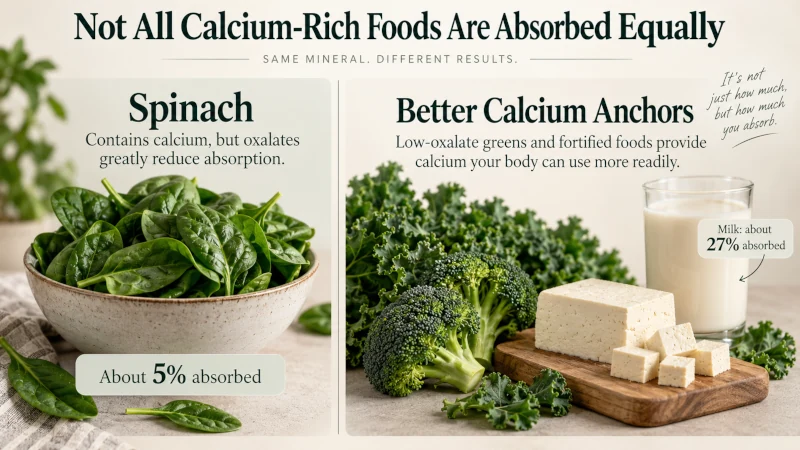
Dairy is the famous source, but it’s far from the only one. Fortified plant milks (soy, almond, oat), calcium-set tofu, fortified orange juice, fortified cereals, and greens like kale, broccoli and bok choy all contribute [NIH ODS, Calcium]. Our roundup of foods high in calcium has more options. One useful nuance: not all greens are equal. Spinach looks calcium-rich on paper, but compounds called oxalates lock most of it up — your body absorbs only about 5% of the calcium in spinach, compared with roughly 27% from milk. Low-oxalate greens like kale, broccoli and cabbage, by contrast, give up their calcium about as well as milk does [NIH ODS, Calcium]. Spinach is still a great food; just don’t count on it as your calcium anchor.
Vitamin D — food falls short for everyone
Vitamin D lets your body actually absorb the calcium you eat, and it supports your immune system. Adults aged 19–70 need 600 IU (15 mcg) a day, rising to 800 IU (20 mcg) after 70 [NIH ODS, Vitamin D].
This one isn’t really a vegetarian problem — it’s a modern-life problem. Your skin makes vitamin D from sunlight, but season, latitude, time indoors and sunscreen all cut into that, so plenty of people fall short regardless of diet [NIH ODS, Vitamin D]. Food doesn’t fully fill the gap either: the richest natural source is fatty fish, which vegetarians skip. That leaves fortified foods — many plant milks, some cereals and orange juice, plus eggs and fortified dairy if you eat them — and UV-exposed mushrooms [NIH ODS, Vitamin D]. If you get little sun, a vitamin D supplement is a reasonable option; a blood test can tell you where you stand.
Zinc — lower absorption from plants
Zinc supports your immune system, wound healing, DNA production and cell growth. Adult men need 11 mg a day and women 8 mg [NIH ODS, Zinc]. Good vegetarian sources include beans, lentils, chickpeas, pumpkin and other seeds, whole grains, and — if you eat them — cheese, yogurt and eggs.
The wrinkle is absorption. Legumes and whole grains contain phytates that bind zinc and lower how much you take up, so zinc from a vegetarian diet is often less well absorbed than from a meat-based one [NIH ODS, Zinc]. That’s a reason to keep zinc foods regular rather than a reason to panic. Soaking, sprouting and fermenting beans and grains can help reduce phytates. If you do supplement, respect the ceiling — the adult upper limit is 40 mg a day, and chronic excess interferes with copper [NIH ODS, Zinc].
Iodine — the quietly forgotten one
Iodine rarely makes the vegetarian checklist, and it should — especially for vegans. Your thyroid needs it to make the hormones that regulate metabolism. Adults need 150 mcg a day, and the requirement climbs sharply in pregnancy (220 mcg) and breastfeeding (290 mcg) [NIH ODS, Iodine].
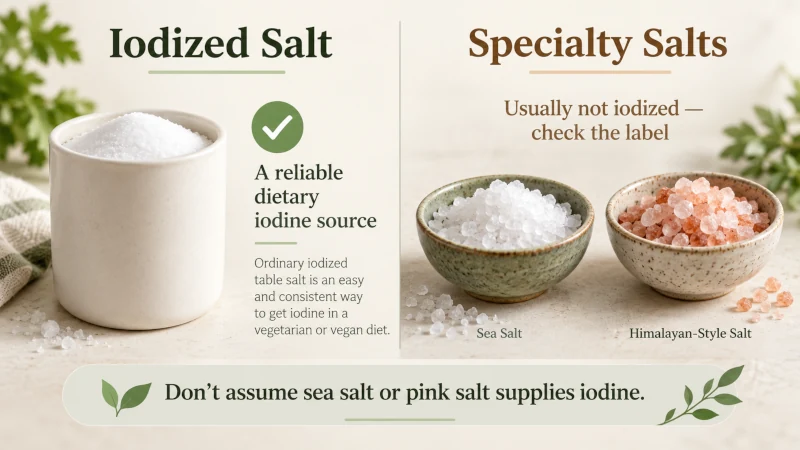
Dairy, eggs and seafood are among the best sources, along with seaweed and iodized table salt [NIH ODS, Iodine]. Two traps catch plant-based eaters. First, people who cut out dairy and eggs can quietly drift low on iodine [NIH ODS, Iodine]. Second — and this corrects a common myth — specialty salts like Himalayan and sea salt are usually not iodized and provide little to no iodine [NIH ODS, Iodine]. If you’ve switched to a fancy salt for the “extra minerals,” you may have removed one of the few reliable iodine sources from your diet without realizing it. Iodized salt, or professional guidance on a supplement, is the fix. A word of caution on seaweed: some varieties (kelp especially) can contain very high, erratic amounts of iodine, so it’s not a precise substitute.
Omega-3 fats — ALA, EPA and DHA
Omega-3 fats support heart and brain health. There are three that matter, and the vegetarian situation is specific. Two of them — EPA and DHA — come mainly from oily fish. The third, ALA (alpha-linolenic acid), is the plant form, found in flaxseed, chia seeds, walnuts, and soybean and canola oils. The recommended intake for ALA is 1.6 g a day for men and 1.1 g for women [NIH ODS, Omega-3].
Your body can convert ALA into EPA and DHA, but the conversion is limited — reported at under 15% [NIH ODS, Omega-3]. That’s why many vegetarians, and especially anyone pregnant or breastfeeding (when DHA matters most for the baby’s development), consider an algae-based DHA/EPA supplement — the same omega-3s fish provide, sourced from the algae the fish get them from in the first place [NIH ODS, Omega-3]. Work a spoonful of ground flax or chia into your day, and add an algal supplement if you want to cover EPA and DHA directly.
Supplements and safety: don’t overcorrect
The theme running through the sections above is worth stating outright: for a few nutrients, a supplement is genuinely useful — B12 above all, often vitamin D, sometimes algal omega-3 or iodine. For others, more can hurt you. Iron and zinc both have firm upper limits (45 mg and 40 mg a day for adults), and pushing past them causes harm, not extra benefit [NIH ODS, Iron] [NIH ODS, Zinc]. Supplements can also interact with medications and with each other. The safe approach is simple: fill the known gaps deliberately, don’t self-prescribe minerals to “be safe,” and let a blood test — not a hunch — tell you when something is actually low.
Who should get personalized advice
A vegetarian diet suits almost everyone, but some situations call for a professional’s eye rather than a web article:
- Pregnancy and breastfeeding. Needs for iron, B12, iodine and DHA all rise, and the stakes are higher. Plan this with your doctor or a registered dietitian.
- Infants and young children. Growing bodies leave little margin for gaps; a vegetarian or vegan diet for a child should be planned with a professional.
- Existing anemia, thyroid, bone or absorption conditions, or if you take medication that affects these nutrients.
- Persistent symptoms — ongoing fatigue, weakness, numbness or tingling in the hands or feet, hair loss, or feeling faint. These can signal iron or B12 deficiency and deserve a blood test rather than a supplement bought on a guess. Nerve symptoms from low B12 can become permanent if ignored, so don’t sit on them [NIH ODS, Vitamin B12].
If your everyday diet isn’t coming together or you’re not sure it’s meeting your needs, a registered dietitian can build a plan around your actual life in a single visit.
A wider payoff: your heart and the planet
Beyond hitting your nutrient targets, eating this way tends to come with broader benefits. The Academy of Nutrition and Dietetics notes that well-planned vegetarian and vegan diets may help prevent and treat certain diseases [Craig, Melina & Levin, 2016] — associations seen across large populations, though how much any individual gains depends on the overall quality of what they eat. A diet of chips and soda is technically vegetarian and won’t do your heart any favors.
There’s an environmental angle too, and here the evidence is strong. A comprehensive analysis of roughly 38,000 farms worldwide found that even the lowest-impact animal products generally place a heavier burden on land and greenhouse gas emissions than their plant-based counterparts — meaning a shift toward plant-based eating is one of the more effective ways an individual can shrink their food footprint [Poore & Nemecek, 2018].
| HEALTH DISCLAIMER: This article is for general education and information only. It is not medical advice and is not a substitute for diagnosis or treatment from a qualified health professional. Nutrient needs vary from person to person. Before starting a supplement or making a major dietary change — and especially if you are pregnant, breastfeeding, feeding a child, managing a medical condition, or taking medication — talk with your doctor or a registered dietitian. If you have symptoms such as ongoing fatigue, weakness, or numbness and tingling in your hands or feet, seek medical evaluation rather than self-treating. |
Frequently Asked Questions
Can you get enough protein on a vegetarian diet?
Yes, comfortably. Beans, lentils, chickpeas, tofu, tempeh, edamame, nuts, seeds and whole grains all supply protein, and eggs and dairy make it easier still. Eat a variety across the day and you don’t need to engineer “complete” proteins at each meal.
What’s the one nutrient every vegetarian should plan for?
Vitamin B12. Plant foods contain essentially none of it, so vegans need a supplement or fortified foods, and many vegetarians benefit from the same [NIH ODS, Vitamin B12]. Vegans should also keep an eye on iodine.
Do I need supplements on a vegetarian diet?
Some are genuinely useful — B12 especially, often vitamin D, and sometimes algal omega-3 or iodine. Others, like iron and zinc, shouldn’t be taken without a reason, because both have upper limits that excess intake exceeds [NIH ODS, Iron] [NIH ODS, Zinc]. A blood test is the honest way to know what you actually need.
Is spinach a good source of calcium?
Not really. Spinach contains calcium, but oxalates block most of it — you absorb only about 5% versus roughly 27% from milk. Kale, broccoli and bok choy give up their calcium far better [NIH ODS, Calcium].
Is a vegetarian diet safe during pregnancy?
It can be, when it’s well planned. The Academy of Nutrition and Dietetics considers appropriately planned vegetarian and vegan diets appropriate during pregnancy and breastfeeding [Craig, Melina & Levin, 2016]. Because needs for iron, B12, iodine and DHA rise, plan it with your doctor or a dietitian.
Will I get enough iron without meat?
Yes, with a little strategy. Plants supply iron, but you absorb it less efficiently, so vegetarians are advised to aim higher — about 1.8 times the standard target — and to pair iron-rich foods with vitamin C to boost absorption [NIH ODS, Iron].
References
- Craig WJ, Melina V, Levin S. Position of the Academy of Nutrition and Dietetics: Vegetarian Diets. Journal of the Academy of Nutrition and Dietetics. 2016;116(12):1970–1980. PMID 27886704. View source
- NIH Office of Dietary Supplements. Vitamin B12 — Fact Sheet for Health Professionals. View source
- NIH Office of Dietary Supplements. Iron — Fact Sheet for Health Professionals. View source
- NIH Office of Dietary Supplements. Calcium — Fact Sheet for Health Professionals. View source
- NIH Office of Dietary Supplements. Vitamin D — Fact Sheet for Health Professionals. View source
- NIH Office of Dietary Supplements. Zinc — Fact Sheet for Health Professionals. View source
- NIH Office of Dietary Supplements. Iodine — Fact Sheet for Health Professionals. View source
- NIH Office of Dietary Supplements. Omega-3 Fatty Acids — Fact Sheet for Health Professionals. View source
- Poore J, Nemecek T. Reducing food’s environmental impacts through producers and consumers. Science. 2018;360(6392):987–992. DOI 10.1126/science.aaq0216. View source
