
False unicorn root (Chamaelirium luteum) is a North American woodland plant whose root has been used for more than two hundred years, mostly in folk remedies for women’s reproductive complaints. The honest summary is short. No human clinical trial has shown it works for any condition, drug-information services now describe it as not safe to swallow [Drugs.com, 2025], and the plant itself is being harvested toward local extinction [United Plant Savers, 2025]. What follows is what is actually known about false unicorn root — and why most herbalists and conservation groups now point people toward gentler, better-studied plants.
What false unicorn root actually is
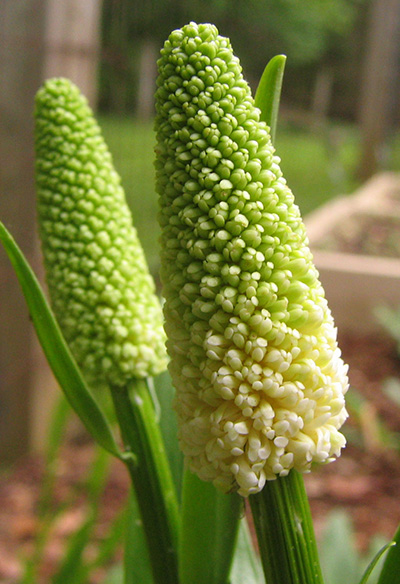
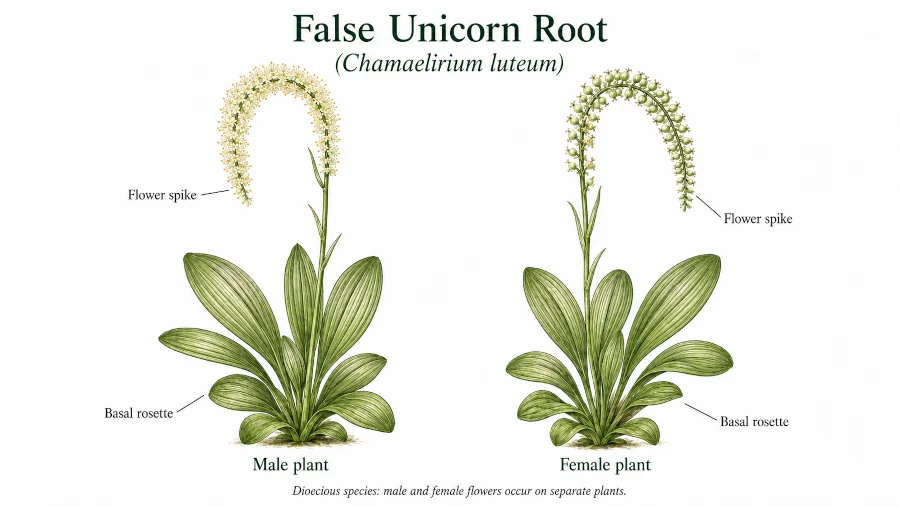
Chamaelirium luteum is a perennial in the bunchflower family (Melanthiaceae; older texts place it in the lily family). It grows in rich, shaded, moist woodland from Florida north to New York and east of the Mississippi River. A basal rosette of leaves sends up a slender flower stalk about two feet tall, blooming in May and June. The plant is dioecious, meaning male and female flowers grow on separate plants [NC State Extension, 2012]. The part used is the root and rhizome, dug in autumn from plants that are usually four to eight years old.
You’ll see it sold under several names — blazing star, devil’s bit, helonias, starwort, fairywand. One point of confusion matters: false unicorn is not the same as “true unicorn root” (Aletris farinosa), an unrelated plant that shares a common name. Because the two are mixed up, and because the herb is scarce, commercial false unicorn products have been found adulterated with true unicorn and other species [Herbal Reality, 2026].
What people have traditionally used it for
False unicorn root earned its reputation as a “woman’s herb.” Native American healers and, later, the Eclectic physicians of the late 1800s and early 1900s used it as a uterine tonic for menstrual and reproductive complaints [EBSCO Research Starters, 2024]. Traditional applications have included:
- Absent periods (amenorrhea), painful periods (dysmenorrhea), irregular cycles, and PMS
- Ovarian cysts, menopausal symptoms, and infertility
- Threatened miscarriage and morning sickness in pregnancy
- Non-reproductive folk uses: a diuretic, a remedy for intestinal worms, an appetite stimulant, and — in larger amounts — to bring on vomiting
These are historical uses, not proven ones. The distinction matters, because modern guidance has reversed at least one of them: the herb that was once chewed to hold a pregnancy is now flagged as something to avoid in pregnancy (more on that below).
What the science actually shows
The diosgenin “hormone” claim is a myth
The root contains steroidal saponins, including a compound called diosgenin, and you’ll often read that diosgenin “balances hormones” or acts like estrogen. Here’s the catch. Diosgenin is used in factories as a chemical starting material to manufacture steroid hormones, but the human body cannot convert diosgenin into hormones, and diosgenin on its own has no hormonal effect in people [EBSCO Research Starters, 2024]; [MedicineNet, 2023]. The popular mechanism behind false unicorn root, in other words, doesn’t hold up.
Lab and animal findings are not the same as benefits
Chemistry groups have isolated and described the herb’s unusual open-chain steroidal saponins and tested some of the purified compounds for cytotoxicity against cancer cell lines in test tubes and in a mouse model [Challinor, 2012]; [Yokosuka, 2013]. That work is interesting chemistry. It is not evidence that drinking the root treats cancer, regulates periods, or improves fertility — and even the basic phytochemistry was described as surprisingly thin as recently as 2012.
There are no human clinical trials
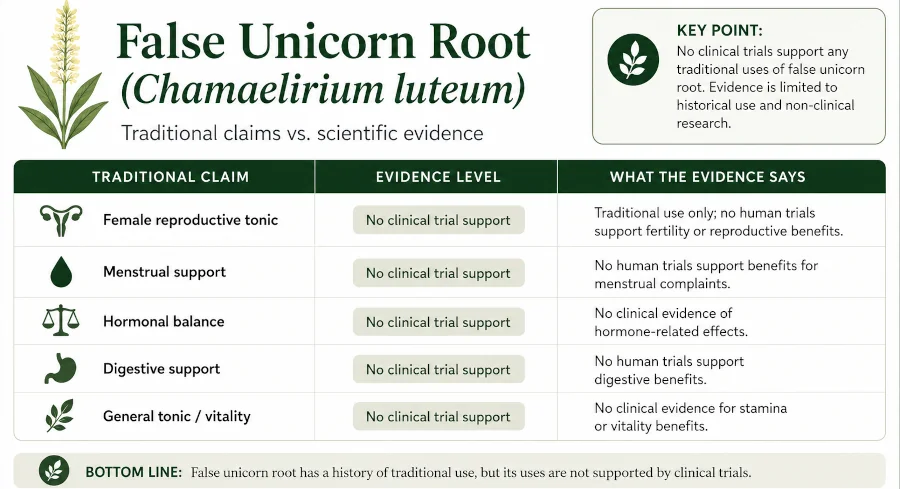
Across the major drug-information references, the verdict is consistent: there are no controlled human studies supporting any use of false unicorn root, and WebMD rates the evidence “insufficient” for every condition it lists [WebMD]. Here is how the common claims stack up against the actual evidence.
| Common claim | What the evidence shows |
| Menstrual problems, PMS | Traditional use only; no clinical trials |
| Fertility / infertility | Traditional use only; no clinical trials |
| “Balances hormones” via diosgenin | Mechanism not supported; the body does not convert diosgenin to hormones |
| Ovarian cysts, menopause symptoms | Insufficient evidence |
| Kidney, digestive, or anti-inflammatory support | Folklore; no human evidence |
| Anticancer (from lab studies) | Isolated compounds showed activity in cells and mice only — not a treatment |
Sources: Drugs.com (2025); WebMD; MedicineNet (2023); EBSCO Research Starters (2024).
Is false unicorn root safe?
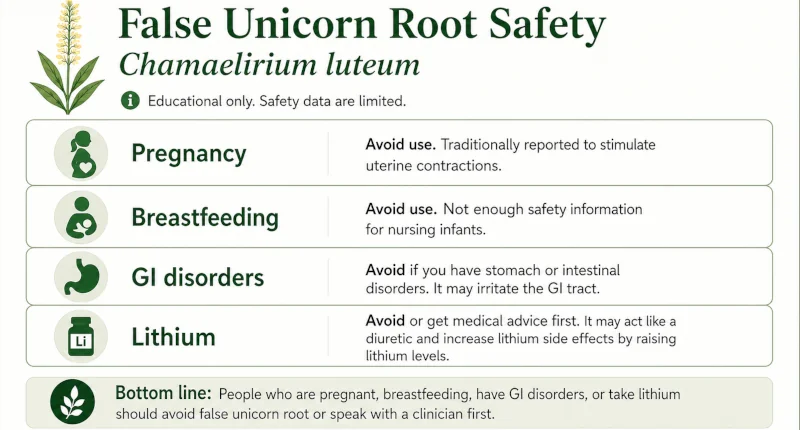
The most commonly reported problem is digestive. The saponins can irritate the stomach and intestines, and larger doses act as an emetic — they make you nauseous and can make you vomit [Drugs.com, 2025]. For that reason, anyone with a stomach or intestinal condition is advised to steer clear [WebMD]. As of its December 2025 review, Drugs.com states plainly that false unicorn is not considered safe for consumption and advises against use.
Pregnancy and breastfeeding
Despite its folk history with pregnancy, false unicorn root is rated unsafe during pregnancy: it may stimulate the uterus and could threaten the pregnancy [WebMD]. Safety during breastfeeding is unknown, so the standard advice is to avoid it then too.
Medication interactions
Two interactions are worth knowing. Because false unicorn can act like a water pill, it may slow the body’s clearance of lithium and push lithium levels higher — a moderate, clinically meaningful interaction [WebMD]. Separately, a laboratory study found root extract inhibited the CYP2D6 and CYP3A4 enzymes, which hints that it could interfere with the many prescription drugs those enzymes process. That signal is theoretical, but if you take regular medication it’s a reason to ask a pharmacist first [Drugs.com, 2025].
Allergic reactions and product quality
As with any botanical, allergy is possible — a rash, itching, or swelling of the face, lips, tongue, or throat means stop and get medical help. And because false unicorn is sold as a supplement rather than an FDA-approved medicine, products vary in strength, labels don’t always match what’s inside, and adulteration is documented [MedicineNet, 2023]. Keep any product well out of reach of children.
Who should avoid false unicorn root
- Anyone pregnant, trying to conceive, or breastfeeding
- People with any stomach or intestinal disorder
- Anyone taking lithium — and, to be cautious, anyone on medicines processed by CYP2D6 or CYP3A4 (ask a pharmacist)
- Children
Given the safety gaps and the conservation picture below, that list covers most people.
Dosage and preparations: why there isn’t a reliable number
There is no established safe or effective dose of false unicorn root, because no clinical trial has defined one and commercial preparations are not standardized [Drugs.com, 2025]. Old herbal texts list roughly 1 to 2 grams of dried root brewed as a tea, or 2 to 5 mL of tincture up to three times a day. Treat those as historical figures, not validated guidance — going past them is exactly what triggers nausea and vomiting. Because the herb is potentially unsafe, hard to dose, and often adulterated, what little serious use remains happens only under a qualified practitioner. For most people the practical dose is none.
The bigger reason to skip it: false unicorn root is endangered
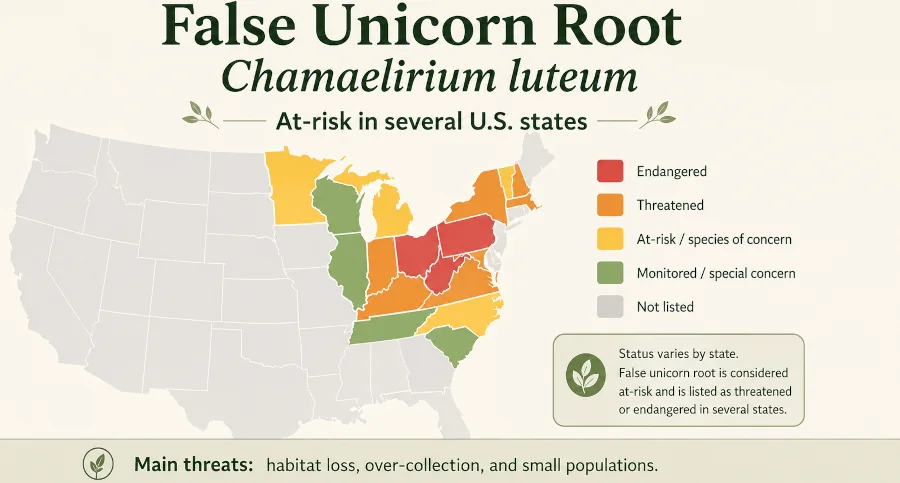
Even setting the weak evidence aside, there’s a strong ethical reason to leave false unicorn root alone. It sits on United Plant Savers’ “At-Risk” list, and it is considered threatened in New York and endangered in Massachusetts, Indiana, and Connecticut because of habitat loss and collection from the wild [United Plant Savers, 2025]; [Drugs.com, 2025].
The plant is uniquely vulnerable to harvesting. Roughly 90% of supply is still taken from the wild, the rhizome does not grow back once it’s dug, and attempts to farm it have largely failed — it grows slowly over years, needs specific shaded and moist woodland soil, and depends on separate male and female plants to set seed [Herbal Reality, 2026]. United Plant Savers’ guidance is blunt: because nearly all of it is wild-dug, it’s best to avoid using it medicinally [United Plant Savers, 2025].
If you’re drawn to it for a specific goal, herbalists who follow conservation guidance point to gentler, non-endangered, and in some cases better-studied substitutes — for example chasteberry (vitex), black cohosh, or dong quai. None of these is a proven cure either, and they still deserve professional guidance, but several have more human research behind them and none is being harvested toward extinction.
Realistic expectations
If you came hoping false unicorn root is a proven fix for fertility, periods, or menopause, it isn’t. The case for it rests on tradition and a handful of chemistry papers, not on outcomes measured in people. The case against casual use rests on genuine safety gaps and a genuine conservation crisis. For most people the sensible move is to treat the underlying issue with a clinician and skip this particular herb.
When to talk to a healthcare professional
The very symptoms people reach for this herb to fix — missed or severely painful periods, trouble conceiving, pelvic pain, bleeding in pregnancy, relentless morning sickness — are the ones that deserve a proper workup, not self-treatment. Causes such as thyroid disorders, PCOS, fibroids, endometriosis, or an ectopic pregnancy need a diagnosis a supplement can’t provide.
Seek urgent care if, after taking any false unicorn product, you have:
- Signs of a severe allergic reaction — swelling of the face, lips, tongue, or throat, hives, or trouble breathing. Call emergency services.
- Persistent vomiting or signs of dehydration
- Any vaginal bleeding or cramping during pregnancy
And if you take lithium or any prescription medicine, check with a pharmacist or doctor before combining it with this or any herbal product. Self-harm, suicide, and other crises aside, this is a sensitive health area; if something feels wrong after taking a supplement, it’s always reasonable to call your provider or a poison control center.
| Health Disclaimer This article is for general education only and is not medical advice, diagnosis, or treatment, and it is not a substitute for care from a licensed healthcare professional. False unicorn root has not been shown in clinical trials to treat, cure, or prevent any disease, and several authorities consider it unsafe to swallow. Talk with a qualified clinician before using any herbal or natural remedy — especially if you are pregnant, breastfeeding, trying to conceive, managing a chronic condition, or taking any medication. Never delay or replace professional care because of something you read here. Any use of this information is at your own risk. |
Frequently asked questions
Does false unicorn root help with fertility?
No clinical trial has shown that it improves fertility; the reputation comes from tradition. It’s also rated unsafe in pregnancy. If you’re trying to conceive, a fertility evaluation will do far more than this herb.
Is false unicorn root safe to take?
Major drug-information sources say there isn’t enough evidence to call it safe, and Drugs.com describes it as not safe for consumption. It can cause nausea and vomiting, irritate the gut, and it’s unsafe during pregnancy.
Does the diosgenin in it act like estrogen?
No. Diosgenin is used industrially as a raw material to make steroid hormones, but the human body doesn’t convert it into hormones, and on its own it has no hormonal effect.
Why is false unicorn root so hard to find and expensive?
It’s an at-risk, partly endangered plant. About 90% of supply is wild-harvested, the root doesn’t regrow once dug, and cultivation has mostly failed — so demand keeps outrunning a shrinking wild supply.
Is it the same thing as “true unicorn root”?
No. True unicorn root is a different plant, Aletris farinosa. The two share common names and are sometimes substituted for one another in products, which is one reason quality varies.
References
- Davis JM. False Unicorn or Fairy Wand (Chamaelirium luteum). NC State Mountain Horticultural Crops Research & Extension Center, 2012. → View source
- United Plant Savers. False Unicorn Root – Chamaelirium luteum (At-Risk species profile). → View source
- Drugs.com. False Unicorn – Uses, Benefits & Dosage (professional monograph, medically reviewed Dec 2025). → View source
- WebMD. False Unicorn – Uses, Side Effects, and Interactions. → View source
- MedicineNet. False Unicorn Root: Benefits, Uses, Side Effects (2023). → View source
- EBSCO Research Starters. False unicorn’s therapeutic uses (2024). → View source
- Herbal Reality. False Unicorn (Chamaelirium luteum): Benefits, Safety, Uses (reviewed 2023/2026). → View source
- Challinor VL, Stuthe JM, Parsons PG, et al. Structure and bioactivity of steroidal saponins isolated from the roots of Chamaelirium luteum (false unicorn). J Nat Prod. 2012;75(8):1469–1479. doi:10.1021/np300393y (PMID 22880631). → View source
- Yokosuka A, Takagi K, Mimaki Y. New cholestane glycosides and sterols from the underground parts of Chamaelirium luteum and their cytotoxic activity. J Nat Med. 2013;67(3):590–598. doi:10.1007/s11418-012-0718-z. → View source
