
Plain constipation — a few days without a bowel movement, hard stools, some bloating — doesn’t raise your temperature. So if you’re wondering whether constipation can cause fever, the honest answer is: not on its own, but the two showing up together is worth paying attention to. A fever usually means your body is reacting to an infection or inflammation [MedlinePlus—Fever, 2025], and when it arrives alongside constipation, something else is often going on.

That something might be harmless, like a virus that has left you dehydrated and off your food. Or it might be a complication that needs care today. The National Institute of Diabetes and Digestive and Kidney Diseases (NIDDK) puts fever on its short list of symptoms that, paired with constipation, mean you should see a doctor right away [NIDDK—Constipation, 2018]. The rest of this page helps you tell the situations apart.
Can constipation cause fever by itself?
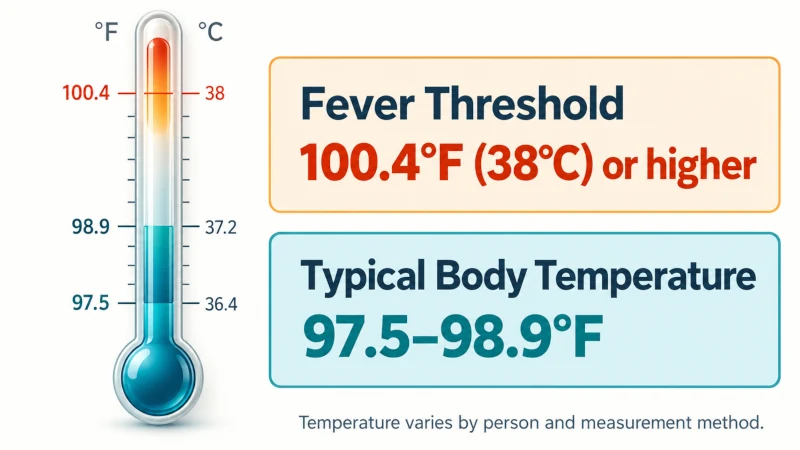
A fever is a body temperature above your normal range. Johns Hopkins puts normal at roughly 97.5°F to 98.9°F (36.4°C to 37.2°C), and most clinicians call 100.4°F (38°C) or higher a fever [Johns Hopkins Medicine—Fever, 2024]. It’s a sign, not a disease — usually of infection, though medicines, heat illness, autoimmune conditions, cancers, and some childhood vaccines can also cause one [MedlinePlus—Fever, 2025].
Ordinary constipation doesn’t fit that picture. A long-standing worry is that stool sitting in the colon “poisons” you. Cleveland Clinic addresses this directly: the colon is built to stretch and hold waste, and it takes a severe illness of the colon for toxins to leak into the body [Cleveland Clinic—Constipation, 2023]. Feeling sluggish and uncomfortable when you’re backed up is real. A fever from simple constipation is not typical.
Why constipation and fever often show up together
When both are present, the link usually runs one of three ways.
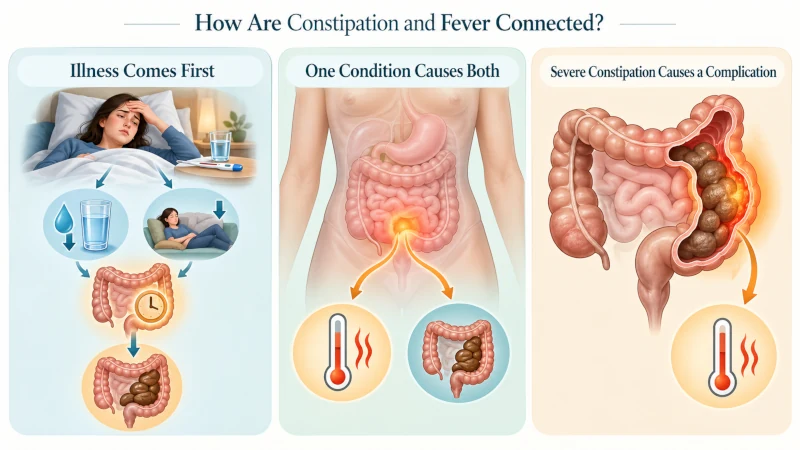
The illness came first
Being sick slows many people’s bowels. You drink less, eat less, and spend more time lying down. Johns Hopkins lists constipation among the signs that can accompany a fever, along with a flushed face, dark urine, and loss of appetite [Johns Hopkins Medicine—Fever, 2024]. Medicines can add to it: narcotic pain relievers are a well-known cause of constipation [NIDDK—Constipation, 2018]. Here the constipation is a side effect of being ill, and it usually settles as you recover.
One condition is causing both
Some illnesses produce fever and constipation at the same time. Diverticulitis and appendicitis are the main examples. The constipation isn’t causing the fever; both are symptoms of the same problem.
Severe constipation led to a complication
This is the least common route and the most serious. When hard stool stays stuck long enough, it can inflame or injure the bowel wall, and infection can follow. That is the situation where constipation genuinely can be the starting point for a fever.
Conditions that link constipation and fever
Fecal impaction and stercoral colitis
Fecal impaction is a large lump of dry, hard stool stuck in the rectum, usually in someone who has been constipated for a long time [MedlinePlus—Fecal Impaction, 2025]. It tends to cause cramping, bloating, straining, and — confusingly — leakage of watery stool around the blockage. Fever isn’t listed as a usual symptom of impaction itself in either the MedlinePlus or Cleveland Clinic overview [MedlinePlus—Fecal Impaction, 2025; Cleveland Clinic—Fecal Impaction, 2022].
A fever matters because it can mark the next stage. Stercoral colitis is inflammation of the colon caused by impacted stool. Cleveland Clinic describes it as rare but serious, with symptoms that can include pain in the lower left abdomen, swelling and tenderness, blood in the stool, and fever. Pressure from the stool can cut off blood supply or wear a hole through the bowel wall (perforation), which can lead to peritonitis and sepsis [Cleveland Clinic—Stercoral Colitis, 2025]. If you’ve been badly constipated and then develop a fever or bleeding, get care the same day.
Diverticulitis
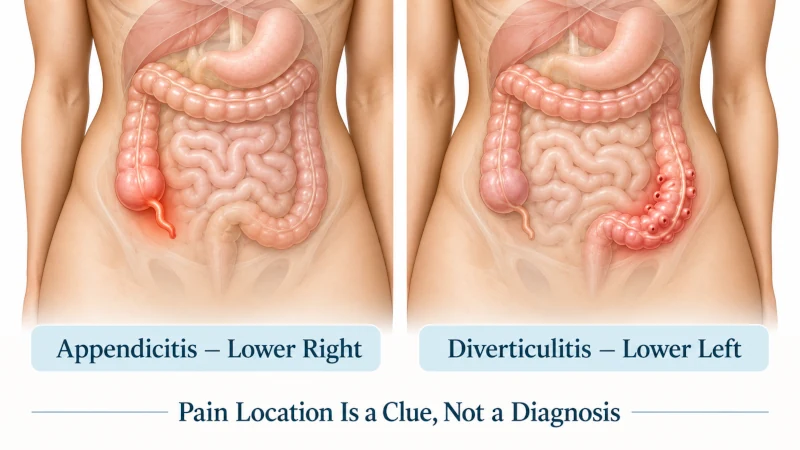
Diverticula are small pouches in the colon wall. When one becomes inflamed, the result is diverticulitis. It can cause abdominal pain (most often in the lower left), constipation or diarrhea, fevers and chills, and nausea or vomiting. The pain often comes on suddenly and is severe, though it can also start mild and build over several days [NIDDK—Diverticular Disease, 2021].
Whether constipation actually causes diverticulitis is less settled than many articles suggest. Cleveland Clinic describes diverticulitis as a possible complication when stool becomes trapped and infected in one of the pouches [Cleveland Clinic—Constipation, 2023]. NIDDK says doctors aren’t sure what causes diverticular disease; it lists low-fiber diets high in red meat, inactivity, obesity, smoking, and NSAID or steroid use as possible risk factors, and treats stool getting caught in a pouch as one idea still being studied [NIDDK—Diverticular Disease, 2021]. Either way, constipation plus fever plus lower-left belly pain is a combination to have checked promptly.
Appendicitis
Appendicitis is a medical emergency. The pain typically begins near the belly button and moves lower and to the right, worsens with movement, coughing, or deep breaths, and gets worse over hours. Fever, nausea or vomiting, loss of appetite, constipation or diarrhea, and an inability to pass gas can come with it. One possible cause is hardened stool blocking the opening of the appendix [NIDDK—Appendicitis, 2021]. Children may not show the typical pattern at all [NIDDK—Appendicitis, 2021], so a child with belly pain and a fever needs a prompt exam.
Anal abscess (and why a fissure is different)
Straining and hard stool can cause hemorrhoids and anal fissures, which are small tears in the lining of the anus [Cleveland Clinic—Constipation, 2023]. A fissure is a tear, not an infection, and doesn’t cause fever by itself. An anorectal abscess is different: a pocket of pus that forms when an anal gland gets clogged with bacteria or stool. Cedars-Sinai lists a fissure that won’t heal — for example, one caused by constipation — among the risk factors, and fever, constipation, painful bowel movements, and a painful, swollen lump near the anus among the symptoms. An abscess usually needs to be drained; antibiotics alone often aren’t enough [Cedars-Sinai].
For everyday hemorrhoid and fissure discomfort without a fever, our guide to herbs and home care for the rectum and anus covers what helps and what doesn’t.
Bowel obstruction
A blockage stops stool and gas from moving through. MedlinePlus advises that if constipation comes on suddenly with abdominal cramps and you can’t pass gas or stool, you should not take laxatives and should call your provider right away [MedlinePlus—Fecal Impaction, 2025]. Inability to pass gas, vomiting, and constant abdominal pain all appear on NIDDK’s see-a-doctor-now list [NIDDK—Constipation, 2018].
At a glance
| Condition | Clues alongside fever | How fast to act |
| Viral or other illness (constipation as a side effect) | Fever came first; general aches, low appetite, little fluid intake | Call your doctor today [NIDDK—Constipation, 2018] |
| Stercoral colitis (from impaction) | Long stretch of severe constipation, then lower-left pain, tenderness, bleeding | Same-day care [Cleveland Clinic—Stercoral Colitis, 2025] |
| Diverticulitis | Sudden lower-left pain, chills, nausea, constipation or diarrhea | Prompt evaluation [NIDDK—Diverticular Disease, 2021] |
| Appendicitis | Pain starting at navel, moving to lower right, worse with movement | Emergency room [NIDDK—Appendicitis, 2021] |
| Anorectal abscess | Constant pain and a swollen, tender lump near the anus | See a doctor promptly [Cedars-Sinai] |
| Bowel obstruction | Can’t pass gas or stool, cramps, swollen belly, vomiting | Call right away; no laxatives [MedlinePlus—Fecal Impaction, 2025] |
Constipation and fever in children

Children most often become constipated by holding in stool — during potty training, to avoid a public bathroom, or because a bowel movement hurt last time — and that can lead to impaction [NIDDK—Constipation in Children, 2018]. A few points are specific to kids:
- Constipation makes bladder infections more likely in children [NIDDK—Bladder Infection in Children, 2025]. A fever with painful, burning, or frequent urination is a reason to call the doctor right away [Johns Hopkins Medicine—Fever, 2024].
- Appendicitis in children may not look typical [NIDDK—Appendicitis, 2021]. Belly pain plus a fever deserves a prompt exam.
- Call right away for any fever in a baby younger than 3 months [Johns Hopkins Medicine—Fever, 2024].
- Take a constipated child to a doctor right away for rectal bleeding, blood in the stool, bloating, constant belly pain, vomiting, or weight loss. Book a visit if constipation lasts more than 2 weeks or doesn’t improve with home care [NIDDK—Constipation in Children, 2018].
Older adults and people with limited mobility
Fecal impaction is most common in older adults, children, people with limited mobility, and people with conditions such as dementia or Parkinson’s disease [Cleveland Clinic—Fecal Impaction, 2022; Johns Hopkins Medicine—Constipation]. Cleveland Clinic estimates that nearly half of older adults living in nursing homes have it, and opioids, some antipsychotics, and calcium channel blockers raise the risk [Cleveland Clinic—Fecal Impaction, 2022]. Symptoms can be easy to miss: loss of appetite, tiredness, new confusion, or watery stool leaking around a blockage [Cleveland Clinic—Fecal Impaction, 2022]. If you care for someone in this group, a fever on top of a stretch of constipation is a reason to call their clinician rather than wait it out.
What to do if you have constipation and a fever
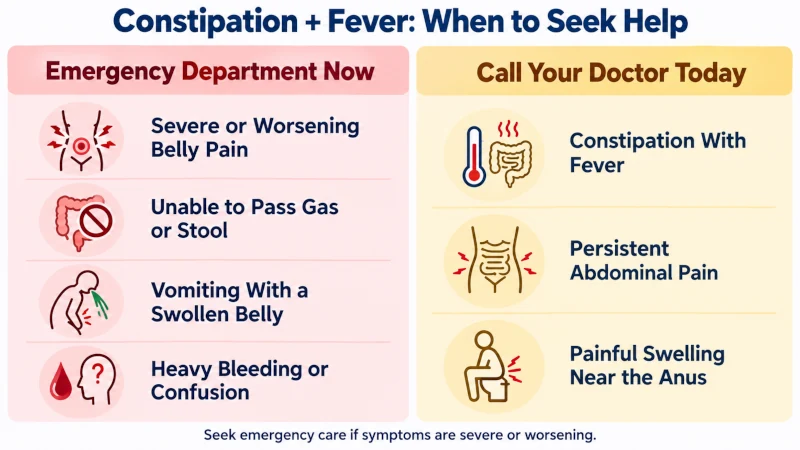
Go to the emergency department now if…
- pain starts near your belly button and moves to the lower right, or belly pain is severe and getting worse [NIDDK—Appendicitis, 2021]
- you can’t pass gas or stool, especially with cramps, a swollen belly, or vomiting [NIDDK—Constipation, 2018; MedlinePlus—Fecal Impaction, 2025]
- there’s heavy rectal bleeding, or fever and bleeding follow a long bout of severe constipation [Cleveland Clinic—Stercoral Colitis, 2025]
- you (or the person you’re caring for) become confused, very drowsy, or have trouble breathing with a fever [Johns Hopkins Medicine—Fever, 2024; Cleveland Clinic—Fecal Impaction, 2022]
Call your doctor today if…
- you have constipation with any fever, constant abdominal pain, lower back pain, or blood in the stool [NIDDK—Constipation, 2018]
- you have a painful, swollen lump near the anus [Cedars-Sinai]
- a child has a fever with urinary symptoms, or a baby under 3 months has any fever [Johns Hopkins Medicine—Fever, 2024]
While you wait to be seen
Drink fluids; fever increases the risk of dehydration, and MedlinePlus recommends drinking enough to prevent it [MedlinePlus—Fever, 2025]. Acetaminophen or ibuprofen can bring a high fever down and make you more comfortable, in doses your provider advises. Children with a fever should not be given aspirin [MedlinePlus—Fever, 2025; Johns Hopkins Medicine—Fever, 2024]. Lowering the number doesn’t treat the cause, so it isn’t a reason to skip being checked.
If constipation came on suddenly with cramps and you can’t pass gas or stool, don’t take a laxative — call instead [MedlinePlus—Fecal Impaction, 2025]. Jot down when the constipation started, your highest temperature, and every medicine and supplement you take. Opioid pain medicines, iron supplements, antacids containing aluminum or calcium, some antidepressants, and some blood pressure drugs can all cause constipation [NIDDK—Constipation, 2018], and that list will help whoever examines you.
Keeping constipation from becoming a problem
Most constipation responds to the basics: plenty of fiber from vegetables, fruits, beans, and whole grains; enough fluids; regular activity; and not ignoring the urge to go [Mayo Clinic, 2025]. Our guide to foods that help with constipation ranks options by the strength of the evidence, and psyllium is the fiber supplement with the most support, as long as you take it with plenty of water. Warm drinks help some people too; our look at the best teas for constipation explains which ones (such as senna) are meant for short-term use only.
See a doctor if constipation lasts longer than three weeks, gets in the way of daily life, or comes with bleeding, black stools, ongoing belly pain, or weight loss you can’t explain [Mayo Clinic, 2025]. Cleveland Clinic advises calling your provider before using laxatives for more than two weeks [Cleveland Clinic—Constipation, 2023]. If constipation keeps returning or alternates with diarrhea, ask about irritable bowel syndrome, a common cause [NIDDK—Constipation, 2018]; our guide to IBS foods to avoid is a sensible next read.
| HEALTH DISCLAIMER: This article is for general education and is not a substitute for diagnosis or treatment by a qualified healthcare professional. Constipation with a fever can signal an infection or a complication that needs prompt care. Contact a clinician right away if you have a fever with constipation, and go to an emergency department for severe or worsening abdominal pain, inability to pass gas or stool, vomiting, heavy bleeding, or confusion. Talk with your doctor or pharmacist before using laxatives, enemas, or supplements — especially if you are pregnant or breastfeeding, caring for a child or an older adult, managing a chronic condition, or taking prescription medicine. |
Frequently Asked Questions
Can constipation cause a low-grade fever?
Not typically. Most clinicians consider 100.4°F (38°C) or higher a fever [Johns Hopkins Medicine—Fever, 2024]. If you’re constipated and running even a mild temperature, an infection or another illness is the more likely explanation for both, and NIDDK still advises seeing a doctor right away when constipation comes with fever [NIDDK—Constipation, 2018].
Can constipation cause fever and chills?
Chills with a fever point toward infection or inflammation. With constipation, diverticulitis is one possibility; NIDDK lists fevers and chills among its symptoms, along with lower-left abdominal pain [NIDDK—Diverticular Disease, 2021]. Get checked promptly.
Can constipation cause a fever in a toddler or child?
Constipation alone isn’t a usual cause, but it does make bladder infections more likely in children [NIDDK—Bladder Infection in Children, 2025], and a constipated child with a fever may simply have another illness. Call the pediatrician, and seek care right away for vomiting, bloating, constant belly pain, or blood in the stool [NIDDK—Constipation in Children, 2018].
Can constipation cause fever and headache?
Headache and constipation are both listed among the signs that can come with a fever [Johns Hopkins Medicine—Fever, 2024], so a viral illness or dehydration can explain all three. Seek immediate care if a fever comes with a stiff neck, confusion, or a purple spotted rash [Johns Hopkins Medicine—Fever, 2024].
Should I take a laxative if I have a fever and constipation?
Check with a clinician first. Don’t take laxatives if constipation came on suddenly with cramps and you can’t pass gas or stool; call your provider right away instead [MedlinePlus—Fecal Impaction, 2025].
How long is too long to go without a bowel movement?
Normal ranges from three times a day to three times a week [Mayo Clinic, 2025]. Make an appointment if symptoms last more than three weeks in adults [Mayo Clinic, 2025] or more than two weeks in children [NIDDK—Constipation in Children, 2018], and seek care right away if fever, vomiting, bleeding, or constant pain appear [NIDDK—Constipation, 2018].
References
- National Institute of Diabetes and Digestive and Kidney Diseases (NIDDK). Symptoms & Causes of Constipation. View source
- NIDDK. Symptoms & Causes of Constipation in Children. View source
- NIDDK. Definition & Facts of Bladder Infection in Children. View source
- NIDDK. Symptoms & Causes of Diverticular Disease. View source
- NIDDK. Symptoms & Causes of Appendicitis. View source
- Mayo Clinic Staff. Constipation — Symptoms and causes. View source
- Cleveland Clinic. Constipation. View source
- Cleveland Clinic. Fecal Impaction. View source
- Cleveland Clinic. Stercoral Colitis. View source
- Johns Hopkins Medicine. Constipation. View source
- Johns Hopkins Medicine. Fever. View source
- MedlinePlus (U.S. National Library of Medicine). View source
- MedlinePlus. Constipation. View source
- MedlinePlus Medical Encyclopedia. Fecal impaction. View source
- Cedars-Sinai. Anorectal Abscess. View source


