
If you’ve searched how to get a flat stomach, you’ve probably been promised a quick fix — a tea, a juice, a seven-second trick. Here’s the honest version. A flatter midsection comes from three separate things: lowering your overall body fat, easing the day-to-day bloating that puffs out your waist, and strengthening the muscles underneath. No single food or exercise melts fat from one spot. What does work is well studied, and most of it is unglamorous. Below is what actually moves the needle, how long it tends to take, and when a stubborn belly is worth a conversation with your doctor.
You can’t spot-reduce belly fat
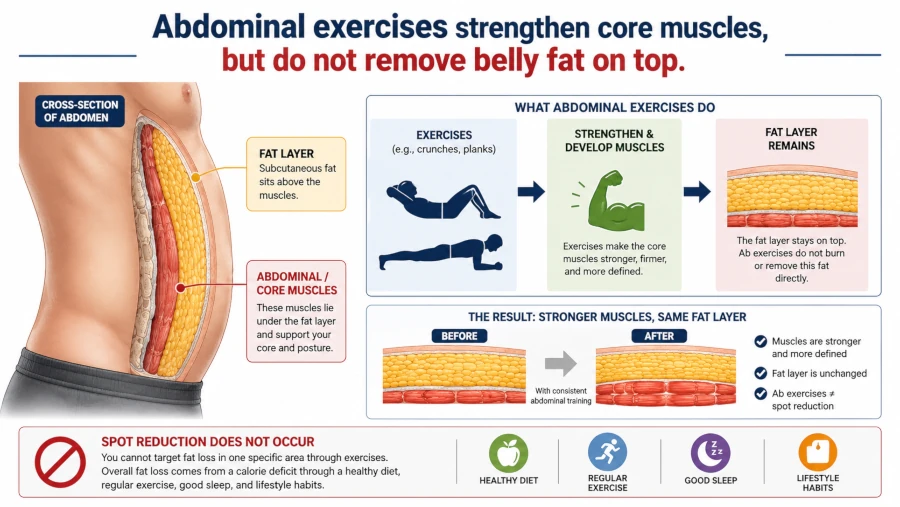
The most repeated myth in this corner of the internet is that crunches burn the fat sitting on your stomach. They don’t. In a controlled trial, 24 sedentary adults did seven abdominal exercises five days a week for six weeks. Their core endurance improved, but there was no change in body fat, abdominal fat, or waist size compared with people who did nothing [Vispute et al., 2011]. Ab work builds the muscle; it does not remove the layer on top of it.
Harvard Health puts it plainly: sit-ups won’t shrink your belly. To lose fat you have to burn more calories than you take in and combine aerobic exercise with strength training [Harvard Health, 2024]. Fat loss happens across the whole body. As your total body fat drops, the fat around your middle drops with it — and abdominal fat actually responds to diet and exercise a little more readily than fat on the hips and thighs.
Flat, bloated, and fat are three different things
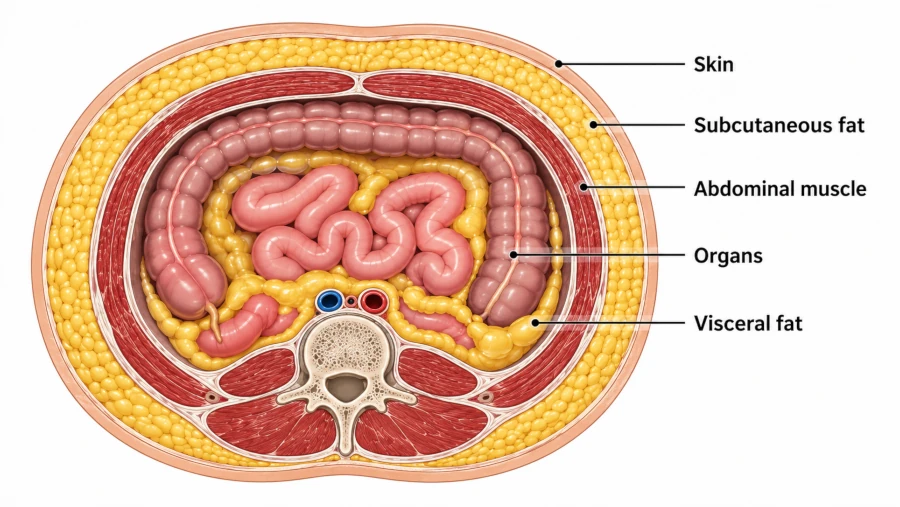
How flat your stomach looks on any given afternoon depends a lot on what’s inside it — food, gas, and fluid. Bloating and water retention can change your waist within hours and have nothing to do with fat. That’s why a “debloating” tea can seem to work overnight and why the effect never lasts.
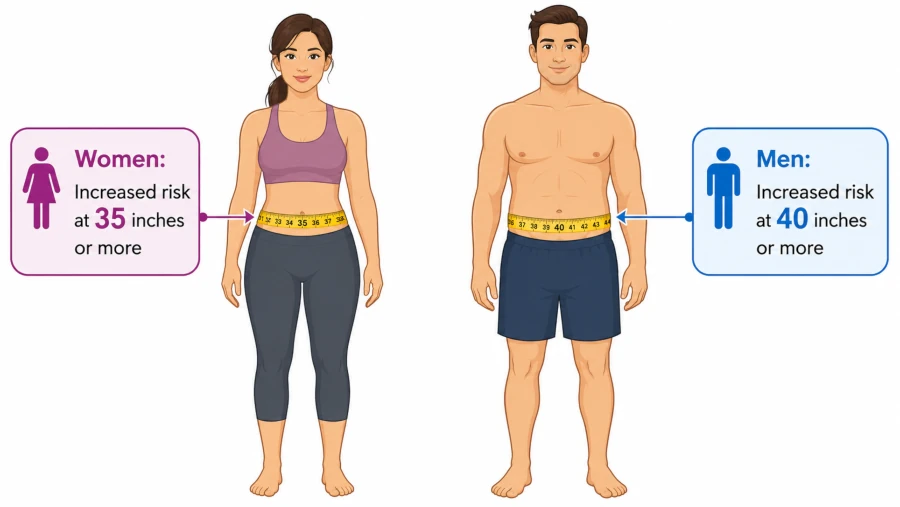
The fat itself comes in two kinds. Subcutaneous fat sits just under the skin. Visceral fat sits deeper, wrapped around your organs, and it’s the more metabolically active and riskier of the two [Cleveland Clinic, 2025]. This is where “flat stomach” quietly becomes a health question, not just a cosmetic one. A waist over 35 inches in women or 40 inches in men is linked to higher rates of heart disease and type 2 diabetes, even when body weight looks normal [Harvard T.H. Chan, 2025].
One more reality: anatomy and genetics set part of your shape. Some people store fat centrally no matter how lean they get, and pregnancy and menopause both shift fat toward the abdomen. You can change your body fat. You can’t fully change where your body prefers to keep it.
Eat in a way that lowers body fat
Diet is where most of the change happens. The single lever that drives fat loss is a modest, steady calorie deficit — eating a bit less than you burn, consistently. The U.S. Centers for Disease Control and Prevention recommends aiming for about 1 to 2 pounds a week, because people who lose weight gradually are far more likely to keep it off than people who crash [CDC, 2025]. Faster loss tends to come back, and it often takes muscle with it.
Fiber, especially the soluble kind
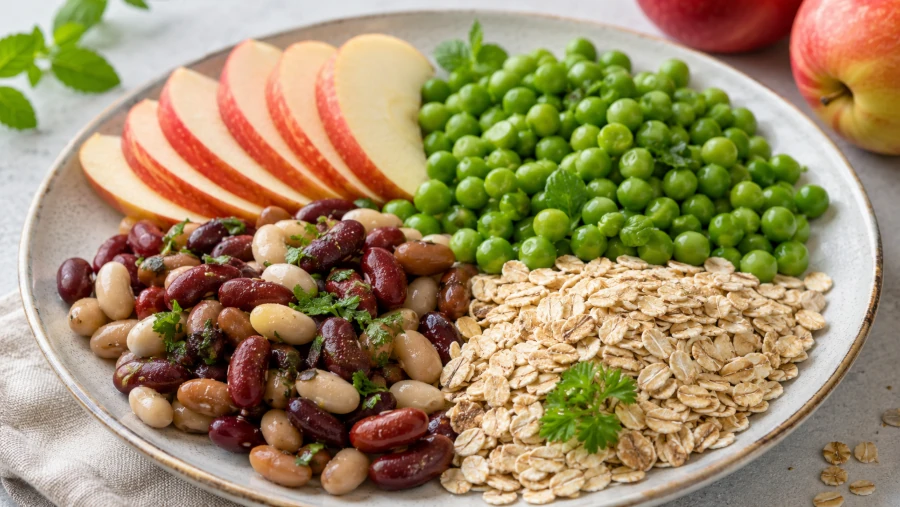
Fiber earns its reputation. In a five-year study of adults, each extra 10 grams of soluble fiber per day was tied to a 3.7% slower rate of visceral fat gain, and the effect grew when people also added activity [Hairston et al., 2012]. Ten grams is roughly two apples, a cup of green peas, and half a cup of beans. Fiber also fills you up and lowers the calorie density of meals, so you eat less without trying as hard [Review, 2025]. Good sources include lentils and other legumes, oats, fiber-rich whole grains such as barley, vegetables, and fruit.
Protein at each meal
Protein blunts hunger and helps protect muscle while you’re in a deficit, which matters because losing muscle slows your metabolism [Review, 2025]. Build meals around a protein source — eggs, fish, poultry, dairy, tofu, or beans — rather than treating it as a side.
Cut the easy wins
- Added sugar and sugary drinks add calories without fullness and are tied to more belly fat. Water, unsweetened coffee, or tea are simple swaps.
- Alcohol is calorie-dense and linked to central fat storage. Cutting back is one of the more reliable ways to trim the waistline.
- Whole, minimally processed foods make the rest easier, because they’re more filling per calorie.
If you want a starting grocery list, our guide to foods that support a healthy metabolism lines up well with everything above.
Move in ways that burn fat and build the core
The combination that reduces fat and waist size is aerobic exercise plus strength training [Harvard Health, 2024]. Federal guidelines put the target at 150 to 300 minutes of moderate aerobic activity a week, plus muscle-strengthening work on two or more days [ODPHP, 2018]. That’s a brisk 30-minute walk most days, plus two short strength sessions — not hours in a gym.
For cardio, pick what you’ll keep doing: walking, jogging, cycling, swimming, or interval training. High-intensity intervals are time-efficient, but they aren’t magic, and consistency beats intensity if the intensity is what makes you quit. Strength training does double duty — it builds muscle that supports fat loss and shapes the body underneath.
Core work, used correctly
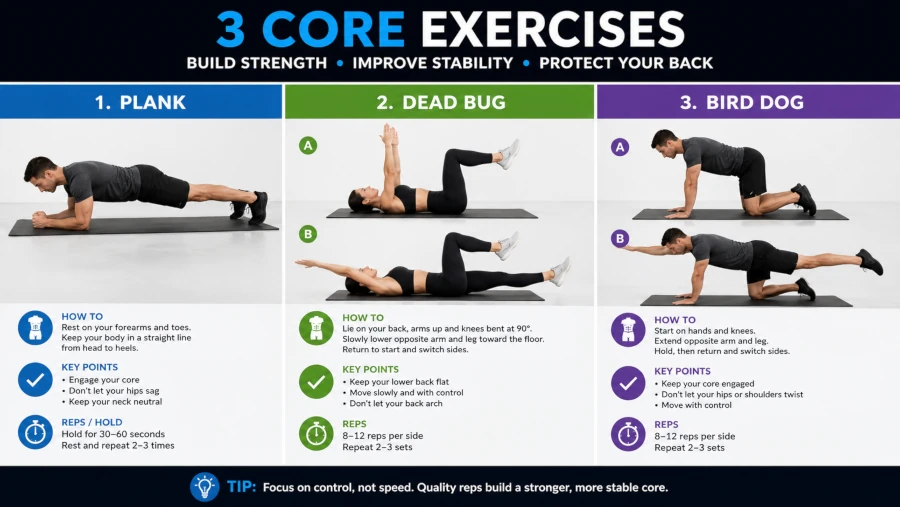
Core exercises won’t burn belly fat [Vispute et al., 2011], but they build the strength, posture, and definition you’ll actually see once your body fat is lower. A short, sensible routine two or three times a week is plenty:
- Plank — hold a straight line from head to heels for 20 to 40 seconds, building up over time. Stop when your form breaks; longer is not better.
- Dead bug — on your back, lower opposite arm and leg slowly while keeping your lower back pressed down. Gentle on the spine and very effective.
- Bird dog — on hands and knees, extend opposite arm and leg, pause, and switch. Trains the deep stabilizing muscles.
- Bicycle or reverse crunches — fine to include for the abdominal muscles, with a controlled pace and no yanking on your neck.
Sleep and stress quietly shape your waistline
Short sleep and chronic stress both push appetite up and are linked to more fat around the middle. The CDC frames good sleep and stress management as part of the same package as nutrition and activity, not optional extras [CDC, 2025]. Most adults do best on 7 to 9 hours, and even a few minutes a day of breathing exercises, a walk, or anything that genuinely relaxes you can take the edge off stress-driven eating.
Reduce bloating for a flatter look now
If your stomach looks distended after meals, some of that is bloating you can ease quickly — just understand you’re changing appearance, not losing fat. Excess sodium pulls in water and puffs out the midsection, so go easy on heavily salted and packaged foods. Carbonated drinks and eating fast (which means swallowing air) both add gas. For some people, specific foods trigger bloating; paying attention to your own pattern beats following a generic “anti-bloat” list. Our roundup of foods that ease digestion is a reasonable place to start.
Realistic expectations and timeline
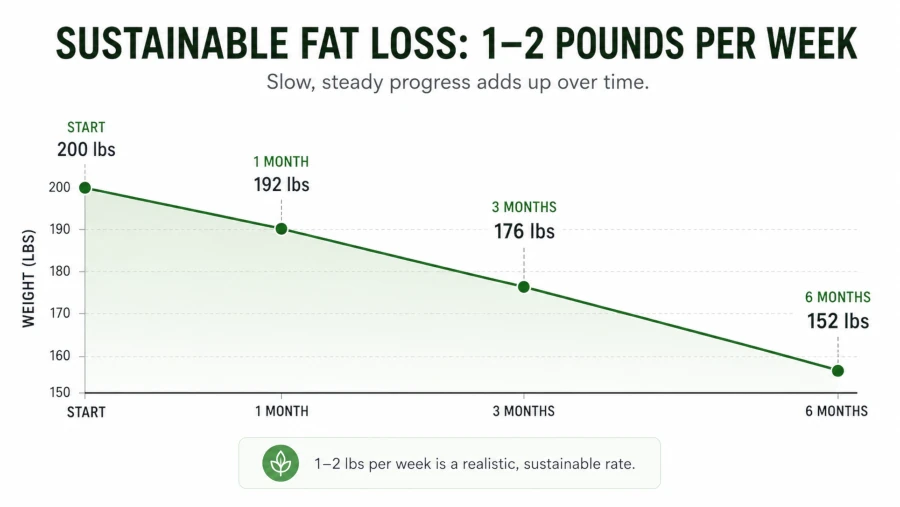
Think weeks to months, not days. At a sustainable 1 to 2 pounds a week [CDC, 2025], a noticeably flatter stomach is a realistic goal for most people who stay consistent. A visible six-pack is a different and much stricter target — it requires a body-fat level that is low, hard to maintain, and not appropriate or healthy for everyone, particularly women, who carry more essential fat for normal hormonal function.
A note on perspective: if chasing a flat stomach starts to mean skipping meals, cutting out whole food groups, or feeling distress about your body, that’s a signal to pause. A registered dietitian or your doctor can help you set goals that are about health rather than a number in the mirror.
Who should be cautious, and when to see a doctor
Some people should check in with a clinician before making big changes:
- Pregnant or recently postpartum — get clearance before core work, since the abdominal muscles may have separated (diastasis recti).
- Anyone with a history of disordered eating, where deliberate calorie restriction can be risky.
- People with diabetes, thyroid, heart, or digestive conditions, or who take medication that affects weight or metabolism. Hormonal shifts around menopause also change where fat settles — see our notes on women’s health and key nutrients.
Treat these as red flags that call for medical care rather than a diet:
- Belly swelling that doesn’t change with diet or exercise, or that comes on rapidly.
- Unintended weight loss, persistent abdominal pain, fever, vomiting, a change in bowel habits, or blood in the stool.
Abdominal swelling can come from fluid buildup, digestive conditions, or other issues that have nothing to do with body fat, and those need a proper evaluation. Self-care also isn’t enough when symptoms persist or worsen, or when worry about your stomach starts to affect your eating or your mood.
| Health Disclaimer This article is for general education only and is not medical advice, diagnosis, or treatment. It is not a substitute for care from a qualified clinician. The information here does not claim to cure, prevent, or treat any disease. Before making major changes to your diet or exercise routine — especially if you are pregnant or postpartum, have a history of disordered eating, live with diabetes, thyroid, heart, or digestive conditions, or take prescription medication — talk with your doctor or a registered dietitian. If you have sudden abdominal swelling, severe or persistent pain, unintended weight loss, or other symptoms described above, seek medical care rather than relying on diet or exercise. |
Frequently asked questions
How long does it take to get a flatter stomach?
Usually weeks to months, not days. A sustainable pace is about 1 to 2 pounds of weight loss a week [CDC, 2025]. Bloating can improve within a day or two, but actual fat loss is gradual.
Do crunches and planks burn belly fat?
No. A controlled trial found six weeks of abdominal exercise improved core endurance but did not reduce abdominal fat or waist size [Vispute et al., 2011]. These moves build muscle; fat loss comes from overall calorie balance plus cardio and strength work.
What foods help reduce belly fat?
There’s no single fat-burning food. Diets higher in fiber and protein and lower in added sugar and alcohol support fat loss and fullness; in one study each extra 10 grams of soluble fiber a day was tied to slower visceral fat gain [Hairston et al., 2012].
Can I get a flat stomach without losing weight?
Sometimes. If the issue is bloating, posture, or a weak core, those can improve without much weight change. If the cause is excess fat, some fat loss is needed — and that means whole-body, not spot, reduction [Harvard Health, 2024].
Why does belly fat matter for health?
Visceral fat deep in the abdomen is metabolically active and tied to higher disease risk. A waist over 35 inches in women or 40 inches in men is linked to greater risk of heart disease and type 2 diabetes [Harvard T.H. Chan, 2025].
Do “7-second” juices, teas, or detox tricks work?
No. At best they reduce bloating temporarily by acting as mild diuretics or laxatives, which isn’t fat loss. Be skeptical of any product promising rapid, effortless belly-fat loss.
References
- Centers for Disease Control and Prevention. “Steps for Losing Weight.” Healthy Weight and Growth (2025). → View source
- U.S. Department of Health and Human Services / ODPHP. “Physical Activity Guidelines for Americans, 2nd edition — Top 10 Things to Know” (2018). → View source
- Harvard Health Publishing. “Should you worry about your waistline?” Harvard Medical School. → View source
- Harvard T.H. Chan School of Public Health. “Abdominal Obesity” (Obesity Prevention Source). → View source
- Cleveland Clinic. “Visceral Fat: What It Is and How It Affects You” (2025). → View source
- Vispute SS, Smith JD, LeCheminant JD, Hurley KS. “The effect of abdominal exercise on abdominal fat.” J Strength Cond Res. 2011;25(9):2559–2564. doi:10.1519/JSC.0b013e3181fb4a46. → View source
- Hairston KG, et al. Lifestyle factors and 5-year change in abdominal fat (soluble fiber and visceral fat). Obesity (Silver Spring), 2012. → View source
- “Protein, fiber, and exercise: a narrative review of their roles in weight management and cardiometabolic health” (2025). → View source
