
A wedge pillow is a firm, triangle-shaped cushion that raises your head and upper body while you sleep, and the main reason people buy one is to keep stomach acid down at night. That single use — easing nighttime acid reflux — is also the benefit with the most research behind it. The other claims you see advertised, from quieter snoring to less back pain, run from modestly supported to mostly anecdotal. This guide separates the strong evidence from the weak, explains what angle and material to look for, and flags who should check with a doctor first.
What a wedge pillow actually does
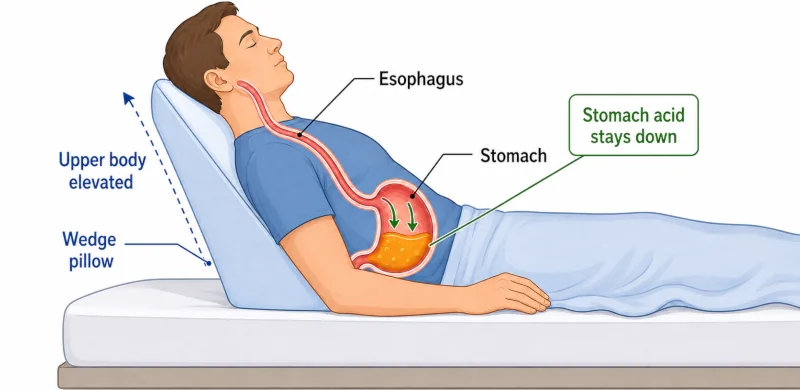
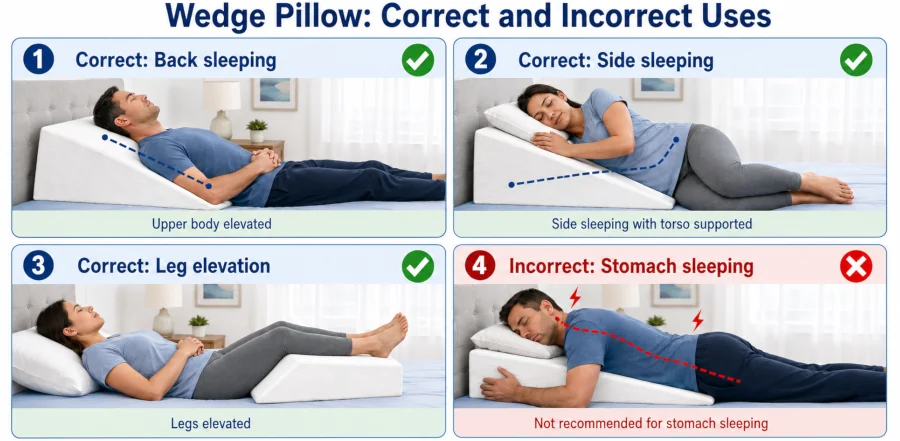
A wedge sits on top of your mattress and props your torso on a gentle slope. Most are described by height: a 6- to 8-inch wedge gives a mild lift, while a 10- to 12-inch wedge is noticeably steeper. Unlike stacking ordinary pillows — which mainly bends your neck — a wedge supports the whole upper body so the incline starts down at your hips.
Gravity does the rest. When your chest sits above your stomach, it is harder for stomach contents to travel back up the esophagus. That is the entire mechanism. It is simple, drug-free, and reusable, which is a lot of the appeal [Cleveland Clinic, 2023]. It also explains why the real benefits cluster around problems that get worse when you lie flat.
Kölbs Bed Wedge Pillow is available in 7.5-inch and 12-inch versions. Match the height to the gentle-versus-steeper incline described rather than choosing the tallest option automatically.
What the evidence shows, strongest first
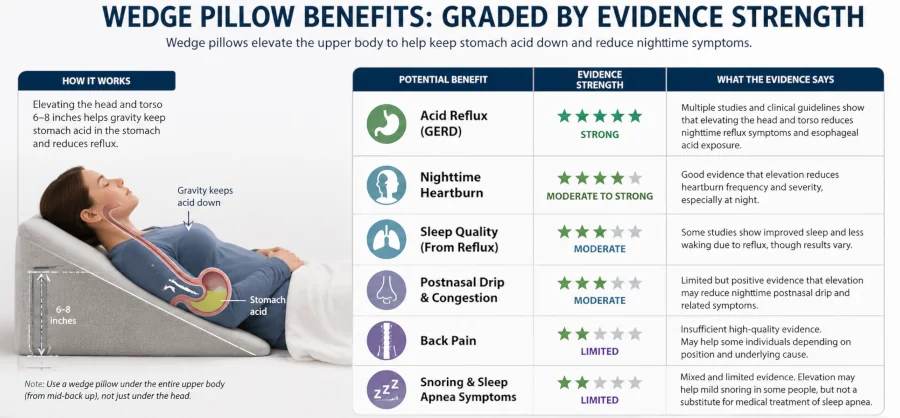
Acid reflux and GERD
This is the strongest case. Both the American College of Gastroenterology and the American Gastroenterological Association include elevating the head of the bed in their guidance for gastroesophageal reflux disease (GERD) — though the ACG rates it a conditional suggestion based on low-quality evidence [ACG, 2022]; [AGA]. In plain terms: it is reasonable to try, but the supporting studies are small.
The studies that exist are encouraging for nighttime symptoms specifically. A 1988 study found that sleeping on a wedge reduced how long the esophagus was exposed to refluxed acid [Hamilton, 1988].
A 2022 systematic review reached a more careful conclusion: in a crossover trial, people with reflux esophagitis who slept on a foam wedge had significantly less acid-exposure time than when they slept flat — but the wedge did not reduce the number of reflux episodes or speed up acid clearance, and raising the whole bed on 20-cm blocks did not show the same effect [Schuitenmaker, 2022]. So a wedge seems to limit how long acid sits against the esophagus, which is the part that drives irritation, even if it does not stop reflux from happening.
Position matters as much as elevation. In a study of 57 people, sleeping on the left side produced the shortest acid-exposure time and the fastest acid clearance — a median 35 seconds versus 76 seconds on the back [Schuitenmaker, AJG 2022]. A wedge that lets you rest slightly turned to your left, rather than flat on your back, may give you both effects at once.
What a wedge will not do: replace medication for significant GERD, heal damage that has already happened, or help with daytime reflux. Treat it as one lifestyle step among several — others include losing excess weight, not eating within two to three hours of bed, and avoiding your personal trigger foods [Mayo Clinic, 2025].
Snoring and sleep apnea
The evidence here is thinner and more specific. Raising the head and trunk can widen the upper airway, and a 2022 study of 45 people with obstructive sleep apnea found that a 30-degree incline lowered the average apnea-hypopnea index (a count of breathing interruptions per hour) from 23.8 to 17.7 [Iannella, 2022]. That is a meaningful drop, but it does not bring moderate apnea into the normal range, and the benefit was clearest for people whose apnea is worse on their back — so-called positional apnea.
Two cautions. A wedge is not a treatment for diagnosed sleep apnea and is no substitute for CPAP or a doctor’s care; untreated apnea raises the risk of high blood pressure and heart problems. And loud, chronic snoring, or gasping and choking during sleep, should be evaluated rather than simply propped up. For ordinary mild snoring without apnea, a gentle incline is a low-risk thing to try.
Back, neck, and recovery after surgery
Direct research on wedge pillows for back or neck pain is limited, so it is worth being honest: most of the benefit here is about comfort and positioning, not proven pain relief. Some people feel better sleeping slightly inclined, or with a wedge under the knees to take load off the lower back.
If your discomfort is muscular, it may also be worth looking at other natural approaches to muscle tension and cramps. After certain operations — shoulder, some abdominal or sinus procedures — surgeons often advise sleeping propped up to reduce strain and swelling and make getting in and out of bed easier. If you are recovering from surgery, follow your surgeon’s specific instructions rather than a general guide.
SJEUQOP 3-piece adjustable bed wedge pillow can be arranged in 4.5-, 7.5-, and 12-inch configurations. A changeable setup may be useful when comfort needs vary, but post-surgery positioning should still follow your surgeon’s instructions.
Circulation and leg swelling
Flipped the other way, a wedge can raise the legs instead of the torso. Elevating the legs above heart level uses gravity to help blood and fluid drain from the lower legs, which can ease the heavy, swollen feeling that builds up by evening. It is a standard comfort measure for mild swelling. It is not a treatment for blood clots, heart disease, or kidney disease — sudden swelling in one leg, especially with pain or redness, needs prompt medical attention, not a pillow.
Memory Foam Leg Elevation Pillow has a dedicated leg-rest shape and a removable, washable cover. Use a product like this only as a comfort aid for mild swelling, not as a substitute for medical evaluation.
How to choose one
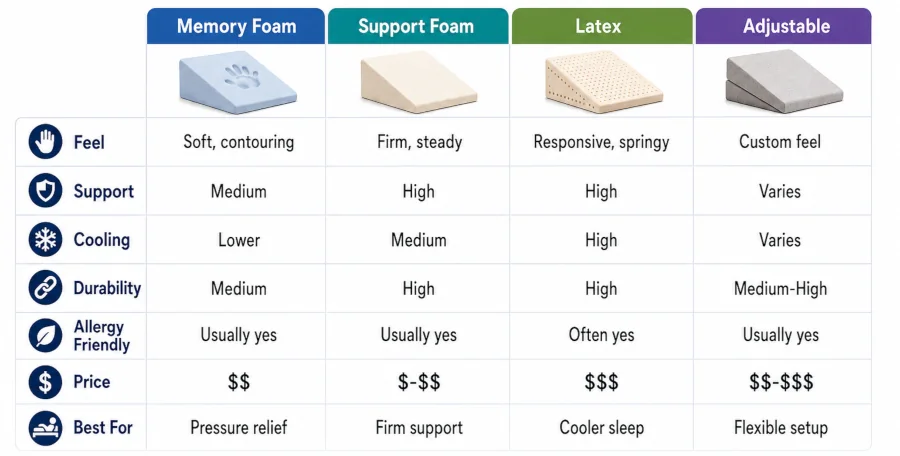
Four things actually matter: angle, height, material, and size. The marketing extras can wait until those fit [Sleep Foundation, 2026].
Material at a glance
| Material | Feel | Holds its shape | Runs hot? | Notes |
| Memory foam | Soft, molds to you | Softens overnight | Tends to | Common, affordable; want a firm base layer |
| Support-foam base | Firm | Holds well | Neutral | Often paired with a memory-foam top |
| Latex | Firm, springy | Holds very well | Cooler | Durable, pricier; avoid if latex-allergic |
| Adjustable / inflatable | Variable | Depends on setting | Cool | Lets you fine-tune the angle |
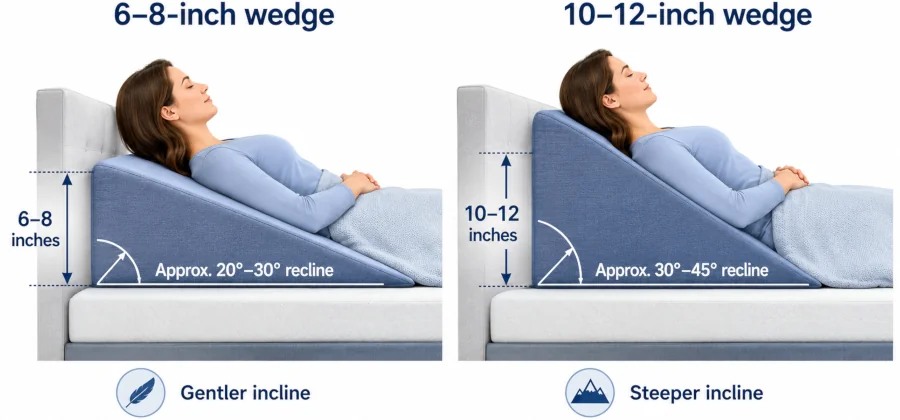
Angle and height. For mild nighttime reflux or simple comfort, a gentle 6- to 8-inch wedge — roughly the elevation used in reflux studies — is usually enough. Steeper 10- to 12-inch wedges give more lift for stronger reflux or post-surgery support, but they can feel like sleeping in a recliner and may bother your lower back if your hips stay flat. If you are unsure, start lower; you cannot easily soften a too-steep wedge. An adjustable model is worth the premium if you want to experiment.
Size. Make sure it is wide and long enough to support your whole torso, not just your head, or you will slide off it or fold at the neck. Side sleepers usually want a wider model. Practical extras that genuinely help: a removable, washable cover; a core firm enough that the slope does not collapse by 3 a.m.; and, if you sleep hot, a breathable cover or latex rather than dense memory foam.
Cozymaker fitted 7.5-inch wedge pillow cover is sized for a 24 × 24 × 7.5-inch wedge. Check the measurements of your pillow first: this is a cover only, not the foam wedge itself.
Getting the most from it
- Give it one to two weeks. Sleeping on an incline feels strange at first, and many people quit before they adjust.
- Don’t sleep face-down on it. A wedge suits back and side sleepers; stomach sleeping on an incline strains the neck and lower back.
- Pair elevation with left-side sleeping if reflux is your main reason for using it.
- Keep your usual pillow on top for head and neck support — the wedge supplies the slope, the pillow the cushioning.
- Wash the cover regularly. Foam can trap dust and allergens over time.
Who should be cautious
During pregnancy, especially the third trimester. This one needs care. A back-elevating wedge keeps you semi-reclined on your back — but from about 28 weeks of pregnancy, going to sleep on your back is linked to a higher risk of stillbirth. A meta-analysis found roughly 2.6 times the odds compared with going to sleep on the left side [Pregnancy sleep review, 2024]. Side sleeping is advised in late pregnancy. If pregnancy heartburn is the problem, talk to your provider; a full-length body or pregnancy pillow that keeps you on your side is usually a better fit than a back wedge.
Momcozy U-shaped full-body maternity pillow is a U-shaped full-body pillow with a removable cover. It is included here as a side-sleeping support option, not as a treatment for pregnancy heartburn.
- Stomach sleepers will likely find a wedge makes neck and back discomfort worse.
- People with certain spine, neck, or shoulder conditions. A fixed angle does not suit everyone — check with a physical therapist or doctor.
- Anyone with diagnosed sleep apnea. Use a wedge only alongside, never instead of, prescribed treatment.
- Babies and infants. Never use a wedge or any inclined product in a crib. Safety regulators have linked inclined infant sleep products to deaths; babies should sleep flat on their backs.
When to see a doctor
A wedge pillow manages symptoms; it does not diagnose anything. See a healthcare professional if heartburn happens more than twice a week, over-the-counter remedies stop working, or you have trouble or pain swallowing, persistent nausea or vomiting, or unexplained weight loss — these can point to something that needs proper evaluation [Mayo Clinic, 2025]. Get emergency help for severe chest pain or pressure, particularly with pain spreading to the arm or jaw or with shortness of breath, since that can be a heart attack rather than heartburn [Mayo Clinic, 2025]. Loud chronic snoring, gasping, or daytime exhaustion deserves a sleep evaluation.
| Health Disclaimer This article is for general education only and is not a substitute for professional medical advice, diagnosis, or treatment. A wedge pillow is a comfort and lifestyle aid, not a medical device or a cure for any condition. Always talk with a qualified healthcare provider about acid reflux, snoring, sleep apnea, pregnancy, post-surgery care, or any persistent symptom before changing how you manage it. If you think you may be having a medical emergency, such as severe chest pain or trouble breathing, call your local emergency number right away. |
Frequently asked questions
Is it safe to sleep on a wedge pillow every night?
For most back and side sleepers, yes. The main adjustment is comfort, not safety. Give your body a week or two to get used to the incline, keep the slope supporting your whole torso rather than just your head, and skip it if you are a stomach sleeper or have a neck or spine condition that the angle aggravates.
What angle is best for acid reflux?
A gentle lift in the 6- to 8-inch range matches the elevation used in reflux research and is comfortable for most people. Steeper is not automatically better and can strain the lower back. Combining the incline with left-side sleeping tends to help more than the angle alone.
Can a wedge pillow replace my reflux medication?
No. It is a lifestyle measure that can reduce nighttime symptoms for some people, but it does not heal the esophagus or control reflux the way prescribed treatment can. Do not stop any medication without talking to the prescriber.
Will a wedge pillow stop snoring?
It may quiet mild or position-related snoring by keeping the airway more open. It is not a treatment for obstructive sleep apnea. If you snore loudly every night, gasp in your sleep, or feel exhausted during the day, ask about a sleep evaluation.
Can I use a wedge pillow during pregnancy?
Be cautious. In late pregnancy, going to sleep on your back is discouraged because of a link to higher stillbirth risk, and a back wedge keeps you in that position. For pregnancy heartburn, a side-supporting body pillow is usually a better choice — and it is worth checking with your provider first.
References
- Sleeping posture in pregnancy: clinical review (supine vs left-lateral going-to-sleep position and stillbirth risk). 2024. → View source
- Katz P.O., et al. ACG Clinical Guideline for the Diagnosis and Management of Gastroesophageal Reflux Disease. Am J Gastroenterol. 2022;117(1):27–56. → View source
- American Gastroenterological Association. Management of Gastroesophageal Reflux Disease (GERD): clinical guidance. → View source
- Hamilton J.W., et al. Sleeping on a wedge diminishes exposure of the esophagus to refluxed acid. Dig Dis Sci. 1988;33(5):518–522. → View source
- Schuitenmaker J.M., et al. Systematic review: clinical effectiveness of interventions for the treatment of nocturnal gastroesophageal reflux. Neurogastroenterol Motil. 2022. → View source
- Schuitenmaker J.M., et al. Associations between sleep position and nocturnal gastroesophageal reflux. Am J Gastroenterol. 2022. → View source
- Iannella G., et al. Head-of-bed elevation (HOBE) for improving positional obstructive sleep apnea (POSA): an experimental study. J Clin Med. 2022;11(19):5620. → View source
- Mayo Clinic. Heartburn — symptoms and causes. Accessed 2025. → View source
- Cleveland Clinic. Sleeping with a wedge pillow may help your acid reflux. 2023. → View source
- Sleep Foundation. Best wedge pillows. 2026. → View source
