
The main sorrel health benefits come down to one leafy green doing two jobs at once: it hands you a genuine dose of vitamin C and minerals, and it delivers a sharp, lemony tang. Both come from the same compound — oxalic acid — which is also the reason sorrel needs a few honest cautions.
So the real answer to “is sorrel good for you?” is: yes, in normal food amounts, for most people; and no, not in large or medicinal quantities, especially if you’re prone to kidney stones. This guide covers the health benefits of sorrel that the evidence actually supports, and the ones that rest on tradition alone.
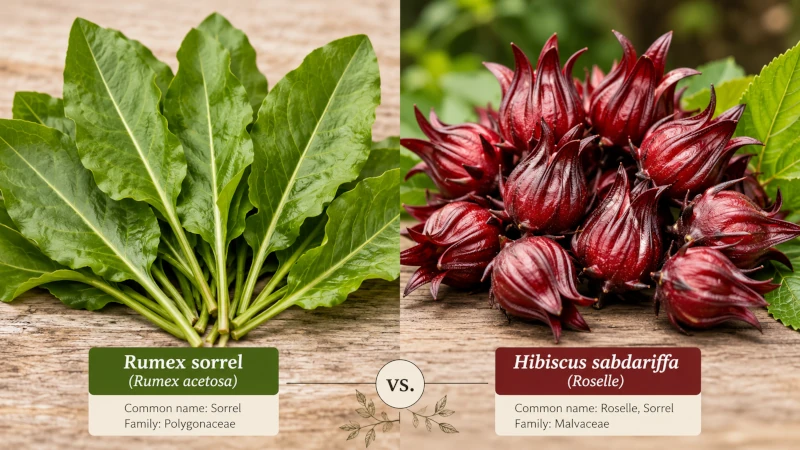
| First, which sorrel? This article is about the leafy green herb Rumex acetosa (garden or common sorrel). In the Caribbean and West Africa, “sorrel” usually means a completely different plant — Hibiscus sabdariffa (roselle), whose red calyces make the tart Christmas drink. They’re unrelated. If you came here for the hibiscus drink, this isn’t the plant you’re looking for. |
What sorrel is
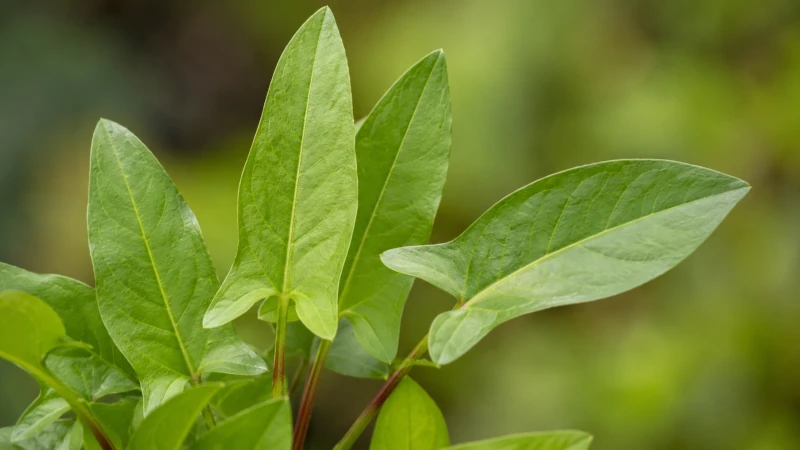
Sorrel is a perennial in the Polygonaceae family — the same botanical family as rhubarb and dock — which is why it shares their tart edge. It grows arrow-shaped leaves on stalks up to roughly 60–70 cm, and its flavor comes from oxalic acid [Aprifel, 2022]. Common sorrel (Rumex acetosa) is the assertive market variety; French sorrel (Rumex scutatus) is milder. Cooks treat the young leaves like a lemony spinach in soups, sauces, and salads.
Sorrel’s nutrition at a glance
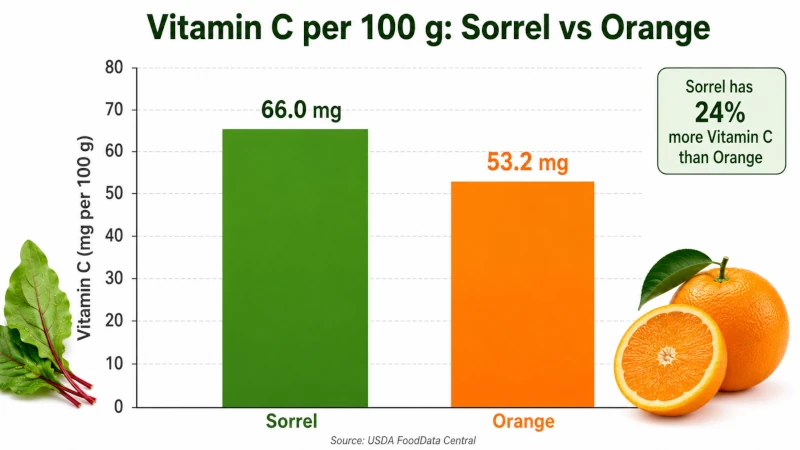
Sorrel is low in calories and surprisingly rich in vitamin C. USDA-based nutrition data put fresh sorrel at about 48 mg of vitamin C per 100 g — comparable to an orange and higher than most everyday leafy greens [Aprifel, 2022]. The leaves also supply vitamin A (as carotenoids), potassium, magnesium and some iron, along with plant polyphenols such as flavonoids and proanthocyanidins [Aprifel, 2022]. One catch worth knowing up front: much of sorrel’s vitamin C is heat-sensitive, so raw or lightly cooked leaves keep more of it than a long-simmered soup [NIH ODS, 2021].
Sorrel health benefits: The evidence
Here’s where each claim actually stands — from well-established to traditional-only.
Vitamin C and scurvy — well established
This is the oldest and best-supported reason sorrel earned its reputation. Sailors and spring foragers ate tart greens like sorrel to stave off scurvy, the disease of vitamin C deficiency. That link is real: vitamin C is needed to build collagen, it helps the body absorb iron from plant foods, and it supports normal immune function; going without it for weeks causes scurvy — fatigue, bleeding gums, poor wound healing [NIH ODS, 2021]. A serving of sorrel is a legitimate contributor here. What the vitamin C in a bowl of sorrel does not do is prevent colds or “boost” immunity beyond meeting your daily needs.
Iron and anemia — real mineral, real caveat
Sorrel contains iron and vitamin C, and vitamin C is known to improve absorption of the non-heme (plant) iron you eat with it — the pairing behind many foods for healthy blood. The catch is sorrel’s own oxalic acid, which binds minerals such as iron and calcium in the gut and reduces how much you take up [Vasas et al., 2015]. So sorrel is a reasonable part of an iron-friendly plate, but it is not a treatment for anemia, and it shouldn’t be your main iron strategy if you’re deficient.
Digestion and the laxative root — traditional
Sorrel has a long folk record as a mild digestive and a gentle laxative. The laxative reputation is most credible for the roots, which — like other docks in the Rumex genus — contain anthraquinone compounds that can stimulate the bowel [Vasas et al., 2015]. This is traditional use supported by plant chemistry, not by clinical trials in people, and it’s not a reason to brew strong sorrel-root preparations at home.
Skin and wound use — traditional, topical
Older herbals applied crushed leaves or fresh juice to skin blemishes and minor sores. There’s essentially no clinical evidence for this, and putting plant juice on broken skin carries an infection risk. Treat it as folklore, not first aid.
Laboratory and animal studies on Rumex acetosa extracts report antioxidant activity, some antiviral action (for example against herpes simplex virus in cell studies), and blood-pressure-lowering effects in animals [Vasas et al., 2015]. These are genuinely interesting leads, but “active in a test tube or a mouse” is a starting point for research — not evidence that eating sorrel treats infections or hypertension in people.
How the claims stack up
| Claim | What the evidence is | Strength |
| Source of vitamin C; helps prevent scurvy | Established nutrition science; sorrel is vitamin-C-rich | Strong |
| Supports iron intake / anemia diet | Contains iron + vitamin C, but oxalate limits absorption | Mixed / limited |
| Eases digestion; mild laxative (root) | Traditional use; anthraquinones in Rumex roots | Traditional |
| Heals acne, skin sores (topical) | Folk use only; no clinical evidence; infection risk | Insufficient |
| Antioxidant / antiviral / lowers blood pressure | Cell-culture and animal studies only | Early-stage |
The oxalic acid problem: sorrel’s real safety limit
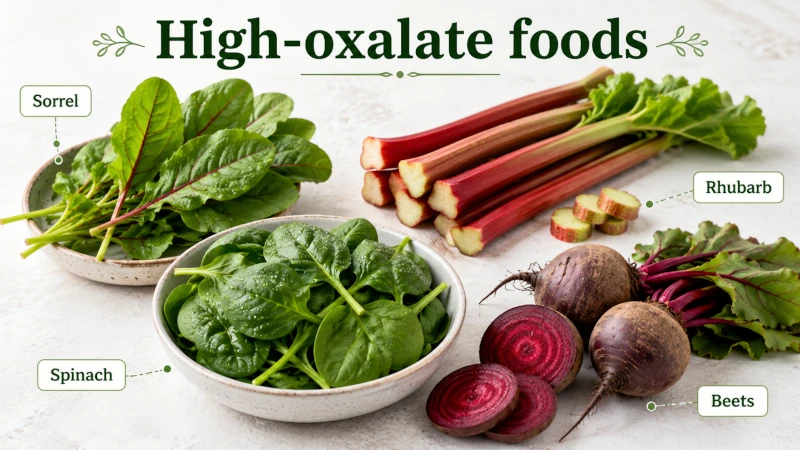
The same acid that makes sorrel taste bright is also its main risk. In the body, oxalate can bind calcium in the urine and crystallize into calcium oxalate — the most common kidney stone. Sorrel belongs firmly in the very-high-oxalate group alongside spinach, rhubarb, and beets [NKF, 2024], which is exactly why it appears on lists of foods that can raise kidney-stone risk.
The nuance matters, though. For most healthy adults, high-oxalate vegetables are nutritious and the risk is small; the guidance to limit them applies most to people who form calcium oxalate stones and have high urinary oxalate [NKF, 2024]. Modern kidney guidance no longer tells everyone to strip oxalates out.
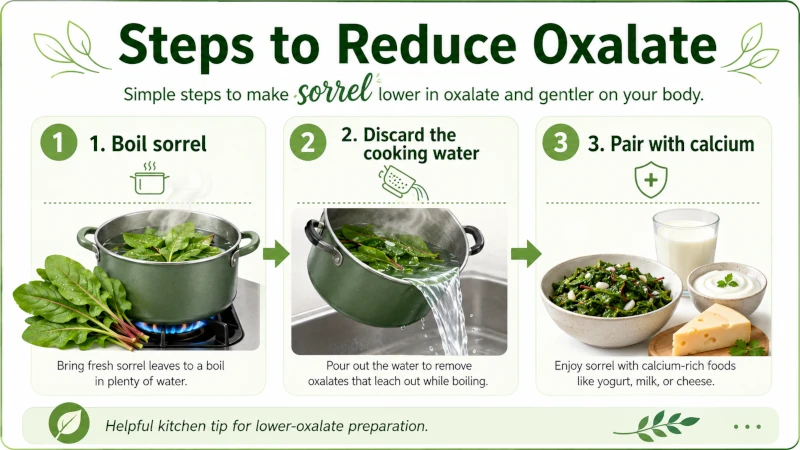
Two practical moves lower the risk without banning the food: drink plenty of fluids, and pair oxalate-rich foods with a calcium source at the same meal, so calcium and oxalate bind in the gut rather than the kidneys [NKF, 2024]. One more point that trips people up: it’s high-dose supplemental vitamin C — not the vitamin C in food — that raises urinary oxalate, so a plate of sorrel is not the same risk as a 1,000 mg vitamin C tablet [NKF (calcium stones), 2024].
Cooking helps. Some oxalate is water-soluble and leaches into the cooking water, so boiling sorrel and discarding the liquid lowers the oxalate load — a reasonable habit for anyone eating it often or in quantity.
How much is too much?
Serious harm from sorrel is rare and tied to large amounts, not a normal serving. Case reports show what the extremes look like: a widely cited 1989 report described a fatal poisoning after a man with existing liver disease ate soup made with a very large quantity of sorrel [Farré et al., 1989], and a 2015 report described a child who developed acute kidney injury after eating a large amount of raw sorrel and then recovered fully [Selçuk et al., 2015].
For context, the oral lethal dose of pure oxalic acid in adults is estimated at roughly 15–30 g [Dassanayake & Gnanathasan, 2012] — far more than any culinary portion. The takeaway isn’t fear; it’s moderation. Sorrel is a seasoning-and-side-dish green, not a smoothie base to drink by the pint.
Who should be careful with sorrel
- People who form calcium oxalate kidney stones, or who have been told they have high urinary oxalate — limit high-oxalate foods like sorrel and follow your clinician’s advice [NKF, 2024].
- People with gout or rheumatoid arthritis — traditional texts advise limiting sorrel. Note the evidence here is weaker and partly historical: gout is driven by uric acid, not oxalate, and sorrel isn’t high in purines, so if you enjoy it, focus on overall gout-friendly eating and ask your doctor.
- Anyone prone to iron or calcium deficiency — sorrel’s oxalate can reduce absorption of these minerals from the same meal, so don’t rely on it as a mineral source.
- During pregnancy and breastfeeding — sorrel as an occasional food is generally fine, but concentrated “medicinal” amounts, sorrel-root preparations, and supplements lack safety data and are best avoided.
- Young children — avoid large amounts of raw sorrel; children are more vulnerable to the effects of a big oxalate load.
- People on regular medication — because sorrel is high in oxalate and vitamin K and is traditionally considered diuretic, check with a pharmacist or doctor if you take blood thinners, diuretics, or have kidney disease before eating it regularly in quantity.
How to enjoy sorrel sensibly
- Treat it as a flavor, not a staple: a handful shredded into soup, sauce, salad, or eggs adds brightness without a big oxalate load.
- Cook and drain when eating larger amounts — boiling and discarding the water lowers soluble oxalate.
- Keep raw sorrel for its vitamin C and cooked sorrel for flavor, since heat degrades vitamin C.
- Skip strong home “remedies” — concentrated infusions, root decoctions, and daily sorrel juice push you toward the oxalate amounts that cause trouble.
Red flags: when to get medical care
Stop and seek prompt medical attention if you develop, especially after eating a large amount of sorrel or other high-oxalate foods:
- Severe pain in the back, side, or lower abdomen that comes in waves, or pain radiating to the groin (possible kidney stone).
- Blood in the urine (pink, red, or brown), or a sharp drop in how much you’re urinating.
- Persistent vomiting, severe abdominal pain, or fever and chills.
- Numbness, tingling, or muscle cramps after a very large intake (possible low calcium).
If you have kidney disease, a history of stones, or you’re unsure, talk to a healthcare professional before making sorrel a regular part of your diet.
| HEALTH DISCLAIMER This article is for general education only and is not medical advice or a substitute for diagnosis or treatment by a qualified professional. Sorrel is a food; most claims about it beyond basic nutrition rest on tradition or early research. If you have kidney stones or kidney disease, gout, take regular medication, are pregnant or breastfeeding, or are feeding young children, talk with your doctor, pharmacist, or a registered dietitian before using sorrel in large or medicinal amounts. For severe pain, blood in the urine, or other red-flag symptoms, seek professional care. |
Frequently asked questions
Is sorrel good for you?
In normal food amounts, yes for most people — it’s low in calories and a solid source of vitamin C plus some minerals [Aprifel, 2022]. The main limit is its oxalic acid, so it’s best as a flavoring green rather than something you eat in large quantities.
Can sorrel cause kidney stones?
Sorrel is high in oxalate, and oxalate is the building block of the most common (calcium oxalate) stones. For people who form these stones, it’s worth limiting; for most others, a normal serving with enough fluids and dietary calcium poses little risk [NKF, 2024].
Does cooking reduce sorrel’s oxalate?
Partly. Some oxalate is water-soluble, so boiling sorrel and discarding the cooking water lowers the amount you consume. Cooking also reduces vitamin C, which is why raw sorrel is better for the vitamin and cooked sorrel for flavor.
Is sorrel the same as the hibiscus “sorrel” drink?
No. The Caribbean sorrel drink is made from Hibiscus sabdariffa (roselle) calyces — an unrelated plant. This article is about the leafy green Rumex acetosa.
Can I take sorrel if I’m pregnant?
Sorrel as an occasional food is generally considered fine, but concentrated or medicinal amounts and sorrel supplements haven’t been studied in pregnancy, so avoid those and ask your healthcare provider.
References
- Aprifel (Agency for Research and Information on Fruit and Vegetables). Sorrel — nutritional sheet (vitamin C ~48 mg/100 g; composition and phytochemistry). 2022. View source
- National Institutes of Health, Office of Dietary Supplements. Vitamin C — Fact Sheet for Consumers (scurvy; collagen; iron absorption; cooking losses). Updated 2021. View source
- National Kidney Foundation. Kidney Stone Diet Plan and Prevention (oxalate and calcium oxalate stones; high-oxalate foods; calcium pairing; hydration). 2024. View source
- National Kidney Foundation. Calcium Kidney Stones (high-dose supplemental vitamin C raises urinary oxalate; strict low-oxalate diets not needed for most). 2024. View source
- Vasas A, Orbán-Gyapai O, Hohmann J. The genus Rumex: review of traditional uses, phytochemistry and pharmacology. Journal of Ethnopharmacology. 2015;175:198–228. PMID 26384001; DOI 10.1016/j.jep.2015.09.001. View source
- Farré M, Xirgu J, Salgado A, Peracaula R, Reig R, Sanz P. Fatal oxalic acid poisoning from sorrel soup. Lancet. 1989;2(8678-8679):1524. PMID 2574796. View source
- Selçuk SN, Gülhan B, Düzova A, Tekşam Ö. Acute tubulointerstitial nephritis due to large amount of sorrel (Rumex acetosa) intake. Clinical Toxicology. 2015;53(5):497. DOI 10.3109/15563650.2015.1033061. View source
- Dassanayake U, Gnanathasan CA. Acute renal failure following oxalic acid poisoning: a case report (oral lethal dose of oxalic acid ~15–30 g). Journal of Occupational Medicine and Toxicology. 2012;7:17. DOI 10.1186/1745-6673-7-17. View source
