
If you’re looking up essential oils for burns because you just burned yourself, put the bottle down and get the burn under cool running water first. That step matters far more than anything in your oil collection, and current first-aid advice from Mayo Clinic and the NHS says not to put oil on a burn at all [Mayo Clinic, 2026; NHS, 2026].
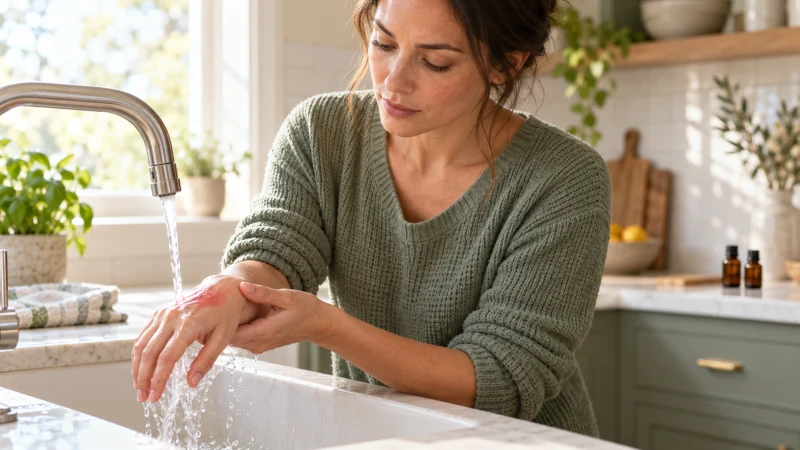
Here’s the honest picture. Essential oils don’t belong on a fresh burn, and the human research on putting them on burned skin is close to nonexistent. Where they do show up in burn research is somewhere you might not expect: hospital burn units, where patients breathed in lavender or rose oil before painful dressing changes. Those studies hint at modest relief from pain and anxiety, but they’re small and have real weaknesses [Lee et al., 2021].
One correction before we go further. An earlier version of this page cited studies that, when we checked them, turned out to be about rats, chickens, and childbirth stitches rather than burns. We’ve fixed that, and every source below has been opened and read.
What to do in the first minutes after a minor burn
Minor burns, the red, painful kind with maybe a small blister, can usually be treated at home [Mayo Clinic, 2026]. The steps most guidance agrees on:
- Cool it with running water. Use cool water, not ice-cold. Advice on timing varies: Mayo Clinic says about 10 minutes, the NHS says 20 minutes (ideally within 3 hours of the burn), and MedlinePlus gives a range of 5 to 30 minutes [Mayo Clinic, 2026; NHS, 2026; MedlinePlus, 2026]. If you’re unsure, lean toward longer.
- Take off rings, watches, and tight clothing near the burn before it swells. Leave anything that’s stuck to the skin [Mayo Clinic, 2026; NHS, 2026].
- Cover it loosely. A clean, non-stick bandage works. The NHS suggests laying cling film over the burn rather than wrapping it around [Mayo Clinic, 2026; NHS, 2026].
- Take an over-the-counter pain reliever if you need one, such as ibuprofen or acetaminophen. Don’t give aspirin to anyone under 19 [Mayo Clinic, 2026; MedlinePlus, 2026].
- Leave blisters alone. They help protect against infection. If one breaks, clean it gently with water [Mayo Clinic, 2026].
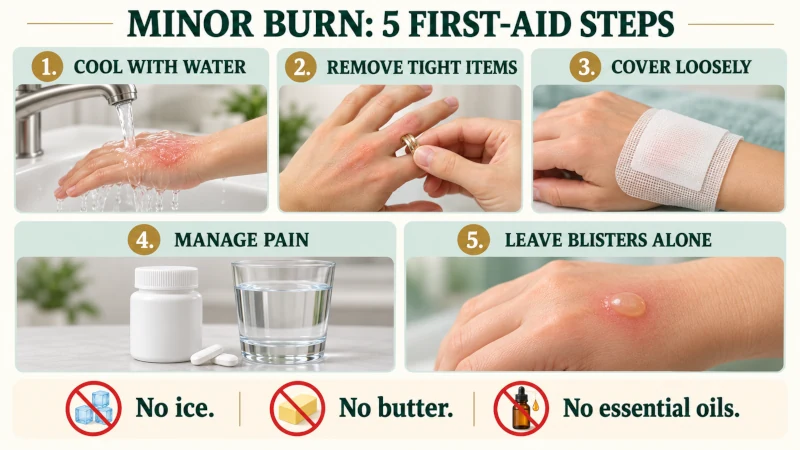
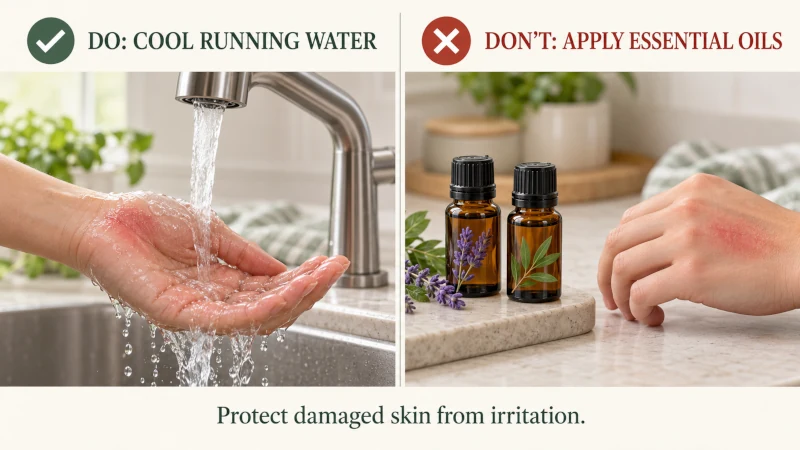
Skip the ice, butter, and toothpaste too. Mayo Clinic warns that butter, toothpaste, and oil can hold in heat, irritate the skin, and make the injury worse; the NHS says not to put creams, oils, or butter on burns [Mayo Clinic, 2026; NHS, 2026].
Why essential oils don’t belong on a fresh burn
Essential oils are concentrated plant chemicals. Even on healthy skin, lavender, tea tree, and peppermint oils can cause rashes, irritation, or allergic reactions in some people [NCCIH, 2025a; NCCIH, 2025b; NCCIH, 2025c]. A burn is skin that’s already injured. Adding a known irritant to it works against what the skin is trying to do.
Then there’s the heat. Oils of any kind can trap heat against a burn, which is why first-aid sources tell you to keep them off [Mayo Clinic, 2026]. That includes the carrier oils, like coconut or jojoba, you’d use to dilute an essential oil.
The one study we found that tested an essential-oil product made specifically for burns reached a blunt conclusion. Researchers at Royal Brisbane Hospital tested a commercial tea tree oil burn cream in the lab. It stopped bacteria no better than the same cream without the tea tree oil, and given evidence that tea tree oil can damage human skin cells, the authors recommended the product not be used on burn wounds [Faoagali et al., 1997].
What the research on essential oils for burns actually shows
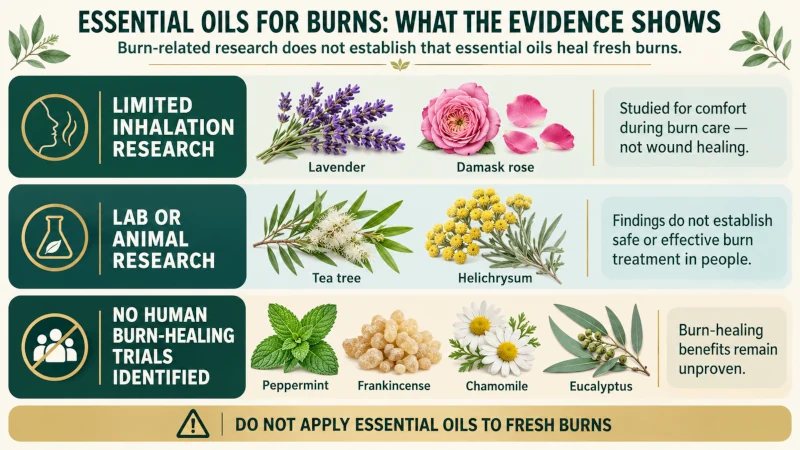
Most claims you’ll see online about oils healing burns trace back to lab dishes, animal studies, or trials of other kinds of wounds. Sorted by oil, it looks like this.
Inhaled aromatherapy in burn units: the strongest evidence, and it’s still weak
A 2021 systematic review pooled eight randomized trials in burn patients. Most tested inhaled lavender, damask rose, or oil blends before dressing changes; a few used aromatherapy massage. Breathing in the oils alongside routine care lowered pain after dressing changes compared with a placebo, by less than one point on the pain scales used, and also reduced anxiety scores [Lee et al., 2021].
Hold that loosely. The reviewers rated the overall risk of bias as concerning, the trials were small, blinding was hard (you can smell lavender), and none of the trials measured side effects [Lee et al., 2021]. Every trial gave the oil by inhalation or massage. None tested oil applied to the burn wound itself.
What that means at home: a few drops of lavender on a tissue nearby might help you feel calmer while a burn heals. It isn’t treating the burn.
Lavender: rats and stitches, not burns
Lavender is the oil most often recommended for burns, and the studies usually cited for it don’t involve burns. One widely cited paper found that 1% lavender oil sped up early wound shrinkage in rats with surgical skin wounds, though by day 14 total healing was no different from untreated wounds [Mori et al., 2016]. Another, a trial in 120 women healing from episiotomy stitches, found less redness with lavender oil than with povidone-iodine but no significant difference in pain [Vakilian et al., 2011].
Neither tells you what lavender does on a human burn. NCCIH says more high-quality research is needed before reliable conclusions can be drawn about lavender, and notes that topical lavender products can cause allergic skin reactions [NCCIH, 2025a]. Our guide to lavender benefits and what the evidence supports covers the areas where lavender’s evidence is stronger, such as anxiety.
Tea tree oil: the burn study advised against it
Tea tree has deep roots in traditional practice; Aboriginal Australians used the leaves on wounds, burns, and insect bites [NCCIH, 2025b]. Modern evidence for burns is thin and not encouraging. Beyond the lab study above, NCCIH says there’s a small amount of evidence for acne and athlete’s foot and not enough to judge most other uses. It also warns that skin redness and irritation can happen, especially with oil that’s old or has been exposed to heat, light, or air [NCCIH, 2025b; Faoagali et al., 1997].
Peppermint: a cooling feel, no burn research
Peppermint’s menthol produces a cooling sensation, which is probably why it lands on burn lists. We found no human research testing peppermint oil on burns. NCCIH describes limited evidence for topical peppermint oil in tension headaches, lists skin rashes and irritation as side effects, and warns never to apply it to the face of an infant or young child, because breathing in the menthol can cause serious problems [NCCIH, 2025c]. Our peppermint benefits guide covers what peppermint is actually useful for.
Frankincense, helichrysum, chamomile, and eucalyptus
These are often sold as burn or scar remedies. Searching for this update, we didn’t find human clinical trials testing any of them on burns. For helichrysum, the research we found is in animals: a 2021 study reported that a 0.5% helichrysum ointment and gel helped surgical wounds close faster in diabetic rats, and the authors said clinical trials are still needed [Andjić et al., 2021]. Chamomile turns up in burn research only as part of aromatherapy massage blends aimed at anxiety and sleep, not applied to the burn [Lee et al., 2021].
The older version of this page named journals that supposedly backed each of these oils, without study details or links. We couldn’t match any of those claims to a real paper, so they’re gone.
Essential oils for burns: evidence at a glance
| Oil | Best evidence related to burns | What it means for you |
| Lavender | Inhaled before dressing changes in small burn-unit trials: modest pain and anxiety relief, high risk of bias. On skin: rat wounds and episiotomy stitches only. | Possibly calming as a scent. Not a burn treatment. |
| Damask rose | Inhaled in burn-unit trials, same limitations. | Same as lavender. |
| Tea tree | One lab study of a tea tree burn cream; authors advised against use on burns. | Keep it off burns. |
| Peppermint | No human burn studies found. | Cooling feel isn’t healing. Never near a young child’s face. |
| Helichrysum | Animal (rat) wound studies. | Unproven in people. |
| Frankincense | No human burn trials found. | Unproven. |
| Chamomile | Used in massage blends for anxiety in burn patients, not on the burn. | Unproven for healing; daisy-family allergy risk. |
| Eucalyptus | No human burn studies found. | Unproven. |
What actually helps a minor burn heal
Most minor burns heal on their own with simple care; the NHS says small burns often take around two weeks [NHS, 2026]. These steps have better support than any essential oil:
- Keep it covered and protected from pressure and rubbing while it heals [MedlinePlus, 2026].
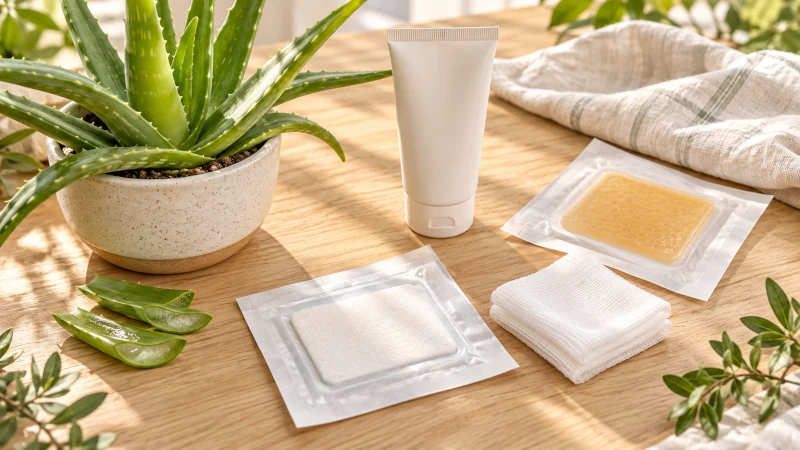
- Moisturize once it has cooled. Mayo Clinic suggests a lotion with aloe vera or cocoa butter once the burn starts healing; the NHS suggests an emollient if the skin gets dry and itchy, and a pharmacist can recommend one [Mayo Clinic, 2026; NHS, 2026]. Our guide to herbs for skin issues explains why aloe has the best support of any plant remedy for burns.
- Ask about honey dressings for a blistered burn. A Cochrane review found high-quality evidence, from two trials with 992 people, that honey dressings healed partial-thickness burns about four to five days faster than conventional dressings [Jull et al., 2015]. That means medical-grade honey in sterile dressings, not honey from your kitchen. Our guide to the health benefits of honey explains the difference.
- Check your tetanus shot. For a deep burn, you may need a booster if it’s been more than five years [Mayo Clinic, 2026].
If you still want to use essential oils, use them this way
Plenty of people find a familiar scent comforting while they’re sore. That’s a reasonable use, with a few ground rules.
- Breathe it, don’t apply it. A few drops on a tissue or in a diffuser keeps oil away from damaged skin, and it’s how oils were used in the burn-unit trials [Lee et al., 2021]. Aromatherapy can cause headaches or coughing in some people [NCCIH, 2025a].
- Wait until the skin has fully closed before putting any diluted oil on the area. Even then, no good human evidence shows it improves scars.
- Dilute, and patch test first. Never use oils undiluted. Recommended strengths vary between sources, and lower is gentler; in the helichrysum rat study, researchers kept it at 0.5% because higher amounts risk skin irritation [Andjić et al., 2021]. Try a small amount on unaffected skin first; our patch testing guide walks through how.
- Stop at the first sign of trouble: redness, itching, burning, or a rash.
- Never swallow essential oils. Swallowed tea tree oil can cause confusion, unsteadiness, and even coma [NCCIH, 2025b].
Side effects, interactions, and who should avoid essential oils
Common side effects
Skin irritation, rashes, and allergic reactions are the main ones for topical lavender, tea tree, and peppermint oils [NCCIH, 2025a; NCCIH, 2025b; NCCIH, 2025c]. Tea tree oil is more likely to irritate when it’s old or has been exposed to heat, light, or air [NCCIH, 2025b]. Inhaled lavender can cause headaches or coughing [NCCIH, 2025a].
Medication interactions
There are theoretical reasons lavender might add to the effect of sedative medicines or herbs, which matters most before surgery [NCCIH, 2025a]. For tea tree and peppermint oils on the skin, NCCIH doesn’t list specific drug interactions, but its general advice holds: if you take any medicine, check with your healthcare provider before using herbal products [NCCIH, 2025b; NCCIH, 2025c].
Pregnancy and breastfeeding
The evidence differs by oil. Little is known about whether lavender is safe in pregnancy or while breastfeeding [NCCIH, 2025a]. Topical tea tree products may be safe during pregnancy and breastfeeding [NCCIH, 2025b]. Peppermint in food amounts is likely safe, but medicinal amounts haven’t been studied well, and if peppermint oil is used on the nipples it should be wiped off before the next feed [NCCIH, 2025c]. If you’re pregnant or nursing, check with your clinician before using any oil regularly.
Children
Never put peppermint oil or menthol on or near a baby’s or young child’s face [NCCIH, 2025c]. A few cases of breast swelling have been reported in children using topical lavender products, though it’s unclear whether lavender caused it [NCCIH, 2025a]. Burns in children deserve a lower threshold for medical care: MedlinePlus advises that children be seen right away, and Mayo Clinic notes babies may need emergency care even for minor burns [MedlinePlus, 2026; Mayo Clinic, 2026].
Who should skip essential oils entirely
- Anyone with an open, blistered, or weeping burn.
- Babies and young children (especially peppermint/menthol near the face).
- People with a history of reactions to fragrances or essential oils.
- People allergic to ragweed or daisies, for chamomile and helichrysum (both in the daisy family); see our herbs for skin guide.
- Anyone taking sedatives or with surgery coming up, for lavender [NCCIH, 2025a].
When a burn needs medical care
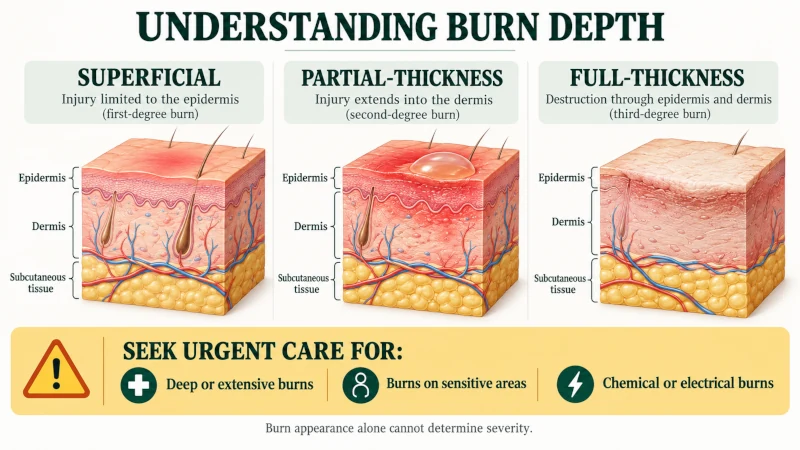
Call 911 or go to the emergency room if a burn [Mayo Clinic, 2026; MedlinePlus, 2026]:
- Goes through all layers of skin, looks dry or leathery, or has charred, white, brown, or black patches.
- Is larger than about 3 inches across (Mayo Clinic) or about the size of your palm or larger (MedlinePlus).
- Is on the face, hands, feet, genitals, buttocks, or a major joint, or wraps around an arm or leg.
- Was caused by electricity, lightning, or strong chemicals.
- Came with smoke inhalation, or the person shows signs of shock such as pale, clammy skin or weakness.
- Swells very fast, or you’re not sure how serious it is.
Contact your healthcare provider promptly if a minor burn still hurts after 48 hours, or if you notice signs of infection: pus or drainage, fever, increasing pain, red streaks spreading from the burn, or swollen lymph nodes [MedlinePlus, 2026]. Children, older adults, and people with weakened immune systems should be seen right away [MedlinePlus, 2026].
| HEALTH DISCLAIMER: This article is for general education and is not a substitute for medical advice, diagnosis, or treatment. Essential oils are not a treatment for burns and should not be applied to a fresh or open burn. They can irritate skin, cause allergic reactions, and be toxic if swallowed. Major burns, burns on the face, hands, feet, genitals, or joints, electrical or chemical burns, and burns in babies and young children need prompt medical care. Talk with a doctor, nurse, or pharmacist before using essential oils if you are pregnant or breastfeeding, caring for a child, taking prescription medicine, or have sensitive or allergy-prone skin. In an emergency, call 911. |
Frequently Asked Questions
Can I put lavender oil on a burn?
Not on a fresh burn. Cool it under running water and cover it instead. First-aid guidance says to keep oils off burns, and the lavender studies people cite were done in rats and episiotomy wounds, not burns [Mayo Clinic, 2026; Mori et al., 2016; Vakilian et al., 2011]. If you like the scent, inhale it from a tissue.
Is coconut oil good for burns?
Not right after the burn. Oils can trap heat and irritate the skin [Mayo Clinic, 2026]. Once the skin has cooled and is healing, an aloe or cocoa butter lotion or a plain emollient is the better choice for dryness [Mayo Clinic, 2026; NHS, 2026].
Do essential oils help burn scars?
There’s no good human evidence that they do. Frankincense and helichrysum scar claims rest, at best, on animal studies [Andjić et al., 2021].
How long should I run a burn under cool water?
Guidance ranges from about 10 minutes (Mayo Clinic) to 20 minutes (NHS); MedlinePlus says 5 to 30 minutes [Mayo Clinic, 2026; NHS, 2026; MedlinePlus, 2026]. Start as soon as you can, and use cool, not icy, water.
What natural remedy has the best evidence for a minor burn?
Cool running water comes first. After that, aloe lotion once the burn has cooled, and, for blistered burns, medical-grade honey dressings recommended by a clinician, which a Cochrane review found healed partial-thickness burns faster than conventional dressings [Mayo Clinic, 2026; Jull et al., 2015].
Is it okay to diffuse essential oils around a child with a burn?
Keep peppermint and other menthol products away from a young child’s face [NCCIH, 2025c], and focus first on getting the burn assessed: MedlinePlus advises children with burns be seen right away [MedlinePlus, 2026].
References
- Mayo Clinic Staff. Burns: First aid. Mayo Clinic. View source
- NHS. Burns and scalds. View source
- MedlinePlus Medical Encyclopedia. Burns. U.S. National Library of Medicine. View source
- National Center for Complementary and Integrative Health. Lavender: Usefulness and Safety. View source
- National Center for Complementary and Integrative Health. Tea Tree Oil: Usefulness and Safety. View source
- National Center for Complementary and Integrative Health. Peppermint Oil: Usefulness and Safety. View source
- Lee HW, Ang L, Kim JT, Lee MS. Aromatherapy for symptom relief in patients with burn: a systematic review and meta-analysis. View source
- Faoagali J, George N, Leditschke JF. Does tea tree oil have a place in the topical treatment of burns? Burns. View source
- Mori HM, Kawanami H, Kawahata H, Aoki M. Wound healing potential of lavender oil by acceleration of granulation and wound contraction through induction of TGF-β in a rat model. View source
- Vakilian K, Atarha M, Bekhradi R, Chaman R. Healing advantages of lavender essential oil during episiotomy recovery: a clinical trial. View source
- Andjić M, Božin B, Draginić N, et al. Formulation and evaluation of Helichrysum italicum essential oil-based topical formulations for wound healing in diabetic rats. View source
- Jull AB, Cullum N, Dumville JC, Westby MJ, Deshpande S, Walker N. Honey as a topical treatment for wounds. View source


