

Magnesium runs quietly behind hundreds of everyday jobs in your body, and most people in the U.S. don’t get quite enough of it — roughly 48% take in less than the estimated requirement from food [NIH ODS, 2026]. That gap is the real story behind the magnesium benefits worth caring about. But the mineral is also oversold. Some of what you’ll read online — that it melts away anxiety, fixes insomnia, or reverses disease — runs far ahead of the science. Here’s the honest version: what magnesium genuinely does, where the evidence is strong, where it’s thin, how much you need, the foods that get you there, and the safety points that actually matter.
What magnesium actually does in your body
Magnesium is a cofactor in more than 300 enzyme systems, which is another way of saying it helps run a huge share of your basic chemistry: making energy, building proteins and DNA, controlling blood sugar, regulating blood pressure, and keeping nerves and muscles firing the way they should [NIH ODS, 2026]. It also helps shuttle calcium and potassium across cell membranes, and that movement is what lets nerves send signals, muscles contract, and your heart keep a steady rhythm [NIH ODS, 2026].
An adult body holds about 25 grams of magnesium. Over half sits in your bones, most of the rest is in soft tissue, and less than 1% circulates in your blood — which your kidneys keep under tight control [NIH ODS, 2026]. That last detail matters: a normal blood test doesn’t reliably tell you whether your total body stores are low, which is part of why quiet, long-term shortfalls slip by. Because potassium and magnesium work so closely together — low magnesium can even drag potassium down — clinicians sometimes look at both, and it’s worth understanding how potassium works in the body alongside it.
The real magnesium benefits, graded by the evidence
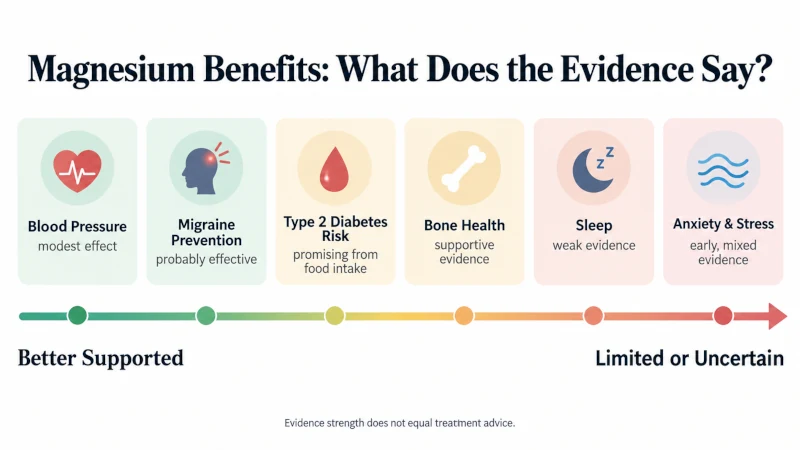
Not every claimed benefit is equally proven. Here’s where the science is solid, where it’s promising, and where it’s still thin.
Blood pressure — modest but real
This is one of magnesium’s better-supported effects, as long as you keep the size of it in perspective. Pooled trials show supplementation nudges blood pressure down by a small amount.
A Cochrane review of 12 trials in 545 people with hypertension found only about a 2.2 mmHg drop in diastolic pressure [NIH ODS, 2026]. A larger meta-analysis of 34 randomized, placebo-controlled trials (about 2,028 people, median dose ~368 mg/day for roughly three months) found systolic pressure fell by about 2.0 mmHg and diastolic by about 1.8 mmHg — with bigger effects in people who started out low in magnesium, insulin resistant, or with higher baseline pressure [Zhang et al., 2016]. In 2022 the FDA allowed a qualified claim that adequate magnesium may reduce hypertension risk, while adding that the evidence is “inconsistent and inconclusive” [NIH ODS, 2026].
The takeaway: magnesium is a small lever, not a substitute for medication, sodium reduction, exercise, or the overall pattern of your diet. If blood pressure is your reason for reading this, it helps to see how sodium, potassium, and magnesium work together rather than treating any one of them as the fix.
Type 2 diabetes risk — promising, mostly from food
People whose diets are higher in magnesium tend to develop type 2 diabetes less often; across large studies, each additional 100 mg a day of magnesium intake was linked to roughly a 15% lower risk [NIH ODS, 2026]. That’s an association from observational research, though, and it travels with fruits, vegetables, and whole grains that carry other benefits too. When it comes to supplements for people who already have diabetes, the trials are small and conflicting, and the American Diabetes Association says there isn’t enough evidence to recommend magnesium for blood-sugar control in people without a deficiency [NIH ODS, 2026]. So: eat for it, don’t count on a pill for it.
Migraine prevention — probably effective, with a catch
Here the evidence is more specific. People who get migraines tend to have lower magnesium levels, and the American Academy of Neurology and the American Headache Society concluded that magnesium is probably effective for preventing them [NIH ODS, 2026]. The catch is important: the doses used for migraine prevention are typically above the safe upper limit for supplements, so this is something to do under a clinician’s direction, not on your own [NIH ODS, 2026].
Bone health — supportive, not proven
About half your body’s magnesium lives in bone, and it influences the hormones and cells that build and maintain the skeleton [NIH ODS, 2026]. Population studies link higher magnesium intake to better bone density, and some find lower magnesium in women with osteoporosis [NIH ODS, 2026]. What’s missing is proof that taking magnesium supplements prevents or treats osteoporosis — the research isn’t there yet. Getting the recommended amount supports bone health; going beyond it hasn’t been shown to add more.
Sleep — popular, weakly supported
Magnesium’s reputation as a sleep aid is bigger than its evidence. The best current synthesis — a meta-analysis of three randomized trials in 151 older adults — found people fell asleep about 17 minutes faster on magnesium than placebo, but the studies were small, at moderate-to-high risk of bias, and rated low to very low certainty [Mah & Pitre, 2021].
Total sleep time didn’t improve significantly. That doesn’t make magnesium useless for sleep, especially if your intake is low to begin with, but it isn’t a proven sleep drug. If you want to explore it, our guide to magnesium glycinate powder covers forms and evening use — and the sleep basics (a consistent schedule, a dark room, less late caffeine) still do more heavy lifting than any supplement.
Anxiety and stress — early and mixed
Magnesium has plausible links to the body’s stress machinery, and it’s heavily marketed for calm. But a systematic review of 18 studies found the evidence only “suggestive,” and the authors judged the overall quality as poor — the trials were small, often bundled magnesium with vitamin B6 or herbs, and showed large placebo responses [Boyle et al., 2017]. Fair summary: it might help some people whose intake is low, but it’s no replacement for real anxiety care.
How much magnesium do you need?
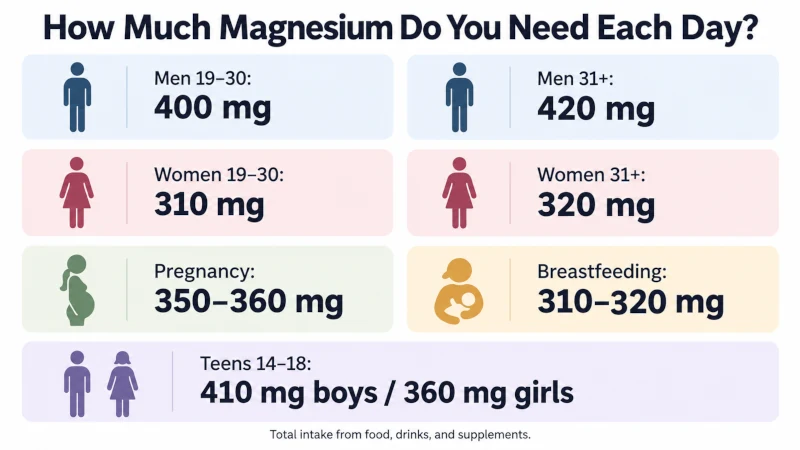
Recommended intakes cover magnesium from everything — food, drinks, and supplements combined [NIH ODS, 2026].
| Group | RDA (per day) |
| Men, 19–30 | 400 mg |
| Men, 31+ | 420 mg |
| Women, 19–30 | 310 mg |
| Women, 31+ | 320 mg |
| Pregnancy | 350–360 mg |
| Breastfeeding | 310–320 mg |
| Children, 1–3 yrs | 80 mg |
| Children, 4–8 yrs | 130 mg |
| Children, 9–13 yrs | 240 mg |
| Teens, 14–18 yrs | 410 mg (boys) / 360 mg (girls) |
Source: NIH Office of Dietary Supplements
The best food sources of magnesium
Food is the better starting point for most people, partly because about 30–40% of the magnesium in food is absorbed and it arrives alongside fiber and other nutrients [NIH ODS, 2026]. Refining grains strips much of it out, which is part of why intakes run low.
| Food (serving) | Magnesium | % Daily Value |
| Pumpkin seeds, roasted, 1 oz | 156 mg | 37% |
| Chia seeds, 1 oz | 111 mg | 26% |
| Almonds, dry roasted, 1 oz | 80 mg | 19% |
| Spinach, boiled, ½ cup | 78 mg | 19% |
| Cashews, dry roasted, 1 oz | 74 mg | 18% |
| Black beans, cooked, ½ cup | 60 mg | 14% |
| Edamame, cooked, ½ cup | 50 mg | 12% |
| Peanut butter, 2 tbsp | 49 mg | 12% |
| Brown rice, cooked, ½ cup | 42 mg | 10% |
| Plain low-fat yogurt, 8 oz | 42 mg | 10% |
| Banana, 1 medium | 32 mg | 8% |

Source: NIH Office of Dietary Supplements / USDA
Signs your magnesium may be low — and who’s most at risk
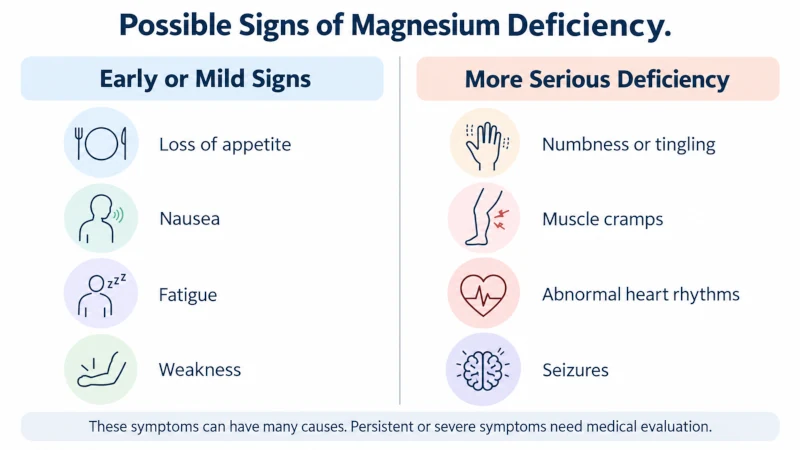
In otherwise healthy people, outright deficiency is uncommon, because the kidneys hold on to magnesium when intake drops [NIH ODS, 2026]. When a shortfall does develop, the early signs are easy to miss: loss of appetite, nausea, fatigue, and weakness. As it worsens, it can bring numbness and tingling, muscle cramps, personality changes, abnormal heart rhythms, and in severe cases seizures or dangerously low calcium or potassium [NIH ODS, 2026].
Some groups are genuinely more likely to run low [NIH ODS, 2026]:
- People with gut conditions such as Crohn’s disease or celiac disease, where diarrhea and malabsorption cause losses.
- People with type 2 diabetes, who lose more magnesium in urine.
- People with alcohol dependence, through poor intake and increased losses.
- Older adults, who absorb less and excrete more, and often take medications that deplete it.
Supplements: forms, dosing, and the upper limit
If food isn’t enough, supplements can fill the gap — but the form and the dose both matter. More soluble forms such as magnesium citrate, lactate, chloride, and aspartate are absorbed better than magnesium oxide or sulfate [NIH ODS, 2026]. So the old shorthand that “magnesium chloride is the best” isn’t quite right — several forms are comparable, and the one that suits you often comes down to tolerance. Read the elemental magnesium figure on the label, since that’s the amount your body actually gets.
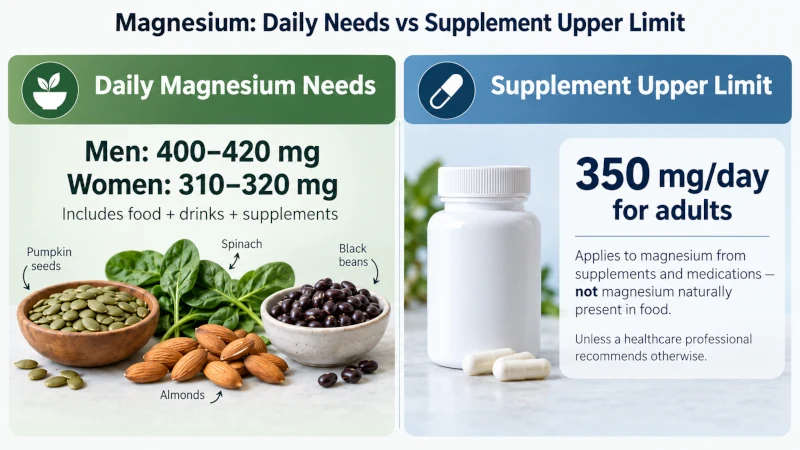
The key safety number: the tolerable upper limit for magnesium from supplements is 350 mg a day for adults [NIH ODS, 2026]. That’s lower than the food-inclusive RDA because your kidneys clear excess magnesium from food, but concentrated supplement doses are what cause trouble. Taking more isn’t more effective, and it raises the odds of side effects.
Side effects, safety, and who should avoid magnesium
Too much supplemental magnesium commonly causes diarrhea, nausea, and abdominal cramping — carbonate, chloride, gluconate, and oxide forms are the usual culprits [NIH ODS, 2026]. Very high intakes (typically from magnesium-containing laxatives or antacids well above 5,000 mg/day, or in people with poor kidney function) can cause true toxicity: low blood pressure, vomiting, facial flushing, lethargy, and then muscle weakness, trouble breathing, irregular heartbeat, and in rare cases cardiac arrest [NIH ODS, 2026]. Fatal cases have been reported, though they’re rare.
Who should not take magnesium supplements without medical guidance: anyone with kidney disease or reduced kidney function, because the ability to clear excess magnesium is impaired and it can build to dangerous levels [NIH ODS, 2026]. The same caution applies if you have a heart rhythm disorder or take medications that affect magnesium.
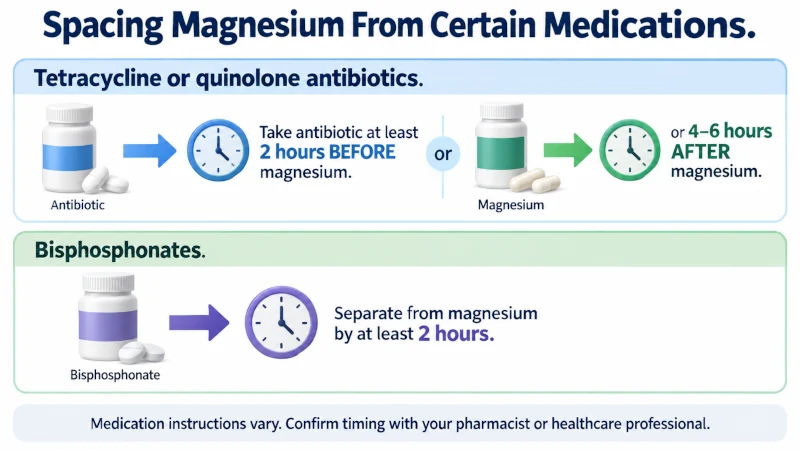
Medication interactions
| Medication | Interaction | Practical step |
| Bisphosphonates (e.g., alendronate) | Magnesium reduces their absorption | Separate by at least 2 hours [NIH ODS, 2026] |
| Tetracycline & quinolone antibiotics | Magnesium binds them, cutting absorption | Antibiotic ≥2 h before or 4–6 h after magnesium [NIH ODS, 2026] |
| Loop & thiazide diuretics | Increase magnesium loss in urine | May deplete magnesium over time [NIH ODS, 2026] |
| Potassium-sparing diuretics | Reduce magnesium excretion | Can raise magnesium levels [NIH ODS, 2026] |
| Proton pump inhibitors, long-term | Can lower magnesium after ~1 year | Levels may need monitoring [NIH ODS, 2026] |
Pregnancy and breastfeeding
Magnesium needs are slightly higher in pregnancy (about 350–360 mg a day) and breastfeeding (about 310–320 mg), and meeting them through food is the goal [NIH ODS, 2026]. Because prenatal vitamins and other supplements already contain magnesium, don’t add a separate magnesium supplement during pregnancy or breastfeeding without checking with your provider first.
When to talk to a healthcare professional
Get individualized advice before supplementing if you have kidney disease, a heart condition, or take any of the medications above, or if you’re pregnant or breastfeeding. And seek prompt medical care for red-flag symptoms — a slow or irregular heartbeat, severe muscle weakness, confusion, fainting, or trouble breathing — which can signal either very low or dangerously high magnesium.
Persistent problems that sent you toward magnesium in the first place — ongoing insomnia, migraines, cramps, palpitations, or anxiety — deserve a proper workup rather than a rising supplement dose that may mask the real cause.
| Health Disclaimer: This article is for educational purposes only and is not a substitute for professional medical advice, diagnosis, or treatment. It cannot account for your personal health history, your kidney function, or your medications. Magnesium is not appropriate for everyone — in particular, people with kidney disease or on certain medications can be harmed by amounts that are safe for others. Talk with a qualified healthcare professional before starting a magnesium supplement, changing your diet significantly, or adjusting any medication. If you think you’re having a medical emergency — such as an irregular heartbeat with severe weakness or trouble breathing — call your local emergency number (911 in the U.S.). |
Frequently Asked Questions
What are the main benefits of magnesium?
The best-supported ones are helping maintain normal blood pressure (a modest effect), supporting healthy blood-sugar metabolism, and — probably — helping prevent migraines [NIH ODS, 2026]. Bone, sleep, and anxiety benefits are weaker or still uncertain [Mah & Pitre, 2021]; [Boyle et al., 2017]. Above all, magnesium keeps hundreds of basic body processes running, so avoiding a deficiency is the real win.
How much magnesium should I take a day?
Total daily targets are about 400–420 mg for men and 310–320 mg for women, counting food and supplements together [NIH ODS, 2026]. If you use a supplement, the upper limit for the supplement portion is 350 mg a day for adults unless a clinician directs otherwise.
Can magnesium help me sleep?
Maybe modestly, especially if your intake is low, but the evidence is weak — the strongest review found people fell asleep about 17 minutes faster than on placebo, from small, low-certainty studies [Mah & Pitre, 2021]. It’s not a proven sleep medication.
Which form of magnesium is best?
There’s no single “best.” Citrate, lactate, chloride, and aspartate are absorbed well; oxide is absorbed less and is more likely to loosen stools [NIH ODS, 2026]. Glycinate is often chosen for being gentle on the stomach. Match the form to your tolerance and check the elemental magnesium on the label.
Who should not take magnesium supplements?
Anyone with kidney disease or reduced kidney function should avoid them unless a clinician approves and monitors, because excess magnesium can accumulate to dangerous levels [NIH ODS, 2026]. People on certain antibiotics, bisphosphonates, or diuretics, and those who are pregnant or breastfeeding, should check first.
Can you take too much magnesium?
From food, that’s rare in healthy people — the kidneys clear the excess. From supplements or magnesium-based laxatives, yes: high doses cause diarrhea and cramping, and very high doses (or normal doses with impaired kidneys) can cause serious toxicity [NIH ODS, 2026].
References
- NIH Office of Dietary Supplements. Magnesium: Fact Sheet for Health Professionals. Updated January 6, 2026. View source
- Mah J, Pitre T. Oral magnesium supplementation for insomnia in older adults: a Systematic Review & Meta-Analysis. BMC Complement Med Ther. 2021;21:125. DOI 10.1186/s12906-021-03297-z. View source
- Boyle NB, Lawton C, Dye L. The Effects of Magnesium Supplementation on Subjective Anxiety and Stress—A Systematic Review. Nutrients. 2017;9(5):429. DOI 10.3390/nu9050429. View source
- Zhang X, Li Y, Del Gobbo LC, et al. Effects of Magnesium Supplementation on Blood Pressure: A Meta-Analysis of Randomized Double-Blind Placebo-Controlled Trials. Hypertension. 2016;68(2):324–333. DOI 10.1161/HYPERTENSIONAHA.116.07664. View source


