
Sodium has an image problem, and most of it is earned. Your body genuinely needs this mineral: it holds water in your bloodstream, keeps your blood pressure from falling too low, and lets your nerves fire and your muscles contract [AHA, 2025b] [MedlinePlus, 2025]. But the amount needed for all of that is tiny — less than 500 mg a day, under a quarter teaspoon of salt [AHA, 2025a]. The average American eats about 3,400 mg [FDA, 2024]. So the real sodium benefits come from getting the right amount, not more of it.
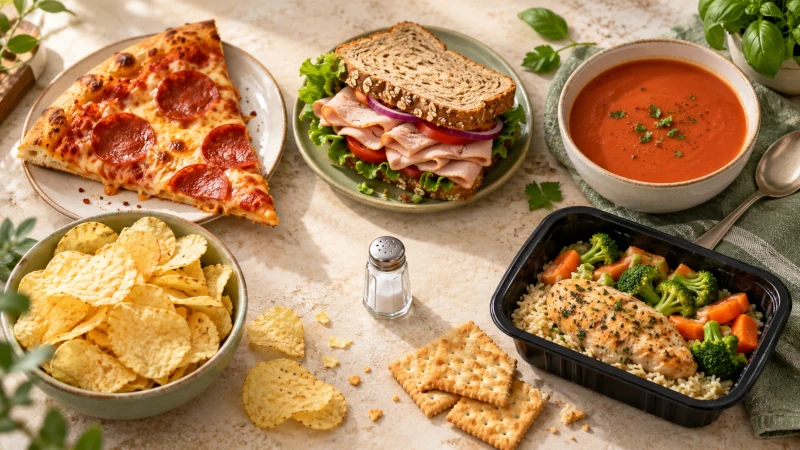
Below: what sodium does, how much you need by age, where it actually comes from, and the situations — heavy sweating, kidney disease, certain medications — where the usual “eat less salt” advice needs adjusting.
What sodium does in your body
Most of your sodium sits in the fluid outside your cells. There it keeps your plasma volume steady, helps hold your blood’s acid-base balance in range, and carries the electrical signals that nerves use to talk to each other [WHO, 2026]. Your kidneys are the regulators, holding on to sodium when you need it and flushing it when you don’t [AHA, 2025b].
You can see how important that job is by what happens when it fails. When sodium outside the cells drops too low, water moves into the cells and they swell. Brain cells are especially sensitive to that swelling, which is why severe low sodium causes confusion and seizures [MedlinePlus, 2025].
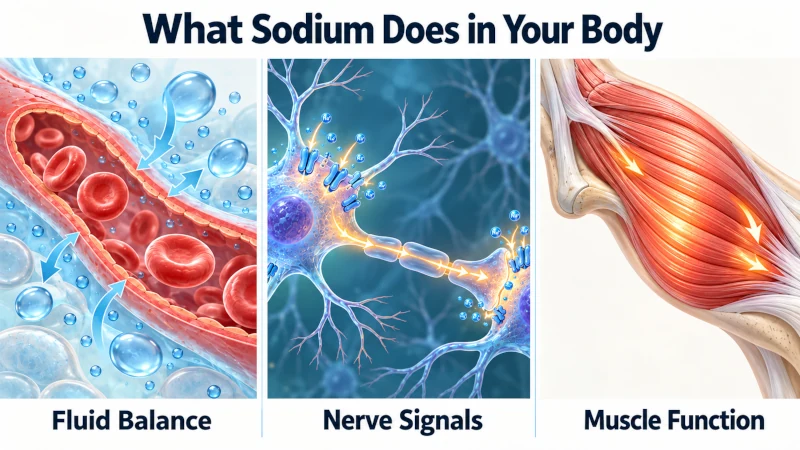
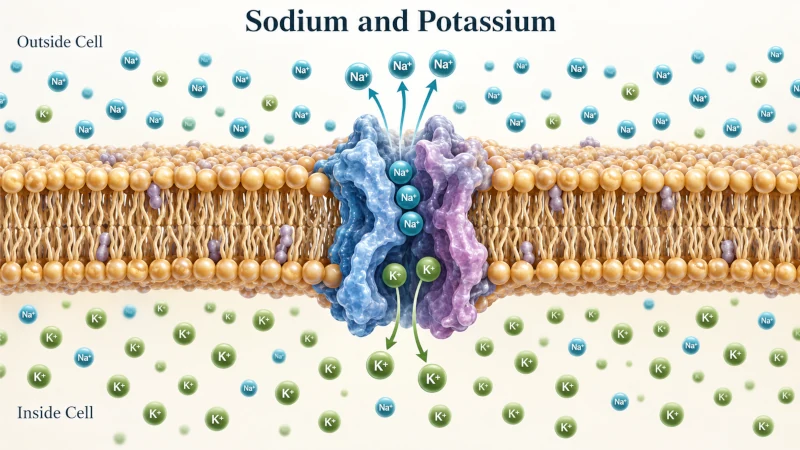
Sodium works as a pair with potassium. Potassium is concentrated inside cells — about 30 times higher than outside — while sodium is the main regulator of fluid outside them. A pump in every cell membrane maintains that difference, and nerve signals, muscle contraction, and kidney function all depend on it [NIH ODS, 2022]. That partnership is also why the two minerals matter together for blood pressure, which our guide to potassium benefits covers in depth.
One correction to an older version of this page: sodium is not what makes stomach acid. Stomach acid is hydrochloric acid, and its chloride comes from the other half of table salt, which is about 40% sodium and 60% chloride by weight [AHA, 2025b]. Our article on what chloride does in the body explains that side of the story.
How much sodium do you need?
There is no Recommended Dietary Allowance for sodium. In 2019 the National Academies set an Adequate Intake (AI) — the amount that covers the needs of healthy people — along with a newer value called the Chronic Disease Risk Reduction intake (CDRR). The CDRR works as a ceiling: if you eat more than it, cutting back is expected to lower chronic disease risk [NASEM, 2019] [NASEM, 2019].
| Life stage | Adequate Intake (mg/day) | Reduce intake if above (CDRR, mg/day) |
| Infants 0–6 months | 110 | Not set |
| Infants 7–12 months | 370 | Not set |
| Children 1–3 years | 800 | 1,200 |
| Children 4–8 years | 1,000 | 1,500 |
| Ages 9–13 | 1,200 | 1,800 |
| Ages 14–18 | 1,500 | 2,300 |
| Adults 19 and older | 1,500 | 2,300 |
| Pregnancy and breastfeeding | 1,500 | Not listed separately |
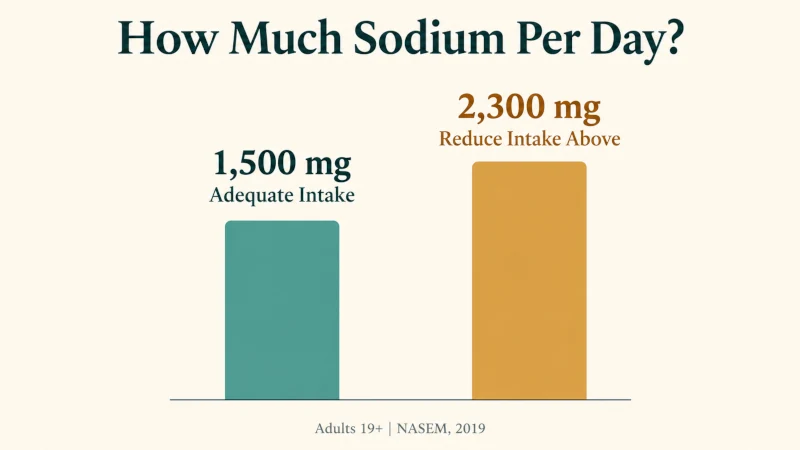
Source: National Academies of Sciences, Engineering, and Medicine, Dietary Reference Intakes for Sodium and Potassium, 2019 [NASEM, 2019]
Other health bodies land in the same neighborhood. The FDA’s Daily Value on food labels is less than 2,300 mg — about one teaspoon of table salt [FDA, 2024]. The American Heart Association recommends no more than 2,300 mg and an ideal of no more than 1,500 mg for most adults, and notes that cutting about 1,000 mg a day can improve blood pressure for most people [AHA, 2025a]. The World Health Organization sets its adult limit a little lower, at under 2,000 mg of sodium, or 5 grams of salt [WHO, 2026].
To translate labels: 1 gram of salt contains 400 mg of sodium [WHO, 2026]. On a Nutrition Facts panel, 5% of the Daily Value or less per serving counts as low in sodium and 20% or more counts as high [FDA, 2024].
If you have seen figures like “RDA 1,100 mg” on older nutrition pages, including a past version of this one, they don’t match current U.S. reference values. Use the table above instead.
Where the sodium in your diet comes from
Here is the part that surprises people: the saltshaker is a minor player. More than 70% of the sodium Americans eat comes from packaged, prepared, and restaurant foods. Only about 5–10% occurs naturally in food, and another 10–15% is added during cooking or at the table [AHA, 2025b].
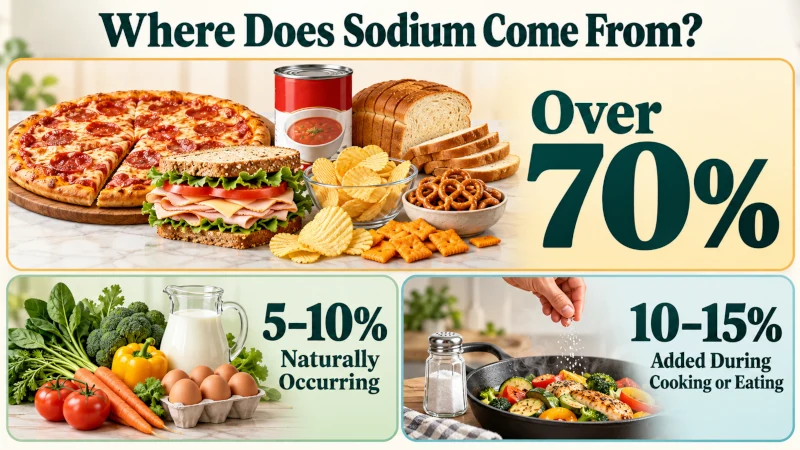
According to CDC data cited by the FDA, about 40% of Americans’ sodium comes from a short list: deli meat sandwiches, pizza, burritos and tacos, soups, savory snacks, poultry, pasta mixed dishes, burgers, and egg dishes [FDA, 2024]. Plenty of high-sodium foods don’t taste salty, either. Breakfast cereals and pastries carry sodium, and bread adds up simply because people eat it several times a day. Additives such as MSG, baking soda, sodium nitrite, and sodium benzoate also count toward the sodium line on a label [FDA, 2024]. Some over-the-counter medicines contain enough sodium to matter, so it’s worth reading drug labels too [AHA, 2024].
Naturally occurring sodium shows up in foods like milk, meat, and shellfish [WHO, 2026]. Fruits and vegetables contribute very little, which is one reason a produce-heavy diet tends to run low in sodium without much effort. For specific swaps, see our guide on how to lower salt and sugar without making food bland.
Sea salt, kelp, and dulse aren’t upgrades
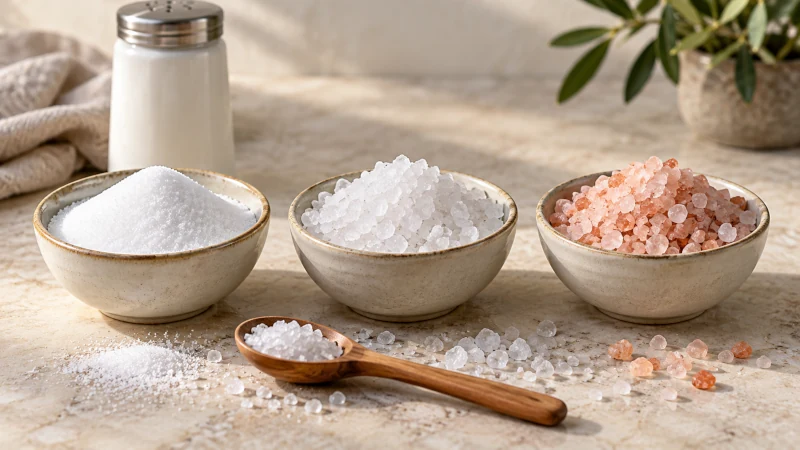
Sea salt is usually just as salty as table salt — both are typically about 40% sodium by weight [AHA, 2024]. Specialty salts, including sea salt, kosher salt, Himalayan salt, and fleur de sel, are usually not iodized, and almost all salt used in processed foods isn’t either [NIH ODS, 2024]. That matters because iodized salt is a main source of iodine, which your thyroid needs; WHO recommends that any salt you use be iodized [WHO, 2026]. If you salt food at home, iodized table salt is the practical choice. Our iodine guide explains why.
An earlier version of this page called Nova Scotia dulse and Norwegian kelp the best source of added salt. We’ve removed that advice. Dulse is fine as an occasional food, but it is rich in iodine and potassium. It may push potassium to dangerous levels in people with kidney problems, may worsen thyroid conditions, and can interact with thyroid medicines, amiodarone, digoxin, and some blood pressure drugs [WebMD/TRC, n.d.]. Seaweed is a food to enjoy with some care, not a salt strategy.
What about aluminum in table salt?
You may have read that free-flowing table salt should be avoided because of aluminum and Alzheimer’s disease. Whether aluminum plays any role in Alzheimer’s is still unresolved: researchers have reported conflicting findings, and the cause of the disease and any link with aluminum remain unknown [CCOHS, 2022]. Aluminum is also present in ordinary food and drinking water [CCOHS, 2022]. That is weak ground for trading iodized salt for an un-iodized specialty salt. If you want to know what’s in a particular brand, the ingredient list will tell you.
The real risk for most people: too much sodium
Excess sodium in your bloodstream pulls water into your blood vessels. More volume means more pressure, and your heart has to work harder. Over time, high blood pressure can overstretch and injure vessel walls and speed up the plaque buildup that blocks blood flow [AHA, 2025b]. Left uncontrolled, it raises the risk of heart attack, heart failure, stroke, kidney disease, and vision loss [FDA, 2024]. Blood pressure also tends to climb with age, so sodium matters more each decade [FDA, 2024].
People don’t all respond the same way. If you are salt-sensitive, sodium has a bigger effect on your blood pressure than it does in others [AHA, 2025b]. Still, the AHA notes that eating less sodium can help blunt the age-related rise in blood pressure even if your numbers are normal today [AHA, 2025b]. Globally, WHO estimates that about 1.7 million deaths in 2023 were associated with too much sodium, and links high-sodium diets to raised blood pressure, cardiovascular disease, gastric cancer, osteoporosis, Ménière’s disease, and kidney disease [WHO, 2026].
The stomach cancer link deserves a careful read. The World Cancer Research Fund found strong evidence that salt-preserved foods — salted meat and fish and salt-preserved vegetables, common in parts of Asia — are a cause of stomach cancer. Evidence on total salt intake, though, was inconclusive, possibly because salt intake is so hard to measure [WCRF, 2016]. So the old claim that everyday salt causes stomach cancer goes further than the data. The stronger case is against heavily salt-cured foods.
Sodium and potassium: the balance that matters
Low potassium raises the risk of high blood pressure, especially when sodium intake is high. Eating more potassium appears to lower blood pressure partly by relaxing blood vessels and helping your kidneys excrete sodium, and the effect seems strongest in salt-sensitive people [NIH ODS, 2022]. That is why advice on sodium increasingly comes paired with advice to eat more fruits, vegetables, beans, and dairy. Our article on how sodium, potassium, and magnesium work together for blood pressure goes deeper.
Two claims from the earlier version of this page didn’t hold up. We couldn’t find an authoritative source for a target 5:1 potassium-to-sodium ratio or for a 100:1 ratio from a produce diet, so we’ve removed them. And the line “you cannot get too much potassium” is wrong for some people. If you have chronic kidney disease or take an ACE inhibitor or a potassium-sparing diuretic, even ordinary dietary amounts of potassium can build up to dangerous levels (hyperkalemia) [NIH ODS, 2022].
Potassium salt substitutes
Swapping regular salt for a potassium-enriched substitute is one of the few changes with outcome data behind it. In the Salt Substitute and Stroke Study, about 21,000 people in 600 villages in rural China — all with a past stroke, or aged 60 or older with high blood pressure — used either regular salt or a substitute made of 75% sodium chloride and 25% potassium chloride. Over about 4.7 years, the substitute group had lower rates of stroke (rate ratio 0.86), major cardiovascular events (0.87), and death (0.88), and serious events attributed to high potassium were not significantly more common [Neal et al., 2021]. WHO now suggests replacing regular table salt with lower-sodium substitutes that contain potassium [WHO, 2026].
Two caveats. A U.S. government review found that at least part of the blood pressure benefit of these products may come from the sodium cut rather than the added potassium [NIH ODS, 2022]. And the potassium content of salt substitutes ranges widely, from about 440 to 2,800 mg per teaspoon, so people with kidney disease or on potassium-raising medications should check with their clinician first [NIH ODS, 2022]. The trial’s results can’t be assumed to apply to those groups.
Can you get too little sodium?
From diet alone, rarely. WHO calls sodium deficiency extremely unlikely in healthy people [WHO, 2026], and healthy kidneys are good at holding on to the sodium you need [AHA, 2025a]. The AHA adds that there is no reliable evidence that eating less than 1,500 mg a day is risky for most people [AHA, 2025a].
Low blood sodium — hyponatremia — is real, but it’s usually a water-balance problem, not a too-little-salt problem. Normal blood sodium runs about 136 to 144 mmol/L. Levels can drop with diuretic medicines (“water pills”), vomiting, diarrhea, heavy sweating, extensive burns, heart failure, kidney disease, cirrhosis, and a hormone condition called SIADH [MedlinePlus, 2025]. Symptoms include headache, nausea and vomiting, fatigue, muscle weakness or cramps, confusion, restlessness, and in severe cases seizures or coma. Sodium that falls quickly, over less than 48 hours, is more dangerous than a slow decline [MedlinePlus, 2025].
The low-sodium guidance also doesn’t fit everyone. The AHA notes its 1,500 mg goal may not apply to people who lose large amounts of sodium in sweat, such as competitive athletes and workers exposed to major heat — foundry workers and firefighters, for example — or to anyone whose healthcare team has told them otherwise [AHA, 2025a]. During sports or other vigorous activity, drinks that contain electrolytes help keep blood sodium in a healthy range [MedlinePlus, 2025].
Sodium benefits and risks: how strong is the evidence?
| Claim | Evidence | Notes |
| Sodium is essential for fluid balance, nerves, and muscles | Established | Basic physiology [WHO, 2026] [AHA, 2025b] |
| Excess sodium raises blood pressure | Strong | Effect varies; larger in salt-sensitive people [AHA, 2025b] |
| Cutting sodium lowers cardiovascular risk | Strong (largely via blood pressure) | Consensus of AHA, FDA, WHO [AHA, 2025b] [FDA, 2024] [WHO, 2026] |
| Potassium salt substitutes reduce stroke and death | One large randomized trial | Older, high-risk adults in rural China [Neal et al., 2021] |
| Salt-preserved foods cause stomach cancer | Strong for those foods | Total salt intake: inconclusive [WCRF, 2016] |
| Intake under 1,500 mg/day is harmful | Not supported for most people | Exceptions: heavy sweaters, some medical conditions [AHA, 2025a] |
| Sea salt is healthier than table salt | Not supported | Similar sodium; usually not iodized [AHA, 2024] [NIH ODS, 2024] |
| Aluminum in salt causes Alzheimer’s | Insufficient / conflicting | Cause and any link unknown [CCOHS, 2022] |
Practical ways to land in the healthy range
Because most sodium arrives already in the food, the biggest gains come from what you buy and order, not from the shaker. These tips come largely from the FDA [FDA, 2024]:
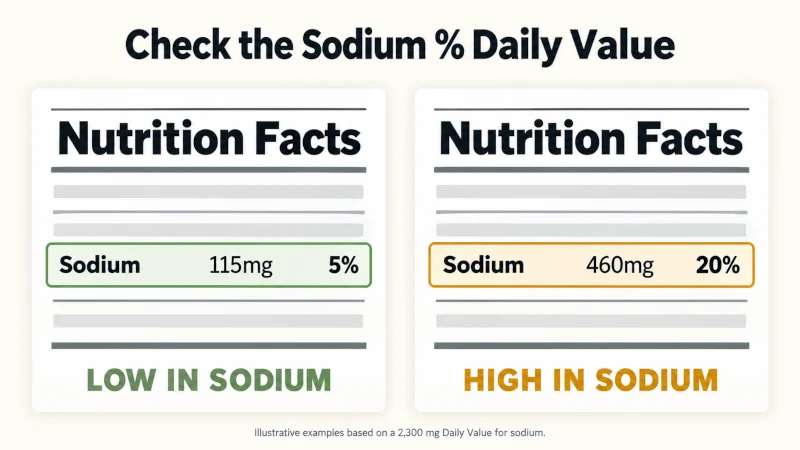
- Read the label. Compare similar products and favor those at 5% Daily Value or less per serving. Check the serving size — two servings means double the sodium.
- Cook more of your own food, and go easy on packaged sauces, seasoning mixes, instant noodles, and flavored rice.
- Buy fresh meat, poultry, and seafood rather than processed versions, and check fresh poultry for added salt water or saline.
- Rinse canned beans, tuna, and vegetables, or choose no-salt-added versions.
- Season with herbs, spices, citrus, and vinegar instead of salt.
- At restaurants, ask for less salt and get sauces and dressings on the side.
If you do salt at the table, try an old tip that survives from the earlier version of this page: pour a small amount into your palm first, so you can see how much you’re using, then add it to your food. Give your taste buds a few weeks. As you cut back, your taste for salt gradually decreases [FDA, 2024].
Pregnancy, breastfeeding, and children
Sodium needs don’t rise during pregnancy or breastfeeding; the Adequate Intake stays at 1,500 mg a day [NASEM, 2019]. What does rise is iodine — pregnant women need about 50% more [NIH ODS, 2024] — so if you salt your food, iodized salt is the better pick. Avoid kelp or seaweed supplements unless your clinician recommends them: seaweeds such as dulse carry large amounts of iodine [WebMD/TRC, n.d.], and the adult upper limit for iodine is 1,100 mcg a day from all sources [NIH ODS, 2024].
Children need less sodium than adults, and the point at which they should cut back is lower too: 1,200 mg for ages 1–3, 1,500 mg for ages 4–8, and 1,800 mg for ages 9–13 [NASEM, 2019]. Don’t restrict or add salt to an infant’s diet without a pediatrician’s guidance.
When to talk to a healthcare professional
General targets are a starting point. Ask your doctor, pharmacist, or a registered dietitian for an individual sodium plan if any of these apply:
- You have high blood pressure, heart failure, chronic kidney disease, or liver cirrhosis.
- You take a diuretic, which can lower both sodium and potassium [MedlinePlus, 2025] [NIH ODS, 2022].
- You take an ACE inhibitor, an ARB, or a potassium-sparing diuretic and are thinking about a salt substitute or regular seaweed [NIH ODS, 2022] [WebMD/TRC, n.d.].
- You have a thyroid condition and eat seaweed often [WebMD/TRC, n.d.].
- You train for endurance events or work in serious heat [AHA, 2025a].
Get emergency care for confusion, seizures, severe headache with vomiting, or sudden extreme weakness — especially after drinking large amounts of water during a long event, after prolonged vomiting or diarrhea, or after starting a new diuretic. These can signal dangerously low blood sodium, which can be life-threatening [MedlinePlus, 2025]. If you use a potassium salt substitute, seek prompt care for heart palpitations, muscle weakness, or a burning or prickling feeling in your limbs, which can be signs of high potassium [NIH ODS, 2022].
| Health Disclaimer: This article is for general education and is not medical advice. It can’t account for your blood pressure, kidney function, medications, or medical history. Sodium and potassium needs differ from person to person, and for some people — including those with kidney disease, heart failure, or who take diuretics or certain blood pressure medicines — general advice may not be safe. Talk with a qualified healthcare professional before making large changes to your salt intake, using a salt substitute, or taking seaweed or electrolyte supplements. If you think you are having a medical emergency, call 911 or your local emergency number. |
Frequently Asked Questions
How much sodium do I need per day?
Healthy adults need about 1,500 mg a day (the Adequate Intake), and should cut back if they eat more than 2,300 mg [NASEM, 2019] [NASEM, 2019]. The body can function on less than 500 mg [AHA, 2025a]. Most Americans eat about 3,400 mg [FDA, 2024].
What are the main benefits of sodium?
Sodium keeps your blood volume and blood pressure stable, helps regulate acid-base balance, and lets nerves send signals and muscles contract [WHO, 2026] [AHA, 2025b]. You get those benefits at modest intakes; eating more doesn’t add more benefit.
Is sea salt or Himalayan salt healthier than table salt?
Not in any meaningful way. Sea salt is typically about 40% sodium, like table salt [AHA, 2024], and specialty salts usually aren’t iodized [NIH ODS, 2024]. Iodized table salt is the more useful choice for home cooking.
What are the signs of low sodium?
Headache, nausea, vomiting, fatigue, muscle cramps or weakness, confusion, and in severe cases seizures [MedlinePlus, 2025]. It usually stems from fluid problems, medications, or illness rather than a low-salt diet, and sudden or severe symptoms need emergency care.
Are potassium salt substitutes safe?
For many people they are a helpful way to cut sodium, and a large trial linked them to fewer strokes and deaths in older, high-risk adults [Neal et al., 2021]. They are not safe for everyone: people with kidney disease or on potassium-raising medications should ask a clinician first [NIH ODS, 2022].
Does salt cause stomach cancer?
Salt-preserved foods such as salted fish, salted meat, and salt-pickled vegetables are a cause of stomach cancer. Evidence on total salt intake is inconclusive [WCRF, 2016].
References
- American Heart Association. How Much Sodium Should I Eat Per Day? View source
- American Heart Association. Get the Scoop on Sodium and Salt. View source
- American Heart Association. 7 Salty Sodium Myths Busted Infographic. View source
- U.S. Food and Drug Administration. Sodium in Your Diet: Use the Nutrition Facts Label and Reduce Your Intake. View source
- National Academies of Sciences, Engineering, and Medicine. Dietary Reference Intakes for Sodium and Potassium. Oria M, Harrison M, Stallings VA, eds. Washington, DC: National Academies Press; 2019. View source
- World Health Organization. Sodium reduction (fact sheet). View source
- MedlinePlus Medical Encyclopedia. Low blood sodium. View source
- NIH Office of Dietary Supplements. Potassium: Fact Sheet for Health Professionals. View source
- NIH Office of Dietary Supplements. Iodine: Fact Sheet for Consumers. View source
- WebMD (content licensed from Therapeutic Research Center). Dulse: Uses, Side Effects, and More. View source
- Fay S. Salt: shaking up the link with stomach cancer. World Cancer Research Fund. View source
- Canadian Centre for Occupational Health and Safety. Alzheimer’s Disease and Aluminum Exposure. View source
- Neal B, Wu Y, Feng X, et al. Effect of Salt Substitution on Cardiovascular Events and Death. View source


