
If you stir a yellow packet into your coffee every morning, here is the straight answer: for most people, Splenda at the amounts people normally use is not a proven health hazard. Its sweetener, sucralose, has been approved in the U.S. since 1998, and in 2026 Europe’s food safety agency re-examined the evidence and kept its safety limit unchanged [FDA, 2025] [EFSA, 2026a]. So is Splenda bad for you? Not in the way many viral posts claim.
That isn’t the same as saying it does nothing. Human studies have found effects on blood sugar, hunger signals, and gut bacteria in some people, and those studies don’t all agree. European risk assessors also flag a kitchen issue that rarely makes it onto packaging: heating sucralose to baking and frying temperatures [EFSA, 2026a]. And the World Health Organization advises against relying on any non-sugar sweetener to manage your weight [WHO, 2023].
What’s actually in a packet of Splenda
Splenda is the brand. Sucralose is the sweetener. It is made from ordinary table sugar in a process that swaps three of the sugar molecule’s hydroxyl groups for three chlorine atoms [FDA Final Rule, 1999], and the result is about 600 times sweeter than sugar [FDA, 2025].
Because so little is needed, the yellow packets are mostly filler. The ingredient list reads dextrose, maltodextrin, sucralose; each 1-gram packet carries about 1 gram of carbohydrate and is labeled zero calories [Splenda packet label, 2026]. Liquid and drink-mix products are formulated differently, so check the label on whatever you use.
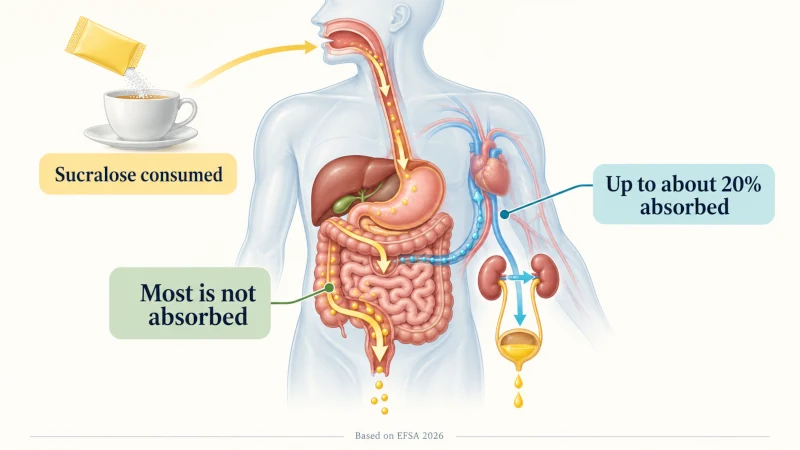
Most of the sucralose you swallow never reaches your bloodstream. EFSA’s scientific panel puts human absorption at no more than about 20%, with the majority leaving the body unchanged in stool and urine [EFSA FAF Panel, 2026].
Yes, it contains chlorine. Here’s why that alone doesn’t settle it
You will see sucralose called “chlorinated sugar” and lined up next to pesticides, solvents and bleach. The chlorine atoms are real. The comparison isn’t useful, because what a molecule does in your body depends on its whole structure, not on one element it shares with something toxic. Table salt is sodium chloride, and you eat it daily. The question that matters is what sucralose itself does at the doses people consume, and that is what the rest of this article is about.
What the FDA and European regulators concluded
The FDA approved sucralose for 15 food categories in 1998 and as a general-purpose sweetener in 1999. Before doing so, it reviewed more than 110 studies looking for effects on the reproductive and nervous systems, cancer, and metabolism, along with human clinical trials on metabolism and in people with diabetes [FDA, 2025]. The agency’s position is that approved high-intensity sweeteners are safe for the general population under their conditions of use [FDA, 2017].
Europe went further back over the evidence more recently. In February 2026, EFSA finished a full re-evaluation of sucralose that drew on research published between 1999 and March 2025. Its experts confirmed the existing acceptable daily intake and found that even the highest estimates of what Europeans actually consume stay below it in every population group [EFSA, 2026b]. They also concluded that sucralose and its impurities and breakdown products raise no genotoxicity concern [EFSA FAF Panel, 2026].
How much Splenda is a lot?
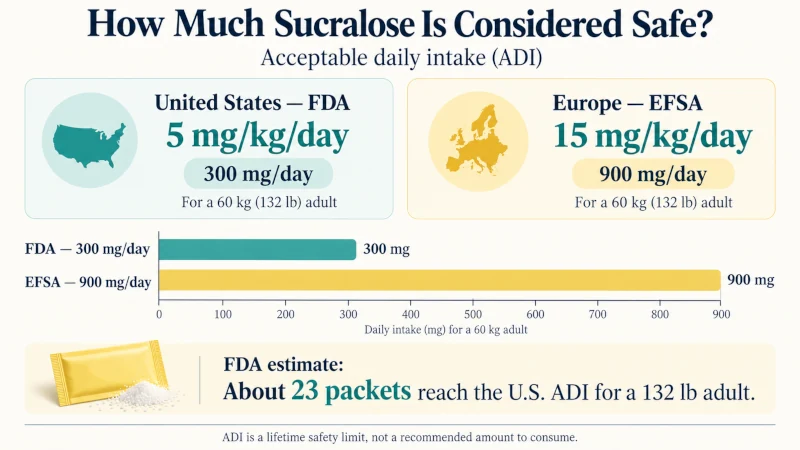
An acceptable daily intake (ADI) is the amount considered safe to eat every day for a lifetime. Regulators build it by finding the highest dose that caused no harm in animal studies and dividing by a safety factor, so the limit sits well below where problems were seen [FDA, 2025]. The U.S. and Europe chose different numbers:
| U.S. (FDA) | Europe (EFSA) | |
| Acceptable daily intake | 5 mg per kg of body weight [FDA, 2025] | 15 mg per kg of body weight [EFSA, 2026a] |
| 132-lb (60 kg) adult | 300 mg/day — about 23 packets [FDA, 2025] | 900 mg/day |
| 150-lb (68 kg) adult | About 340 mg/day | About 1,020 mg/day |
The 60 kg packet figure is FDA’s; the other per-person figures are simple arithmetic from each agency’s ADI. Sucralose in diet drinks, yogurt and other foods counts toward the same total.
For perspective, when FDA expanded sucralose to all foods, it estimated that even a heavy consumer at the 90th percentile would take in about 2.4 mg per kg per day — roughly half the U.S. limit [FDA Final Rule, 1999].
Is Splenda bad for you? Where the evidence is still open
Regulatory approval answers one question: is there a known toxic effect at normal doses? It doesn’t answer whether sucralose subtly shifts how your body handles food. That second question is where the active research is, and the findings are uneven.
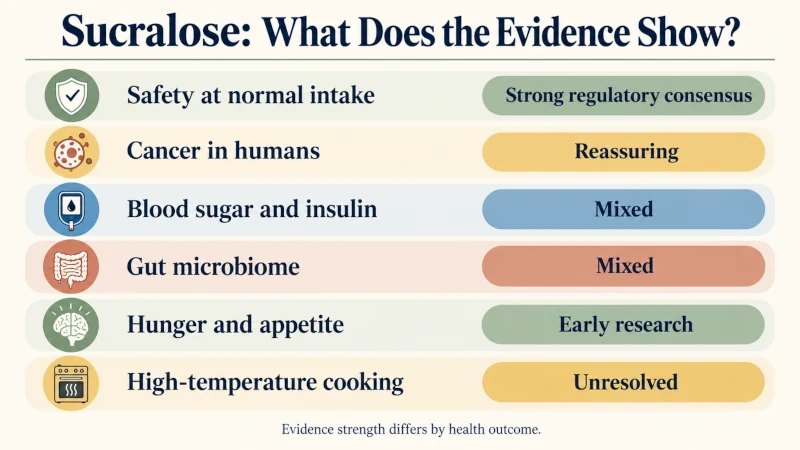
Evidence at a glance
| Question | What the evidence shows | Strength |
| Safe at normal intake? | FDA approval; EFSA’s 2026 re-evaluation kept its intake limit and found exposure below it [FDA, 2025] [EFSA, 2026a] | Strong regulatory consensus |
| Cancer in people | No evidence it causes cancer; a large French cohort found no association [NCI, 2023] | Reassuring |
| Blood sugar and insulin | Some trials show changes; pooled short trials show none [Suez et al., 2022] [Wulandari et al., 2026] | Mixed |
| Hunger signals | One acute brain-imaging trial [Chakravartti et al., 2025] | Early |
| Gut bacteria | Changes in some trials, no consistent pattern when pooled [Suez et al., 2022] [Wulandari et al., 2026] | Mixed |
| Weight control | WHO advises against relying on it; trials replacing sugary drinks show small benefits [WHO, 2023] [NCI, 2023] | Mixed |
| DNA damage | A related impurity damaged DNA in lab cells; EFSA found no genotoxicity concern [Schiffman et al., 2023] [EFSA FAF Panel, 2026] | Lab signal only |
| Baking and frying | Chlorinated by-products can’t be ruled out at home cooking temperatures [EFSA, 2026a] [BfR, 2026] | Unresolved — regulators advise caution |
Blood sugar and insulin: mixed
Sucralose contains no sugar, and the FDA notes that high-intensity sweeteners generally won’t raise blood sugar on their own [FDA, 2017]. The harder question is whether sucralose changes how you respond to the sugar you eat alongside it.
In a small 2013 crossover study, 17 adults with obesity who didn’t normally use sweeteners drank either sucralose or water before a glucose drink. After sucralose, their blood sugar peaked higher and their insulin response was larger [Pepino et al., 2013]. A 2022 randomized trial in healthy adults found that sucralose, taken as a group, impaired glucose responses — but the effect varied a lot from person to person and tracked with changes in each participant’s gut bacteria [Suez et al., 2022].
Other trials have found little. A 2026 meta-analysis pooling seven randomized trials in healthy adults found no significant effect of sucralose on fasting blood sugar or insulin resistance. Its authors are candid about the limits: the trials were small, most lasted under four weeks, and the analysis had low statistical power to detect modest effects [Wulandari et al., 2026].
Taken together, the evidence doesn’t show that Splenda causes diabetes, and it doesn’t show sucralose is metabolically inert either. If you have diabetes or prediabetes, your own readings tell you more than any average — our guide to what your blood sugar numbers mean is a useful reference.
Hunger and appetite: early
A 2025 randomized crossover trial put 75 young adults through brain scans after drinking water, a sugar drink, or a sucralose drink matched for sweetness. Compared with sugar, sucralose increased blood flow in the hypothalamus — the brain’s appetite-control center — and people reported feeling hungrier. Compared with water, sucralose still increased hypothalamic blood flow but didn’t change hunger ratings [Chakravartti et al., 2025]. The effects were strongest in participants with obesity, and women showed larger brain changes than men [Keck School of Medicine of USC, 2025].
This measured a single drink over a couple of hours. It suggests a mechanism worth studying; it doesn’t show that Splenda makes anyone gain weight.
Gut bacteria: mixed
Sucralose that isn’t absorbed travels on to your colon, where your gut bacteria live. In the 2022 trial, sucralose changed the composition of participants’ stool and oral microbiomes [Suez et al., 2022]. The 2026 meta-analysis, however, found no significant effect on gut microbial diversity or on the short-chain fatty acids bacteria produce, and composition shifts went in different directions in different studies [Wulandari et al., 2026].
If gut health is your priority, what you add to your plate probably matters more than one sweetener. These foods with good evidence for gut health are a sensible place to start.
Weight control: the WHO’s position
In 2023, the WHO recommended against using non-sugar sweeteners — sucralose and stevia included — as a way to control weight. Its review found no long-term benefit for body fat and hinted at possible long-term risks, including type 2 diabetes and heart disease, in adults [WHO, 2023]. Two caveats are easy to miss: the WHO rated the recommendation conditional, because people who use sweeteners may differ in other ways that explain the disease links, and it doesn’t apply to people who already have diabetes [WHO, 2023].
Randomized trials paint a slightly kinder picture. In one trial of adults with overweight, people drinking sucralose-sweetened drinks didn’t gain weight while those drinking sugar did, and a meta-analysis of 17 trials found that swapping sugary drinks for low- or no-calorie versions led to small improvements in body weight [NCI, 2023]. A sensible reading: switching from regular soda to a diet version can be a useful step, and water or unsweetened drinks are the better long-term goal.
The “DNA damage” headline
In 2023, researchers reported that sucralose-6-acetate — a compound that occurs as an intermediate and impurity in sucralose manufacturing — damaged DNA in human cells grown in the lab. They found it at up to 0.67% in commercial sucralose samples, and in rodents it showed up in feces at up to 10% of the sucralose level. In lab-grown gut tissue, both sucralose and the impurity made the gut lining leakier [Schiffman et al., 2023].
Those are real laboratory findings, and they prompted headlines warning that Splenda damages DNA. What they haven’t shown is that people eating sucralose get enough of the impurity to cause harm. EFSA weighed this research in its 2026 re-evaluation and concluded there is no genotoxicity concern for sucralose or its impurities [EFSA FAF Panel, 2026]; it also noted that the compounds found in the rat study may have been impurities already present rather than products of digestion [NC State University via ScienceDaily, 2026]. A separate 2026 study of commercial-grade sucralose, written partly by authors affiliated with a sucralose manufacturer, reported mostly negative genetic-toxicity results, though one test picked up DNA-damage signals; it tested commercial sucralose, not the isolated impurity [NC State University via ScienceDaily, 2026].
Fair summary: a laboratory warning sign that regulators have looked at and not found convincing for people, with questions about the impurity itself still open.
Cancer: reassuring so far
According to the National Cancer Institute, a range of studies have found no evidence that sucralose causes cancer in humans. The large French NutriNet-Santé cohort, which linked some other sweeteners to slightly higher cancer risk, found no association for sucralose [NCI, 2023].
The heating question most labels don’t mention
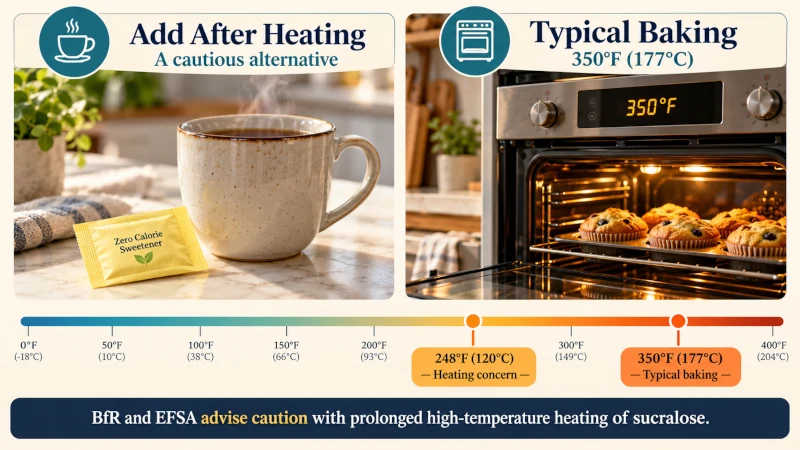
Here is where the regulators don’t speak with one voice. The FDA describes sucralose as heat stable and suitable for baking [FDA, 2025]. Germany’s Federal Institute for Risk Assessment (BfR) sees it differently: when sucralose is heated above 120 °C (248 °F) for a prolonged time, it gradually breaks down and releases chlorine, which can form chlorinated organic compounds with harmful potential [BfR, 2026].
EFSA’s 2026 review sided with caution on this point. Its experts couldn’t confirm the safety of expanding sucralose into more baked goods, and they said the formation of chlorinated compounds during home baking or frying, where temperatures and cooking times vary widely, can’t be excluded [EFSA, 2026a]. They added that the currently authorized industrial uses aren’t expected to reach those conditions [EFSA, 2026b].
Most home baking happens around 350 °F (about 175 °C), well above that 248 °F threshold. Until the question is settled, BfR’s advice is simple: don’t heat foods containing sucralose to baking, frying or roasting temperatures, or add sucralose after cooking [BfR, 2026]. Stirring it into coffee, tea, or a finished dish isn’t the concern here.
Claims you’ll run into online
| Claim | What the evidence shows |
| “Sucralose is chlorinated sugar, basically bleach or DDT.” | It does carry three chlorine atoms [FDA Final Rule, 1999]. Safety depends on the whole molecule, and sucralose itself has been tested across more than 110 studies [FDA, 2025]. |
| “It was barely tested in humans before approval.” | FDA reviewed more than 110 studies, including human clinical trials on metabolism and in people with diabetes [FDA, 2025]. EFSA’s 2026 review covered research published through March 2025 [EFSA, 2026b]. |
| “It builds up in your body fat for years.” | Absorption is low — no more than about 20% — and most of the dose leaves the body unchanged [EFSA FAF Panel, 2026]. |
| “Animal studies show it shrinks and swells organs.” | High-dose animal findings are exactly what safety limits are built from: regulators take the highest dose that caused no harm and divide it by a safety factor [FDA, 2025]. |
| “It’s natural because it’s made from sugar.” | It starts as sugar but is a manufactured food additive, regulated as one [FDA, 2025] [FDA Final Rule, 1999]. |
| “Zero calories, so use as much as you like.” | Packets are mostly dextrose and maltodextrin, about 1 gram of carbohydrate each [Splenda packet label, 2026]. Small, but it adds up across a day. |
Who should be more careful with Splenda
If you have diabetes or prediabetes
Sucralose is one of the few sweeteners the WHO specifically leaves open to people with diabetes [WHO, 2023], and it generally won’t raise blood sugar by itself [FDA, 2017]. Still, the packets do contain a little carbohydrate [Splenda packet label, 2026], and the research on insulin responses is mixed. Check your readings after sucralose-sweetened foods to learn your own response, and build sweetener choices into your broader plan — our list of foods that support steadier blood sugar can help.
Pregnancy and breastfeeding
Nemours KidsHealth, whose guidance is medically reviewed by pediatricians, says most FDA-approved low-calorie sweeteners are fine in moderation during pregnancy. Research continues, and some studies suggest that heavy sweetener use in pregnancy may be linked to a higher chance of the child being overweight later [Nemours KidsHealth, 2023]. We didn’t find authoritative guidance specific to sucralose during breastfeeding, so if you’re nursing and use a lot of it, ask your doctor or a lactation consultant.
Children
No source we reviewed sets a separate safety limit for children beyond the body-weight-based ADI. The WHO’s broader advice is to reduce how sweet the diet is overall, starting early in life [WHO, 2023]. That points toward water and milk as everyday drinks rather than routinely swapping sugar for sucralose.
Medications
None of the regulatory reviews we checked identify drug interactions with sucralose. In the 2023 laboratory study, the impurity sucralose-6-acetate blocked two liver enzymes, CYP1A2 and CYP2C19, that help clear some medicines [Schiffman et al., 2023]. Whether that happens in people at real-world doses is unknown. If you take a medication with a narrow dosing window and use a lot of sucralose, it’s a reasonable question for your pharmacist.
If you think Splenda bothers you
Some people say sucralose gives them headaches, bloating or other symptoms. Group studies can miss individual reactions, so take your own experience seriously. The FDA’s advice is to stop using the sweetener and talk with your healthcare provider [FDA, 2017].
A simple test can help: cut out sucralose for one to two weeks, then reintroduce it and notice how you feel. Avoid other sweeteners during the test so you can tell which one is involved. Keep expectations calibrated — a home trial can’t separate a real reaction from expectation, and it isn’t a diagnosis. If symptoms continue after you stop, look for another cause with your doctor.
If you’d rather use less
Wanting less of something doesn’t require believing it’s poison. If you’d like to cut back:
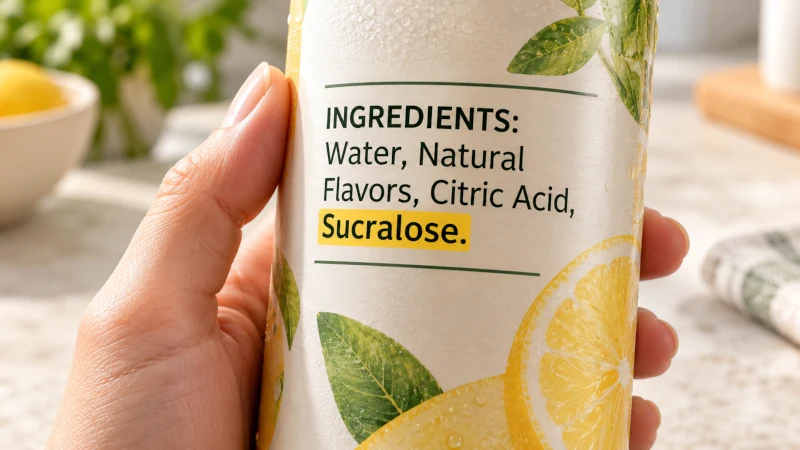
- Read ingredient lists. Sucralose appears by name in U.S. products and as E 955 in Europe [EFSA, 2026b]. It turns up in diet drinks, yogurts, protein products and “no sugar added” snacks.
- Don’t bake or fry with it until the heating question is resolved. Add it after cooking, or choose a recipe sweetened another way [BfR, 2026].
- Count the packets. If you’re using many a day, cutting the number back is an easy first step.
- Swap one drink at a time. Replacing one daily sweetened drink with sparkling water or unsweetened tea tends to stick better than an overnight overhaul. Our step-by-step guide to cutting back on sugar covers the practical side.
- Don’t assume “natural” sweeteners are a free pass. FDA has not objected to purified stevia and monk fruit extracts as safe ingredients [FDA, 2017], but the WHO’s weight-control advice covers stevia too [WHO, 2023]. The goal is less sweetness overall, not a better-sounding sweetener.
We cover the other common tabletop sweetener in detail in our guide to aspartame and who should actually avoid it.
When to talk to a doctor
Sucralose isn’t a known cause of medical emergencies. But symptoms people sometimes blame on a sweetener can have causes that need attention.
Call 911 or go to an emergency room if you have:
- Swelling of the lips, tongue or throat, or trouble breathing after eating or drinking anything
- Fainting, confusion, or a very high or very low blood sugar reading that won’t correct, if you have diabetes
- Severe abdominal pain, vomiting blood, or black, tarry stools
Make an appointment if:
- Your blood sugar readings have changed and you can’t explain why
- Digestive symptoms persist for weeks even after you’ve stopped sucralose
- You’re pregnant, planning a pregnancy or breastfeeding and use sweeteners heavily
- You want help building a lower-sugar eating plan — a registered dietitian is a good fit
| HEALTH DISCLAIMER This article is for general education. It is not medical advice, a diagnosis, or a treatment plan, and it cannot account for your health history or medications. Sweetener choices are personal, and the research on sucralose is still developing. If you have diabetes, are pregnant or breastfeeding, are choosing foods for a child, or take medication, talk with your doctor, a registered dietitian, or a pharmacist before making significant changes. Never adjust diabetes medication because of something you read here. If you have signs of a severe allergic reaction, call 911 or your local emergency number. |
Frequently Asked Questions
How many Splenda packets a day is safe?
FDA estimates that a 132-pound (60 kg) person would need about 23 packets a day to reach the U.S. acceptable daily intake [FDA, 2025]. That limit has a safety margin built in, and sucralose from drinks and foods counts toward it too.
Is Splenda better than sugar?
They carry different risks. Excess added sugar has well-established downsides, while sucralose’s risks are less certain and appear smaller. But the WHO found no long-term body-fat benefit from non-sugar sweeteners [WHO, 2023]. Using less of both is the better aim.
Does Splenda raise blood sugar or insulin?
On its own it generally doesn’t raise blood sugar [FDA, 2017]. Some studies found that sucralose taken before sugar increased glucose and insulin responses [Pepino et al., 2013] [Suez et al., 2022], while pooled short trials found no effect on fasting glucose or insulin resistance [Wulandari et al., 2026]. The evidence is mixed.
Can I bake with Splenda?
FDA considers sucralose heat stable for baking [FDA, 2025], but German and European risk assessors say harmful chlorinated compounds can’t be ruled out when it is heated above 120 °C (248 °F), as happens in home baking and frying [BfR, 2026] [EFSA, 2026a]. Until that’s resolved, the cautious choice is to add sucralose after cooking.
Does Splenda cause cancer?
The National Cancer Institute says studies have found no evidence that sucralose causes cancer in humans, and a large French cohort found no link [NCI, 2023].
Is Splenda safe during pregnancy?
Most FDA-approved low-calorie sweeteners are considered fine in moderation during pregnancy, though research continues [Nemours KidsHealth, 2023]. Talk with your obstetric provider if you use a lot.
References
- U.S. Food and Drug Administration. Aspartame and Other Sweeteners in Food. → View source
- U.S. Food and Drug Administration. High-Intensity Sweeteners. → View source
- U.S. Food and Drug Administration. Food Additives Permitted for Direct Addition to Food for Human Consumption; Sucralose. → View source
- European Food Safety Authority. EFSA finds sucralose safe when used as currently authorised; cannot confirm safety of extending its use. → View source
- European Food Safety Authority. PLS: Re-evaluation of sucralose (E 955) as a food additive. → View source
- EFSA Panel on Food Additives and Flavourings (FAF); Castle L, et al. Re-evaluation of sucralose (E 955) as a food additive and evaluation of a new application on extension of use of sucralose (E 955) in fine bakery wares. → View source
- German Federal Institute for Risk Assessment (BfR). Sucralose – Heating above 120 °C can produce substances that are harmful to health. → View source
- World Health Organization. WHO advises not to use non-sugar sweeteners for weight control in newly released guideline. → View source
- National Cancer Institute. Artificial Sweeteners and Cancer. → View source
- Pepino MY, Tiemann CD, Patterson BW, Wice BM, Klein S. Sucralose affects glycemic and hormonal responses to an oral glucose load. Diabetes Care. → View source
- Suez J, Cohen Y, Valdés-Mas R, et al. Personalized microbiome-driven effects of non-nutritive sweeteners on human glucose tolerance. Cell. → View source
- Chakravartti SP, Jann K, Veit R, et al. Non-caloric sweetener effects on brain appetite regulation in individuals across varying body weights. → View source
- Keck School of Medicine of USC. Calorie-free sweeteners can disrupt the brain’s appetite signals. → View source
- Wulandari DT, Andarwulan N, Saraswati, Palupi E, Średnicka-Tober D. Effect of Sucralose Consumption on Gut Microbiota: A Systematic Review and Meta-Analysis of Randomized Controlled Trials. → View source
- Schiffman SS, Scholl EH, Furey TS, Nagle HT. Toxicological and pharmacokinetic properties of sucralose-6-acetate and its parent sucralose: in vitro screening assays. J Toxicol Environ Health B Crit Rev. → View source
- North Carolina State University. Popular sweetener byproduct damages DNA in human cells. → View source
- Nemours KidsHealth. Using Artificial Sweeteners During Pregnancy. → View source
- Splenda Zero Calorie Sweetener, 50-count packets — ingredient and nutrition panel as listed by ShopRite (Wakefern Food Corp.). → View source


