
A gummy labeled “hemp” might be candy with a little hemp seed oil in it, a CBD product that avoids the word “CBD,” or something with no hemp in it at all. That’s the honest answer to the hemp gummies vs CBD gummies question: the names overlap on the shelf, but the contents don’t have to.
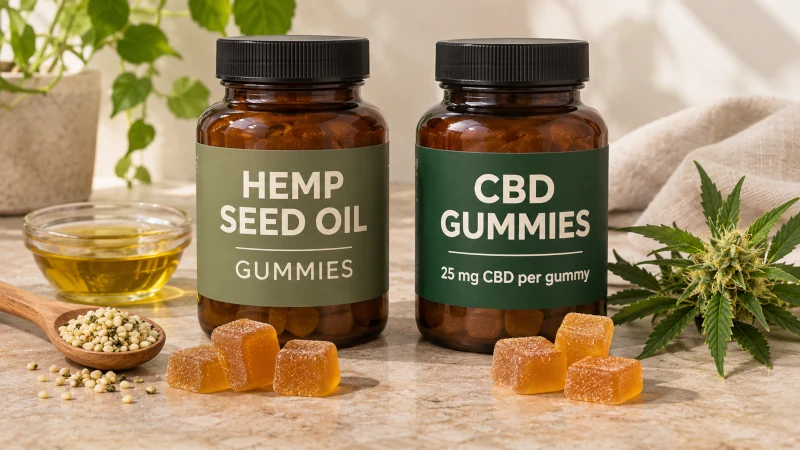
A true hemp gummy is made with oil pressed from hemp seeds, and hemp seeds don’t naturally contain THC or CBD [FDA, 2024]. A CBD gummy contains cannabidiol extracted from the plant’s flowers and leaves, usually with a milligram amount printed on the label. The first is a food ingredient. The second is an active compound that the FDA links to possible liver harm and medication interactions [FDA, 2023]. That difference matters most if you take prescription drugs, are pregnant, or get drug tested for work.
Hemp gummies vs CBD gummies at a glance
| Hemp seed oil gummies | CBD gummies | |
| Main ingredient | Oil pressed from hemp seeds | Cannabidiol (CBD) extract |
| Plant part | Seeds | Flowers and leaves |
| CBD | None naturally; trace amounts at most | Usually listed in mg per gummy |
| THC | Trace amounts at most | None (isolate), non-detectable (broad spectrum), or small amounts (full spectrum) |
| Can it make you high? | No, according to the FDA | Not expected from CBD; full-spectrum products carry small amounts of THC |
| Drug-test risk | Low | Low for pure CBD; real for full-spectrum products |
| Best evidence | Hemp seed is a nutritious food; gummies themselves are untested | One prescription CBD drug for specific seizure disorders; limited evidence for anxiety, sleep and pain |
| Federal food status | Hulled seed, seed protein and seed oil cleared for food use | FDA says CBD cannot be added to food or sold as a dietary supplement |
Sources: [FDA, 2024], [NCCIH, 2019], [Spindle et al., 2020], [Dahlgren et al., 2020].
Seeds vs. flowers: why the plant part changes everything
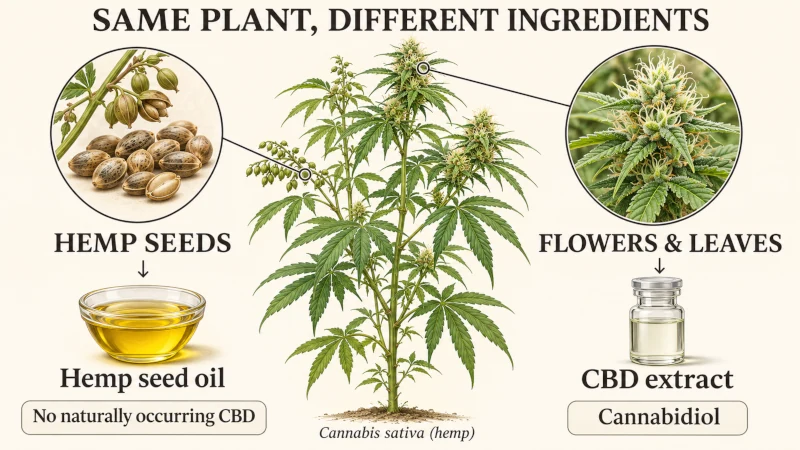
Both products start with Cannabis sativa, but they use different parts of it. Hemp seed is a real food. It typically contains more than 30% oil and about 25% protein, and its oil is rich in the two essential fatty acids, linoleic acid (omega-6) and alpha-linolenic acid (omega-3), usually in a ratio between 2:1 and 3:1 [Callaway, 2004]. If you want the background on those two fats, our guide to what essential fatty acids actually do covers it.
The FDA reviewed hulled hemp seed, hemp seed protein powder and hemp seed oil in 2018 and had no questions about their safety as foods. The agency notes the seeds pick up only trace THC or CBD from other parts of the plant during harvesting and processing, and that eating them can’t make you high [FDA, 2024].
CBD is a different story. It comes from the flowers and leaves, and the FDA treats it as a drug ingredient because it’s the active ingredient in an approved medicine, Epidiolex. That’s why the agency says CBD can’t be added to food or sold as a dietary supplement [FDA, 2024]. In 2023 the FDA went further, saying neither the food nor the supplement rules are a good fit for CBD and that it won’t write rules to allow it [FDA, 2023].
Why “hemp” on the label tells you so little
Here’s the part most comparison articles skip. “Hemp” is a legitimate word for a seed-oil product, but it’s also a convenient word for sellers who want to avoid saying “CBD.” Amazon’s seller guidance says it doesn’t allow consumable CBD, yet gummies promoting “hemp extract” with CBD-style benefits are common there [CBD Oracle, 2024b].
When CBD Oracle, a CBD consumer publication, bought 56 popular “hemp” products on Amazon in early 2024 and sent them to an accredited lab, only 30% contained CBD. About 62% had no detectable cannabinoids, 43% showed no sign of hemp at all, and 11% contained THC. Only two products came within 10% of their labeled dose [CBD Oracle, 2024a]. That investigation wasn’t peer reviewed and used a small, non-random sample, so treat the exact percentages loosely. The pattern still matters: the word on the front of the bottle doesn’t tell you what’s inside.
Products that do say “CBD” aren’t reliably accurate either. In a JAMA study of 84 CBD products bought online, 31% were labeled within 10% of their actual CBD content, 43% contained more CBD than stated, 26% contained less, and THC turned up in 18 of them [Bonn-Miller et al., 2017]. That study tested oils, tinctures and vape liquids rather than gummies, but Mayo Clinic makes the same broader point: CBD sold as foods or supplements hasn’t been rigorously tested for safety, quality or label accuracy [Mayo Clinic, 2026].
How to read the label
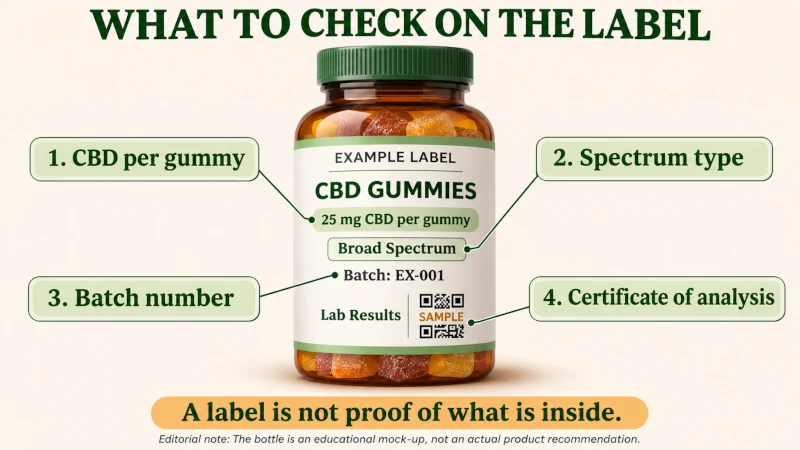
You can usually sort a gummy in under a minute if you know where to look.
- Find the milligram number. A CBD gummy will normally state milligrams of CBD (or cannabidiol) per gummy. If the label says only “hemp oil” or “hemp seed oil” and gives no cannabinoid amount, you’re most likely looking at a seed-oil product.
- Be suspicious of a big “hemp” number with nothing named. “Hemp extract 1,000 mg” doesn’t tell you how much CBD, if any, is in each piece.
- Check the spectrum type. Sellers use three terms, explained below. They change your THC exposure.
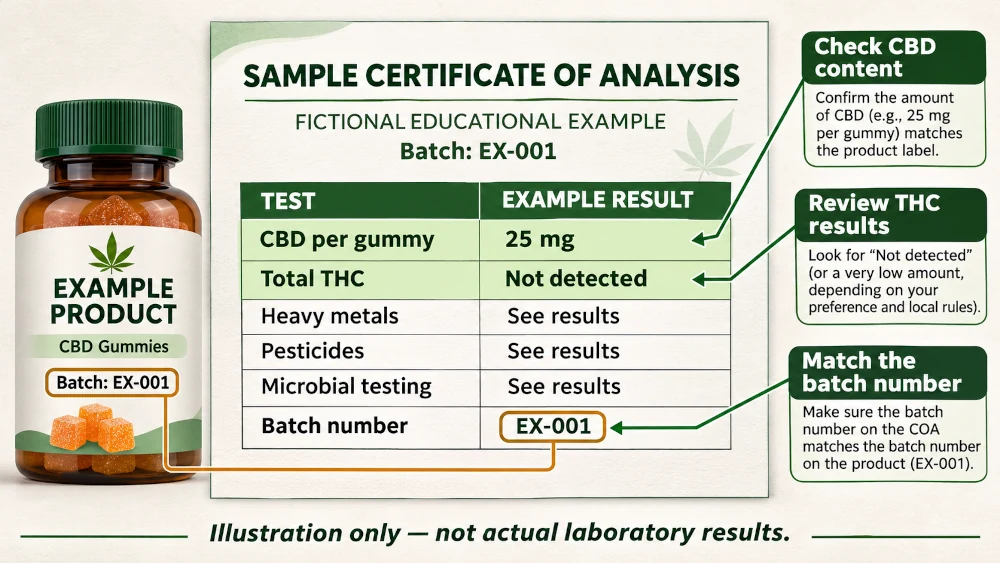
- Ask for a batch-matched certificate of analysis (COA). This is a third-party lab report. The batch number on it should match the one on your package, and it should list both CBD and THC per gummy. Better reports also cover contaminants such as pesticides, heavy metals and microbes, which the FDA has received reports about in CBD products [FDA, 2019].
- Treat treatment claims as a red flag. The only FDA-approved CBD product is Epidiolex, a prescription oral solution for certain rare seizure conditions [Mayo Clinic, 2026]. A gummy promising to fix pain, anxiety or insomnia is making a claim no regulator has accepted.
Isolate, broad spectrum, full spectrum
These are marketing terms, but they’re used fairly consistently. Isolate contains CBD alone. Broad spectrum contains CBD plus other hemp compounds, with THC reduced to levels the lab can’t detect. Full spectrum keeps a small amount of THC. If you’re drug tested or want no THC at all, isolate or broad spectrum with a COA showing non-detectable THC is the safer choice, though not a guarantee (see the drug-test section below). Our CBD gummies buyer’s guide goes through specific products using these checks.
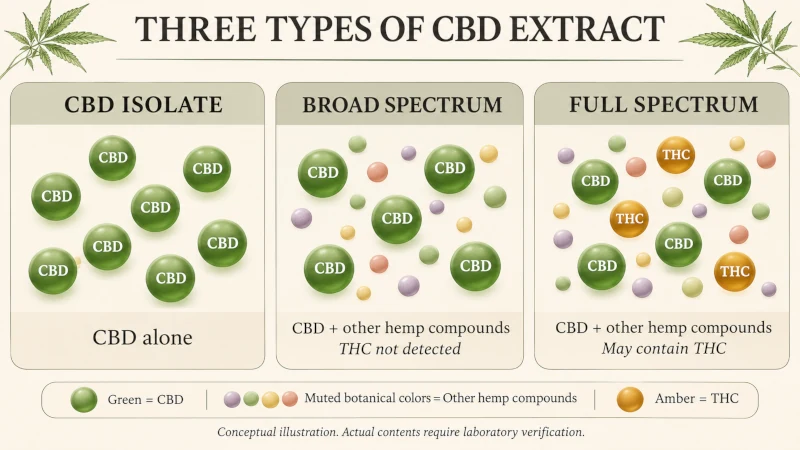
What each one can realistically do
Hemp seed gummies: nutrition, in small doses
Hemp seed’s protein and fat profile is well documented [Callaway, 2004]. The catch is the format. A gummy is mostly sweetener and gelling agent, so unless the label lists a meaningful amount of oil or omega-3 per serving, assume the hemp content is small. Claims about better skin, hair, mood or energy rest on the nutrient profile of the seed, not on studies of hemp gummies. If hemp nutrition is what you want, a spoonful of hulled hemp seeds on yogurt or salad gets you far more of it, without the sugar.
CBD gummies: one proven use, and it isn’t a gummy
CBD has solid evidence in exactly one setting. The FDA approved Epidiolex for seizures linked to Lennox-Gastaut syndrome, Dravet syndrome and tuberous sclerosis complex in patients 1 year and older [FDA, 2024]. That’s a prescription drug, dosed and monitored by a doctor.
For the reasons most people buy gummies, the evidence is thin. One small study of 24 people with social anxiety disorder found less anxiety during a simulated public-speaking test after CBD than after placebo. In people without other illnesses, the effect of cannabinoids on sleep is uncertain. For chronic pain, the research on cannabinoids as a group shows a small benefit, mostly for nerve pain, with more side effects than placebo [NCCIH, 2019]. Mayo Clinic’s 2026 summary puts it plainly: there isn’t much proof CBD works for uses like anxiety [Mayo Clinic, 2026].
| Use | Evidence strength | What that means for you |
| Seizures in Lennox-Gastaut, Dravet or TSC | Strong (FDA-approved drug) | Applies to prescription Epidiolex, not store-bought gummies |
| Anxiety | Limited, early | Small studies only; may help some people, unproven as a treatment |
| Sleep | Insufficient | Unclear in people without other health conditions |
| Chronic pain | Limited | Small benefit for cannabinoids overall, mostly nerve pain; not specific to CBD gummies |
| Hemp seed nutrition | Well established for the seed | Not studied as a gummy; amounts per gummy are usually small |
Sources: [FDA, 2024], [NCCIH, 2019], [Mayo Clinic, 2026], [Callaway, 2004].
If stress is what you’re trying to fix, compare CBD with options that have been studied more, such as those in our review of cortisol and stress supplements or our look at calming herbs and their risks. Diet plays a part too; see foods that may help with anxiety.
Will either one get you high or fail a drug test?
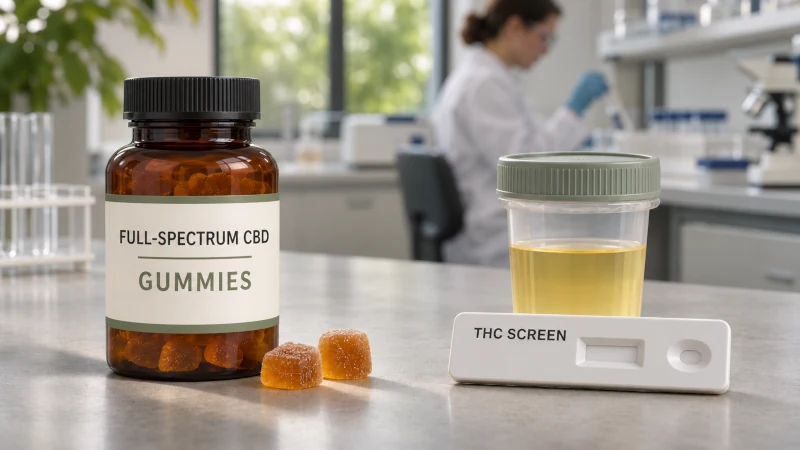
Hemp seed products can’t make you high [FDA, 2024]. CBD isn’t expected to either. In a four-week trial where people took a full-spectrum CBD extract daily, averaging about 0.8 mg of THC a day, none reported feeling psychoactive effects [Dahlgren et al., 2020].
Drug tests are a different question, because they look for a THC breakdown product, not for CBD. In a small study of six adults, a single 100 mg dose of pure CBD did not produce a confirmed positive urine test, but a CBD-rich product containing THC did [Spindle et al., 2020]. In the four-week full-spectrum trial, half the participants who finished (7 of 14) tested positive for THC [Dahlgren et al., 2020].
So pure CBD is low risk, full spectrum is a real risk, and labels aren’t always right about which one you have. Over-the-counter CBD products can contain THC that isn’t listed [NCCIH, 2019]. If a positive test would cost you a job, a license or a custody case, the cautious answer is to skip CBD products.
The legal picture changes on December 11, 2026
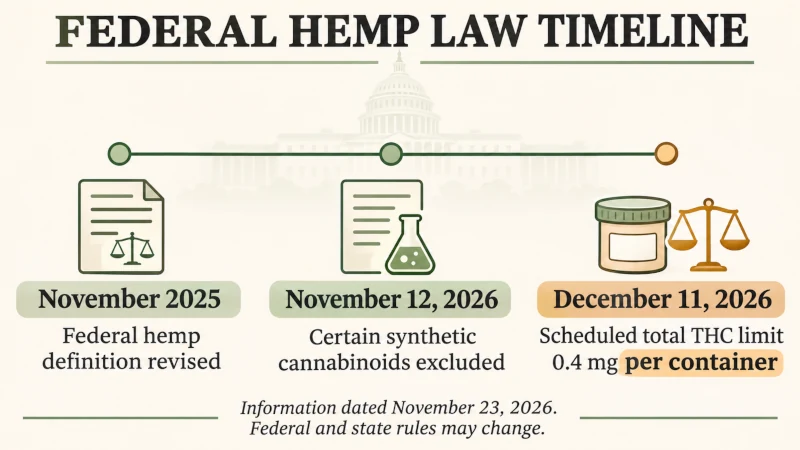
Federal law passed in November 2025 rewrote the definition of legal hemp, and it’s taking effect in two steps. Since November 12, 2026, hemp products may contain only cannabinoids the plant can naturally produce, which excludes synthetic ones. Starting December 11, 2026, the law counts total THC rather than delta-9 THC alone and limits finished hemp-derived cannabinoid products to 0.4 mg of total THC per container [Vicente LLP, 2026].
CBD itself isn’t banned. But a full-spectrum CBD gummy bottle whose THC adds up to more than 0.4 mg per container would fall outside the federal hemp definition on that date [Vicente LLP, 2026]. As of mid-November 2026, Congress hadn’t passed a further delay; a bill that would keep hemp-derived THC legal for adults 21 and older under new rules had been introduced but not voted on [WRAL, 2026]. State laws vary on top of this, so check your state’s rules and expect brands to reformulate.
Safety: side effects, interactions and who should skip CBD
Hemp seed oil gummies raise few concerns beyond sugar content and the mislabeling problem above. Gummies of any kind look like candy, though, so store them where children can’t reach them. CBD needs more care.
Common side effects of CBD
Reported side effects include sleepiness, mood changes, decreased appetite and diarrhea [NCCIH, 2019], as well as rash, vomiting, tiredness and liver injury [Mayo Clinic, 2026]. The FDA has also flagged possible harm to the male reproductive system [FDA, 2023]. People who regularly use THC may be more prone to psychotic effects or thinking problems when they add CBD [NCCIH, 2019].
Medication interactions
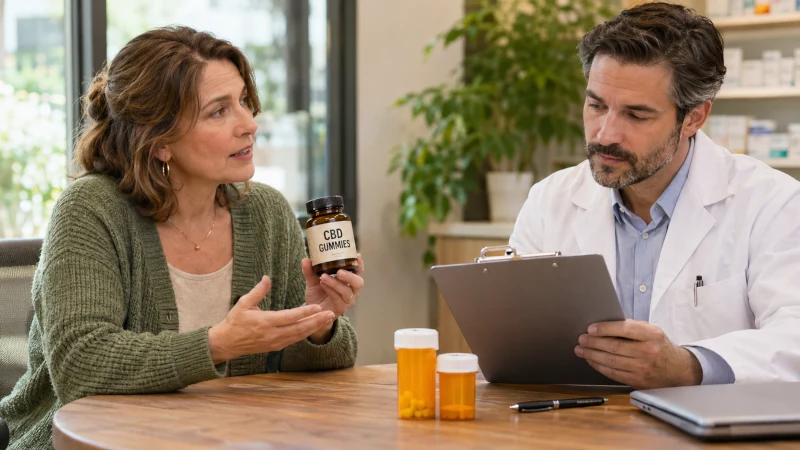
CBD can interact with other medicines and raise the risk of side effects. Mayo Clinic names blood thinners, antiseizure drugs and sedatives as examples [Mayo Clinic, 2026]. The Epidiolex label adds detail: CBD affects how the liver processes a number of drugs, combining it with valproate raises the risk of liver-enzyme problems, and alcohol or other sedating drugs can add to drowsiness [Epidiolex label, 2026]. Those label findings come from prescription doses. How much they apply at the lower doses in a gummy is less well studied, but the FDA still lists drug interactions among its main CBD safety concerns [FDA, 2023]. If you take any daily medication, ask a pharmacist before starting CBD.
Pregnancy and breastfeeding
The FDA advises avoiding CBD, THC and marijuana in any form while pregnant or breastfeeding. Research in people is lacking; in pregnant animals, high doses caused reproductive problems in developing male fetuses. Some CBD is expected to pass into breast milk, and products may be contaminated with THC or other substances that could reach the baby [FDA, 2019].
Who should avoid CBD gummies or check with a clinician first
- People who are pregnant, trying to conceive or breastfeeding
- Children, unless a doctor has prescribed a CBD medicine
- Anyone with liver disease or abnormal liver tests
- People taking blood thinners, antiseizure drugs, sedatives or several daily medications
- Anyone subject to workplace, sports or legal drug testing
- People who regularly use THC and have a history of psychosis
When to get medical help
Stop CBD and call a clinician promptly if you notice signs that the Epidiolex label lists for liver problems: loss of appetite, nausea or vomiting, unusual tiredness, itching, yellowing of the skin or eyes, dark urine, or pain in the upper right side of your belly [Epidiolex label, 2026].
If a child eats a gummy, or an adult has a strong reaction to one (which can happen if a “hemp” product secretly contains THC), call Poison Help at 1-800-222-1222. Call 911 if the person is unconscious or having trouble breathing [HRSA Poison Help, n.d.].
And if you’re reaching for gummies night after night for anxiety, insomnia or pain, that’s a sign to see a clinician. Those problems have treatments with far better evidence.
Which one fits what you want?
- You want hemp nutrition: eat hulled hemp seeds or use hemp seed oil in food. A gummy is a costly, sugary way to get a small amount.
- You want to try CBD for stress or sleep: set modest expectations, pick a product with a batch-matched COA, choose isolate or broad spectrum if THC is a concern, start with the lowest serving on the label, and tell your doctor or pharmacist.
- You want zero chance of THC: a seed-oil product from a reputable food brand is the safer bet, and even then, check the ingredient list.
- You’re pregnant, on regular medication or have liver problems: skip CBD or talk to a clinician first.
| HEALTH DISCLAIMER: This article is for general education and isn’t a substitute for advice from a doctor, pharmacist or other qualified health professional. CBD can interact with medications and isn’t appropriate for everyone. Talk with a healthcare provider before using CBD or hemp products, especially if you’re pregnant, breastfeeding, taking medication or managing a health condition. Hemp and CBD laws change and differ by state; check current rules where you live. |
Frequently Asked Questions
Are hemp gummies the same as CBD gummies?
Not necessarily. A true hemp gummy uses hemp seed oil, which has no meaningful CBD. A CBD gummy lists milligrams of cannabidiol. Because some sellers use “hemp” to avoid saying “CBD,” check the label for a milligram amount and a lab report.
Will hemp gummies make me fail a drug test?
A genuine hemp seed oil gummy is low risk, since the seeds carry only trace THC [FDA, 2024]. The bigger risk is a mislabeled product: lab testing of popular “hemp” products sold online has found undeclared THC in some [CBD Oracle, 2024a].
Can I take CBD gummies with my medications?
Ask a pharmacist first. CBD can interact with blood thinners, antiseizure drugs and sedatives, among others [Mayo Clinic, 2026], and it adds to drowsiness from alcohol and other sedating drugs [Epidiolex label, 2026].
Are CBD gummies still legal after December 11, 2026?
CBD isn’t banned federally, but finished hemp-derived products are limited to 0.4 mg of total THC per container from that date unless Congress changes the law [Vicente LLP, 2026]. Many full-spectrum gummies won’t meet that limit. State rules also apply.
Do hemp gummies help with sleep or anxiety?
There’s no good evidence that hemp seed oil gummies do. Evidence for CBD is limited for anxiety and uncertain for sleep in otherwise healthy people [NCCIH, 2019].
Is it safe to take CBD gummies while pregnant or breastfeeding?
The FDA advises against using CBD in any form during pregnancy or while breastfeeding [FDA, 2019].
References
- U.S. Food and Drug Administration. FDA Regulation of Cannabis and Cannabis-Derived Products, Including Cannabidiol (CBD). View source
- Food and Drug Administration. FDA Concludes that Existing Regulatory Frameworks for Foods and Supplements are Not Appropriate for Cannabidiol, Will Work with Congress on a New Way Forward. View source
- U.S. Food and Drug Administration. What You Should Know About Using Cannabis, Including CBD, When Pregnant or Breastfeeding. View source
- EPIDIOLEX (cannabidiol) oral solution, full prescribing information and Medication Guide. View source
- National Center for Complementary and Integrative Health. Cannabis (Marijuana) and Cannabinoids: What You Need To Know. View source
- Mayo Clinic Staff. Is CBD safe and effective? View source
- Bonn-Miller MO, Loflin MJE, Thomas BF, Marcu JP, Hyke T, Vandrey R. Labeling accuracy of cannabidiol extracts sold online. View source
- Dahlgren MK, Sagar KA, Lambros AM, Smith RT, Gruber SA. Urinary tetrahydrocannabinol after 4 weeks of a full-spectrum, high-cannabidiol treatment in an open-label clinical trial. View source
- Spindle TR, Cone EJ, Kuntz D, et al. Urinary pharmacokinetic profile of cannabinoids following administration of vaporized and oral cannabidiol and vaporized CBD-dominant cannabis. View source
- Callaway JC. Hempseed as a nutritional resource: an overview. Euphytica. View source
- Johnson L. Liars Ruling the Roost: Lab Testing Reveals the Reality Behind Amazon’s Hemp Market. CBD Oracle, View source
- Johnson L. Don’t Ask; Don’t Tell: Study Reveals Amazon’s Hidden Market for THC Gummies. View source
- Vicente LLP. Federal Hemp Definition Change: Synthetic and Artificial Cannabinoids Now Prohibited. View source
- WRAL. In Depth: Last call for hemp-derived THC? Nationwide ban looms. View source
- Poison Help (HRSA). The Poison Help Guide to Edible Marijuana Safety. View source


