
Creatine gummies vs powder has become one of the most common supplement questions in 2026, now that chewable creatine products fill every fitness aisle.

Gummies look easier, taste better, and promise the same benefits as the old scoop-and-shaker routine. For most people, though, the real question is not which one tastes better. It is which option actually delivers an effective dose, better value per serving, and a label you can trust.
Current guidance from Harvard Health and the U.S. Department of Defense’s Operation Supplement Safety program still centers on creatine monohydrate as the most studied form, with common daily intake for ongoing use clustering around 3 to 5 grams per day [Harvard Health, 2024; OPSS, 2025].
This article compares the two formats honestly — dose accuracy, cost, ingredients, quality control, and who each one actually suits.
Quick answer
For most people, creatine powder is the better default choice. It is usually easier to dose, cheaper per effective serving, simpler from an ingredient standpoint, and more consistent from one batch to the next. Gummies can still make sense for travelers and people who know they will not stick with a powder — but only if the label is transparent and the brand provides real quality signals.
That conclusion is consistent with the current evidence base around creatine monohydrate, the way dietary supplements are regulated in the United States, and the quality concerns that have surfaced in recent independent testing of creatine gummy products [NIH ODS, 2025; Harvard Health, 2024; Athletech News, 2025].
What creatine actually does
Creatine helps regenerate adenosine triphosphate (ATP), the short-burst fuel your muscles rely on during heavy lifting, sprinting, and other high-intensity efforts. The NIH Office of Dietary Supplements explains that creatine helps supply muscles with energy for short-term, predominantly anaerobic activity, while Harvard Health describes it as contributing to rapid energy production and potentially supporting power or speed bursts in short anaerobic efforts [NIH ODS, 2025; Harvard Health, 2024].
This matters for the gummy-versus-powder question because the underlying decision is not really about format at all. What matters is whether you are getting creatine monohydrate, in a practical daily amount, from a product whose label you can trust. Harvard Health identifies creatine monohydrate as the most commonly used and most studied form, and OPSS likewise focuses its performance guidance on creatine monohydrate rather than newer variants [Harvard Health, 2024; OPSS, 2025].
Creatine gummies vs powder at a glance
| Factor | Creatine Powder | Creatine Gummies |
| Dose accuracy | Usually clear, scoop-based | Depends on gummy count and label honesty |
| Cost per effective serving | Typically lower | Typically higher |
| Ingredient simplicity | Often just creatine monohydrate | Adds sugars, gelling agents, flavors |
| Convenience | Good (needs water and a scoop) | Excellent (grab-and-go) |
| Quality-control concerns | Lower in recent testing | Higher; several gummies failed lab tests |
| Best for | Budget, control, consistency | Portability and travel routines |
The sections below walk through each of these factors in plain English so you can decide which one fits your situation [Harvard Health, 2024; OPSS, 2025; Athletech News, 2025].
1) Dose accuracy: powder usually wins
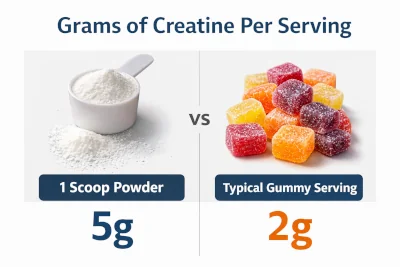
OPSS states that creatine monohydrate in amounts as low as 3 grams per day can be safe and effective at raising muscle creatine levels, and most maintenance guidance falls in the 3 to 5 grams per day range. Harvard Health gives the same general range for daily adult use [OPSS, 2025; Harvard Health, 2024].
With powder, a single scoop typically delivers 3 to 5 grams. Gummies are less straightforward. The format itself is not the issue — the issue is that gummies often contain smaller amounts per piece, which means you may need three, four, or even five gummies to match one scoop of powder. That makes label clarity essential.
A simple rule makes this easier: if a gummy label does not clearly show how many pieces add up to roughly 3 to 5 grams of creatine monohydrate, treat it as a warning sign and move on.
2) Cost per effective serving
Price tags on the shelf are not the number that matters. What matters is the cost per serving that actually delivers enough creatine to do something. Gummies usually lose on this math because they add packaging, binders, sweeteners, and manufacturing complexity, and because several pieces are often needed to match what a powder scoop provides in one step.
A cleaner way to compare two creatine products is:
Real cost per serving = price ÷ number of servings that actually deliver 3–5 g of creatine
Run that math on most creatine products and powder comes out ahead for any buyer who is focused on long-term value [OPSS, 2025; Harvard Health, 2024].
3) Ingredient simplicity
If cleaner labels matter to you, powder usually wins again. Many quality creatine powders contain one ingredient: creatine monohydrate. Gummies, by contrast, need sweeteners, gelling agents (gelatin or pectin), flavor systems, coloring, and sometimes preservatives simply to become a chewable candy. Harvard Health explicitly notes that supplements may contain other ingredients that could be unsuitable for some users [Harvard Health, 2024].
For a natural-health audience this is a real decision point, not a technicality. A supplement that is easier to take is not automatically better. Before you buy a creatine gummy, scan the label for:
- Form: confirm it says creatine monohydrate
- Grams per serving: how many gummies equal 3–5 g
- Sugars and sweeteners: total and type
- Gelling agent: gelatin vs pectin if that matters to you
- Colors, flavors, and fillers: natural or synthetic
4) Quality control: the biggest reason to be careful with gummies
This is the most important section of the article. The NIH Office of Dietary Supplements explains that dietary supplements are not reviewed by the FDA for safety and effectiveness before they are marketed, the way prescription and over-the-counter medications are.
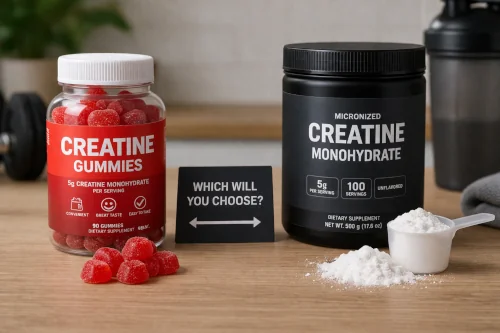
ODS specifically recommends looking for products that carry third-party certification as a way to gain added assurance that what is on the label is actually in the bottle. Harvard Health makes the same broader point that the FDA does not regulate the accuracy of supplement contents [NIH ODS, 2025; Harvard Health, 2024].
That general caution becomes especially relevant with creatine gummies because recent independent lab testing has flagged serious label-accuracy problems in this specific category.
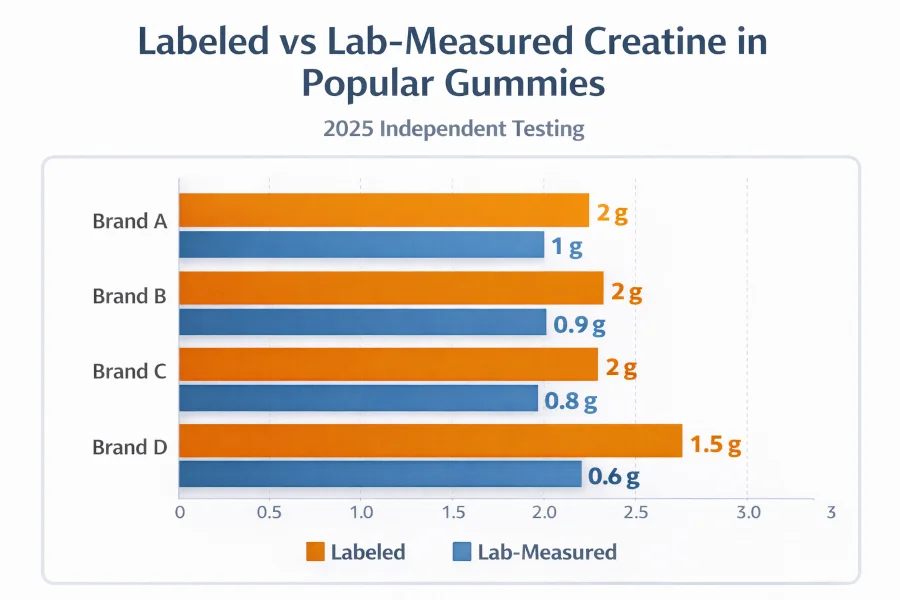
In 2025, supplement-testing platform SuppCo commissioned an ISO-17025-accredited lab to test six popular creatine gummy products sold on Amazon. Four of the six contained almost no creatine at all, with some delivering as little as 0.005 grams per serving despite label claims of around 5 grams [Athletech News, 2025].
Separately, supplement manufacturer NOW Foods tested twelve creatine gummy brands using high-performance liquid chromatography.
Nearly half of the tested gummies failed to meet label claims, and several of the failing products also contained significant levels of creatinine — a breakdown product that suggests the creatine has degraded during manufacturing [NOW/SupplySide Supplement Journal, 2025].
Both rounds of testing point to the same underlying problem: creatine is stable as a dry powder but can degrade into creatinine when exposed to water, heat, and acidity — exactly the conditions used to manufacture gummies.
That does not mean every creatine gummy on the market is weak or fake. It does mean buyers should demand stronger quality signals in this category than they might for a straightforward powder. Before you buy a creatine gummy, look for all four of the following:
- A label that clearly names creatine monohydrate as the active form
- A clearly stated grams-per-serving amount with serving size in number of gummies
- Third-party testing or certification (NSF, Informed Sport, USP, or a published Certificate of Analysis)
- Transparent batch-level lab reports rather than vague “tested for purity” marketing claims
5) Convenience and consistency
This is where gummies have a legitimate advantage. Some people travel constantly. Some dislike powders, shakers, or the taste of creatine mixed in water. Some know from experience that they are more likely to stay consistent with a chewable than a scoop-and-mix routine.
For those people, gummies may be the better behavioral fit, because the most effective supplement is the one you will actually take.
But convenience only counts if the product delivers the dose on the label. A convenient gummy that underdoses creatine is not really convenient — it is just a more pleasant way to spend money without getting the benefit you are paying for [Athletech News, 2025; NIH ODS, 2025].
Are creatine gummies as effective as powder?
They can be. If a creatine gummy uses creatine monohydrate, delivers enough of it per serving, and the label claim has been verified by third-party testing, there is a reasonable basis to expect it to work similarly to powder for the outcomes creatine is actually studied for — strength, power, and short-burst high-intensity performance.
The issue is not the gummy format in theory. The issue is that powder is easier to dose correctly, easier to compare between brands, less prone to degradation during manufacturing, and less exposed to the quality-control problems that have surfaced in parts of the gummy market [Harvard Health, 2024; OPSS, 2025; Athletech News, 2025].
Who should choose creatine powder?
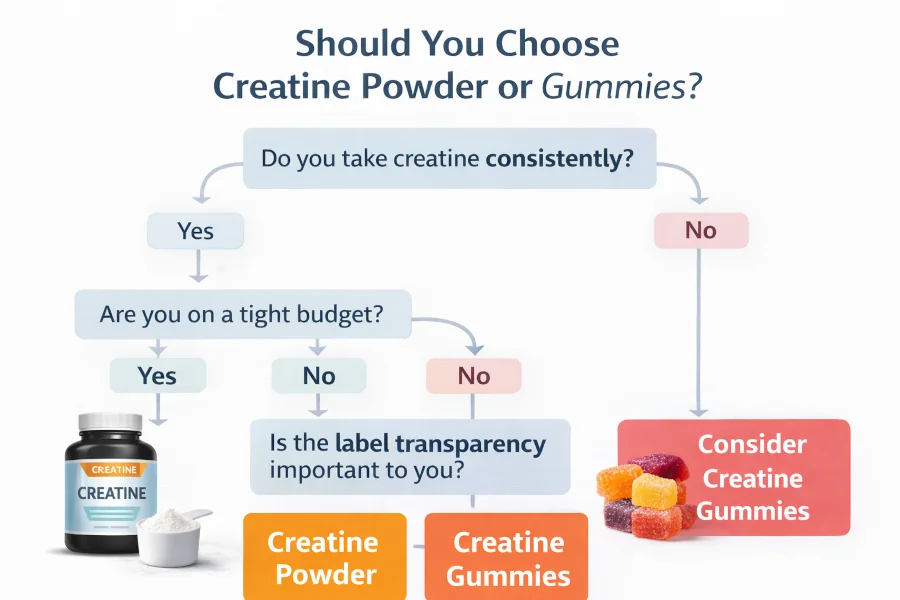
Choose powder if you want the safest default. It fits readers who care most about value, clear dosing, fewer added ingredients, and alignment with the strongest evidence base — which is specifically built around plain creatine monohydrate, not newer or trendier forms.
It also makes more sense for anyone taking creatine daily over several months, where small differences in cost and dose accuracy add up. If you also like comparing supplement options side by side, our guide to metformin vs berberine walks through a similar head-to-head breakdown for metabolic support [Harvard Health, 2024; NIH ODS, 2025].
Who should choose creatine gummies?
Choose gummies if convenience is literally the difference between taking creatine consistently and not taking it at all. That may apply to frequent travelers, beginners, and people who know they will not stick to a scoop-and-shaker routine.
In those cases the behavioral win matters more than small cost differences. Just make sure the serving size is clearly labeled and the brand provides real quality signals — third-party testing, published certificates of analysis, or recognized certifications.
If you read labels carefully on other gummy supplements, our guide to the best CBD gummies for sleep and anxiety uses a similar what-to-look-for approach [NIH ODS, 2025; Athletech News, 2025].
What to look for before you buy either format
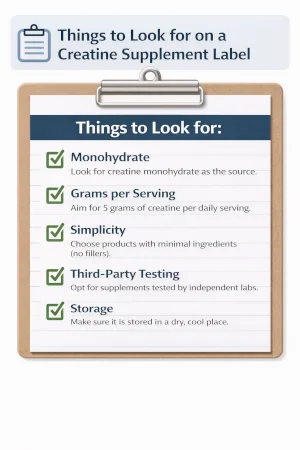
- Form: creatine monohydrate listed clearly on the label
- Dose: grams per serving stated, with a serving size that realistically reaches 3–5 g per day
- Simplicity: an ingredient list you can read without a dictionary
- Testing: third-party certification or published batch test results when available
- Storage: dry, sealed, and away from heat — especially important for gummies, where moisture can accelerate creatine degradation
That checklist mirrors the strongest themes across current guidance: monohydrate has the strongest research base, daily use commonly centers on 3 to 5 grams, and third-party testing is the main tool consumers have in a category where premarket approval is not required [Harvard Health, 2024; OPSS, 2025; NIH ODS, 2025].
Side effects, safety, and who should be cautious
Creatine is one of the most-studied sports supplements in existence, and for most healthy adults the typical maintenance dose is generally well tolerated.
Harvard Health states that 3 to 5 grams daily of creatine is generally safe for most adults, and specifically advises that people with kidney disease should talk with their doctor before using it.
Harvard also notes that some people retain a couple of pounds of fluid during the first week of supplementation, and OPSS notes that early weight gain during a loading protocol is mostly water retention [Harvard Health, 2024; OPSS, 2025].
The NIH ODS fact sheet also flags that exercise and athletic-performance supplements may cause side effects and may interact with medications, and recommends talking with a healthcare provider before starting anything new [NIH ODS, 2025].
Common anecdotal side effects reported with creatine include mild gastrointestinal upset, bloating, and muscle cramping — particularly at higher intakes or with inadequate hydration [OPSS, 2025].
Who should talk to a doctor before using creatine
- Anyone with kidney disease or a history of kidney problems
- Anyone on prescription medications, especially those affecting kidney function or blood pressure
- People who are pregnant or breastfeeding
- Adolescents, who are not the main study population in most creatine research
- People with a history of eating disorders or who are uncomfortable with short-term water weight gain
Realistic expectations
Creatine is not a stimulant. You are unlikely to feel anything on day one. Most users notice the small performance differences over weeks of consistent training, not in a single workout. If a product promises dramatic day-one results, that is a marketing claim, not science.
Final verdict
When it comes to creatine gummies vs powder, powder remains the better default choice in 2026. It is easier to dose, usually easier on your budget, easier to evaluate, and less exposed to the quality-control issues that have surfaced in parts of the gummy market.
Gummies can still be the right call for the right person — especially when convenience is the difference between taking creatine consistently and not taking it at all — but they come with a higher label-scrutiny burden [Harvard Health, 2024; OPSS, 2025; Athletech News, 2025].
Bottom line: choose powder for value, control, and a simpler label. Choose gummies only when convenience is genuinely the tradeoff and the brand gives you real, verifiable reasons to trust what is inside. For a similar side-by-side breakdown in another supplement category, see our colostrum vs collagen guide.
| Health Disclaimer: This article is for educational and informational purposes only. It is not medical advice and is not intended to diagnose, treat, cure, or prevent any disease. Creatine is a dietary supplement, and individual responses, medication interactions, and underlying health conditions vary. Always talk with a qualified healthcare professional — such as a physician, pharmacist, or registered dietitian — before starting, stopping, or changing any supplement, especially if you have kidney disease, take prescription medications, are pregnant or breastfeeding, or are giving supplements to a minor. |
Frequently Asked Questions
Are creatine gummies as effective as powder?
They can be, but only if they use creatine monohydrate, deliver enough grams per serving to reach 3–5 g per day, and the label claim holds up to testing. Powder is usually easier to dose accurately and easier to compare across brands [OPSS, 2025; Athletech News, 2025].
How much creatine should I take per day?
Current guidance commonly centers on 3 to 5 grams per day of creatine monohydrate for ongoing use. Some protocols use a short loading phase of around 20 g/day split into four doses for 5–7 days, followed by a 3–5 g maintenance dose, though loading is not required to eventually reach the same muscle saturation [Harvard Health, 2024; OPSS, 2025].
Is creatine powder better than gummies?
For most people, yes — especially on cost per effective serving, dose control, and ingredient simplicity. Gummies can still be the better choice when convenience is the real limiting factor for consistency [Harvard Health, 2024; NIH ODS, 2025].
Why did so many creatine gummies fail recent lab testing?
Creatine is stable as a dry powder but tends to break down into creatinine when exposed to water, heat, and acidity during gummy manufacturing. Independent testing in 2025 — including lab tests commissioned by SuppCo and in-house testing by NOW Foods — found that a significant share of popular gummy brands contained far less creatine than claimed [Athletech News, 2025; NOW/SupplySide Supplement Journal, 2025].
Do I need to “load” creatine?
No. A loading phase saturates muscles faster, but taking 3–5 g per day without loading reaches the same endpoint over a few weeks, without the early water-weight jump some people dislike [OPSS, 2025].
References
- SupplySide Supplement Journal. (2025, March 28). NOW Tests Creatine Gummies, Finding Almost Half to Be Severely Understrength. → View source
- Harvard Health Publishing. (2024). What Is Creatine? Potential Benefits and Risks of This Popular Supplement. Harvard Medical School. → View source
- National Institutes of Health, Office of Dietary Supplements. (2025). Dietary Supplements for Exercise and Athletic Performance — Fact Sheet for Health Professionals. → View source
- Operation Supplement Safety (OPSS). (2025, April 7). Creatine Monohydrate: Dietary Supplement for Performance. Consortium for Health and Military Performance, USU. → View source
- Athletech News. (2025, June 18). Top Creatine Gummies on Amazon Contain Little to No Creatine, Report Finds (covering SuppCo independent lab testing). → View source
