Most acerola cherry supplements look almost identical on the shelf — the same fruit on the label, the same promises about natural vitamin C and immune support — yet what ends up in the bottle varies a lot. The gap between a well-made acerola product and a forgettable one shows up in two places you actually care about: how much real vitamin C you get per serving, and how much you pay for it.
This is a buyer’s guide, not a product review. Below are seven checks you can run on any acerola supplement in about two minutes, whether you’re holding a bottle in a store or scrolling a product page online. Each check is grounded in how acerola is processed, how U.S. supplement labels are regulated, and what published research says about where the quality differences come from. For background on the fruit itself, see our complete acerola cherry guide.
| Educational note: This article is for general information and is based on research from reputable sources. It isn’t medical advice and shouldn’t replace guidance from a qualified healthcare professional. |
Acerola supplement forms at a glance
Before judging quality, it helps to know what you’re choosing between. Acerola comes in several formats, and each trades something off. The powder forms are where the biggest nutritional differences live; the rest is mostly about convenience and cost.
| Form | What it is | Best for | Trade-off |
| Freeze-dried powder | Whole fruit dried under vacuum at sub-zero temperatures | Highest nutrient retention; smoothies and recipes | Costs more; less precise dosing |
| Spray-dried powder | Juice dried with a maltodextrin carrier under heat | Lower price; drink mixes | Lower vitamin C density; contains a carrier |
| Capsules | Powder in a vegetable or gelatin shell | Convenience, travel, exact dosing | Slightly higher cost per mg of vitamin C |
| Tablets | Compressed powder, usually with binders | Low cost, long shelf life | May add fillers; harder to swallow for some |
| Gummies | Acerola extract with sweeteners and pectin | Kids and pill-averse users | Added sugar; less vitamin C per serving |
| Liquid extracts | Concentrated liquid in a dropper bottle | Easy dosing without swallowing pills | Often blended with other ingredients |
The 7 checks that separate good acerola cherry supplements from filler
1. A clearly stated milligram amount of vitamin C
This is the most important line on the label, and the easiest to verify. A good acerola supplement tells you exactly how many milligrams of vitamin C are in each serving — not just “500 mg of acerola extract” or “packed with vitamin C.” Those two numbers are not the same thing.
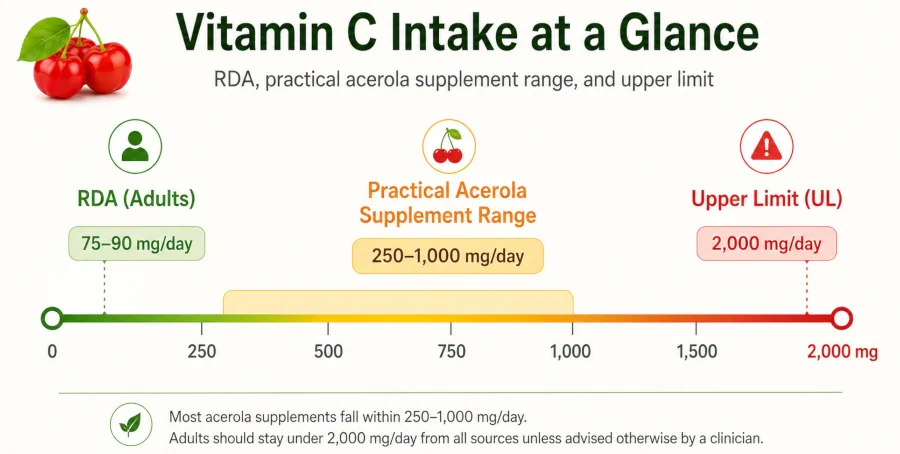
Acerola powders differ widely in how concentrated their vitamin C is, depending on how the fruit was grown, harvested, and dried [Delva & Schneider, 2013]. Without a stated milligram figure, you can’t compare two products or check your intake against the vitamin C reference values — 90 mg/day for adult men and 75 mg/day for adult women, with a tolerable upper limit of 2,000 mg/day for adults [NIH ODS, 2025].
Look for: wording like “Vitamin C (from acerola): 250 mg per serving.” Watch for: “naturally rich in vitamin C” with no number attached.
2. Acerola as the only source of vitamin C
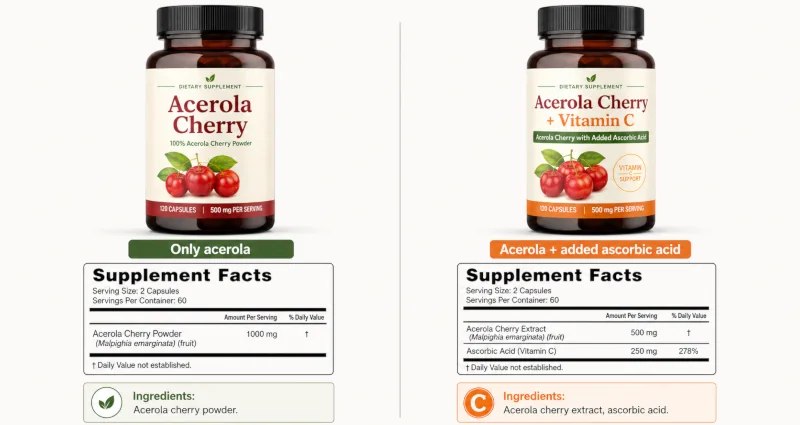
This is the check most buyers miss. Plenty of “natural” acerola supplements are actually synthetic ascorbic acid with a small amount of acerola blended in for the label. The acerola is decoration; the bulk of the vitamin C is manufactured.
That isn’t dangerous — synthetic and acerola-derived ascorbic acid are the same molecule, and the body absorbs them comparably [NIH ODS, 2025]. But it defeats the point of paying a whole-food premium. If you mainly want ascorbic acid, a plain vitamin C tablet costs far less.
Look for: an ingredient list where acerola (Malpighia emarginata) extract or fruit powder is the only vitamin C source. Watch for: “ascorbic acid,” “sodium ascorbate,” or “calcium ascorbate” listed separately alongside the acerola.
3. A disclosed processing method
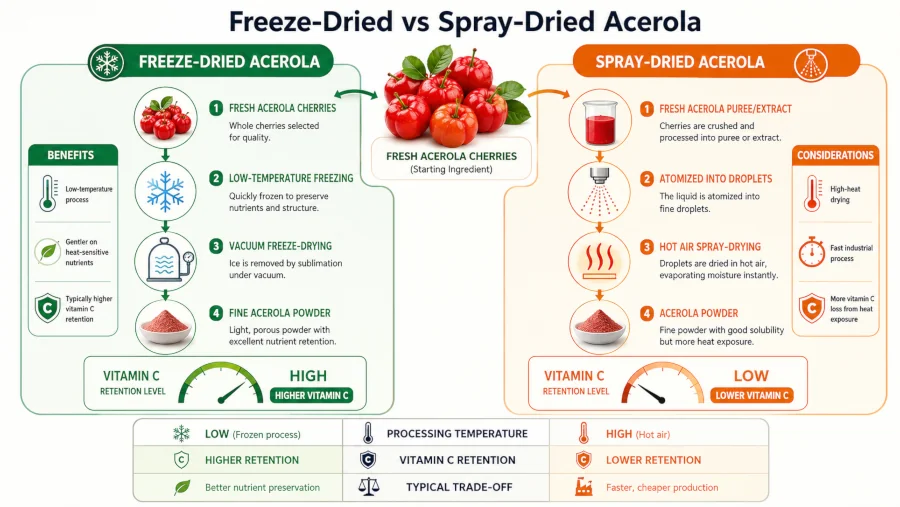
How the fruit is dried changes what’s in the bottle. Freeze-drying happens at sub-zero temperatures under vacuum, so no heat is applied and more of the vitamin C, polyphenols, color, and flavor survive. Spray-drying sprays juice into a heated chamber and needs a carrier — usually maltodextrin — to work, which both dilutes the powder and exposes the vitamin C to heat [Delva & Schneider, 2013].
Neither method is “bad.” Freeze-dried is more concentrated and carrier-free; spray-dried is cheaper and fine if you mainly want vitamin C. The problem is not knowing which one you’re paying for. Companies that freeze-dry almost always say so prominently, because it’s a selling point. If a label says nothing about processing, it’s reasonable to assume spray-dried.
4. A short, transparent ingredient list
The best acerola powders have strikingly short ingredient lists — sometimes a single line: organic acerola cherry. A little silicon dioxide (an anti-caking flow agent, usually under 2%) is acceptable, and spray-dried products will list maltodextrin as the carrier. What you don’t want is a wall of fillers, artificial colors, added sugars, or a “proprietary blend” that hides how much of each ingredient you’re getting.
Look for: three ingredients or fewer for a quality powder; capsules should name the shell material (vegetable cellulose if you avoid animal products). Watch for: “proprietary blend” wording, FD&C dyes, titanium dioxide, or a long list of excipients with no clear purpose.
5. Real organic certification, not just the word “natural”
Organic certification verifies that the acerola was grown without synthetic pesticides, herbicides, or fertilizers, and that sourcing, processing, and labeling met a defined standard with third-party oversight. That verification chain is the main practical benefit. It does not, by itself, guarantee more vitamin C — growing conditions, ripeness at harvest, and drying method drive the nutrient content more than the organic label does [Delva & Schneider, 2013].
Look for: a USDA Organic seal, EU Organic mark, or equivalent, with the certifying body named. Watch for: “natural,” “wild-crafted,” or “organic-style” with no certifier. Those words aren’t regulated and mean little on their own.
6. Independent third-party testing
In the United States, supplements are regulated by the FDA, but unlike prescription drugs they don’t need pre-market approval; manufacturers are responsible for safety and labeling, and the FDA acts after products reach the market [FDA, 2024]. That’s why independent testing matters — it’s the most reliable way to confirm what’s actually in a product.
Recognized verifiers include NSF and USP. An NSF or USP mark means an outside lab confirmed the contents match the label and screened for contaminants such as heavy metals [NSF] [USP]. A solid acerola supplement is tested for vitamin C content, heavy metals (lead, arsenic, cadmium, mercury), pesticide residues, microbial contamination, and ingredient identity. Some brands publish a batch Certificate of Analysis (CoA) or will email one on request.
Watch for: no mention of independent testing anywhere on the label or product page — especially for products from regions with lighter regulatory oversight.
7. A named country of origin
Brazil is the world’s largest acerola producer and has the most established cultivation and processing infrastructure, which generally means more consistent quality and traceability [Prakash & Baskaran, 2018]. Other producers include Puerto Rico, parts of Central America, Vietnam, and Madagascar. Origin matters because climate and soil affect the fruit’s vitamin C, and because heavy-metal and contamination risk vary by region. A company that’s proud of its sourcing usually tells you not just the country but sometimes the region or farm.
Watch for: no origin at all, or vague phrasing like “sourced globally.”
A two-minute pre-purchase checklist
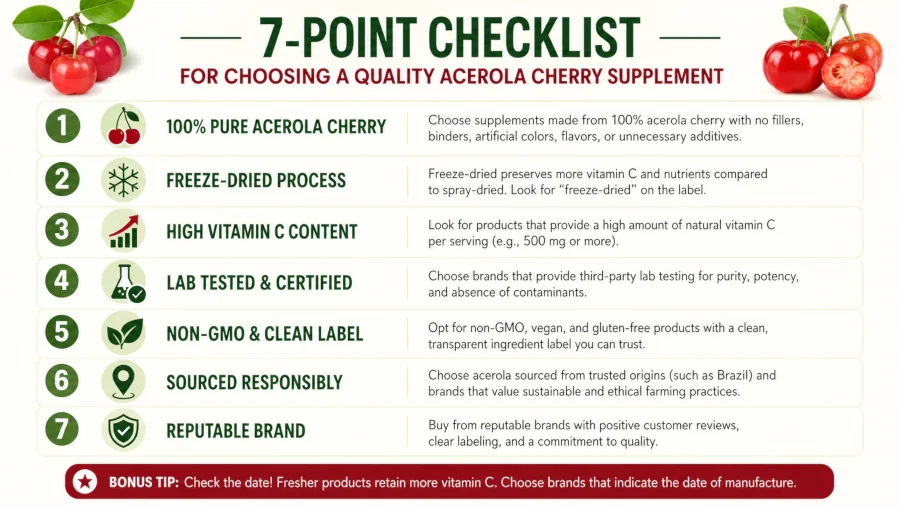
Run any acerola supplement through these seven points before you buy. If it fails three or more, keep looking. If it passes all seven, the price difference is usually earned.
| # | Check | What a pass looks like |
| 1 | Vitamin C stated in mg per serving | A specific number, not marketing language |
| 2 | Acerola is the only vitamin C source | No separate “ascorbic acid” on the list |
| 3 | Processing method disclosed | Freeze-dried or spray-dried clearly stated |
| 4 | Short, clean ingredient list | No fillers or proprietary blends |
| 5 | Organic certification | USDA Organic or equivalent, certifier named |
| 6 | Third-party tested | NSF, USP, or a posted Certificate of Analysis |
| 7 | Country of origin named | A real location (Brazil is a good sign) |
Marketing red flags worth knowing
Beyond the seven checks, a handful of patterns reliably signal a weaker product or an overreaching brand.
- Sky-high vitamin C percentages. Even concentrated freeze-dried powder from unripe fruit tops out around 30–35% vitamin C by weight [Delva & Schneider, 2013]. A claim of 50%+ “from acerola” usually means synthetic ascorbic acid was blended in.
- Disease claims. Any supplement marketed as treating, curing, or preventing a specific disease is making a claim the FDA doesn’t allow for dietary supplements [FDA, 2024]. Credible brands talk about nutrient content, not cures.
- Heavy reliance on “natural” and “pure.” Unregulated words often stand in for the certifications a product doesn’t have.
- Proprietary-blend dosing. A single combined weight hides how much acerola — and therefore how much vitamin C — you actually get.
- Aggressive subscription lock-in. Hard-to-cancel auto-ship is a sign a company is optimizing for retention, not the product.
Capsules, powder, tablets, or gummies: which form fits you?
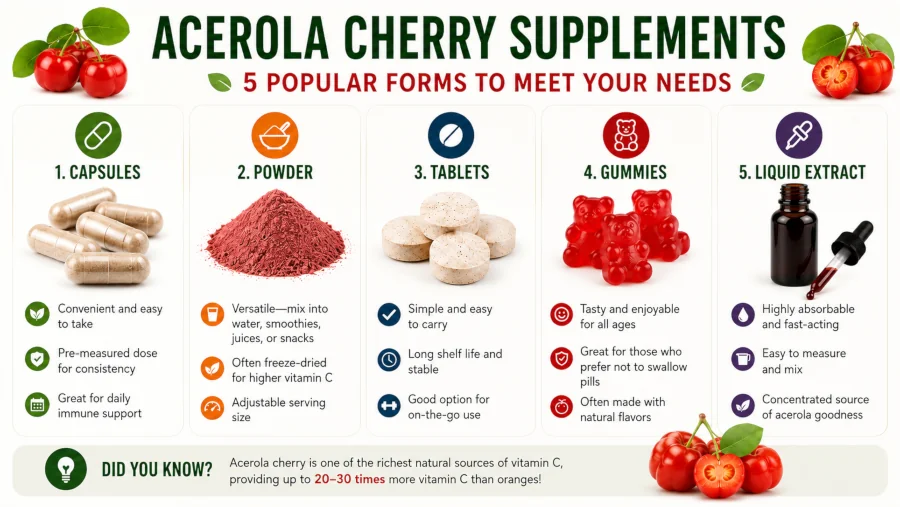
There’s no single best form — only the one that matches your priorities.
Capsules are the convenient default: a measured dose, no taste, easy to travel with. You pay a little more per milligram for the shell and the convenience.
Tablets are usually the cheapest per serving and keep well, but they tend to carry more binders and fillers and can be harder to swallow.
Bulk powder is the most cost-effective and the most flexible — stir it into smoothies, yogurt, or water — at the cost of measuring it out and tolerating an intensely tart flavor.
Gummies win on palatability for kids and people who hate pills, but they add sugar, use pectin or gelatin binders, and deliver less vitamin C per serving. Reach for them when taste is the deciding factor, not efficiency.
Liquid extracts suit people who can’t swallow capsules and are often blended with rosehip or citrus bioflavonoids — which may be a plus or a complication depending on what you want.
How much vitamin C should an acerola supplement give you?
There’s no official acerola-specific dose, so the sensible anchor is vitamin C intake itself [NIH ODS, 2025]. The reference values below come from the National Academies [IOM, 2000].
| Group | Vitamin C RDA | Practical range from acerola |
| Adult women | 75 mg/day | 100–500 mg/day |
| Adult men | 90 mg/day | 100–500 mg/day |
| Pregnancy (19+) | 85 mg/day | Talk to your provider |
| Breastfeeding (19+) | 120 mg/day | Talk to your provider |
| Adult upper limit | 2,000 mg/day | Stay below this |
For most healthy adults, 100–500 mg of vitamin C a day from acerola is a reasonable, evidence-informed range — comfortably above the RDA and well under the upper limit. It’s worth being realistic about benefits: taking vitamin C regularly at around 200 mg/day modestly shortens the average cold (by roughly 8% in adults and 14% in children) but does not prevent colds in the general population, and starting it only after symptoms begin doesn’t reliably help [NIH ODS, 2025] [Carr & Maggini, 2017]. Count vitamin C from every source — acerola, multivitamin, diet, other supplements — when you add up your daily total. For form-by-form detail, see our acerola dosage guide.
Setting realistic expectations
A quality acerola supplement is a useful way to get concentrated, whole-food vitamin C, and it carries polyphenols — flavonoids and anthocyanins — that a plain ascorbic acid tablet doesn’t [Prakash & Baskaran, 2018]. A small study in healthy Japanese adults also found that something in acerola juice favorably affected how ascorbic acid was absorbed and excreted compared with ascorbic acid alone — preliminary, but interesting [Uchida et al., 2011]. Vitamin C itself supports normal immune function, collagen synthesis, and antioxidant defense [Carr & Maggini, 2017] [Linus Pauling Institute].
What it can’t do is cure illness, replace a balanced diet, make you immune to colds, or offset poor sleep and chronic stress. The supplement industry runs on inflated promises; your job as a buyer is to filter them. For what acerola can realistically do, see our guide to acerola cherry health benefits, and for its full nutrient profile, our acerola nutrition overview.
Safety, side effects, and who should be cautious
Vitamin C has low toxicity, and acerola is generally well tolerated. Most issues come from taking too much vitamin C rather than from acerola itself. A few situations are worth flagging [NIH ODS, 2025]:
- Digestive upset. Large doses of vitamin C — generally above 1,000–2,000 mg/day — can cause diarrhea, nausea, and cramps. Staying within the 100–500 mg range avoids this for most people.
- Kidney stones. People prone to oxalate kidney stones may want to avoid high-dose (≥1 g/day) vitamin C, which can raise urinary oxalate [Linus Pauling Institute].
- Iron overload (hemochromatosis). Because vitamin C increases iron absorption, people with hereditary hemochromatosis should be cautious with high doses [NIH ODS, 2025].
- Medication considerations. Vitamin C may interact with some regimens; people on chemotherapy or radiation should check with their oncologist before taking antioxidant supplements [NIH ODS, 2025].
- Latex-fruit sensitivity. Some people with latex allergy react to certain fruits; if that’s you, introduce acerola cautiously.
- Pregnancy and breastfeeding. Staying near the RDA is reasonable, but talk to your provider before adding a supplement.
Talk to a healthcare professional before starting acerola if you’re pregnant or breastfeeding, have kidney disease or a history of kidney stones, have hemochromatosis or another iron-overload condition, take prescription medication, or are undergoing cancer treatment. For a fuller rundown, see our acerola side effects and safety guide.
| Health Disclaimer: This article is for educational purposes only and is not a substitute for professional medical advice, diagnosis, or treatment. Dietary supplements can affect people differently and may interact with medications or medical conditions. Nothing here is intended to diagnose, treat, cure, or prevent any disease. Always consult a qualified healthcare professional before starting any new supplement, especially if you are pregnant or breastfeeding, take medication, or have a medical condition. |
Frequently asked questions
How can I tell if an acerola supplement contains synthetic vitamin C?
Read the ingredient list. If “ascorbic acid,” “sodium ascorbate,” or “calcium ascorbate” appears as a separate ingredient next to acerola extract or fruit powder, synthetic vitamin C has been added. A true whole-food product lists only the fruit — plus, at most, maltodextrin (spray-dried versions) or a little silicon dioxide as a flow agent.
Are acerola supplements regulated by the FDA?
Yes, but not like drugs. Supplements don’t need pre-market approval; manufacturers are responsible for safety and honest labeling, and the FDA acts after products are on the market [FDA, 2024]. That’s exactly why independent NSF or USP testing adds value — it’s outside verification that the label is accurate.
Is freeze-dried acerola worth the extra cost?
If nutrient retention is your priority, yes — freeze-drying skips the heat and the maltodextrin carrier, so the powder is more concentrated and carrier-free [Delva & Schneider, 2013]. If you mainly want vitamin C and price matters most, a quality spray-dried product is a reasonable choice.
How do I know how much vitamin C is in a capsule?
Look for vitamin C stated in milligrams per serving on the Supplement Facts panel. If the label only gives an amount of “acerola extract” with no vitamin C figure, it isn’t standardized and you can’t know what you’re getting per dose.
Can I just take a plain vitamin C tablet instead?
You can — synthetic and acerola-derived ascorbic acid are the same molecule with comparable absorption [NIH ODS, 2025]. People choose acerola for the accompanying polyphenols and a preference for whole-food forms; a small study also suggested acerola juice favorably affected vitamin C absorption [Uchida et al., 2011]. If those don’t matter to you, plain ascorbic acid is cheaper.
Key takeaways
- Quality comes down to seven checks: a stated mg of vitamin C, acerola as the only vitamin C source, a disclosed drying method, a short ingredient list, real organic certification, third-party testing, and a named origin.
- The single most common red flag is “ascorbic acid” listed separately from acerola — a sign you’re paying a whole-food price for mostly synthetic vitamin C.
- No form is best for everyone: freeze-dried powder for nutrition per milligram, capsules for convenience, gummies for palatability over efficiency.
- For most healthy adults, 100–500 mg of vitamin C a day from acerola sits above the RDA and well under the 2,000 mg upper limit — count every source toward your total.
- A clean, transparent, well-tested product supports normal nutrition; it doesn’t cure disease or replace a balanced diet.
References
- NIH Office of Dietary Supplements. Vitamin C: Fact Sheet for Health Professionals. Updated 2025. → View source
- Delva L, Schneider RG. Acerola (Malpighia emarginata DC): Production, Postharvest Handling, Nutrition, and Biological Activity. Food Reviews International. 2013;29(2):107–126. → View source
- Prakash A, Baskaran R. Acerola, an untapped functional superfruit: a review on latest frontiers. J Food Sci Technol. 2018;55(9):3373–3384. → View source
- Uchida E, Kondo Y, Amano A, et al. Absorption and excretion of ascorbic acid alone and in acerola (Malpighia emarginata) juice: comparison in healthy Japanese subjects. Biol Pharm Bull. 2011;34(11):1744–1747. → View source
- Carr AC, Maggini S. Vitamin C and Immune Function. Nutrients. 2017;9(11):1211. → View source
- U.S. Food and Drug Administration. Dietary Supplements. Content current as of 2024. → View source
- NSF. Dietary Supplement and Vitamin Certification. → View source
- U.S. Pharmacopeia (USP). USP Verified Mark for Dietary Supplements. → View source
- Linus Pauling Institute, Oregon State University. Micronutrient Information Center: Vitamin C. → View source
- Institute of Medicine (US). Dietary Reference Intakes for Vitamin C, Vitamin E, Selenium, and Carotenoids. National Academies Press; 2000. → View source
- U.S. Department of Agriculture. FoodData Central. → View source
