
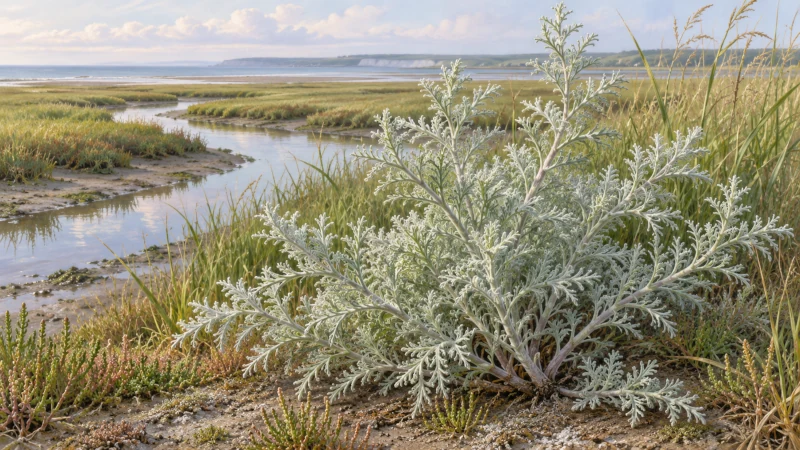
Sea wormwood (Artemisia maritima) has one use with a real basis behind it. Its unopened flower heads contain santonin, a compound that nineteenth-century doctors used as a vermifuge, a medicine to drive out intestinal worms. That same compound is the reason not to take it now. Santonin is toxic at doses not far above the ones that worked. It builds up in the body, and medicine stopped using it once safer drugs arrived [Sakipova et al., 2017]. If you’re looking into sea wormwood as a natural dewormer, a single prescribed tablet now does the job better, and far more safely, than anything you could make from the plant.
What sea wormwood is
Sea wormwood is a low, aromatic subshrub in the daisy family. It is native to Britain and Ireland, its wider range covers Eurasia, and it grows about half a metre to a metre tall. Fine hairs give its feathery leaves a soft, silvery look, and they smell medicinal [RHS]. Its relatives include common wormwood (Artemisia absinthium), the bitter herb behind absinthe, and the kitchen herb tarragon (Artemisia dracunculus).
One naming trap: “wormseed” is an old common name for sea wormwood itself [RHS]. But the plant usually sold as wormseed today is epazote (Dysphania ambrosioides), a different plant with its own toxicity problems.
The USDA’s ethnobotanical database lists sea wormwood’s traditional uses as a vermifuge, an ascaricide (roundworm killer), a stomachic and a tonic. The same list also includes “fatality” [USDA, Ethnobotany]. All of these come from the same chemistry.
How sea wormwood was used: santonin and roundworm
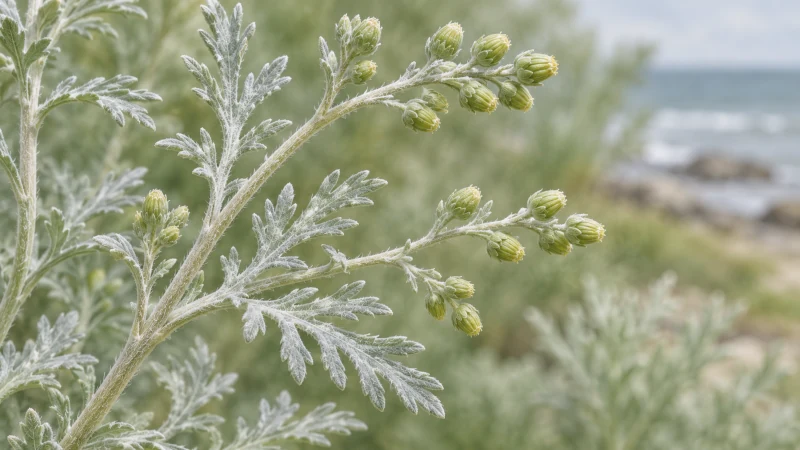
Santonin is concentrated in the unopened flower heads, and the amount drops quickly once the heads open [BPC, 1911]. By the late 1800s it was the leading drug against the large roundworm, Ascaris lumbricoides. King’s American Dispensatory (1898) called it the chief remedy for roundworm. It also noted that santonin worked less well on pinworm and not at all on tapeworm [Felter & Lloyd, 1898].
Santonin didn’t clear worms on its own, either. The same text instructs that a purgative should come before and after each dose, to carry the worms out of the bowel [Felter & Lloyd, 1898]. That “worked” is a historical judgment. No modern controlled trial has tested sea wormwood against today’s drugs, and none would be run, given the toxicity.
Santonica, Levant wormseed and a tangle of names
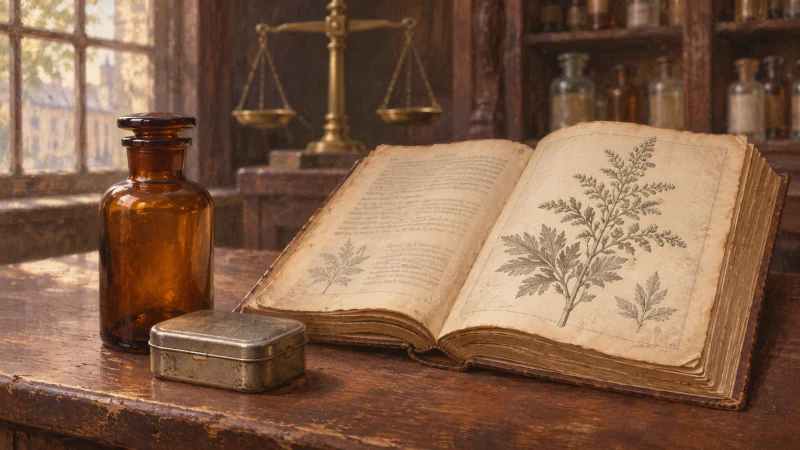
In older herbals, santonin is tied to “santonica,” “Levant wormseed” or “semen contra.” The British Pharmaceutical Codex of 1911 defined santonica as the dried, unopened flower heads of a Central Asian variety of sea wormwood (Artemisia maritima var. stechmanniana). The heads were collected in Turkestan and contained 2–3.5% santonin [BPC, 1911]. Modern researchers treat santonica as a separate species, Artemisia cina, and most current santonin research uses that plant [Sakipova et al., 2020].
The coastal European sea wormwood contains santonin too [USDA, Phytochemicals]. But nothing about a plant in front of you tells you how much santonin it holds.
Why santonin fell out of use
Santonin is toxic at about 60 mg in children and 200 mg in adults [Sakipova et al., 2017] [Sakipova et al., 2020]. Your body clears it slowly, so it doesn’t take one big overdose. Doses repeated over days can build up until santonin acts as a cumulative poison [Sakipova et al., 2017].
The signature warning sign is xanthopsia. Bright objects look yellow, dark surfaces can take on a violet tinge, and in serious cases it led to blindness [Sakipova et al., 2017]. Nineteenth-century physicians also reported convulsions after children were given “worm lozenges.” King’s records that a dose as small as 2 grains (about 130 mg) was said to have killed a weak five-year-old [Felter & Lloyd, 1898]. Santonin is no longer used in human medicine because of that toxicity [Sakipova et al., 2017].
Why a homemade dose is the real danger
Herbal preparations are measured in grams of plant, not milligrams of santonin. Run the numbers using the figures above. If flower heads carry 2–3.5% santonin, as pharmaceutical santonica did [BPC, 1911], then 2 grams of powder holds roughly 40–70 mg. That is already at or above the dose reported as toxic for a child [Sakipova et al., 2017].
Wild and dried plants vary, and nothing in a kitchen can tell you where in that range your batch falls. There is no safe way to dose sea wormwood at home, and the risk falls hardest on children.
What treats intestinal worms today
Roundworm, whipworm and hookworm all respond to inexpensive, well-studied medicines. For roundworm, the U.S. Centers for Disease Control and Prevention lists albendazole 400 mg once, mebendazole 100 mg twice daily for three days or 500 mg once, or ivermectin 150–200 mcg/kg once. The doses are the same for adults and children [CDC, 2024]. The same guidance adds two caveats: albendazole isn’t FDA-approved for roundworm, and ivermectin’s safety in children under 15 kg is unclear.
These drugs have strong evidence behind them. A Cochrane review of 30 randomized trials with 6,442 participants found that single doses of albendazole, mebendazole and ivermectin all cured most infections. Illustrative cure rates ran from roughly 88% to 98%, depending on the comparison, and no trial reported serious adverse events [Conterno et al., 2020].
The World Health Organization recommends albendazole (400 mg) and mebendazole (500 mg) for regular treatment of school-age children where these worms are common. Both drugs are donated to national health ministries through WHO. About 1.5 billion people, roughly a quarter of the world, carry these infections [WHO, 2023].
| Santonin (sea wormwood / santonica) | Modern deworming drugs | |
| Status | No longer used in medicine because of toxicity | WHO-recommended; donated for school programmes |
| Roundworm | Historically the main remedy; needed a purgative before and after | Single dose cures most infections (illustrative 88–98%) |
| Tapeworm | No effect | Different, specific drugs exist; needs diagnosis first |
| Dose control | Plant content varies; toxic near 60 mg (child) | Fixed, tested doses |
| Main safety problem | Yellow vision, blindness, convulsions, deaths in children; builds up in the body | No serious adverse events reported across 30 trials |
How santonin compares with the medicines used today. Sources: Felter & Lloyd, 1898; Sakipova et al., 2017; Conterno et al., 2020; WHO, 2023.
Other traditional uses of sea wormwood, and the evidence
Old herbals also describe sea wormwood as a bitter tonic to stir appetite, and the USDA database lists it as a stomachic and tonic [USDA, Ethnobotany]. Bitter Artemisia herbs do have a long reputation for this. But we found no controlled human trials of Artemisia maritima for digestion, fever or anything else. Treat these as traditional claims, not established benefits. And remember that a sea wormwood tea for indigestion still carries santonin.
Sea wormwood is one of several old dewormers with the same problem. Male fern, a historical tapeworm remedy, and concentrated wormseed oil also had effective doses close to toxic ones. Our review of herbs that kill parasites covers which herbal options have any human evidence at all.
Sea wormwood safety: who should avoid it
No one should use sea wormwood or santonin to treat worms at home. The margin for error is thinnest for:
- Children. Their toxic threshold is less than a third of an adult’s [Sakipova et al., 2017], and the historical deaths recorded were in children [Felter & Lloyd, 1898].
- People with eye disease or a seizure disorder. Santonin’s best-documented harms are vision changes and convulsions, so these groups have the least reserve.
- Anyone on regular medication. There’s no interaction data for sea wormwood preparations. With an unknown santonin dose, interactions can’t be predicted.
If someone has taken a sea wormwood or other wormwood preparation and develops yellow- or violet-tinged vision, vision loss or a seizure, treat it as an emergency. Call emergency services or poison control.
Pregnancy and breastfeeding
There is no safety data for sea wormwood in pregnancy or breastfeeding, so avoid it. If you’re pregnant and think you have worms, see a clinician, because treatment is still possible. Mayo Clinic notes that pyrantel pamoate can be used during pregnancy [Mayo Clinic, 2025b]. The CDC advises clinicians to weigh the risks of treatment to the fetus against the risks of the infection progressing [CDC, 2024].
When worm symptoms need urgent care

Adult roundworms usually cause no acute symptoms [CDC DPDx]. Heavy infections are different. Get prompt medical care, not a home remedy, for:
- Severe stomach cramping and vomiting, which can mean a mass of worms is blocking the intestine [Mayo Clinic, 2025a].
- Serious stomach pain with constipation, or a worm in your vomit or stool [Mayo Clinic, 2025a].
- Severe pain from worms blocking the bile duct or pancreatic duct [Mayo Clinic, 2025a] [CDC DPDx].
- A dry cough that may bring up blood, wheezing or shortness of breath during early infection, when larvae pass through the lungs [Mayo Clinic, 2025a].
Ongoing stomach pain, diarrhea or vomiting also deserve a visit [Mayo Clinic, 2025a]. Diagnosis is simple. Finding eggs in a stool sample is the standard method [CDC DPDx], though eggs may not show up until about 40 days after infection. If you pass a worm, bring it in for identification [Mayo Clinic, 2025b]. Confirming the type of worm matters because tapeworm and other parasites need different drugs.
| HEALTH DISCLAIMER: This article is for general education and is not medical advice. Sea wormwood and santonin are described for historical and informational purposes; nothing here recommends using them. Do not treat intestinal worms, your own or a child’s, with sea wormwood or any homemade preparation. If you think you or your child has a parasitic infection, see a doctor, who can confirm the diagnosis and prescribe a proven treatment. Talk to a qualified healthcare professional before using any herb or supplement, especially if you are pregnant, breastfeeding, taking medication or managing a health condition. |
Frequently Asked Questions
Is sea wormwood safe to take for parasites?
No. Its active compound, santonin, is toxic at around 60 mg for a child [Sakipova et al., 2017], and a homemade preparation gives no way to know how much you’re taking. Prescription dewormers are safer and cure most roundworm infections in a single dose [Conterno et al., 2020].
What are the benefits of sea wormwood?
Its one documented use was historical: santonin from the flower heads expelled roundworms [Felter & Lloyd, 1898]. Its traditional use as a bitter appetite tonic hasn’t been tested in human trials. Neither use is a reason to take it today.
Does sea wormwood work against tapeworm?
No. Historical medical texts describe santonin as acting on roundworm, less well on pinworm and not at all on tapeworm [Felter & Lloyd, 1898]. Tapeworm needs a specific diagnosis and a different drug.
Is sea wormwood the same as wormwood or wormseed?
No. Common wormwood (Artemisia absinthium) is a related but separate species. “Wormseed” is an old name for sea wormwood’s flower heads [RHS], but the plant sold as wormseed today is usually epazote (Dysphania ambrosioides), which is unrelated.
What should I use instead to treat worms?
See a healthcare provider for a stool test. For roundworm, the standard options are albendazole, mebendazole or ivermectin, usually over one to three days at most [CDC, 2024]. In pregnancy, a clinician can choose an option such as pyrantel pamoate [Mayo Clinic, 2025b].
References
- Sakipova Z, Wong NSH, Bekezhanova T, Sadykova, Shukirbekova A, Boylan F. View source
- Sakipova Z, Giorno TBS, Bekezhanova T, Wong NSH, Shukirbekova A, Fernandes PD, Boylan F. View source
- Felter HW, Lloyd JU. King’s American Dispensatory: Santoninum (U.S.P.)—Santonin. View source
- British Pharmaceutical Codex. Santonica (Artemisia maritima). View source
- U.S. Department of Agriculture, Agricultural Research Service. Dr. Duke’s Phytochemical and Ethnobotanical Databases: View source
- U.S. Department of Agriculture, Agricultural Research Service. Dr. Duke’s Phytochemical and Ethnobotanical Databases: View source
- Royal Horticultural Society. Artemisia maritima (sea wormwood): plant profile. View source
- Centers for Disease Control and Prevention. Clinical Care of Soil-transmitted Helminths. View source
- Centers for Disease Control and Prevention, DPDx. Ascariasis. View source
- Conterno LO, Turchi MD, Corrêa I, Monteiro de Barros Almeida RA. Anthelmintic drugs for treating ascariasis. View source
- World Health Organization. Soil-transmitted helminth infections. View source
- Mayo Clinic. Ascariasis: Symptoms and causes. View source
- Mayo Clinic. Ascariasis: Diagnosis and treatment. View source


