
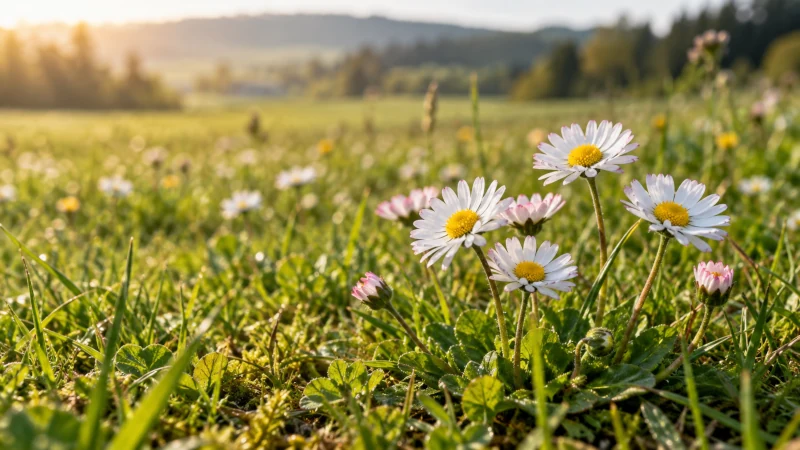
The little white-and-yellow flower in your lawn has a bigger medical reputation than you might expect. The wild daisy flower — Bellis perennis, also called the common or English daisy — was once a go-to folk remedy for bruises, wounds, coughs and fevers. What it lacks is human evidence. No clinical trial has tested daisy tea or a daisy compress for any condition, and a leading natural-medicines database finds no good scientific support for those uses [WebMD/Natural Medicines, 2020].
So here is the practical version. The flowers are edible and pleasant in a salad. The medicinal claims are tradition, not treatment. And if you are pregnant, breastfeeding or allergic to plants in the daisy family, skip it.
What is the wild daisy?
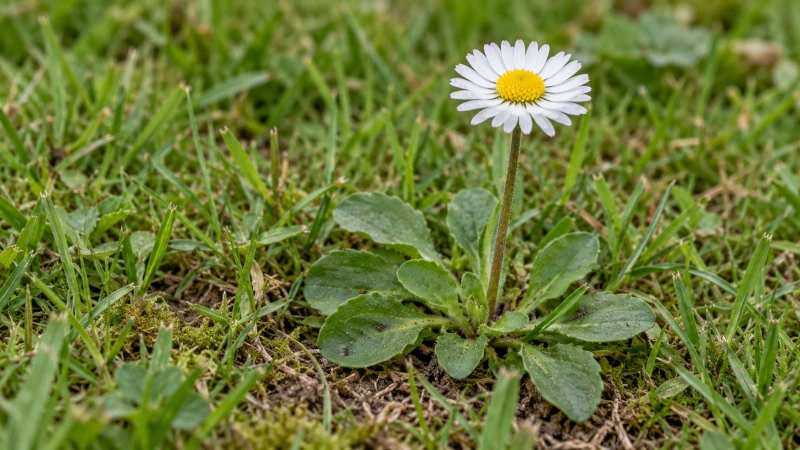
Wild daisy, common daisy, English daisy and lawn daisy are all the same plant, Bellis perennis, a member of the enormous Asteraceae family. It grows as a flat rosette of dark green, spoon-shaped leaves and sends up single flower heads: a yellow centre ringed by white petals that are often tinged pink. It rarely tops 10 cm (4 inches) [RHS, n.d.]. Its old English folk names include bruisewort and bone flower, which tell you exactly what people once used it for [RHS, n.d.].
The plant is native from Madeira across Europe and the Mediterranean to Central Asia, and it has naturalized far beyond that, including across much of Canada and the northern and western United States [Kew POWO, n.d.].
| Quick facts | |
| Botanical name | Bellis perennis L. |
| Family | Asteraceae (also called Compositae), the daisy family |
| Other English names | Common daisy, English daisy, lawn daisy, bruisewort, bone flower, herb Margaret |
| Native range | Madeira and Europe to the Mediterranean and Central Asia; naturalized in North America and elsewhere |
| Size | Usually under 10 cm (4 in) |
| Parts traditionally used | Flowers and leaves |
Sources: RHS; Kew Plants of the World Online; apotheken.de.
Several unrelated plants share the “daisy” name. If you buy a dried herb, tea or extract, check that the label names Bellis perennis.
A long folk reputation
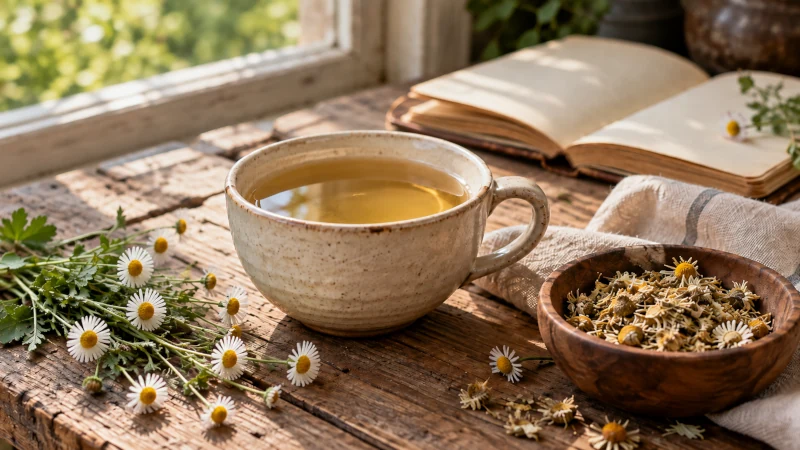
Daisy’s medical history lives mostly in old herbals. In 1543 the German botanist Leonhart Fuchs recommended it as a wound remedy, and the English herbalist John Gerard prescribed it for fever, liver inflammation and pain of every kind [apotheken.de, 2018]. Folk medicine used the tea to loosen phlegm in coughs and bronchitis, and the crushed leaves on injuries and skin complaints [apotheken.de, 2018].
There is a darker footnote. A German ordinance from 1793 called for the plant to be wiped out, most likely because people were using it to try to end pregnancies [apotheken.de, 2018]. No modern research has tested that reputation either way, and there is no reliable safety information on daisy in pregnancy [WebMD/Natural Medicines, 2020].
What’s inside a daisy
Chemists have catalogued more than 310 compounds in Bellis perennis. The most prominent are triterpene saponins, alongside flavonoids such as apigenin glycosides and a group of compounds called polyacetylenes [Albien & Stark, 2023]. Those saponins are why daisy turns up in so many laboratory papers.
The researchers who reviewed this work make a blunt point, though: most studies tested crude extracts, and it usually remains unclear which compound, if any, is responsible for an effect [Albien & Stark, 2023]. Knowing what is in a plant is not the same as knowing what it does in your body.
Wild daisy flower benefits: what the evidence shows
Bruises, wounds and skin
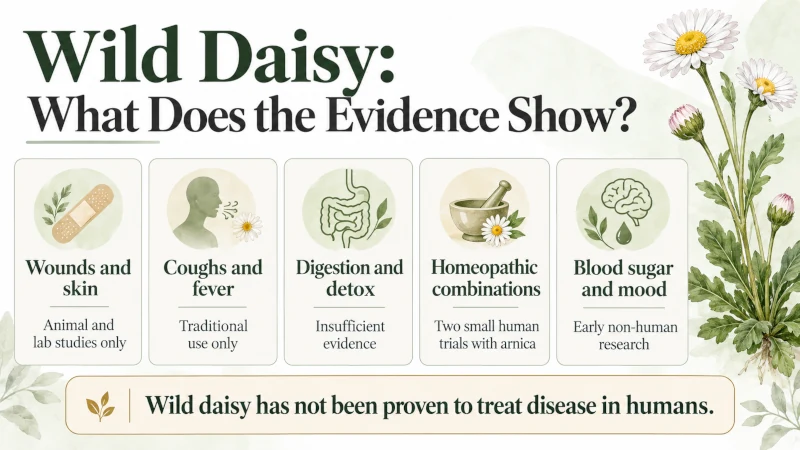
This is the strongest part of the case, and it is still thin. In the single controlled animal study, researchers made small punch wounds on 12 rats and treated some with an ointment containing a concentrated fraction of daisy flowers. At 30 days those wounds had fully closed, compared with about 85% for plain ointment and 87% for untreated wounds, and tissue samples showed less scarring [Karakaş et al., 2012]. In human skin cells grown in a dish, a flower extract also boosted collagen production [Albien & Stark, 2023].
That is interesting biology. It is not proof that a homemade compress will heal a bruise faster. Evidence: animal and laboratory only.
Fever, colds and coughs
Herbal sources describe daisy tea as sweat-inducing, fever-lowering and expectorant. None of those effects has been tested in people, and the evidence for daisy in cough, bronchitis and bleeding is rated as not good enough to support those uses [WebMD/Natural Medicines, 2020].
A warm herbal tea can still feel soothing and keeps your fluids up, which genuinely matters when you are sick. For drinks and foods with better support, see our guide to foods to eat when you have a fever, our evidence-rated look at herbs for coughs and lung health, and what helps when you are sick with bronchitis. Evidence: traditional use only.
Digestion, “detox” and laxative claims
Older herbals also call daisy depurative (blood-cleansing), laxative, mildly diuretic and an appetite stimulant. No human research backs any of these, and “blood-cleansing” is not a measurable effect. If constipation is the problem you are trying to solve, prunes, kiwifruit and fiber have real trial data behind them — see our list of foods that help with constipation, ranked by evidence. Evidence: insufficient.
Homeopathic Bellis perennis
This is where the only human trials sit, and they are easy to misread. Homeopathic “Bellis perennis” is diluted so heavily that little or none of the plant may remain. Both trials also paired it with homeopathic arnica, so neither can tell you what daisy does on its own.
In a small preliminary trial of 40 women after childbirth, those given arnica-plus-daisy pellets kept stable hemoglobin levels at 72 hours, while hemoglobin fell in the placebo group, which the authors read as less blood loss [Oberbaum et al., 2005]. In a trial of 55 women having a mastectomy with immediate breast reconstruction, the same combination shortened the time until surgical drains could come out — 11.1 days versus 13.5 on placebo — but made no difference to pain, quality of life or complications [Lotan et al., 2020].
Both studies were small and came from the same Jerusalem research group. Weigh them against the wider record: the U.S. National Center for Complementary and Integrative Health says there is little evidence that homeopathy works for any specific condition, that some products labeled homeopathic contain enough active ingredient to cause side effects, and that no homeopathic product is FDA-approved [NCCIH, 2021]. Evidence: limited, from two small trials of a combination product.
Early lab and animal findings
Researchers have also reported antioxidant activity in test tubes, lower blood sugar in a hen’s-egg model, calmer anxiety- and depression-related behavior in rodents, and smaller rises in blood fats in mice after an oily meal [Albien & Stark, 2023]. None of this has been tested in people. It is a reason for more research, not a reason to drink daisy tea for diabetes, mood or cholesterol. Evidence: early-stage, non-human.
| Claimed use | What has actually been studied | Evidence grade |
| Wounds and bruises (on the skin) | One rat study; skin-cell lab work | Animal / lab only |
| Fever, cough, bronchitis | Nothing in humans | Traditional use only |
| Laxative, diuretic, “blood-cleansing” | Nothing in humans | Insufficient |
| Postpartum bleeding; fluid after breast surgery | Two small trials of homeopathic arnica + daisy, same research group | Limited |
| Blood sugar, mood, cholesterol | Test-tube, egg and rodent studies | Early-stage |
| As a food | Long culinary use | Traditional food use |
Eating wild daisy
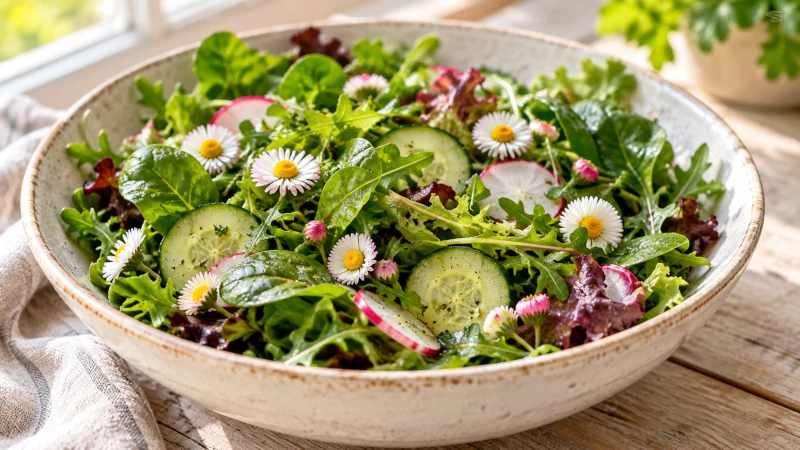
Daisy is a food plant as much as a folk medicine; Kew lists it among species used for food [Kew POWO, n.d.]. The buds and half-open flowers have a mild, nutty flavor, while fully open flowers taste slightly bitter. The buds can even be pickled as a stand-in for capers [apotheken.de, 2018]. A handful scattered over a green salad is the simplest way to try them.
A few precautions make foraging safer:
- Pick only where you know no weedkiller, fertilizer or pesticide has been used. That rules out many lawns, parks and roadsides.
- Avoid spots where dogs are walked, and wash everything well.
- Be sure of what you are picking. When in doubt, grow your own from labeled seed.
- If you are allergic to daisy-family plants, do not eat it. In sensitized people, chewing the leaves of these plants can inflame the lips and mouth [DermNet, 2024].
If you try daisy tea or a compress
There is no established safe or effective dose of wild daisy [WebMD/Natural Medicines, 2020]. German herbal tradition describes an infusion of about 2 teaspoons of dried flowers in 2 cups of water, steeped for 20 minutes, with 2 to 4 cups a day [apotheken.de, 2018]. Treat that as a description of custom, not a tested dose — and keep it occasional rather than daily.
Leaf decoctions were traditionally laid on wounds as compresses [apotheken.de, 2018]. Keep any plant compress to unbroken skin. An open cut needs rinsing under running water, a thin layer of petroleum jelly or antibiotic ointment, and a clean covering [Mayo Clinic, 2024]. Stop using daisy if you notice itching, redness or a rash.
Side effects, interactions and who should avoid wild daisy
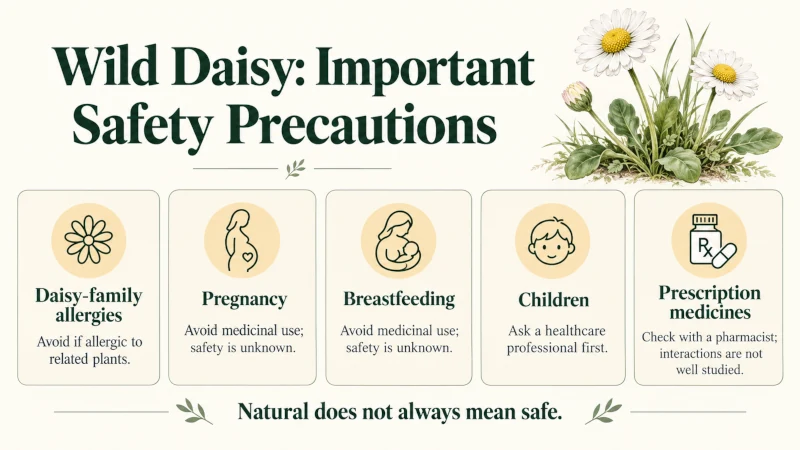
There is not enough reliable information to know whether wild daisy is safe by mouth or what its side effects are [WebMD/Natural Medicines, 2020]. What is known points to a few clear cautions.
- Daisy-family allergy. If you react to ragweed, chrysanthemums, marigolds or other daisies, wild daisy may trigger a reaction too [WebMD/Natural Medicines, 2020]. Allergens in this family, called sesquiterpene lactones, are a common cause of contact dermatitis, and drinking a tea made from a plant you are sensitized to can cause a widespread rash [DermNet, 2024].
- Pregnancy and breastfeeding. Avoid it. Safety has not been established [WebMD/Natural Medicines, 2020], and the plant has a historical association with attempts to end pregnancy [apotheken.de, 2018].
- Children. There are no safety data for children. Do not give daisy teas or extracts to a child without advice from their doctor.
- Medications. No drug interactions have been documented, but that reflects a lack of research rather than proof of safety [WebMD/Natural Medicines, 2020]. If you take prescription medicines, ask your pharmacist before using daisy as a remedy.
- Homeopathic products. Some products labeled homeopathic are not highly diluted and can cause side effects or interactions [NCCIH, 2021]. Bring the product to your doctor or pharmacist, and never use it in place of treatment you need.
When to see a doctor instead
Wild daisy has no role in treating an infection, a deep wound or a high fever. Get medical care if any of these apply.
Fever [Mayo Clinic, 2025]:
- An adult temperature of 103°F (39.4°C) or higher.
- Fever with a severe headache, stiff neck, rash, sensitivity to light, confusion, trouble breathing, chest pain, persistent vomiting, pain when urinating or a seizure — seek care immediately.
- Any baby under 3 months with a rectal temperature of 100.4°F (38°C) or higher, or a child whose fever lasts more than three days.
Wounds [Mayo Clinic, 2024]:
- Signs of infection: spreading redness or color change, increasing pain, drainage, warmth or swelling.
- A deep or dirty wound when your last tetanus shot was more than five years ago, or dirt you cannot remove.
Infectious illness. Some herbal sources list daisy for measles, scarlet fever and mumps. These need a diagnosis, not a home remedy. Painful swelling in front of the ear, for instance, can be parotitis — inflammation of the parotid salivary gland, most often caused by mumps or a bacterial infection — and bacterial cases can need hospital treatment with intravenous antibiotics [AL Ghabra et al., StatPearls, 2025].
| HEALTH DISCLAIMER: This article is for general education only. It is not medical advice and does not replace diagnosis or treatment from a qualified healthcare professional. Wild daisy has not been shown to treat, cure or prevent any disease. Talk with your doctor or pharmacist before using any herbal or homeopathic remedy, especially if you are pregnant or breastfeeding, caring for a child, taking prescription medication, have a plant allergy, or are managing a chronic condition. Seek prompt care for any of the warning signs listed above. |
Frequently Asked Questions
Is wild daisy safe to eat?
For most people, yes, in salad amounts. The buds and flowers are the parts most often eaten [apotheken.de, 2018]. Pick only from unsprayed ground, wash it well, and avoid it if you are allergic to daisy-family plants or are pregnant [WebMD/Natural Medicines, 2020].
Does wild daisy help bruises heal?
It might, but no one has shown it in people. Its reputation rests on folk use, one rat study in which a concentrated flower ointment sped wound closure, and laboratory work on skin cells [Karakaş et al., 2012].
Is homeopathic Bellis perennis the same as daisy tea?
No. Homeopathic pellets are extremely diluted, and the human trials tested them only in combination with arnica [Lotan et al., 2020]. Overall, there is little evidence that homeopathy works for any specific condition [NCCIH, 2021].
Can I drink daisy tea while pregnant or breastfeeding?
No. There is not enough reliable safety information, and the standard advice is to avoid it [WebMD/Natural Medicines, 2020].
Will daisy tea bring down a fever?
There is no evidence that it does. Rest and fluids help you feel better, and some fevers need a doctor — for adults, a temperature of 103°F (39.4°C) or higher, or fever with a stiff neck, rash, confusion or trouble breathing [Mayo Clinic, 2025].
References
- Albien A-L, Stark TD. (Bio)active compounds in daisy flower (Bellis perennis). Molecules. View source
- Karakaş FP, Karakaş A, Boran Ç, Türker AU, Yalçin FN, Bilensoy E. The evaluation of topical administration of Bellis perennis fraction on circular excision wound healing in Wistar albino rats. View source
- Oberbaum M, Galoyan N, Lerner-Geva L, et al. The effect of the homeopathic remedies Arnica montana and Bellis perennis on mild postpartum bleeding — a randomized, double-blind, placebo-controlled study — preliminary results. Complement Ther Med. View source
- Lotan AM, Gronovich Y, Lysy I, et al. Arnica montana and Bellis perennis for seroma reduction following mastectomy and immediate breast reconstruction: randomized, double-blind, placebo-controlled trial. View source
- National Center for Complementary and Integrative Health. Homeopathy: What You Need To Know. View source
- WebMD / Natural Medicines Comprehensive Database (Consumer Version). Wild Daisy: Overview, Uses, Side Effects, Precautions. View source
- Oakley A. Compositae allergy. DermNet. View source
- Royal Botanic Gardens, Kew. Bellis perennis L. Plants of the World Online. View source
- Royal Horticultural Society. Bellis perennis (daisy) — RHS plant profile. View source
- Brendler T, Gruenwald J, Jaenicke C. Gänseblümchen. apotheken.de (Deutscher Apotheker Verlag). View source
- Mayo Clinic Staff. Fever — Symptoms and causes. Mayo Clinic. View source
- Mayo Clinic Staff. Cuts and scrapes: First aid. Mayo Clinic. View source
- AL Ghabra Y, Goldin J, Pandey S. Parotitis. View source


