
Most of the safflower you will ever eat comes in a bottle. The safflower plant (Carthamus tinctorius) is grown mainly for the oil pressed from its seeds, and that oil is where the useful health evidence sits: used in place of butter and other saturated fats, it can modestly improve cholesterol. The flowers are a different story. They have a long record in herbal medicine but little human research behind them, and they carry real risks during pregnancy and for anyone who takes a blood thinner.
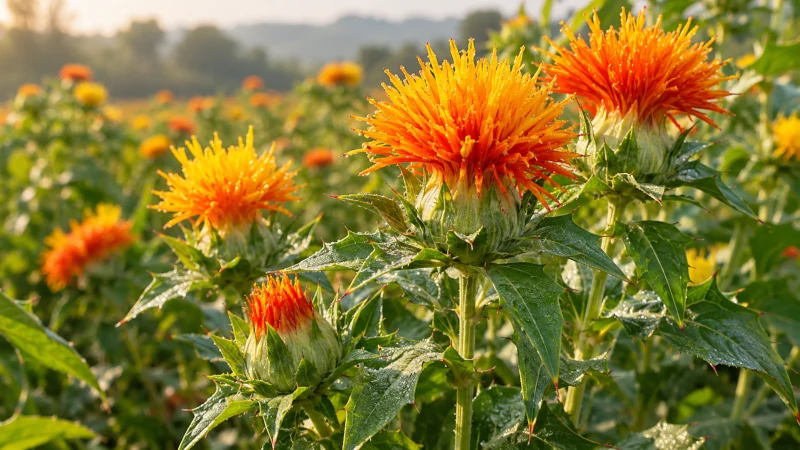
Here is what the safflower plant is, what the research does and does not show, and how to use it without getting hurt.
What is the safflower plant?
Safflower is a spiny, thistle-like annual in the daisy family (Asteraceae, also called Compositae), the same family as sunflowers and ragweed [Delshad et al., 2018]. Its natural range runs from southwest to Central Asia, and it is one of the oldest crops people have grown for color [University of Oxford Plants 400].
That color history is remarkable. Safflower dye has been found in Egyptian textiles about 4,000 years old, and its fruits turned up in Tutankhamun’s tomb. In Britain, its red dye stained the cotton tape tied around legal papers, which is where the phrase “red tape” comes from. Its yellow dyes were used as a cheap stand-in for true saffron, which earned it nicknames such as bastard saffron and dyer’s saffron [University of Oxford Plants 400]. Today the seeds, not the petals, are the main product.
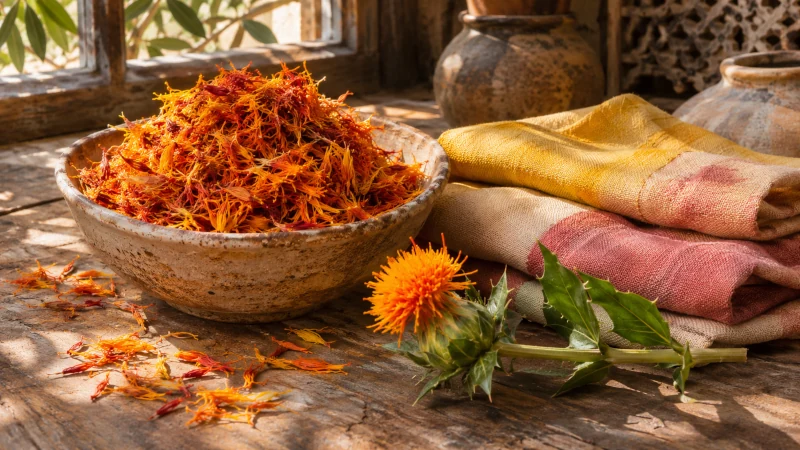
Safflower plant quick facts
| Scientific name | Carthamus tinctorius L. |
| Family | Asteraceae (Compositae), the daisy family [Delshad et al., 2018] |
| Other names | False saffron, dyer’s saffron, bastard saffron; carthame (French); cártamo (Spanish) |
| Parts used | Seeds (pressed for oil) and the dried flower petals (florets) |
| Main compounds | Seed oil: linoleic acid (omega-6) or oleic acid, depending on variety. Flowers: pigments including carthamin and hydroxysafflor yellow A [Delshad et al., 2018] |
| Common uses today | Cooking oil, food coloring, and herbal preparations |
Two kinds of safflower oil, and why the label matters
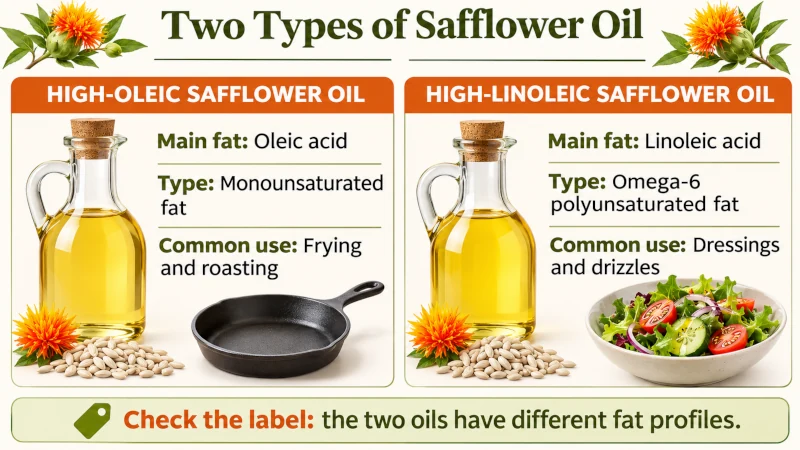
“Safflower oil” on a label can mean two quite different products, and most health claims depend on which one you have.
High-linoleic safflower oil is the traditional type. It is one of the richest sources of the omega-6 fat linoleic acid, at roughly 75 grams per 100 grams of oil [Ramsden et al., 2013]. It is best used unheated, in dressings or drizzled on finished food [Medical News Today, 2023].
High-oleic safflower oil comes from varieties bred to be rich in oleic acid, the same monounsaturated fat that dominates olive oil. It holds up better to high-heat cooking [Medical News Today, 2023]. Oils with at least 70% oleic acid, including high-oleic safflower, are allowed to carry a qualified heart-health claim on U.S. labels [FDA, 2018].
If the bottle does not say “high oleic,” assume you are buying the high-linoleic kind.
Safflower plant health benefits: what the research supports
Evidence at a glance
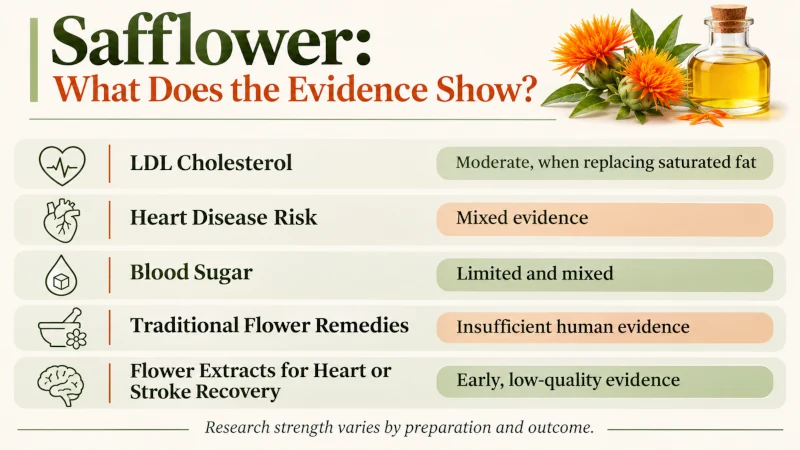
| Claim | What the evidence shows | Strength |
| Lowers LDL and total cholesterol (oil) | Works when the oil replaces saturated fat. A professional database rates it “possibly effective” for high cholesterol [Natural Medicines via RxList]. | Moderate, but replacement-dependent |
| Lowers heart disease risk (oil) | Broad trial evidence favors swapping saturated fat for vegetable oils [Sacks et al., 2017]; one older safflower-specific trial found more deaths [Ramsden et al., 2013]. | Mixed / debated |
| Improves blood sugar (oil) | One small trial in women with type 2 diabetes found lower HbA1c [Asp et al., 2011]; rated insufficient evidence overall [Natural Medicines via RxList]. | Limited and mixed |
| Treats fever, colds, or constipation (flower) | Traditional use only; not established in humans [Delshad et al., 2018; Natural Medicines via RxList]. | Insufficient |
| Helps heart or stroke recovery (flower extracts) | Mostly older Chinese clinical reports with little design detail, plus animal studies [Delshad et al., 2018; Bai et al., 2025]. | Early / low quality |
Cholesterol and heart health
This is safflower’s strongest case, and it comes with a catch. Safflower oil can lower total and LDL (“bad”) cholesterol, though it does not appear to lower triglycerides or raise HDL [Natural Medicines via RxList]. That fits the wider picture: the American Heart Association concluded that trials replacing saturated fat with polyunsaturated vegetable oil cut cardiovascular events by about 30% [Sacks et al., 2017].
Notice the word “replacing.” The FDA’s qualified claim for high-oleic oils is worded the same way: about 1½ tablespoons (20 grams) a day may reduce coronary heart disease risk only when the oil takes the place of fats higher in saturated fat and does not add calories. The FDA also describes that evidence as supportive but not conclusive [FDA, 2018]. Pouring safflower oil on top of an unchanged diet is not the same thing.
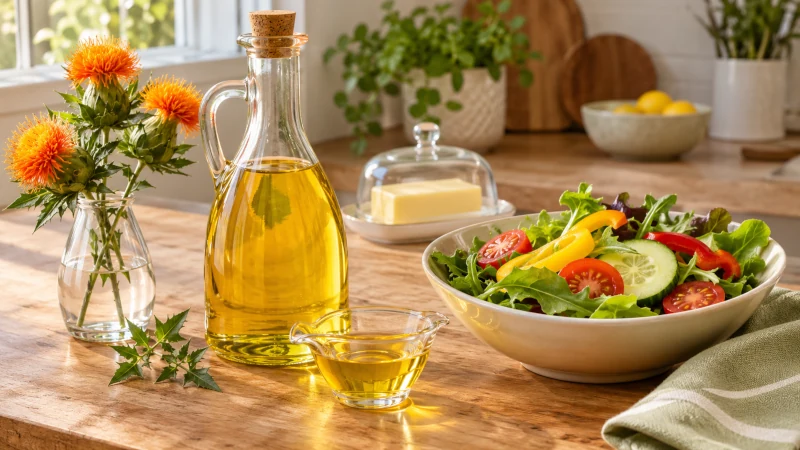
There is also a genuine counterpoint. In the Sydney Diet Heart Study, run from 1966 to 1973, 458 men who had recently had a coronary event were assigned either their usual diet or one that replaced saturated fats with safflower oil and safflower-oil margarine. When researchers recovered and reanalyzed the original data, the safflower group had a higher death rate (17.6% versus 11.8%) [Ramsden et al., 2013]. Researchers still disagree about how much weight one decades-old trial should carry against the larger body of evidence. A reasonable reading: high-oleic safflower oil sits comfortably within mainstream heart-health advice, while loading up on high-linoleic oil specifically is less clearly beneficial.
If you are changing oils to improve your numbers, it helps to know your starting point. Our guide to getting a cholesterol test at home or in a lab explains what the results mean. If your triglycerides are the problem, safflower oil will not fix them; these evidence-based ways to lower triglycerides are a better place to start.
Blood sugar and inflammation
The most cited study here is small. In a crossover trial, 55 post-menopausal women with obesity and type 2 diabetes were enrolled and 35 finished. Taking 8 grams of high-linoleic safflower oil a day for 16 weeks lowered HbA1c by about 0.64 percentage points, raised HDL cholesterol, and reduced C-reactive protein, a marker of inflammation [Asp et al., 2011]. The authors could not say whether the linoleic acid or something else in the oil was responsible, and dropout was high.
Other data cut the other way. Natural Medicines rates safflower’s evidence for diabetes as insufficient and warns that the oil may raise blood sugar in some people [Natural Medicines via RxList]. Treat safflower oil as a reasonable kitchen fat for people with diabetes, not a blood-sugar treatment.
The flower: traditional uses and lab research
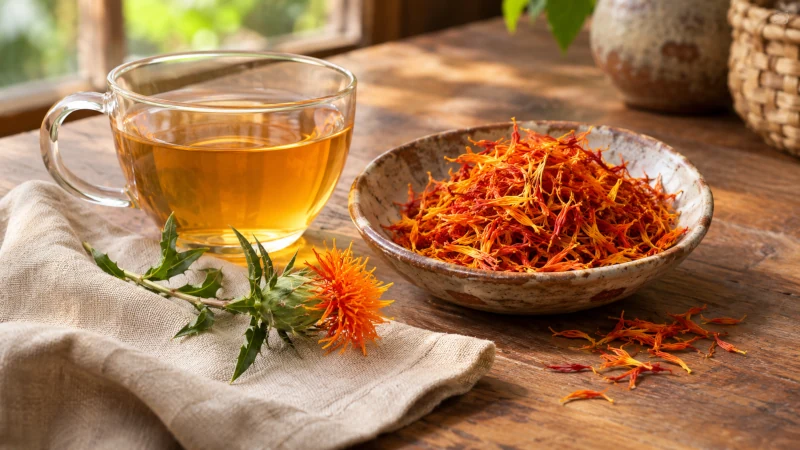
In Persian, Indian, and Chinese traditions, safflower petals have been used for painful or absent periods, pain after childbirth, joint pain, and as a laxative. Oil from the plant was also used to bring on sweating to break a fever [Delshad et al., 2018]. None of these uses has been confirmed in good-quality human trials; Natural Medicines lists fever, pain, and constipation as having insufficient evidence [Natural Medicines via RxList]. For a fever or a cold, food, fluids, and rest have better support. See our guides on what to eat when you have a fever and foods that help with colds and flu.
Lab interest centers on hydroxysafflor yellow A, a flower pigment linked to most of the reported effects [Delshad et al., 2018]. In China, injectable safflower preparations are used for heart disease and stroke, but the clinical reports behind them are mostly small, older, or thinly described, and recent reviewers say research on the plant remains limited [Delshad et al., 2018; Bai et al., 2025]. Promising chemistry is not the same as a proven treatment.
How to use safflower sensibly
As a cooking oil. This is the use with the best evidence and the lowest risk. Swap it in for butter, lard, or coconut oil rather than adding it on top. Choose high-oleic for frying and roasting. Like all oils it is calorie-dense, at roughly 120 calories per tablespoon [Medical News Today, 2023].
As a flower tea or supplement. No dose has been tested and shown to be safe and effective. Traditional Persian texts set a ceiling of about 3 grams of flower a day [Delshad et al., 2018], which is a historical limit, not a recommendation. Some herbal books describe taking a spoonful of the oil on an empty stomach as a purgative; there is no clinical evidence for that, and safer, better-studied options exist for constipation. If you want to try safflower flower for any health reason, check with a pharmacist or doctor first, especially if you take any regular medicine.
Beware of mix-ups. Cheap “saffron” is sometimes safflower. That is a quality problem for cooks, and a safety one in pregnancy, because the two plants have different effects.
Side effects, interactions, and who should avoid safflower
Safflower seed oil in normal food amounts is likely safe for most people. The flower is possibly safe by mouth for most adults, but it has more cautions [Natural Medicines via RxList].
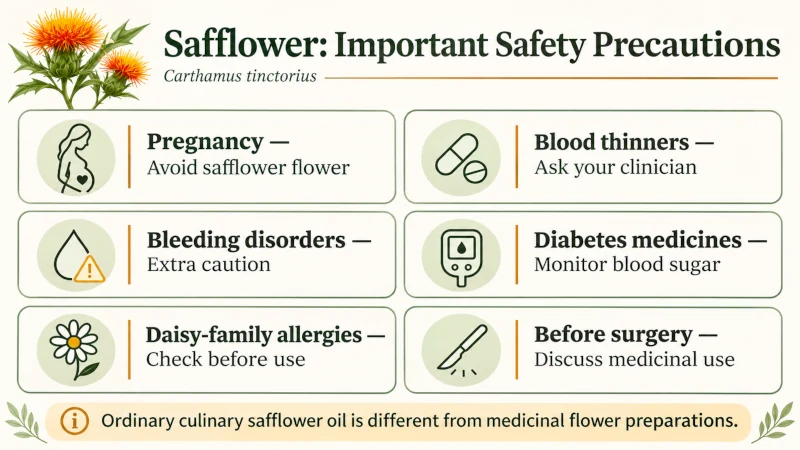
- Pregnancy: Avoid safflower flower entirely. It is rated likely unsafe because it may bring on menstrual bleeding, cause uterine contractions, and lead to miscarriage [Natural Medicines via RxList]. Animal studies also link early-pregnancy exposure to changes in the developing embryo [Delshad et al., 2018]. Safflower oil in ordinary cooking amounts is considered possibly safe.
- Breastfeeding: There is too little safety information on medicinal amounts of the oil or flower, so avoid them [Natural Medicines via RxList].
- Trying to conceive: Mouse studies found the flower extract reduced ovarian follicles and, at high doses, harmed the testes [Delshad et al., 2018]. Human relevance is unknown, but there is no reason to take flower supplements while trying for a baby.
- Bleeding disorders and blood thinners: Safflower may slow blood clotting [Natural Medicines via RxList], and flower extracts reduced clotting in animal studies [Delshad et al., 2018]. Large amounts could raise bruising and bleeding risk alongside warfarin, heparin, aspirin, clopidogrel, or ibuprofen [Natural Medicines via RxList].
- Surgery: Stop medicinal safflower at least 2 weeks before a scheduled procedure [Natural Medicines via RxList].
- Diabetes medicines: Safflower oil may affect blood sugar control, so monitor your levels if you start taking it in supplement amounts alongside insulin or other diabetes drugs [Natural Medicines via RxList].
- Daisy-family allergies: People allergic to ragweed or other Asteraceae plants may react to safflower [Natural Medicines via RxList]. Injected safflower products carry a higher allergy risk: one review of Chinese case reports found 14 cases of allergic shock, all within 30 minutes of the injection [Sun et al., 2013]. If you have these allergies, ask before trying other thistle-like herbs such as carline thistle as well.
When to get medical help
Call emergency services right away if you have swelling of the lips, tongue, or throat, trouble breathing, or a spreading rash after using any safflower product. Contact a doctor promptly if you notice unusual bruising, nosebleeds that will not stop, or blood in your urine or stool, especially if you take a blood thinner. If you are pregnant and have cramping or bleeding after taking an herbal product, seek care the same day.
Self-care is not enough when a fever lasts more than a few days, comes with a stiff neck, confusion, or trouble breathing, or occurs in an infant. Herbal teas, safflower or otherwise, are not a substitute for that assessment.
| HEALTH DISCLAIMER: This article is for general education. It is not medical advice and does not replace diagnosis or treatment from a qualified healthcare professional. Safflower flower and supplements can interact with medicines and are not safe in pregnancy. Talk to your doctor or pharmacist before using safflower for any health purpose, especially if you are pregnant, breastfeeding, trying to conceive, have a bleeding disorder, take blood thinners or diabetes medicine, have allergies to ragweed or daisy-family plants, or have surgery planned. |
Frequently Asked Questions
Is safflower the same as saffron?
No. Saffron comes from the crocus flower, while safflower is a thistle-like plant in the daisy family. Safflower’s yellow petals have long been used as a cheaper substitute for saffron’s color, which is why it is sometimes called false or bastard saffron [University of Oxford Plants 400].
Is safflower oil healthy?
It can be, depending on what it replaces. Using it instead of butter or other saturated fats can lower LDL cholesterol [Natural Medicines via RxList; Sacks et al., 2017]. High-oleic safflower oil qualifies for an FDA heart-health claim when it replaces saturated fat [FDA, 2018]. Adding it on top of your usual diet just adds calories.
Is safflower oil an omega-6 oil?
The traditional high-linoleic type is one of the richest omega-6 sources available, at about 75 grams of linoleic acid per 100 grams [Ramsden et al., 2013]. High-oleic safflower oil is mostly monounsaturated fat instead. Check the label.
Can I drink safflower tea while pregnant?
No. Safflower flower is rated likely unsafe in pregnancy because it can trigger uterine contractions and miscarriage [Natural Medicines via RxList]. Normal cooking amounts of safflower oil are a different matter and are considered possibly safe.
Can safflower interact with blood thinners?
It may. Safflower can slow clotting, and large amounts may increase bleeding risk with drugs such as warfarin, aspirin, or clopidogrel [Natural Medicines via RxList]. Tell your doctor or pharmacist before taking safflower supplements or flower preparations.
References
- Asp ML, Collene AL, Norris LE, et al. Time-dependent effects of safflower oil to improve glycemia, inflammation and blood lipids in obese, post-menopausal women with type 2 diabetes: a randomized, double-masked, crossover study. View source
- Bai H, Yang J, Wang R. Carthamus tinctorius L.: a comprehensive review of its ethnomedicine, phytochemistry, pharmacology, and clinical applications. View source
- Delshad E, Yousefi M, Sasannezhad P, Rakhshandeh H, Ayati Z. Medical uses of Carthamus tinctorius L. (safflower): a comprehensive review from traditional medicine to modern medicine. View source
- Harris S. Safflower (Carthamus species). Oxford University Plants 400. University of Oxford, Department of Plant Sciences. n.d. View source
- Leonard J; medically reviewed by Wilson DR. Six health benefits of safflower oil. Medical News Today. View source
- Natural Medicines Comprehensive Database. Safflower. View source
- Ramsden CE, Zamora D, Leelarthaepin B, et al. Use of dietary linoleic acid for secondary prevention of coronary heart disease and death: evaluation of recovered data from the Sydney Diet Heart Study and updated meta-analysis. View source
- Sacks FM, Lichtenstein AH, Wu JHY, et al. Dietary fats and cardiovascular disease: a presidential advisory from the American Heart Association. Circulation. View source
- Sun Z, Lian F, Zhang J, Sun J, Guo Y, Zhang Y. A literature analysis on 14 cases of allergic shock caused by safflower injection. View source
- U.S. Food and Drug Administration. FDA completes review of qualified health claim petition for oleic acid and the risk of coronary heart disease. View source


