
If you’ve come across carline thistle and want to know what it does, here’s the straight version before the folklore: this is an old European remedy whose reputation rests almost entirely on centuries of traditional use, not on modern human studies. The plant — Carlina acaulis — has genuinely interesting chemistry, and a handful of its compounds do things worth watching in the laboratory.
But the honest picture of carline thistle plant health benefits is that the root has never been tested in the kind of human trials that would let anyone promise it treats a disease, and one of its main compounds is actually toxic in lab studies. So the history is fun, the flower head is a real (and safe) wild food, and the medicinal root deserves caution and a conversation with your doctor rather than a spot in your daily routine.
That’s the summary. Here’s the detail, claim by claim.
What is carline thistle?
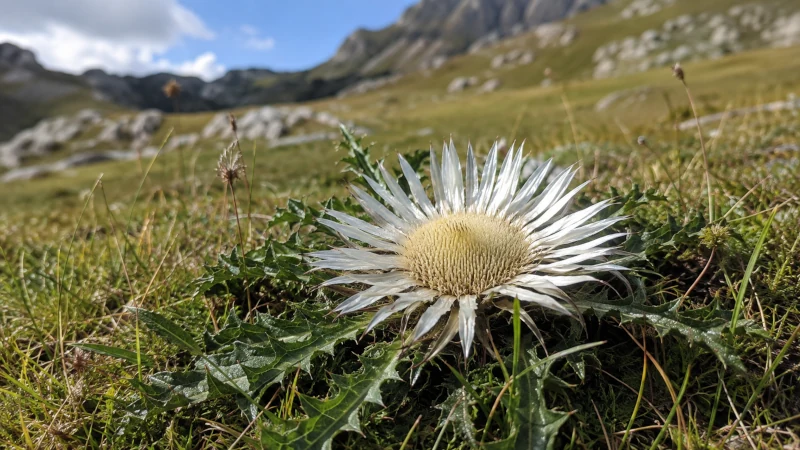
Carline thistle sits flat in mountain meadows like a large, straw-colored star pressed into the grass — a spiny rosette of leaves with a single wide flower head, up to about 12 centimeters across, and often barely any stem at all. That’s why it’s also called the stemless carline thistle. Some walkers think it looks like a fried egg dropped in the field; botanically it’s a member of the daisy family (Asteraceae), and it grows wild through the Alps, the Pyrenees, and the Balkans.
It has one charming party trick: the papery bracts around the flower head open in dry weather and close up when the air turns damp, which earned it the folk name “weather thistle.” None of that is medicinal, but it tells you something useful — this is a wild plant with a long, romantic reputation, and reputation is exactly the thing to separate from evidence.
The plague legend, and the small grain of truth inside it
The plant’s name carries a story. Legend says an angel told the emperor Charlemagne that this thistle would protect his soldiers from the plague, so he had them eat it — and the plant, “Carline,” supposedly honors him. Centuries later a 16th-century Spanish physician, Andrés de Laguna, recommended the root as a remedy against plague. It wasn’t. Plague is a bacterial infection, and millions of Europeans died of it regardless of any thistle.
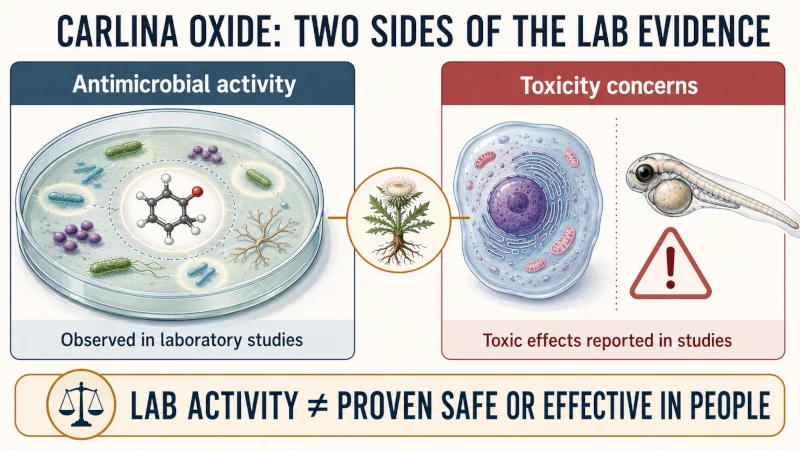
For a long time that was the whole story: a charming myth, medically worthless. What makes carline thistle a little more interesting is that its root does contain something with real antimicrobial activity — just not in the way the legend imagined. The root’s essential oil is dominated by a compound called carlina oxide, and in laboratory tests carlina oxide can kill microbes and even single-celled parasites [Herrmann et al., 2011]. That’s a genuine thread of truth behind an old story.

It is also where careful reading matters. “Kills microbes in a dish” is a long way from “protects people from infection,” and carlina oxide comes with a serious catch covered in the safety section below. There’s no evidence it prevents or cures any infectious disease in humans. The legend earns a smile; it doesn’t earn a place in your medicine cabinet.
What’s actually inside the root
The medicinally used part is the root (the flower head is used as food). Chemically, the root is roughly one-fifth inulin — a prebiotic plant fiber — along with tannins, resins, bitter sesquiterpene lactones, chlorogenic acids, and flavonoids such as C-glycosides of luteolin and apigenin [Molecules, 2023]. Its small fraction of essential oil (only 1–2% of the root) is where carlina oxide lives, making up the large majority of that oil [Toxins, 2020].
That mix explains the plant’s traditional identity. Bitter compounds and tannins are the classic signature of a “digestive bitter,” which is precisely the role carline thistle played in old European herbals.
Carline thistle plant health benefits: tradition vs. evidence
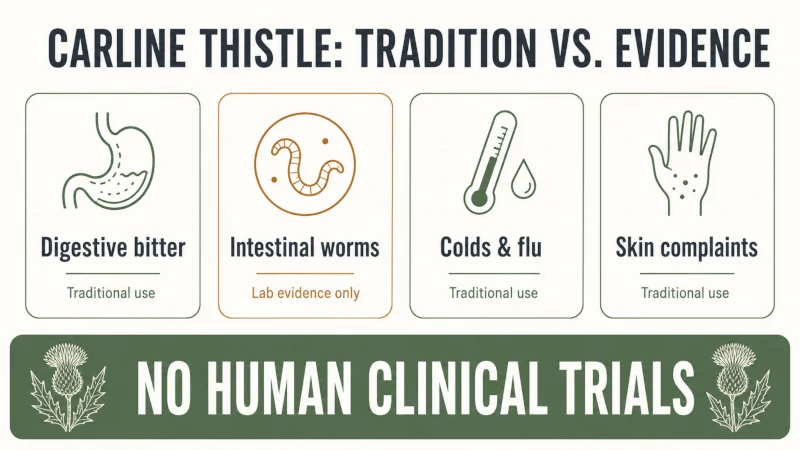
Here’s the part worth being precise about. Every use below is genuinely traditional — documented in the historical record and reviewed by ethnopharmacologists [Strzemski et al., 2019]. What none of them has is a modern human clinical trial. Keep that distinction in mind as you read.
| Traditional use | Evidence level | What that means for you |
| Digestive bitter | Traditional; plausible mechanism; no human trials | Bitter root may prime digestion, but not shown to beat placebo |
| Intestinal worms | Traditional; lab activity only; no human evidence | A stool test and standard medicine are far more reliable |
| Colds & flu (sweating) | Traditional/anecdotal; no evidence | One old anecdote is not proof it shortens illness |
| Skin complaints | Traditional topical use; unproven | Longstanding folk practice, not a proven treatment |
| Anticancer / insecticide | Early lab & animal research only | Interesting leads; not treatments for people |
A bitter digestive tonic
The best-fitting traditional use is as a bitter to nudge along sluggish digestion — for poor appetite, mild indigestion, and to stimulate bile flow. This is plausible on mechanism alone: bitters have been used across many cultures to prime the digestive system, and carline thistle root is genuinely bitter. If you’re interested in this angle, it’s worth understanding how bitter and digestive herbs are generally used before assuming any single plant is special. What’s missing is any controlled human study showing carline thistle specifically improves digestion better than other bitters or placebo. Reasonable mechanism, no clinical proof.
Intestinal worms
Carline thistle appears on centuries-old lists of vermifuges — herbs taken to expel intestinal worms — usually as a root decoction. Some of its compounds do show anti-parasite activity in the lab [Herrmann et al., 2011]. But laboratory activity is not the same as clearing a real infection in a person, and carline thistle sits squarely in the category of traditional worm remedies that lack good human evidence. Intestinal worms are one of the easiest infections a doctor can confirm with a simple test and clear with a cheap, well-studied medicine — which is a far more reliable path than a folk decoction, especially for a child.
Colds, flu, and “sweating it out”
The root was traditionally taken to make you sweat (a diaphoretic), which is where its cold-and-flu reputation comes from. One frequently repeated anecdote credits it with helping during the 1918 influenza pandemic. Treat that as historical color, not data — a single old observation is not evidence that it shortens or prevents respiratory illness, and nothing since has shown that it does. If you’re feeling run down, the foods and habits that genuinely support you through a cold rest on much firmer ground.
Skin complaints
Historically, the most consistent use across regions was topical: root preparations applied to skin problems, including acne, eczema, and ulcers [Strzemski et al., 2019]. This is longstanding folk practice rather than a proven treatment, and applying a compound to broken or inflamed skin carries its own risks (see safety, below).
What the newest lab research is looking at
Carline thistle nearly vanished from medicine by the end of the 19th century, and modern researchers are now revisiting it. Current work is almost entirely preclinical — cells in dishes and, at most, animal models. Extracts have been tested for effects on cancer cell lines [Molecules, 2023], and the essential oil has drawn interest as a natural insecticide and acaricide [Spinozzi et al., 2023]. These are early leads, not treatments. It would be a mistake — the exact mistake old herbals made with the plague — to read “active in a lab” as “works in people.”
How carline thistle is used (and the safer way to enjoy it)
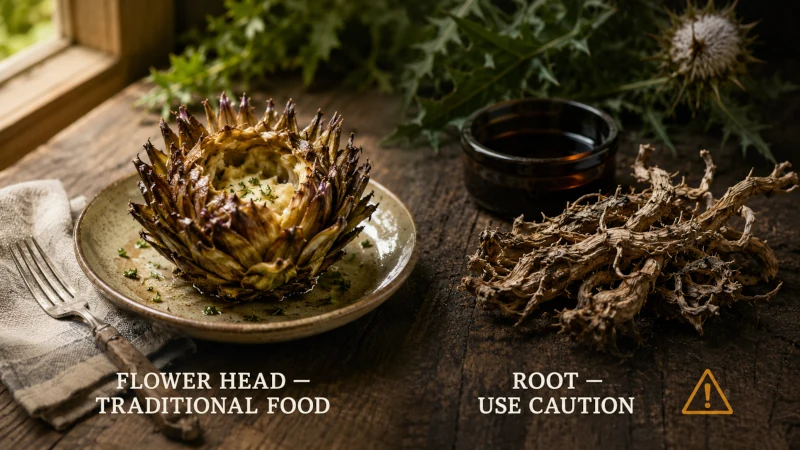
There’s a clean split here between food and medicine.
As food, it’s low-risk. The fleshy flower head can be cooked and eaten much like a small globe artichoke — hence its regional nickname, “wild artichoke.” This is the well-established, sensible way to meet the plant, and it’s how many people in the Alps and Pyrenees have used it for generations.
As a medicine, be cautious. Traditionally the root was simmered into a decoction. If you’re curious about the mechanics of that kind of preparation, the general methods for preparing herbs explain how decoctions work. But given the toxicity findings below, this is not a root to self-dose by eye. Old herbals themselves warned against exceeding the amount because it can trigger nausea and vomiting — unsurprising, since the root was also historically used to induce vomiting. If you’re considering the root medicinally, talk to a doctor or pharmacist first, and don’t improvise a dose from a website.
Side effects, safety, and who should avoid carline thistle
This is the section most carline thistle write-ups skip, and it’s the most important one.
The clearest safety signal comes from carlina oxide, the dominant compound in the root’s essential oil. In laboratory testing it was toxic to human cells — both normal skin cells and cancer cells — and in a zebrafish model it was highly toxic to developing embryos, with malformations and heart-slowing effects, at low concentrations [Toxins, 2020]. That’s a compound-level finding, not a report of people being harmed, and researchers have noted that root extracts stripped of carlina oxide behaved very differently. But it’s a real reason not to treat the whole root as casually safe.
Beyond that:
- Nausea and vomiting. The root is a bitter emetic in larger amounts. This is the most likely everyday side effect.
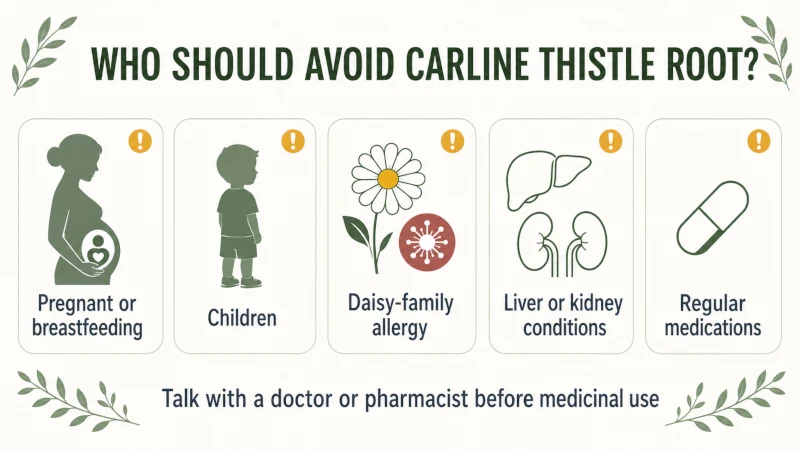
- Pregnancy and breastfeeding — avoid. Given the teratogenic (developmental) toxicity of carlina oxide in the zebrafish study, and the complete absence of human safety data, there is no basis for using carline thistle root while pregnant or nursing.
- Children — avoid. Smaller bodies are more vulnerable to toxic plant compounds, and there’s no pediatric safety data. A treatable problem like worms should be handled by a pediatrician, not a home decoction.
- Allergy. Carline thistle is in the daisy family (Asteraceae). If you react to ragweed, daisies, marigolds, or chrysanthemums, you may be more likely to react to it.
- Liver or kidney conditions, or any regular medication. Because the root has essentially never been studied in people, its interactions with medicines are unknown rather than proven safe. If you take prescription drugs or have a chronic condition, ask a doctor or pharmacist before using it.
The theme running through all of this: “natural” and “traditional” are not the same as “safe,” and an under-studied root with a toxic signature compound is exactly the kind of remedy to approach slowly and with professional input.
When to see a doctor
Carline thistle is reached for in situations that can have real red flags. Don’t let a folk remedy delay proper care:
- Suspected intestinal worms — especially in a child, or if you can see worms or segments in the stool, or there’s belly pain, blood in the stool, vomiting, or weight loss. A stool test settles it, and treatment is simple.
- A cold or flu that turns serious — get prompt care for a fever above 103°F (39.4°C) or lasting more than three days, shortness of breath or chest pain, confusion, or symptoms that improve and then suddenly worsen.
- Ongoing digestive trouble — persistent loss of appetite, unexplained weight loss, difficulty swallowing, or black or bloody stools all warrant a doctor rather than a bitter tonic.
Seek urgent care or call 911 for severe abdominal pain, trouble breathing, or — after taking any herbal preparation — confusion, a racing or very slow heartbeat, yellowing of the skin or eyes, or a sharp drop in how much urine you’re passing. You can also reach Poison Control at 1-800-222-1222.
| Health Disclaimer: This article is for general education and is not a substitute for professional medical advice, diagnosis, or treatment. Carline thistle has not been evaluated in human clinical trials, and its main essential-oil compound is toxic in laboratory studies. Do not use carline thistle root medicinally — and especially not during pregnancy or breastfeeding, in children, or alongside prescription medication — without first speaking to your doctor or pharmacist. Never use it to self-treat a suspected infection or delay care for a red-flag symptom. If you experience a serious reaction after taking any herbal product, seek medical attention promptly or call Poison Control at 1-800-222-1222; for severe symptoms such as difficulty breathing, call 911. |
Frequently Asked Questions
Is carline thistle safe to take?
The cooked flower head is a traditional food and low-risk for most people. The root used medicinally is a different matter: it’s an under-studied bitter that can cause nausea and vomiting, and its main essential-oil compound (carlina oxide) is toxic in lab studies. Anyone considering the root should talk to a doctor or pharmacist first, and it should be avoided in pregnancy, breastfeeding, and childhood.
Does carline thistle actually cure the plague, or any infection?
No. That’s a medieval legend. Plague is a bacterial disease, and no herb prevents or cures it. The root’s essential oil does have antimicrobial activity in the laboratory, which is a small kernel of truth behind the myth — but laboratory activity is not the same as treating infection in a person, and there’s no human evidence for it.
What is carline thistle used for traditionally?
As a digestive bitter (for poor appetite and sluggish digestion), to expel intestinal worms, to promote sweating during colds and flu, and applied to the skin for problems like acne and eczema. All of these are traditional uses; none is backed by modern human trials.
Can I eat carline thistle?
Yes — the fleshy flower head is cooked and eaten much like a small globe artichoke, which is why it’s sometimes called “wild artichoke.” That culinary use is the plant’s safest and most established one.
Are there drug interactions with carline thistle?
Because the plant has essentially never been studied in humans, its interactions are unknown rather than proven safe — which is its own kind of caution. If you take any regular medication or have a liver or kidney condition, check with a doctor or pharmacist before using the root.
Who should avoid carline thistle?
Anyone who is pregnant or breastfeeding, children, people with an allergy to daisy-family plants (ragweed, marigold, chrysanthemum), and anyone with a chronic condition or on regular medication unless a healthcare professional has said it’s appropriate.
References
- Strzemski M, Wójciak-Kosior M, Sowa I, Załuski D, Verpoorte R. Historical and traditional medical applications of Carlina acaulis L. — A critical ethnopharmacological review. Journal of Ethnopharmacology. 2019;239:111842. PMID 30948315. View source
- Wnorowski A, et al. Toxicity of Carlina Oxide — A Natural Polyacetylene from the Carlina acaulis Roots — In Vitro and In Vivo Study. Toxins. 2020;12(4):239. PMID 32283677. View source
- Polyphenolic Composition of Carlina acaulis L. Extract and Cytotoxic Potential against Colorectal Adenocarcinoma and Cervical Cancer Cells. Molecules. 2023. PMID 37630400 / PMC10458490. View source
- Herrmann F, et al. Carlina oxide — a natural polyacetylene from Carlina acaulis (Asteraceae) with potent antitrypanosomal and antimicrobial properties. 2011. PMID 21678234. View source
- Spinozzi E, et al. Carlina acaulis L. (Asteraceae): Biology, Phytochemistry, and Application as a Promising Source of Effective Green Insecticides and Acaricides. Industrial Crops and Products. 2023;192:116076. DOI 10.1016/j.indcrop.2022.116076. View source
