
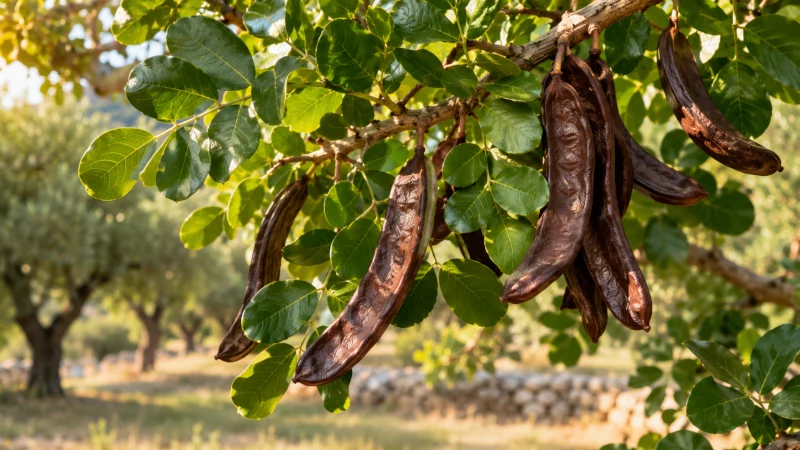
The carob tree (Ceratonia siliqua) gives you two very different products. Its sweet brown pods are dried and ground into carob powder, the caffeine-free stand-in for cocoa. Its seeds are milled into locust bean gum, the thickener listed as E410 on food labels [Goulas, 2016; EFSA, 2017].
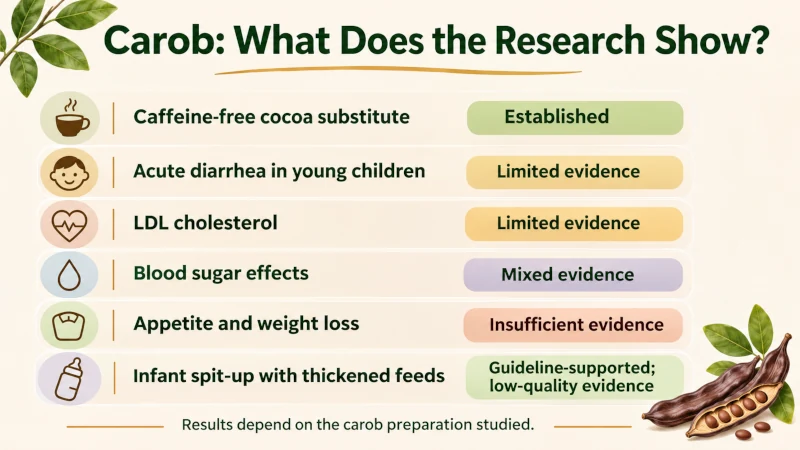
What can the carob tree actually do for your health? Less than many herbal guides promise, but more than nothing. Small clinical trials support tannin-rich carob pod powder as an add-on to oral rehydration for young children with acute diarrhea. A few trials of concentrated carob fiber found lower LDL cholesterol. Carob-thickened feeds can cut visible spit-up in some babies. Claims about weight loss and blood sugar rest on thin, partly contradictory evidence.
| Use | What the research shows | Evidence strength |
| Acute diarrhea in young children (with rehydration) | Two small hospital trials: faster recovery when carob was added | Limited but consistent |
| Travelers’ diarrhea in adults | One large trial: only a non-significant trend | Not supported |
| LDL cholesterol | Small trials of specific carob-fiber products; LDL down 7–22% | Limited, product-specific |
| Blood sugar | Conflicting results | Mixed |
| Appetite and weight | Short-term hormone shifts only; no weight-loss trials | Insufficient |
| Infant spit-up (thickened feeds) | Thickening reduces visible regurgitation | Guideline-supported; low-quality evidence |
| Caffeine-free cocoa substitute | No caffeine or theobromine; low fat | Well established (composition) |
What is the carob tree?
Carob is an evergreen member of the legume family, widely grown around the Mediterranean [Goulas, 2016; Nemet, 2022]. You may also see it sold as St. John’s bread or locust bean. Its fruit is a leathery brown pod, usually 10 to 30 cm long. About 90% of the pod is pulp; the other 10% is seed [Goulas, 2016].
Pulp and seeds are two different products
The pulp is what becomes carob powder, flour, chips and syrup. It’s naturally sweet: roughly half its dry weight is sugar, mostly sucrose. It also carries a large load of tannins and insoluble fiber, very little fat, and neither caffeine nor theobromine, the stimulants found in cocoa [Goulas, 2016].
The seeds are a separate story. Their inner endosperm is milled into locust bean gum (also called carob bean gum), a fiber that swells in water and thickens foods like ice cream and yogurt [Goulas, 2016]. Europe’s food safety agency re-evaluated the gum in 2017 and found no safety concern for the general population at its reported uses [EFSA, 2017].
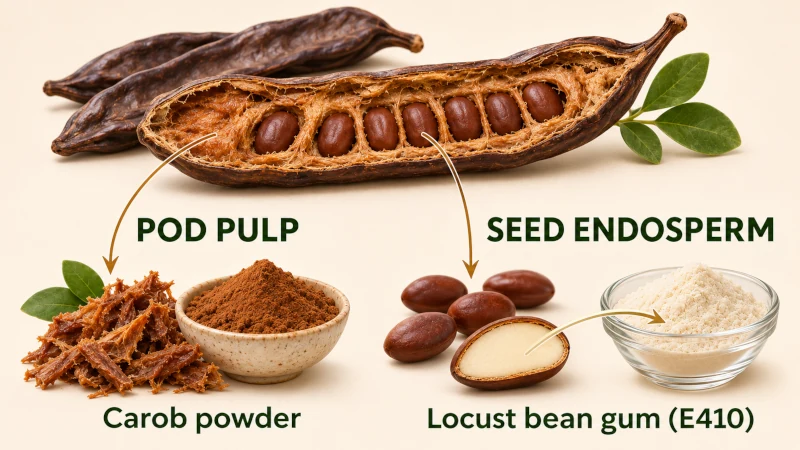
That split matters when you read a health claim. A study of tannin-rich pod powder tells you very little about gum capsules, and the reverse is just as true.
Carob tree benefits: what the research shows
Acute diarrhea in young children: limited but promising
This is carob’s best-documented medical use. In a randomized, placebo-controlled trial, 41 hospitalized infants aged 3 to 21 months all received oral rehydration fluid. Those also given tannin-rich carob pod powder (1.5 g per kg of body weight a day, up to 15 g) recovered in about 2 days, versus 3.75 days on placebo. Fever, vomiting and weight normalized faster too [Loeb, 1989].
A later trial in Turkey randomized 80 children aged 4 to 48 months to the WHO oral rehydration solution with or without carob bean juice. The carob group had diarrhea for 45% less time and passed 44% less stool [Akşit, 1998].
Keep those numbers in proportion. Both trials were small, decades old, and run under hospital supervision with specific preparations; the Turkish authors themselves said the juice needed technological processing before wider use [Akşit, 1998]. In adults, a placebo-controlled trial of an insoluble carob fraction in 755 volunteers with travelers’ diarrhea showed only a positive trend, not a clear benefit [Goulas, 2016].
What this means for you: carob is a reasonable food once a child is eating again, and it already appears among the gentler foods that help with diarrhea. It doesn’t replace rehydration. The American Academy of Pediatrics advises against homemade remedies for children’s diarrhea and recommends commercial electrolyte solutions over home-mixed ones [AAP, 2021]. Talk to your pediatrician before giving any carob product as a treatment.
Cholesterol: modest, product-specific results
Carob fiber is mostly insoluble, the kind that usually does little for cholesterol. Yet a few trials found an effect. In an 8-week open-label pilot, 47 adults with moderately high cholesterol added 15 g a day of a carob pulp preparation; LDL fell by about 12% at six weeks [Zunft, 2001].
A double-blind, placebo-controlled trial in 58 adults using the same daily amount followed [Zunft, 2003]. One review describes an LDL reduction of about 10.5% versus placebo [Goulas, 2016], while another tabulates a much smaller change [Nemet, 2022], so treat that result as modest and uncertain. A Spanish trial of 88 adults found LDL 22.5% lower than baseline after four weeks of 4 g twice a day of a concentrated carob polyphenol fiber; the placebo group didn’t change [Ruiz-Roso, 2010].
A 2022 review of the human studies put the LDL drops between 7.4% and 22.5%, well below what statins achieve. The reviewers noted that each study used a different product, dose and population, and that none measured heart attacks, strokes or deaths. They saw carob, at most, as an add-on to lifestyle changes in mild cases or alongside standard treatment [Nemet, 2022].
Notice what was tested: standardized carob fiber preparations, several of them commercial ingredients. Carob chips or a carob candy bar won’t deliver comparable amounts. If your cholesterol is high, carob is not a substitute for anything your clinician has prescribed; it can sit alongside the broader fiber-rich eating pattern in our guide to foods for healthy digestion.
Blood sugar: genuinely mixed
Carob is often sold as diabetes-friendly. It’s naturally sweet and contains D-pinitol, a compound studied for insulin-like effects [Goulas, 2016]. The clinical picture is messier. In a randomized crossover study of 20 healthy adults, adding 5 or 10 g of carob fiber to a glucose drink raised blood glucose by 47% and 64% and insulin by roughly 20–25%, compared with the drink alone. The researchers cautioned that a normal mixed meal might behave differently [Gruendel, 2007].
Meanwhile, WebMD’s pharmacist-reviewed monograph describes carob as possibly blood-sugar-lowering and flags a risk of low blood sugar when it’s combined with diabetes medicines [WebMD, 2026]. Those two signals point in opposite directions, and that is the honest answer: carob’s effect on blood sugar is not established. Carob powder and syrup are also sugar-rich. If you have diabetes, count carob foods as carbohydrate and check with your care team before trying carob supplements.
Appetite and weight: not enough evidence
Locust bean gum swells in the stomach, which is why some herbal sources recommend gum capsules before meals for weight loss. No weight-loss trials support that. In one short laboratory study, a meal enriched with carob fiber lowered acylated ghrelin, a hunger hormone [Gruendel, 2006]. When the same research group gave carob fiber with a glucose drink, acylated ghrelin didn’t change [Gruendel, 2007]. A few hours of hormone shifts is a long way from eating less or losing weight.
Infant spit-up: locust bean gum in thickened feeds
This is the one carob use that appears in pediatric guidelines, with an important caveat about who makes the call. The 2018 joint North American and European pediatric gastroenterology guidelines suggest thickened feeds for visible regurgitation in infants with reflux disease. They rate the evidence low to very low and note that thickening doesn’t clearly help other symptoms [Rosen, 2018].
For babies who drink breast milk, the guidelines note that carob bean–based thickeners can be added to it, and that these thickeners are approved for infants after 42 weeks’ gestation [Rosen, 2018]. Spitting up is common in healthy babies. Thickening is a decision to make with your pediatrician, using a product designed for infants, never a homemade carob flour mixture.
Carob vs. cocoa
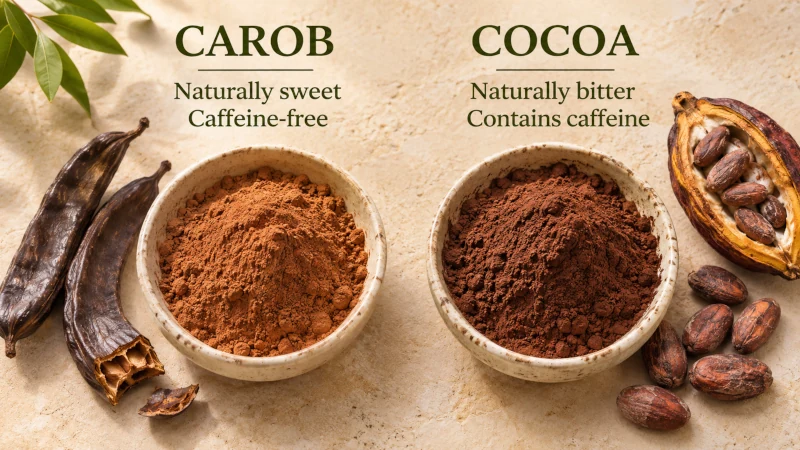
Carob tastes sweeter and milder than cocoa, closer to caramel than to dark chocolate. Its main advantage is what it lacks: no caffeine and no theobromine [Goulas, 2016]. That makes it a practical swap if stimulants bother you or you’re cutting back in the evening.
| Feature | Carob powder | Cocoa powder |
| Source | Pod pulp of the carob tree | Seeds (beans) of the cacao tree |
| Caffeine and theobromine | None [Goulas, 2016] | Present |
| Taste | Naturally sweet | Bitter unless sweetened |
| Fat | Very low [Goulas, 2016] | Contains cocoa butter |
| Watch for | Added sugar and fat in carob bars and chips | Added sugar in sweetened products |
How to use carob
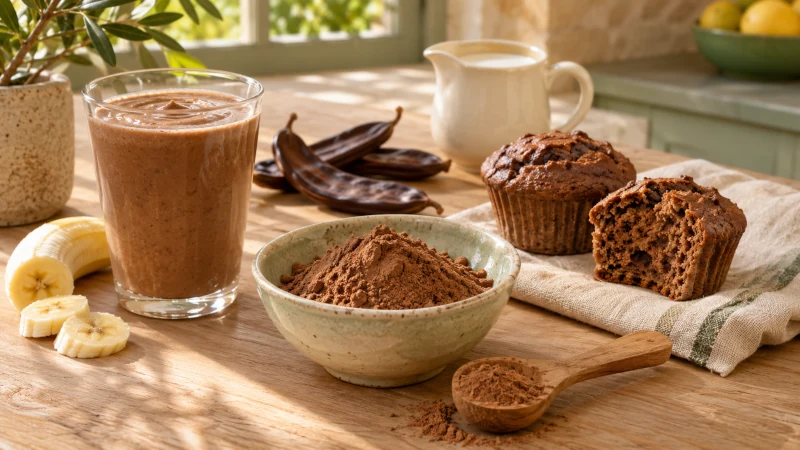
- Carob powder or flour: use it in baking, smoothies or warm milk. Because it’s sweeter than cocoa, you can often trim the added sugar in a recipe.
- Carob syrup: a sweetener, and still sugar. Use it the way you’d use honey or molasses.
- Carob chips and bars: read the label; many contain added sugar and fats.
- Locust bean gum (E410): you probably already eat it in ice cream or yogurt. There’s no good reason to take it as a supplement.
- Carob fiber supplements: the cholesterol trials used 8–15 g a day of specific preparations. No standard dose exists, and the FDA has not tested carob products to confirm what’s on the label [WebMD, 2026].
Add carob fiber gradually and drink water with it; gas and bloating are the usual complaints when people start [WebMD, 2026]. If regularity is your main goal, prunes, kiwifruit and other foods that help with constipation have far better evidence. And don’t confuse carob with cassia fistula, another pod-bearing legume tree whose pulp is used as a stimulant laxative: a different product with different risks. For everyday gut support, variety matters more than any single food; see our best foods for gut health.
The other “carob trees” of the Americas
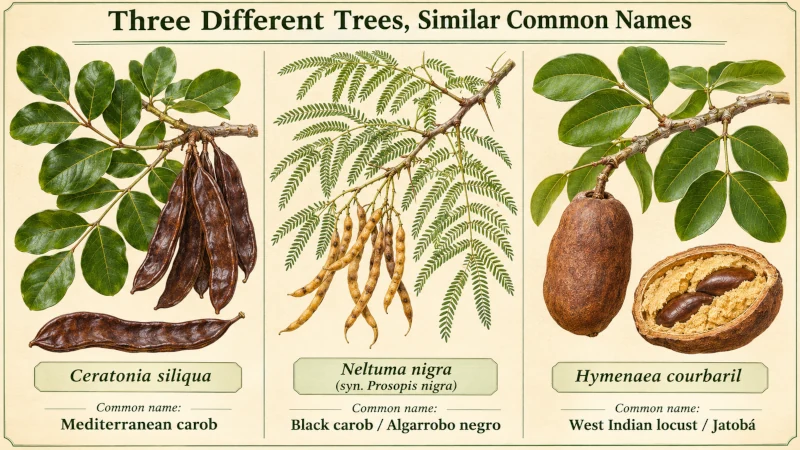
When Spanish settlers reached South America, they gave the name algarrobo, the Spanish word for carob, to native Prosopis trees with similar sweet pods [Joseau, 2023]. One of them, Prosopis (now Neltuma) nigra, is the algarrobo negro or black carob of Argentina. Its pods are ground into flour and used for traditional foods and drinks, including añapa, a sweet, unfermented drink made by soaking crushed pods in water [Joseau, 2023].
A third tree, Hymenaea courbaril, known as the West Indian locust or jatobá and also called algarrobo in Spanish, grows from Mexico and the Caribbean to Brazil. Its trunk and roots yield a resin sold as South American copal, used mainly in varnish and incense, and its bark is a folk remedy for coughs [Orwa, 2009; Britannica, n.d.].
These are separate species. None of the carob research above applies to them, and their traditional respiratory uses haven’t been tested in good human trials.
Side effects and safety
As a food, carob appears to be well tolerated by most people [WebMD, 2026].
Common side effects
Because carob is high in fiber, gas, bloating and stomach discomfort are the most likely side effects, especially when you first start or increase the amount [WebMD, 2026]. Very heavy, regular use may also reduce absorption of minerals such as iron, calcium and zinc, according to an older study cited by the breastfeeding database e-lactancia [e-lactancia, 2019].
Allergy
Carob allergy is uncommon. Most reported cases involve rhinitis or asthma in workers who inhale carob flour on the job; a small number of reactions after eating it have been described, including one in a 5-month-old infant [EFSA, 2017]. If you have legume allergies (peanut, soy, lentils), mention them to your clinician before using carob supplements [WebMD, 2026]. Stop and get help right away for swelling of the face or throat, wheezing, hives, or trouble breathing.
Medication interactions
Interactions haven’t been well studied. WebMD’s monograph lists these possibilities [WebMD, 2026]:
- Diabetes medicines: a possible additive blood-sugar-lowering effect. Given the conflicting glucose research above, monitor closely if you combine them.
- Cholesterol-lowering medicines: a possible additive effect; your clinician may want to recheck your lipids.
- Any medicine taken by mouth: fiber may slow absorption. Take other oral medicines a few hours apart from carob supplements, or ask your pharmacist.
Pregnancy and breastfeeding
Carob in normal food amounts is generally fine. Whether larger supplement doses affect pregnancy, or pass into breast milk in meaningful amounts, isn’t known [WebMD, 2026]. The e-lactancia database rates moderate carob intake as compatible with breastfeeding [e-lactancia, 2019]. Talk to your clinician before using concentrated carob products while pregnant or nursing.
Babies and young children
Give fluids first. For a child with diarrhea, oral rehydration and your pediatrician’s advice come before any food remedy, and the AAP warns against homemade remedies [AAP, 2021]. Use thickened feeds only under pediatric guidance; carob bean thickeners are not approved before 42 weeks’ gestation [Rosen, 2018]. EFSA has also said its data were not enough to assess locust bean gum in special medical foods for infants and young children with underlying conditions [EFSA, 2017].
Who should avoid carob or check first
- Anyone allergic to carob or locust bean gum [WebMD, 2026].
- People with diabetes who take glucose-lowering medicine, before using carob supplements.
- People on cholesterol medicine or other time-sensitive oral medicines.
- Parents of premature babies or infants with medical conditions, before any carob-thickened feed.
- Anyone told to limit fiber, before using carob fiber supplements.
When to see a doctor
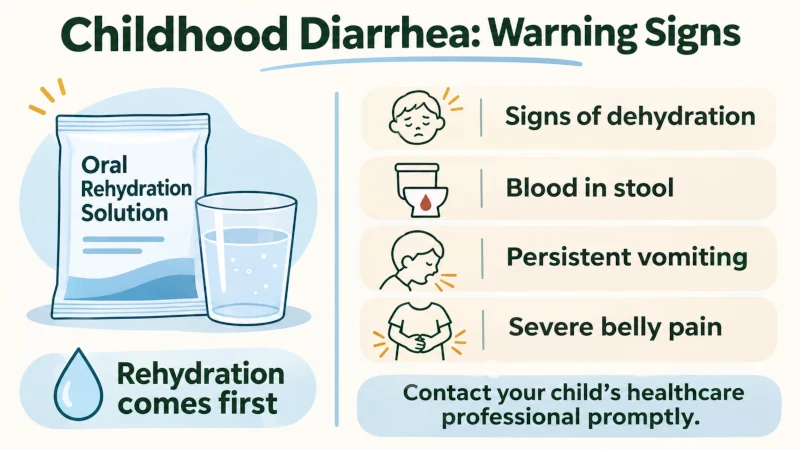
Diarrhea can dehydrate a young child quickly. Call your child’s doctor right away for signs of dehydration, or if your child has diarrhea and any of the following [AAP, 2021]:
- Fever lasting longer than 24 to 48 hours
- Bloody stools
- Vomiting that lasts more than 12 to 24 hours
- Vomit that is green, bloody, or looks like coffee grounds
- A swollen-looking belly or severe belly pain
- Refusing to eat or drink
- A rash or yellowing of the skin or eyes
Adults should see a doctor if diarrhea lasts more than two days without improvement, or with dehydration, severe abdominal or rectal pain, bloody or black stools, or a fever above 102°F (39°C) [Mayo Clinic, 2026].
For babies who spit up, the reflux guidelines list warning signs that point to something other than ordinary reflux: weight loss, lethargy, fever, persistent forceful vomiting, green (bilious) vomit, vomiting blood, a swollen belly, or spitting up that starts after 6 months of age [Rosen, 2018]. Any of these needs prompt medical attention.
| HEALTH DISCLAIMER: This article is for general education and is not a substitute for professional medical advice, diagnosis, or treatment. Carob is a food and a supplement ingredient; it does not cure or replace treatment for diarrhea, high cholesterol, diabetes, or reflux. Do not use carob as a treatment for a child without talking to a pediatrician, and always put oral rehydration first. If you are pregnant or breastfeeding, take prescription medicines, have diabetes or allergies, or are caring for an infant, check with a qualified healthcare professional before using carob supplements or thickeners. Seek medical care promptly for any of the warning signs listed above. |
Frequently Asked Questions
Is carob healthier than chocolate?
It’s different rather than simply healthier. Carob has no caffeine or theobromine and very little fat, but it’s naturally high in sugar [Goulas, 2016]. Carob bars and chips often add more sugar and fat, so compare labels the way you would with chocolate.
Does carob have caffeine?
No. Carob pods contain neither caffeine nor theobromine, which is why carob is used as a cocoa substitute [Goulas, 2016].
Can carob stop diarrhea?
Two small trials in young children found faster recovery when carob was added to oral rehydration [Loeb, 1989; Akşit, 1998]. Evidence in adults is weak [Goulas, 2016]. Rehydration comes first, and a child should get carob as a treatment only with a pediatrician’s advice [AAP, 2021].
Can carob lower cholesterol?
Specific carob fiber preparations lowered LDL by roughly 7–22% in small, short trials, and none tracked heart outcomes [Nemet, 2022]. It may help a little alongside a healthy diet; it doesn’t replace prescribed treatment.
Is locust bean gum safe?
For the general population, yes at normal food-additive levels, according to EFSA’s 2017 re-evaluation. Allergic reactions are rare [EFSA, 2017].
Is carob safe for babies?
Only as your pediatrician directs. Carob bean thickeners for breast milk are approved for infants after 42 weeks’ gestation, and thickened feeds are meant for visible regurgitation, not routine use [Rosen, 2018]. Don’t make homemade carob remedies for infants [AAP, 2021].
References
- Goulas V, Stylos E, Chatziathanasiadou MV, Mavromoustakos T, Tzakos AG. Functional components of carob fruit: linking the chemical and biological space. View source
- Nemet M, Vasilić M, Tomas A. Lipid-lowering effects of carob extracts (Ceratonia siliqua): proposed mechanisms and clinical importance. View source
- Loeb H, Vandenplas Y, Würsch P, Guesry P. Tannin-rich carob pod for the treatment of acute-onset diarrhea. J Pediatr Gastroenterol Nutr. View source
- Akşit S, Çağlayan S, Çukan R, Yaprak I. Carob bean juice: a powerful adjunct to oral rehydration solution treatment in diarrhoea. View source
- Zunft HJ, Lüder W, Harde A, et al. Carob pulp preparation for treatment of hypercholesterolemia. View source
- Zunft HJ, Lüder W, Harde A, et al. Carob pulp preparation rich in insoluble fibre lowers total and LDL cholesterol in hypercholesterolemic patients. View source
- Ruiz-Roso B, Quintela JC, de la Fuente E, Haya J, Pérez-Olleros L. Insoluble carob fiber rich in polyphenols lowers total and LDL cholesterol in hypercholesterolemic subjects. View source
- Gruendel S, Garcia AL, Otto B, et al. Carob pulp preparation rich in insoluble dietary fiber and polyphenols enhances lipid oxidation and lowers postprandial acylated ghrelin in humans. View source
- Gruendel S, Otto B, Garcia AL, et al. Carob pulp preparation rich in insoluble dietary fibre and polyphenols increases plasma glucose and serum insulin responses in combination with a glucose load in humans. View source
- Vermeulen M (writer); Johnston B (medical reviewer). Carob — Uses, Side Effects, and More. WebMD. View source
- EFSA Panel on Food Additives and Nutrient Sources added to Food (ANS). Re-evaluation of locust bean gum (E 410) as a food additive. View source
- Rosen R, Vandenplas Y, Singendonk M, et al. Pediatric gastroesophageal reflux clinical practice guidelines: View source
- American Academy of Pediatrics. Diarrhea in Children: What Parents Need to Know. HealthyChildren.org. View source
- Mayo Clinic Staff. Diarrhea — Symptoms and causes. Mayo Clinic. View source
- APILAM. Carob (Ceratonia siliqua) and breastfeeding. e-lactancia.org. View source
- Joseau MJ, Rodriguez Reartes S, Frassoni JE. The legumes of Neltuma spp. (ex Prosopis spp.) and their properties for human and animal food. In: Production and Utilization of Legumes. View source
- Orwa C, Mutua A, Kindt R, Jamnadass R, Anthony S. Agroforestree Database 4.0: Hymenaea courbaril. View source


