
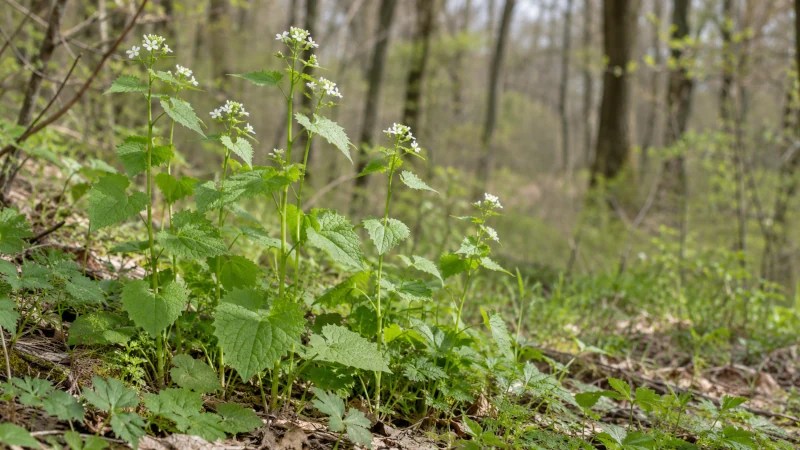
Hedge garlic is a common wild plant you can eat. Its young leaves taste like a cross between garlic and mustard, and they work well in salads, pesto and cooked greens. What hedge garlic isn’t is a proven medicine. The traditional claims attached to it — that it eases gout, lowers blood pressure or heals wounds — have never been tested in people.
That gap is the most useful thing to know before you pick a handful. Below: what the plant actually is, what’s in it, how to eat it sensibly, and the few genuine safety points most herbal pages skip.
What is hedge garlic?
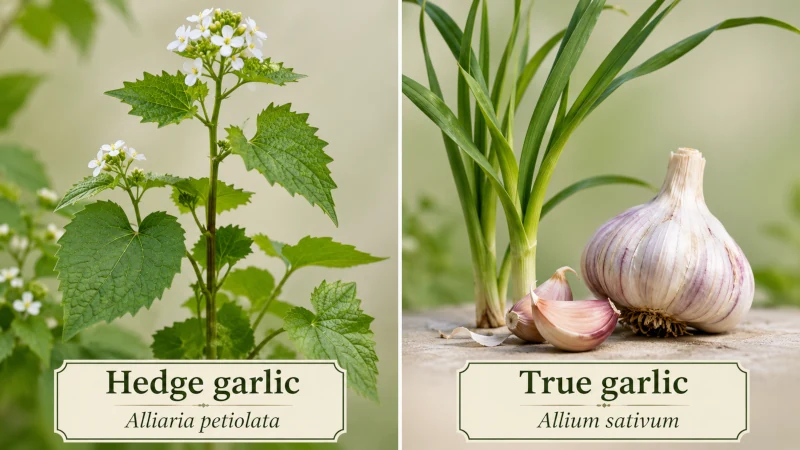
Hedge garlic is Alliaria petiolata, better known in North America as garlic mustard and in Britain as jack-by-the-hedge. Other folk names include poor man’s mustard and penny hedge [Wild Food UK, 2025]. Despite the name, it isn’t a garlic at all. It belongs to the mustard family (Brassicaceae, also called Cruciferae), alongside cabbage, watercress and horseradish. The garlic part is the smell of a crushed leaf.
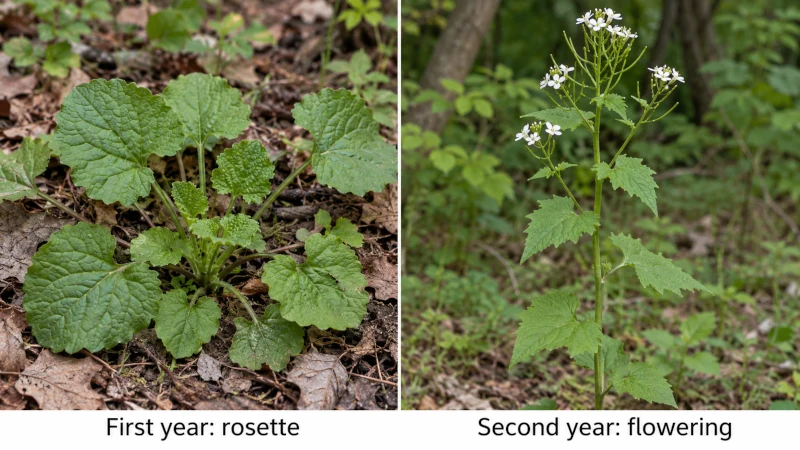
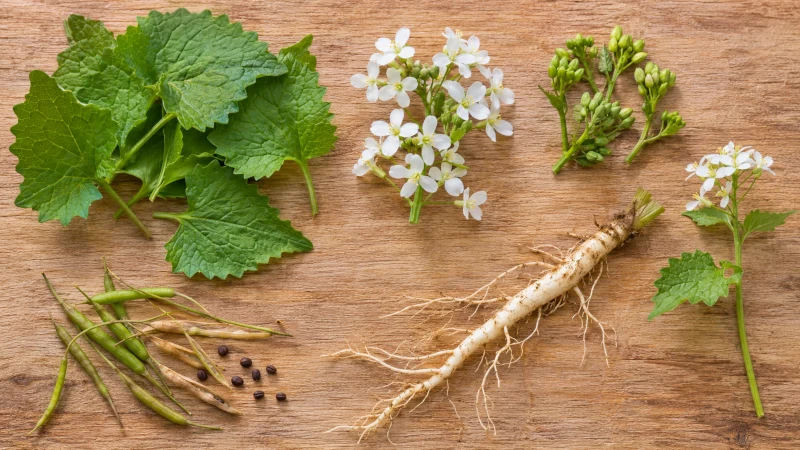
It’s a biennial. In year one it forms a low rosette of broad, heart-shaped leaves. In year two it sends up a flower stalk that can reach about a metre and a half, topped with clusters of tiny four-petalled white flowers and then thin, upright seed pods [Wild Food UK, 2025]. You’ll find it along hedgerows, woodland edges, shady paths and scrub.
The plant is native to Europe and parts of Asia and Africa [Frisch et al., 2015]. Settlers brought it to North America in the 1800s for cooking and medicine [Kurtz & Hansen, 2014], and it is now one of the most recognizable invasive plants in the forests of the eastern United States and southern Canada [Cipollini, 2016]. That matters if you forage, and we’ll come back to it.
What’s actually in it
The bite comes from glucosinolates, the sulfur compounds that run through the whole mustard family. Hedge garlic’s main one is sinigrin, with glucotropaeolin as the second [Cipollini, 2016]. When you chop or chew the leaves, an enzyme called myrosinase turns sinigrin into allyl isothiocyanate — the same pungent compound behind the heat of mustard and horseradish [Linus Pauling Institute, 2017a]. It makes up roughly half of the volatile compounds in fresh leaves [Cipollini, 2016].
Two less familiar compounds deserve a mention. The plant makes alliarinoside, which is structurally related to the cyanide-releasing glucosides found in some food plants [Frisch et al., 2015]. And it releases measurable cyanide from its tissues: one study found levels reaching 100 ppm fresh weight, highest in the young leaves of first-year seedlings [Cipollini & Gruner, 2007]. The safety section explains what that does and doesn’t mean.
You’ll often read that hedge garlic is loaded with vitamins A and C. Many wild greens are. But recent, reliable nutrient analyses for this particular plant are hard to find, so treat precise vitamin figures online with some caution.
Hedge garlic health benefits: what the evidence shows
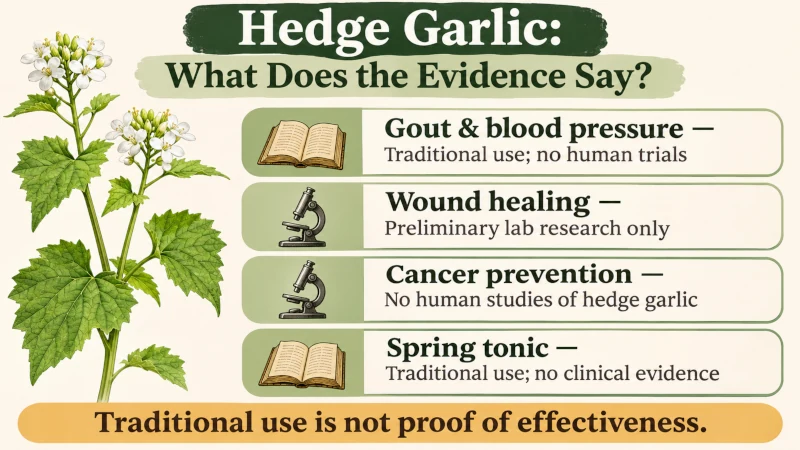
The short version: no clinical trial has tested hedge garlic for any health condition in people. Every benefit you’ll see claimed comes from tradition, from test-tube studies of extracts, or from evidence borrowed from other mustard-family plants.
| Claim | Where it comes from | Evidence in people |
| Spring tonic for tiredness | Traditional European herbalism | None |
| Gout, arthritis, obesity, high blood pressure | Traditional use | None |
| Diuretic (“water pill”) effect | Traditional use | None |
| Antiseptic / wound healing | Folk use; lab tests of extracts | None — lab only |
| Cancer prevention | Cell and animal studies of related compounds | None for hedge garlic; mixed for mustard-family vegetables in general |
Traditional uses: spring tonic, gout, arthritis, weight and blood pressure
Older European herbals recommend hedge garlic as a spring “cleansing” treatment and for gout, arthritis, obesity and high blood pressure [Pamplona-Roger, 2000 — UNVERIFIED print source]. Foraging guides repeat versions of the list, adding asthma and rheumatism and calling the plant diuretic [Wild Food UK, 2025]. These uses are part of the plant’s history. None has been tested in a controlled trial, and no amount has been shown to help.
If one of those conditions brought you here, the evidence-based levers are elsewhere. For gout, food and drink choices make a real difference — see our guide to gout-friendly foods — although most people still need medication. For blood pressure, cutting back on the foods that raise blood pressure, salt above all, has far more support than any wild green. And if the diuretic idea appeals, our review of herbal remedies for the urinary system explains why “flushing” herbs are a poor choice for anyone with swelling from heart or kidney problems.
The “antiseptic” wound-healing claim
Some herbal sources tell you to wash wounds and skin ulcers with fresh hedge garlic juice and then apply juice-soaked compresses. Please don’t.
The lab evidence is thin. One preliminary study found that methanol extracts of the leaves and roots had moderate antimicrobial activity in the test tube [Katanić Stanković et al., 2020]. That says nothing about whether crushed leaves help a wound heal, and there are no human studies. Meanwhile, the plant’s signature compound, allyl isothiocyanate, is a strong skin irritant; mustard applied to skin has caused second-degree burns [Gaiser & Köhl, 2017]. An open wound is the worst place to find out how your skin reacts.
For minor cuts, rinse under running water, keep the wound covered, and see a clinician if you notice spreading redness or discoloration, warmth, swelling, drainage or increasing pain [Mayo Clinic, 2024]. A skin ulcer that isn’t healing needs a proper medical assessment, especially if you have diabetes.
Cancer and the mustard-oil connection
Isothiocyanates, the family allyl isothiocyanate belongs to, are among the most studied compounds in cancer-prevention research. In cells and animals they show antioxidant and anti-inflammatory activity and act on several cancer-related pathways [Linus Pauling Institute, 2017a]. In people the picture is murkier. Studies of cruciferous vegetables and cancer risk have produced mixed results [National Cancer Institute, 2012], and there isn’t enough evidence that isothiocyanates from vegetables lower cancer risk [Linus Pauling Institute, 2017a].
Hedge garlic itself has never been studied for cancer in humans. Counting it as one more leafy green in a vegetable-rich diet is reasonable. Treating it as cancer prevention is not.
Hedge garlic is not a stand-in for garlic
The name invites a mix-up. Hedge garlic sits in a different plant family from true garlic (Allium sativum), and its flavor comes from mustard-family glucosinolates [Cipollini, 2016] rather than garlic’s own chemistry. So none of the garlic research transfers. The modest benefits studied for garlic come from garlic and concentrated garlic supplements, not from plants that happen to smell similar. If garlic is what you’re really curious about, our evidence review of garlic’s benefits covers what the trials found.
How to eat hedge garlic
Expect a mild garlic flavor with a mustardy finish. Opinion splits on its slightly bitter aftertaste, and a good dressing usually settles the argument [Wild Food UK, 2025]. Lemon, cheese, nuts and olive oil all help.
What to pick
- Young first-year leaves and the tender tops of second-year plants — for salads, sandwiches, pesto, or wilted into soups and stir-fries [Wild Food UK, 2025].
- Flowers and flower buds — a peppery garnish.
- Seeds — ground into a mustard-style condiment.
- Roots at the end of the second year — they taste a little like mild horseradish.
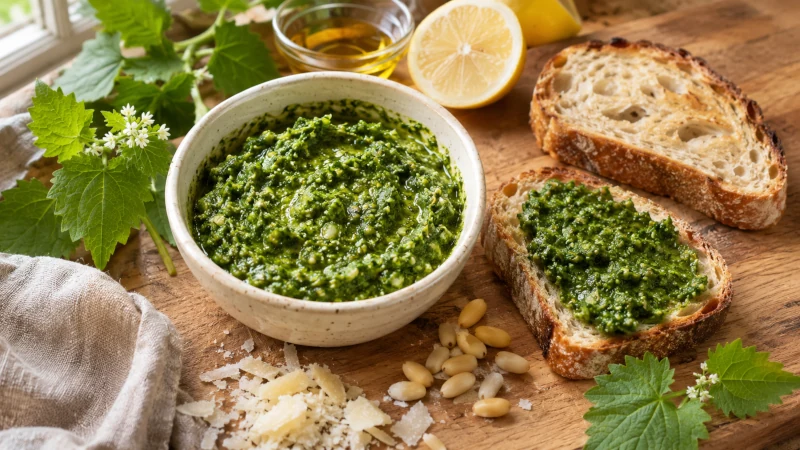
The overwintering rosette holds up to cold, so you can find usable leaves even in winter [Wild Food UK, 2025].
Treat hedge garlic like a strong herb or a handful of arugula: a flavoring and an occasional green, not a daily tonic or a juice. That approach also keeps you on the right side of the safety questions below. If you enjoy spring foraging, stinging nettle is another common wild green; cook it first and the sting disappears.
Foraging it responsibly
- Be sure of your identification. Once it flowers, the small white four-petalled blooms and the garlic smell of a crushed leaf make hedge garlic hard to confuse with much else [Wild Food UK, 2025]. First-year rosettes are trickier. If you aren’t certain, leave it.
- Pick from clean ground, away from roadsides, sprayed field edges and dog-walking routes.
- In North America, harvest in a way that helps. Pull the whole plant, roots included, before seed pods form. If plants have flowered or set seed, bag them, and keep them out of yard waste and home compost [UNH Extension, n.d.]. Seeds can keep maturing after a plant is pulled, which is why Wisconsin’s natural resources agency advises bagging pulled plants and carrying them out of the woods [Wisconsin DNR, 2024].
Safety: side effects and who should avoid hedge garlic
There’s no formal research on the safety of eating hedge garlic, so the guidance here comes from what’s known about its chemistry and its plant family.
Cyanide in young leaves
This is the finding most worth respecting. Researchers measured cyanide in hedge garlic tissue reaching 100 ppm fresh weight — a level considered toxic to many vertebrates — and the highest concentrations were in the young leaves of first-year seedlings [Cipollini & Gruner, 2007], which are exactly the leaves foragers prefer. The study measured the plant, not people eating it, so it can’t tell you what a culinary serving does in the body.
The sensible response is moderation. Use hedge garlic as a seasoning green mixed with other ingredients rather than eating it by the bowlful. Some herbal texts recommend drinking spoonfuls of the fresh juice after every meal as a spring treatment; we’d skip that. Concentrating a wild plant into a daily dose is where unknown risks pile up.
Skin irritation
Crushed leaves and juice release mustard oils that can irritate skin, eyes and broken skin [Gaiser & Köhl, 2017]. Wash your hands after handling a lot of it, and keep the juice away from your eyes and any wounds.
Thyroid
Breakdown products of some mustard-family glucosinolates can interfere with thyroid hormone production or with iodine uptake. In practice, this doesn’t appear to raise the risk of an underactive thyroid unless someone is also short of iodine, and a human study in which people ate about 5 ounces of cooked Brussels sprouts a day for four weeks found no effect on thyroid function [Linus Pauling Institute, 2017b]. If you have a thyroid condition or may be low in iodine, keep hedge garlic to occasional culinary use.
Pregnancy, breastfeeding and children
There’s no safety information on hedge garlic in pregnancy or breastfeeding. Normal food amounts of mustard-family vegetables aren’t known to cause problems in pregnancy, but nothing is known about concentrated glucosinolate products [Linus Pauling Institute, 2017a]. Given the open cyanide question, the cautious route is to avoid juices, extracts and medicinal amounts entirely and keep any culinary use small. The same applies to children, for whom there are no data.
Medications and allergies
No drug interactions have been documented for hedge garlic. Isothiocyanates can affect cytochrome P450 liver enzymes in laboratory studies, so concentrated products could in theory change how some medications are processed [Linus Pauling Institute, 2017a]. If you take prescription medication and are thinking about anything beyond culinary amounts, ask your pharmacist first. If mustard, horseradish or other mustard-family foods give you allergic reactions, skip hedge garlic.
When to get medical help
- Call emergency services for trouble breathing, swelling of the face, lips or throat, or collapse after eating any wild plant.
- Call Poison Control or seek urgent care if you feel unwell after eating a wild plant — vomiting, dizziness, confusion or unusual breathlessness. Bring or photograph the plant.
- See a clinician for a wound with spreading redness, warmth, swelling, drainage or worsening pain [Mayo Clinic, 2024], or for a skin ulcer that isn’t healing.
- Talk to your doctor before using any herb for gout, arthritis, high blood pressure or another ongoing condition, and don’t stop prescribed medication in favor of a plant.
| HEALTH DISCLAIMER: This article is for general education and is not medical advice. Hedge garlic has not been shown to treat or prevent any disease, and it is not a substitute for diagnosis or treatment from a qualified healthcare professional. Wild plants vary in their chemistry and can be misidentified. Eat only plants you can identify with confidence, in modest culinary amounts. Do not apply hedge garlic juice to wounds or broken skin. If you are pregnant or breastfeeding, have a thyroid condition, take prescription medication, or are considering hedge garlic for a child, talk with your doctor or pharmacist first. Seek urgent care for any severe reaction or worrying symptoms. |
Frequently Asked Questions
Is hedge garlic the same as garlic mustard?
Yes. Hedge garlic, garlic mustard and jack-by-the-hedge are all common names for Alliaria petiolata, a member of the mustard family [Wild Food UK, 2025].
Can you eat hedge garlic raw?
Yes. Young leaves are traditionally eaten raw in salads [Wild Food UK, 2025]. Because young first-year leaves contain the highest cyanide levels measured in the plant [Cipollini & Gruner, 2007], keep raw portions modest and mix them with other greens.
Does hedge garlic have the same benefits as garlic?
No. It is a different plant with different chemistry, and none of the research on garlic applies to it. It simply smells a little like garlic when crushed.
Is hedge garlic good for gout or high blood pressure?
There is no evidence that it is. Those uses come from traditional herbalism and have never been tested in people. Diet changes with real evidence, plus medical care, are the better route.
Can I put hedge garlic on a cut or skin ulcer?
No. There are no human studies supporting it, and its mustard oils can irritate skin [Gaiser & Köhl, 2017]. Clean minor cuts with water, keep them covered, and get medical help for signs of infection [Mayo Clinic, 2024].
Why do conservation groups encourage people to pull it?
In North America hedge garlic is invasive. Pulling whole plants before they set seed, and bagging plants that have already flowered, helps stop it spreading [UNH Extension, n.d.].
References
- Cipollini D, Gruner B. Cyanide in the chemical arsenal of garlic mustard, Alliaria petiolata. Journal of Chemical Ecology. View source
- Cipollini D. A review of garlic mustard (Alliaria petiolata, Brassicaceae) as an allelopathic plant. Journal of the Torrey Botanical Society. View source
- Frisch T, Motawia MS, Olsen CE, Agerbirk N, Møller BL, Bjarnholt N. Diversified glucosinolate metabolism: biosynthesis of hydrogen cyanide and of the hydroxynitrile glucoside alliarinoside in relation to sinigrin metabolism in Alliaria petiolata. Frontiers in Plant Science. View source
- Kurtz CM, Hansen MH. An assessment of garlic mustard in northern U.S. forests. Res. Note NRS-199. View source
- Linus Pauling Institute, Oregon State University. Isothiocyanates. Micronutrient Information Center. View source
- Linus Pauling Institute, Oregon State University. Cruciferous Vegetables. Micronutrient Information Center. View source
- National Cancer Institute. Cruciferous Vegetables and Cancer Prevention. View source
- Katanić Stanković J, Matić S, Srećković N, Stanić S, Mihailović V. Preliminary assessment of antimicrobial and antigenotoxic potential of garlic mustard (Alliaria petiolata, Brassicaceae) extracts. View source
- Gaiser MR, Köhl H. Second-degree burns after the application of a mustard-and-honey body wrap. Deutsches Ärzteblatt International. View source
- Mayo Clinic Staff. Cuts and scrapes: First aid. View source
- University of New Hampshire Cooperative Extension. Garlic mustard fact sheet. n.d. View source
- Segerson-Mueller E. Best disposal methods for garlic mustard. View source
- Wild Food UK. Hedge Garlic. Hedgerow Guide. View source


