
Couch grass is the stubborn lawn weed most gardeners spend years trying to dig out, and its pale underground stems have been dried and brewed into a bladder-flushing tea across Europe for generations. Here is the honest version of the couch grass benefits story: European regulators accept the tea as a traditional remedy that increases urine flow as a supporting measure in minor urinary complaints, but no well-controlled trial has shown it treats an infection, dissolves a kidney stone, or does most of what older herbals promise [EMA, 2022].
That still leaves room for it. For a healthy adult with mild bladder irritation, couch grass tea appears to be low-risk and is reasonable to try for a few weeks. If you have a fever, blood in your urine, or pain in your back or side, it is the wrong tool, and the section on when to see a doctor matters more than anything else on this page.
What couch grass is
Couch grass is Elymus repens, a creeping perennial grass that also goes by quack grass, twitch grass and dog grass. Botanists moved it out of the genus Agropyron, but the European Pharmacopoeia still lists the medicinal material under the older name Agropyron repens, and you will also see Triticum repens and Graminis rhizoma on labels [EMA assessment report, 2022].
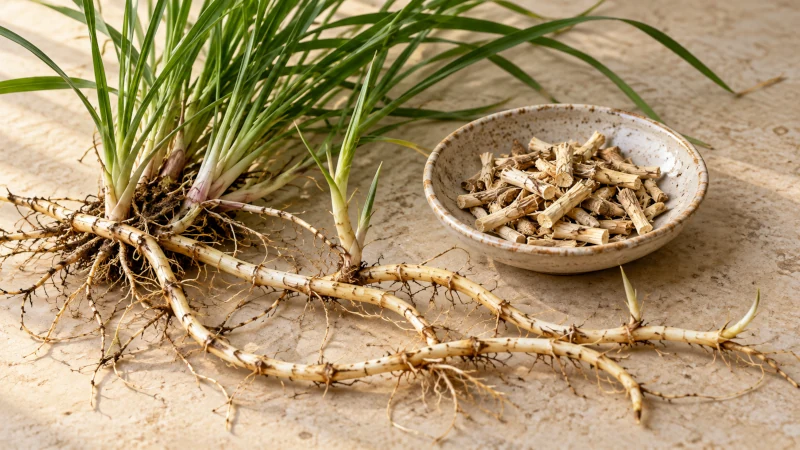
The part used is the rhizome — the shiny, straw-coloured, hollow runner that spreads underground — washed, dried and stripped of its fine roots. It tastes bland and faintly sweet. Most of its bulk is a fructose-based carbohydrate called triticin (around 12% of the dried rhizome), along with free sugars, mannitol, mucilage, small amounts of silicates and phenolic compounds, and a trace of essential oil [EMA assessment report, 2022]; [Drugs.com, 2025].
One correction worth making, because it is repeated all over the internet, including in earlier versions of this page: couch grass is often said to contain a natural antibiotic called agropyrene. When later researchers re-distilled the rhizome oil, they could not find it, and the European assessors note that agropyrene has since turned up only in the oils of certain wormwood species [EMA assessment report, 2022]. Couch grass is not an antibiotic.
Couch grass benefits: what the evidence actually shows
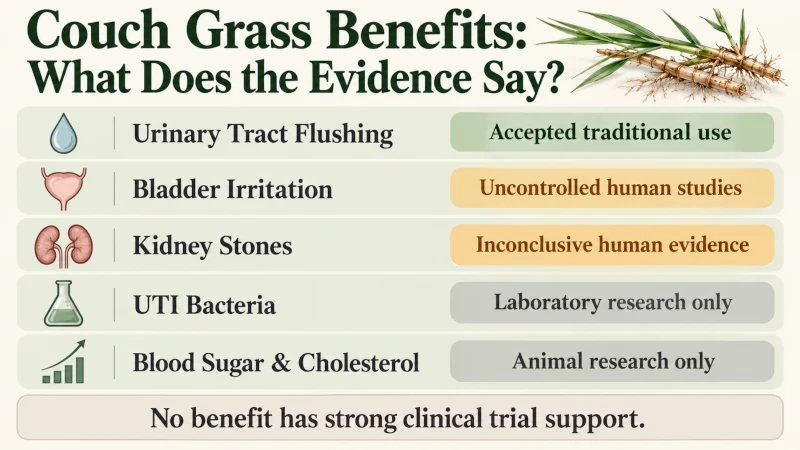
Most claims about couch grass come from traditional use. The table grades each one by the best evidence that exists for it.
| Claimed benefit | Best evidence available | What that means for you |
| Flushing the urinary tract in minor complaints | Traditional use, accepted in an EU herbal monograph | Accepted on 30+ years of use, not on trials |
| Easing cystitis and irritable bladder symptoms | Two uncontrolled observational studies | Encouraging, but nothing to compare against |
| Kidney stones | One small, unblinded trial of a combination product; one negative rat study | Unproven |
| Stopping UTI bacteria from sticking | Laboratory cell studies only | An interesting mechanism, not a treatment |
| Blood sugar and cholesterol | Rat studies only | No human data |
| Gout, arthritis, fever | Folk tradition only | No supporting research found |
Flushing the urinary tract: the one accepted use
The European Medicines Agency’s herbal committee accepts couch grass rhizome as a “traditional herbal medicinal product used to increase the amount of urine to achieve flushing of the urinary tract as an adjuvant in minor urinary complaints” [EMA, 2022]. Two words in that sentence do a lot of work. Traditional means the product has a documented history of at least 30 years of medicinal use, including 15 in the EU; it is not a finding of proven efficacy. Adjuvant means a helper alongside other care, not a treatment on its own [EMA assessment report, 2022].
The assessors were candid about the mechanism, too. They could not confirm from the available data that couch grass infusions or decoctions actually increase urine output. The only animal evidence of a diuretic effect came from a 1971 rat study using a cold-water extract, a preparation nobody traditionally drinks [EMA assessment report, 2022].
So a large part of any flushing effect may simply be the water. At the upper end of the EU dose you would drink a litre of tea a day, and extra fluid on its own helps keep urine dilute. That is true of most traditional bladder herbs, as our guide to herbal remedies for the urinary system explains in more detail.
Bladder irritation and cystitis symptoms
Two German observational studies are the closest thing to clinical evidence. In a 1981 open study, 99 people with various urinary complaints took a couch grass fluid extract for about a month, and most reported fewer symptoms. In a larger post-marketing survey from 2000, 313 people with irritable bladder, urethritis, cystitis or prostatitis took 50–60 drops of the extract for 12 days. By the end, between 32% and 53% were symptom-free, depending on the diagnosis, and no side effects were reported [EMA assessment report, 2022].
Neither study had a comparison group. Mild bladder symptoms often settle on their own, and without a placebo arm there is no way to tell how much of that improvement was the herb. The European assessors concluded the data could not support any claim of proven efficacy [EMA assessment report, 2022].
A bacterial bladder infection is a different problem from bladder irritation. Couch grass has not been shown to clear one, and an untreated infection can spread to the kidneys.
Kidney stones
This is the claim with the most marketing behind it and the least to stand on. The best-known trial randomized 50 Italian patients with kidney stones to either potassium citrate alone or a supplement combining potassium citrate (24 mEq) with 100 mg of dry couch grass extract, twice daily, on top of their standard medication and diet. After five months, the combination group had a larger reduction in the number and size of stones [Brardi et al., 2012].
The trouble is the design. It was small and unblinded, the two groups received different potassium citrate doses, and there was no arm taking couch grass alone or a placebo. The European assessors concluded that no conclusion about couch grass itself could be drawn from it [EMA assessment report, 2022]. A 2019 study in 50 children with kidney stones also reported fewer and smaller stones with a couch grass extract, but the assessors found its methods too thinly described to rely on [EMA assessment report, 2022].
In the one controlled animal experiment, a couch grass infusion given to rats on different diets did not improve the main urinary risk factors for calcium oxalate stones [Grases et al., 1995].
If you form stones, the measures with real evidence are drinking enough to keep your urine pale and adjusting your diet to your specific stone type. Our article on foods that raise kidney stone risk walks through that by stone type.
Lab research on UTI bacteria
One line of research is genuinely interesting. German researchers found that an acetone extract of couch grass rhizome reduced the ability of urinary E. coli to attach to human bladder cells in the lab, and they isolated the compound responsible [Beydokthi et al., 2017]. Stopping bacteria from sticking, rather than killing them, is the same idea behind the cranberry research.
The catch: the more water-soluble extracts, the ones closest to a cup of tea, had no effect. The active compound is fat-soluble, present in small amounts, and nobody knows whether it reaches the bladder after you drink it [EMA assessment report, 2022]. Treat this as a reason for more research, not a reason to rely on the tea.
Blood sugar, cholesterol, gout and the rest
Rat studies have reported lower blood sugar and blood fats in diabetic rats given a water extract of the rhizome [Drugs.com, 2025]. No human studies exist. If you take diabetes medication, do not swap or adjust it based on this.
Older herbals also list couch grass for gout, rheumatism, skin conditions and fevers. Neither the European assessment nor the Drugs.com review found clinical evidence for any of these uses [EMA assessment report, 2022]; [Drugs.com, 2025]. If gout brought you here, diet and medication have far more to offer; our guide to gout-friendly foods is a better starting point.
How to make and use couch grass tea

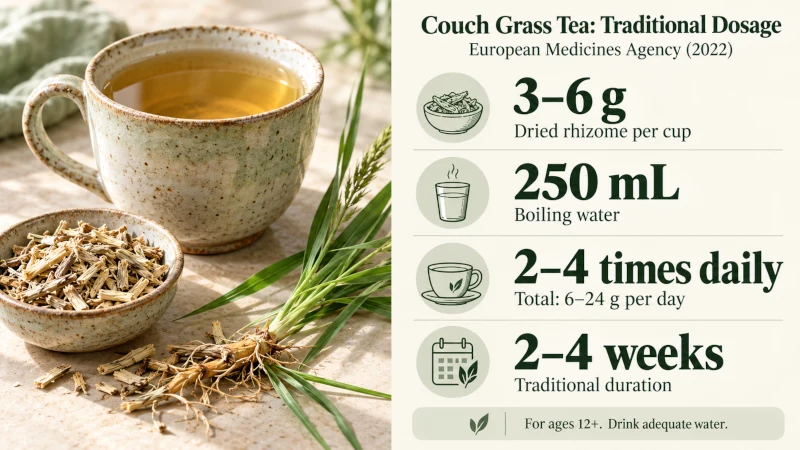
The EU monograph gives these doses for adults and adolescents aged 12 and over [EMA, 2022]:
| Form | Single dose | How often | Who |
| Tea (cut, dried rhizome) | 3–6 g in 250 ml (about 1 cup) boiling water | 2–4 times a day (6–24 g total) | Adults and adolescents 12+ |
| Liquid extract (1:1, 20–25% alcohol) | 3–8 ml | 2–4 times a day | Adults only |
| Tincture (1:5, 40% alcohol) | 5–15 ml | 3 times a day | Adults only |
To make the tea, pour a cup of boiling water over the rhizome, cover it, and let it steep for 10–15 minutes before straining; the monograph allows either an infusion or a short simmer (decoction) [EMA, 2022]; [EMA assessment report, 2022]. European assessors measured an average teaspoon of the cut rhizome at roughly 3.3–4.7 g, so one well-filled teaspoon per cup lands in range [EMA assessment report, 2022]. A kitchen scale is more reliable.
A few practical points from the monograph:
- Drink extra water alongside it. The monograph states that adequate fluid intake is required for the flushing effect.
- Keep it short. Traditional use runs 2 to 4 weeks.
- Check in if nothing changes. If symptoms persist while you are using it, see a doctor or qualified practitioner [EMA, 2022].
Older herbal encyclopedias, including the source behind the previous version of this page, suggest stronger decoctions of 30–40 g per litre. At four cups a day that can exceed the 24 g daily ceiling in the current EU monograph, so stick to the monograph range.
When buying, choose a product that names the plant (Elymus repens or Agropyron repens) and the part (rhizome). Herbal teas sold as food or supplements are not checked the way medicines are, so a clearly labelled product from a reputable supplier is the best you can do.
Side effects, interactions, and who should avoid couch grass
Side effects. The EU monograph lists none known [EMA, 2022]. In the 313-person survey, no adverse effects were reported, and the WHO’s global reporting database held just three reports from 2011–2020 that mentioned the plant, none with a confirmed link [EMA assessment report, 2022]. Because it is a grass, an allergic reaction is possible, and anyone allergic to it should not use it [Drugs.com, 2025]; [EMA, 2022].
Medication interactions. None have been reported or well documented [EMA, 2022]; [Drugs.com, 2025]. That mostly reflects how little it has been studied. As a practical precaution, if you take a water pill (diuretic), lithium, or any medicine where your fluid balance is closely managed, ask your pharmacist before adding a “flushing” tea. Drugs.com also notes a theoretical risk of interference with some laboratory blood tests from a protein found in couch grass leaves [Drugs.com, 2025].
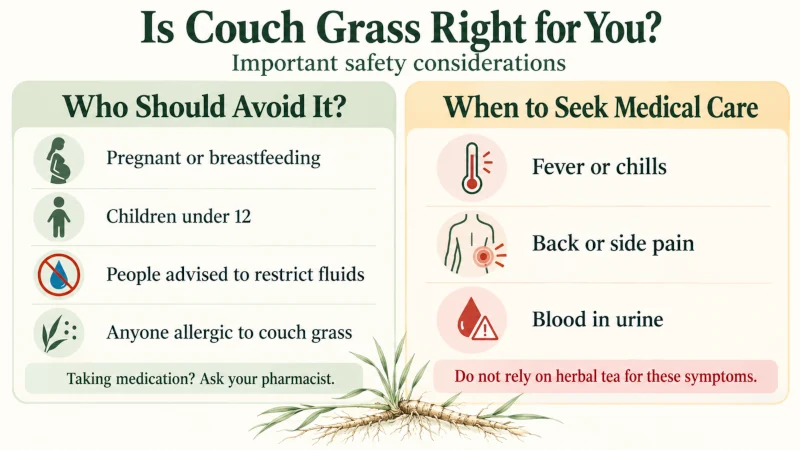
Who should avoid it:
- Pregnant or breastfeeding women. Safety has not been established, and both the EU monograph and Drugs.com advise against use [EMA, 2022]; [Drugs.com, 2025].
- Children under 12 (tea), and anyone under 18 (alcohol-based extracts and tinctures), because there are no adequate data [EMA, 2022].
- People told to limit fluids, such as those with significant heart or kidney disease. The flushing approach depends on drinking more, so the monograph does not recommend it here [EMA, 2022]. Do not use couch grass to manage swelling from heart or kidney problems; that swelling needs medical treatment.
- Anyone allergic to couch grass or with a known grass allergy who reacts to it.
There are no long-term safety studies. Tests for effects on reproduction, genetic damage and cancer risk have not been done [EMA, 2022], which is one more reason to keep courses short.
When to see a doctor instead
Couch grass is for mild, uncomplicated bladder discomfort. These symptoms call for a health professional, not a tea.
Contact a doctor promptly if you have signs of a bladder infection: burning when you urinate, a frequent or urgent need to go even when little comes out, lower belly discomfort, or urine that is cloudy, bloody or strong-smelling [NIDDK, 2024]. The EU monograph adds: see a doctor if fever, painful urination, cramping or blood in the urine appears while you are using couch grass [EMA, 2022].
Get care the same day if you have fever and chills, nausea or vomiting, or pain in your back, side or groin. These can mean the infection has reached a kidney, which can cause serious problems if not treated early [NIDDK, 2024].
See someone right away if you have sharp pain in your back, side, lower belly or groin, pink, red or brown urine, or trouble passing urine. These are typical kidney stone symptoms and may point to something more serious [NIDDK, 2017].
Our overview of urinary system diseases covers which conditions herbs can reasonably support and which need medical treatment from the start.
| HEALTH DISCLAIMER: This article is for general education and is not medical advice. Couch grass is a traditional herbal remedy with limited clinical evidence, and it is not a treatment for urinary tract infections, kidney stones or kidney disease. It is not recommended during pregnancy or breastfeeding, for children under 12, or for anyone advised to limit fluids. Talk to your doctor or pharmacist before using it, especially if you take prescription medicines or have a heart or kidney condition, and seek care promptly if you have fever, blood in your urine, or pain in your back or side. |
Frequently Asked Questions
Does couch grass tea cure a UTI?
No. There is no evidence that couch grass clears a bacterial infection, and it is not an antibiotic. Lab studies suggest one compound may make it harder for bacteria to stick to bladder cells, but it does not appear in the water-based tea in any meaningful amount. If you have UTI symptoms, see a doctor [NIDDK, 2024].
Can couch grass dissolve kidney stones?
There is no good evidence that it can. The one human trial tested couch grass mixed with potassium citrate, had no couch-grass-only or placebo group, and was not blinded, so European assessors judged it inconclusive [EMA assessment report, 2022]. Hydration and stone-specific diet changes are better supported.
How much couch grass tea can I drink a day?
The EU monograph allows 3–6 g of dried rhizome per cup, 2–4 times a day, for a total of 6–24 g, traditionally for 2 to 4 weeks in adults and adolescents 12 and over [EMA, 2022]. Drink plenty of water as well.
Is couch grass a diuretic?
It is traditionally used as one, but European assessors could not confirm a diuretic effect for the tea from the available studies [EMA assessment report, 2022]. Much of the “flushing” may come from the extra fluid you drink with it.
Is couch grass the same as Bermuda grass?
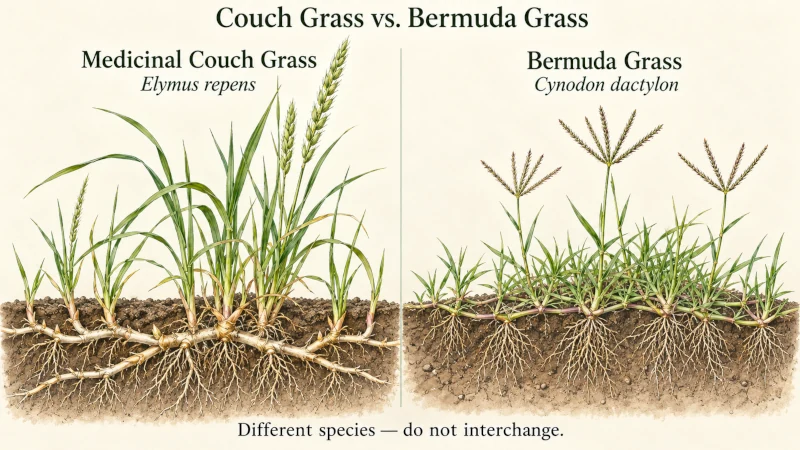
No. Medicinal couch grass is Elymus repens. In Australia, “couch” is also the common name for Bermuda grass, Cynodon dactylon [Bushland Perth], a different plant. The research and dosing in this article apply only to Elymus repens rhizome.
Who should not take couch grass?
Avoid it if you are pregnant or breastfeeding, for children under 12, and if you have been told to limit your fluids because of heart or kidney disease. Ask a pharmacist first if you take diuretics, lithium or other medicines affected by fluid balance [EMA, 2022].
References
- European Medicines Agency, Committee on Herbal Medicinal Products. European Union herbal monograph on Agropyron repens (L.) P. Beauv., rhizoma — Final, Revision 1. EMA/HMPC/114726/2021. View source
- European Medicines Agency, Committee on Herbal Medicinal Products. Assessment report on Agropyron repens (L.) P. Beauv., rhizoma — Final, Revision 1. EMA/HMPC/113793/2021. View source
- Drugs.com. Couch Grass (professional natural products monograph). View source
- Brardi S, Imperiali P, Cevenini G, Verdacchi T, Ponchietti R. Effects of the association of potassium citrate and Agropyrum repens in renal stone treatment: results of a prospective randomized comparison with potassium citrate. View source
- Beydokthi SS, Sendker J, Brandt S, Hensel A. Traditionally used medicinal plants against uncomplicated urinary tract infections: hexadecyl coumaric acid ester from the rhizomes of Agropyron repens (L.) P. Beauv. with antiadhesive activity against uropathogenic E. coli. Fitoterapia. View source
- Grases F, Ramis M, Costa-Bauzá A, March JG. Effect of Herniaria hirsuta and Agropyron repens on calcium oxalate urolithiasis risk in rats. J Ethnopharmacol. View source
- National Institute of Diabetes and Digestive and Kidney Diseases. Symptoms & Causes of Bladder Infection in Adults. View source
- National Institute of Diabetes and Digestive and Kidney Diseases. Symptoms & Causes of Kidney Stones. View source
- Urban Bushland Council WA (Bushland Perth). Couch Grass (Cynodon dactylon) weed profile. View source


