
The wild dog rose earns its reputation in two ways. Its hips are one of the richest wild sources of vitamin C, and a standardized powder made from Rosa canina hips has modest, mostly manufacturer-funded evidence for easing osteoarthritis pain. Most of the other traditional claims for Rosa canina — for colds, parasites, kidney stones and sore eyes — have little or no clinical support. Here is what the research shows, how people use the hips, and who should be careful.
What Rosa canina is
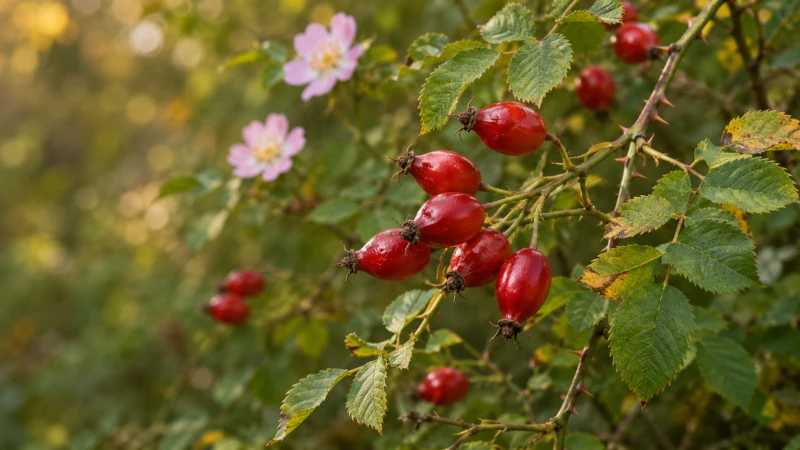
Rosa canina is a prickly, scrambling shrub in the rose family, usually one to three meters tall, with five-petaled white or pale pink flowers. It grows wild across Europe and has naturalized in parts of North America. You may see it sold as dog rose, wild brier, brier hip or eglantine; in Spanish it is escaramujo, in French églantier.
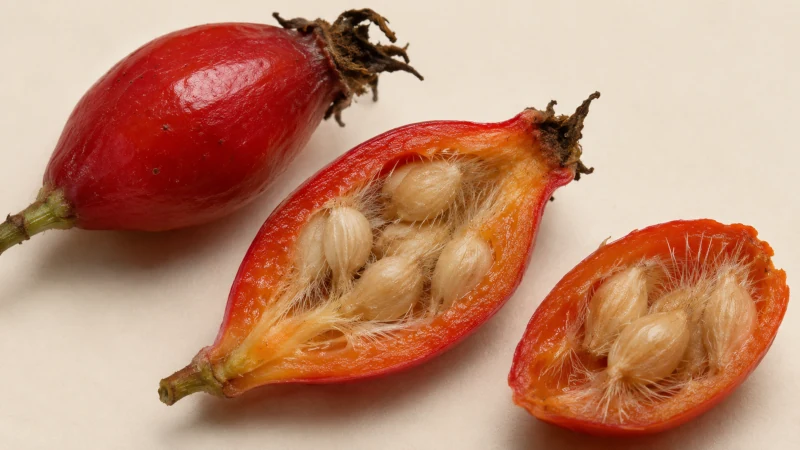
The red, olive-shaped “fruit” is technically a hip, a fleshy cup that forms from the base of the flower. Inside sit hard seeds packed in stiff, fine hairs. Those hairs matter more than they sound. When a dermatologist went looking for commercial itching powder, the only product he could find was ground rose hips, and the itch they cause is mechanical, like coarse wool, rather than allergic [Albert, 1998]. Scrape them out before you eat the hips.
Rosa canina and vitamin C
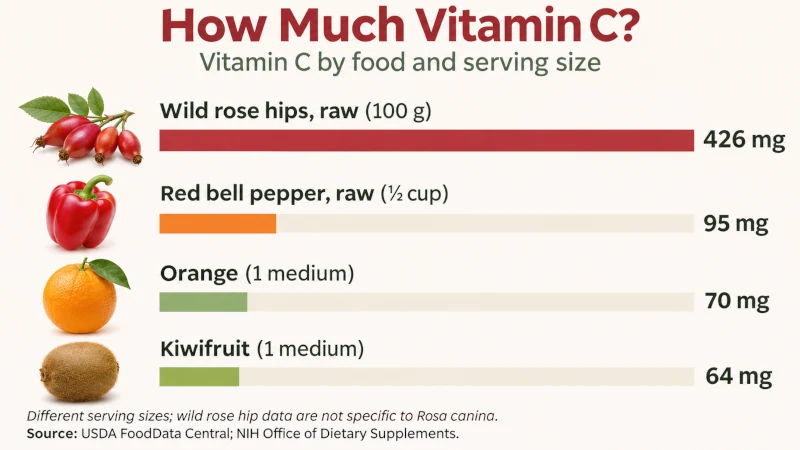
Fresh wild rose hips are genuinely rich in vitamin C. USDA food composition data list raw wild rose hips — a North American sample, not Rosa canina specifically — at about 426 mg per 100 grams [USDA FoodData Central]. For perspective, adults need 90 mg a day (men) or 75 mg (women), plus 35 mg if you smoke [NIH ODS, 2025].
| Food | Vitamin C | Source |
| Wild rose hips, raw, 100 g | about 426 mg | USDA FoodData Central |
| Red pepper, raw, ½ cup | 95 mg | NIH ODS, 2025 |
| Orange, 1 medium | 70 mg | NIH ODS, 2025 |
| Kiwifruit, 1 medium | 64 mg | NIH ODS, 2025 |
| Dried rose hip tea | Low and unpredictable | RxList / Natural Medicines |
Two things shrink that headline number in real life. Content varies a lot with ripeness, drying time and temperature [Cohen, 2012]. And vitamin C does not survive processing well: much of it is destroyed by drying and storage, which is why some “natural” rose hip vitamin C supplements are topped up with synthetic ascorbic acid without saying so on the label [RxList / Natural Medicines]. A cup of rose hip tea tastes good, but it is not a reliable way to get vitamin C.
If a concentrated food source is what you’re after, our comparison of acerola cherry vs orange vitamin C shows how the high-vitamin-C fruits actually stack up.
What the evidence says about Rosa canina benefits
Osteoarthritis pain: the best-studied use
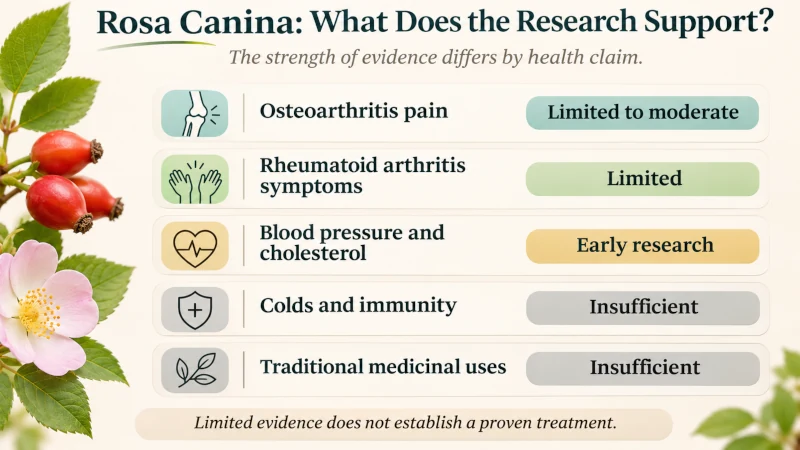
Nearly all clinical research on Rosa canina uses one patented powder made from the seeds and shells of a cultivated subtype, sold as Hyben Vital, LitoZin or Rose-Hip Vital [Cohen, 2012]. A 2008 meta-analysis pooled three randomized, placebo-controlled trials in 287 people with hip or knee osteoarthritis, most taking 5 g a day for about three months. The powder reduced pain by a small-to-moderate amount (effect size 0.37), and people taking it were about twice as likely to be counted as responders. Roughly six people needed to take it for one extra person to respond [Christensen et al., 2008].
Now the limits. All three trials were supported by the manufacturer, and the meta-analysis authors called the data sparse and asked for large, independent, longer trials [Christensen et al., 2008]. A Cochrane review of oral herbal products for osteoarthritis could pool data for only two products (Boswellia and avocado-soybean unsaponifiables).
For the rest, rose hip included, it concluded the available single studies were too limited to say whether they help [Cameron & Chrubasik, 2014]. A 2026 reanalysis of a later 120-person trial of the same powder reported that standard between-group comparisons did not separate rose hip from placebo, and argued for a dose-response signal instead [Nutrients, 2026]. The most widely cited review of the product’s safety and anti-inflammatory profile was written by an author who disclosed paid work for the brand [Cohen, 2012].
What that means for you: if you have mild-to-moderate osteoarthritis and want to try something alongside your usual care, the studied powder is a reasonable, low-risk experiment. Expect a modest effect at best, give it about three months, and choose a seed-and-shell powder like the one tested. It is not a substitute for exercise, weight management or the pain relief your clinician recommends.
Rheumatoid arthritis
One six-month trial in 89 adults with rheumatoid arthritis compared 5 g a day of the same powder with placebo. The rose hip group’s disability score improved slightly while the placebo group’s worsened, but the pain scale showed no difference between groups [Willich et al., 2010]. At most, that supports rose hip as an add-on. It does nothing to slow joint damage, so it is never a replacement for disease-modifying treatment.
Blood pressure and cholesterol
In a six-week crossover trial, 31 adults with obesity drank 40 g of rose hip powder a day. Compared with a control drink, systolic blood pressure fell 3.4%, total cholesterol 4.9% and LDL cholesterol 6%. Body weight, blood sugar control and diastolic pressure did not change [Andersson et al., 2012]. Interesting, but it is one small study at a large daily dose. Treat it as early research, not a reason to adjust any medication.
Colds, flu and immunity
Rose hips have long been taken to ward off winter colds, but there are no good trials of rose hip itself; the Natural Medicines database rates the evidence as insufficient [RxList / Natural Medicines]. For vitamin C in general, taking at least 200 mg a day regularly does not stop most people catching colds, though it modestly shortens them — by about 8% in adults and 14% in children. Starting vitamin C after symptoms appear does not seem to help [NIH ODS, 2025]. For food choices with better evidence, see our guide to the best foods for cold and flu.
Traditional uses without clinical support
Several long-standing uses of Rosa canina rest on tradition alone:
- Mild diuretic or “depurative” for fluid retention and gout. No human trials. A possible water-pill-like effect is the reason for a lithium interaction warning [RxList / Natural Medicines]. New swelling of the legs or ankles needs a medical check, not a tea.
- Root or leaf decoctions for diarrhea. Rated insufficient evidence [RxList / Natural Medicines]. Most short bouts settle on their own with fluids; know the warning signs that diarrhea needs a doctor.
- Eating whole hips to expel intestinal worms. There is no evidence for this. Tapeworms and other parasites are diagnosed with tests and treated with prescription drugs — our guide to pork parasites and how they’re treated explains why herbal cleanses don’t work.
- Rose water as an eye wash. Some herbal sources recommend bathing sore or inflamed eyes in home-steeped rose petal water. Don’t. Anything put in the eye has to be sterile, because the eye bypasses some of the body’s natural defenses [FDA, 2026]. If your lids are red and crusty, the safe eyelid-care routine for blepharitis is a better place to start.
- Seeds for kidney or bladder stones. We found no human evidence that the seeds dissolve stones, and none for claims that ground seeds are toxic to the nervous system.
Evidence at a glance
| Use | What has been tested | Evidence grade |
| Osteoarthritis pain | 3 manufacturer-funded RCTs (287 people) of a standardized powder; a later 120-person trial was null on standard analysis | Limited to moderate — promising, not confirmed |
| Rheumatoid arthritis symptoms | 1 RCT (89 people) | Limited |
| Blood pressure and cholesterol | 1 small crossover trial (31 people) | Early |
| Vitamin C source | Food composition data | Well established for fresh hips; poor for dried products and tea |
| Colds and immunity | No rose hip trials | Insufficient |
| Diuretic, diarrhea, parasites, stones | Traditional use only | Insufficient |
| Eye washes | Traditional use only | Not recommended (sterility risk) |
How to use rose hips
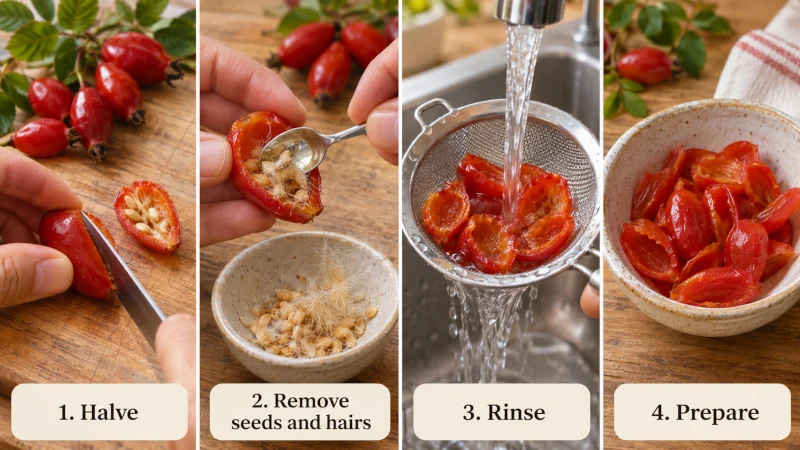
As food. Pick fully ripe, deep red hips in autumn, and only from plants you can identify with confidence. Halve them, scrape out every seed and hair, and rinse well — gloves help. You can eat the flesh fresh, purée it, or cook it into syrup, jam or soup, accepting that heat costs some vitamin C. A simple raw version: mash the cleaned flesh with an equal weight of sugar and keep it in the fridge for a few days. That is a lot of sugar, so count it if you manage blood glucose.
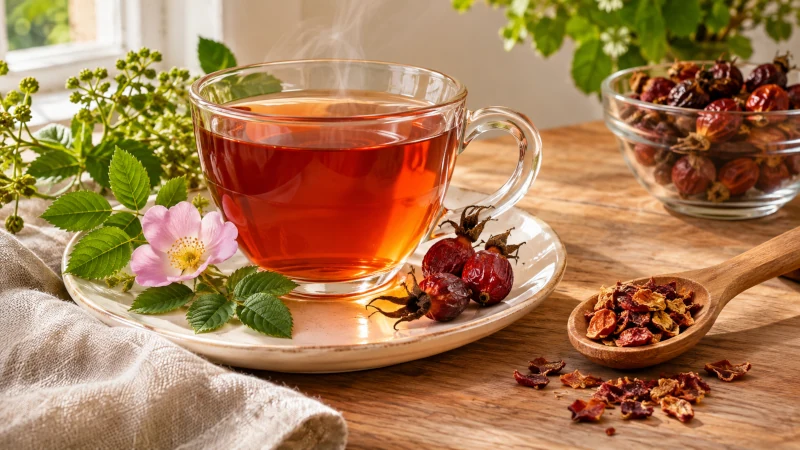
As tea. Dried rose hip tea is pleasant and tart. Enjoy it as a drink rather than as a supplement.
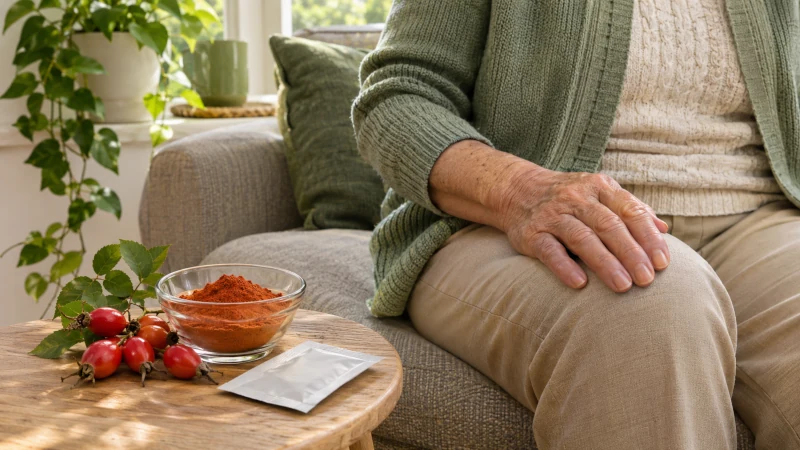
As a supplement. The osteoarthritis trials used 5 g a day of a standardized seed-and-shell powder for three to four months [Christensen et al., 2008] [Cohen, 2012]. There is no established dose for any other use [RxList / Natural Medicines]. Look for a product that names its plant parts, is third-party tested, and states whether vitamin C has been added.
Side effects, interactions and who should avoid Rosa canina
Common side effects
Rose hip is likely safe for most adults in normal amounts. Reported side effects include nausea, vomiting, diarrhea, constipation, heartburn, stomach cramps, fatigue, headache and trouble sleeping; inhaling the dust can trigger allergy in some people [RxList / Natural Medicines]. In the arthritis trials, problems were occasional mild allergic reactions or stomach complaints [Cohen, 2012]. Stop and get help if you develop hives, facial swelling or trouble breathing.
Medication interactions
| Medicine | Possible issue | Rating* |
| Lithium | A diuretic-like effect could reduce lithium clearance and raise levels | Moderate |
| Blood thinners and antiplatelets (warfarin, clopidogrel, heparin, aspirin) | A rose hip compound might affect clotting; large doses of vitamin C might also blunt warfarin’s effect | Moderate |
| Estrogens, including birth control pills | Vitamin C may increase estrogen absorption | Moderate |
| Fluphenazine | Large amounts of vitamin C may reduce its effect | Moderate |
| Aluminum antacids | Vitamin C may raise aluminum absorption; take rose hip 2 hours before or 4 hours after | Moderate |
| Aspirin, salsalate, choline magnesium trisalicylate (high doses) | Vitamin C may slow their clearance | Minor |
*Ratings from the Natural Medicines database as published by RxList.
The clotting question is genuinely unsettled. The database flags a compound called rugosin E, which was studied in a different species, Rosa rugosa [RxList / Natural Medicines]. A review of the Rosa canina powder reports no effect on platelets or clotting, but that rests on manufacturer data and a review author paid by the brand [Cohen, 2012]. If you take any blood thinner, talk to your prescriber first, and stop rose hip supplements two weeks before planned surgery as a precaution [RxList / Natural Medicines].
Pregnancy and breastfeeding
There isn’t enough reliable safety information on rose hip supplements during pregnancy or breastfeeding, so stick to food amounts [RxList / Natural Medicines]. A little rose hip jam or tea is a very different thing from a daily concentrated powder.
Who should skip it or check first
- People with kidney stones, especially oxalate stones. Whether high vitamin C intake raises stone risk is still debated; the clearest evidence is in people who already have high urinary oxalate [NIH ODS, 2025].
- People with hemochromatosis or other iron overload, thalassemia, or certain anemias. Vitamin C increases iron absorption [NIH ODS, 2025] [RxList / Natural Medicines].
- People with sickle cell disease or G6PD deficiency, where large vitamin C intakes carry extra risk [RxList / Natural Medicines].
- Anyone on lithium or a blood thinner, or with a bleeding disorder or upcoming surgery (see above).
- Children. The trials were in adults, so supplements haven’t been tested in children; food amounts are a different matter.
Whatever you take, keep total vitamin C from food and supplements under the adult upper limit of 2,000 mg a day; above that, stomach cramps, nausea and diarrhea become more likely [NIH ODS, 2025].
When to see a doctor
Joint pain is rarely an emergency, but don’t self-treat it with rose hip if it comes with any of these [Mayo Clinic, 2023]:
- Make an appointment if the joint is swollen, red, tender and warm, or you have a fever.
- Get care right away if joint pain follows an injury and the joint looks out of shape, you can’t use it, the pain is severe, or there is sudden swelling.
Also check in with your clinician before adding rose hip if you take prescription medicines, if arthritis pain is getting worse despite treatment, or if you’ve been diagnosed with rheumatoid or another inflammatory arthritis.
| HEALTH DISCLAIMER: This article is for general education only and is not medical advice, diagnosis or treatment. Rose hip products are dietary supplements; their benefits for any condition have not been established beyond doubt. Talk with a doctor or pharmacist before using rose hip supplements if you are pregnant or breastfeeding, take prescription medicines (especially lithium, blood thinners or estrogens), have kidney stones, iron overload, sickle cell disease or a bleeding disorder, or are giving it to a child. Never put homemade herbal preparations in your eyes. Seek prompt care for a hot, swollen joint, joint pain with fever, or signs of an allergic reaction. |
Frequently Asked Questions
Is Rosa canina the same as rose hip?
Rose hips are the fruit of any rose. Rosa canina, the dog rose, is the species most often used in European herbal products and the one used in the osteoarthritis trials [Cohen, 2012]. Hips from other species, such as Rosa rugosa, differ in their chemistry.
Does rose hip tea contain much vitamin C?
Less than you’d think. Drying, processing and storage destroy much of the vitamin C in rose hips [RxList / Natural Medicines], so tea is an unreliable source. Fresh, cleaned hips are far better.
How long does rose hip take to work for joint pain?
The osteoarthritis trials ran about three to four months at 5 g a day, and the rheumatoid arthritis trial ran six months [Christensen et al., 2008] [Willich et al., 2010]. If you notice no change after about three months, it probably isn’t helping you.
Can I take rose hip with blood thinners?
Check with your prescriber first. One database flags a possible effect on clotting and a vitamin C interaction with warfarin, while manufacturer-linked data report no effect on platelets [RxList / Natural Medicines] [Cohen, 2012]. The evidence is mixed, so caution makes sense.
Is rose hip safe during pregnancy?
Food amounts, such as jam or tea, are generally fine. Concentrated supplements haven’t been studied enough in pregnancy or breastfeeding to call them safe [RxList / Natural Medicines].
References
- Albert MR. Novelty shop “itching powder.” View source
- Andersson U, Berger K, Högberg A, Landin-Olsson M, Holm C. View source
- Cameron M, Chrubasik S. Oral herbal therapies for treating osteoarthritis. View source
- Christensen R, Bartels EM, Altman RD, Astrup A, Bliddal H. View source
- Cohen M. Rosehip: an evidence based herbal medicine for inflammation and arthritis. View source
- Mayo Clinic Staff. Joint pain: when to see a doctor. View source
- National Institutes of Health, Office of Dietary Supplements. Vitamin C: Fact Sheet for Health Professionals. View source
- Natural Medicines Comprehensive Database, via RxList. Rose Hip: uses, side effects, precautions and interactions. View source
- Reanalysis of a randomized, placebo-controlled trial of standardized Rosa canina powder in hip and knee osteoarthritis (NCT01459939). View source
- U.S. Department of Agriculture, FoodData Central. View source
- U.S. Food and Drug Administration. What You Should Know about Eye Drops. View source


