
Finding what causes diarrhea can range from a 24-hour stomach bug to a lifelong gut condition, and telling them apart is what decides whether you wait it out at home or pick up the phone. Diarrhea has a plain definition: loose, watery stools three or more times a day, or noticeably more often than is normal for you [NIDDK, 2023]. Most cases are short and clear up on their own. The real danger is rarely the diarrhea itself; it is the fluid your body loses while it lasts.
What’s actually happening in your gut
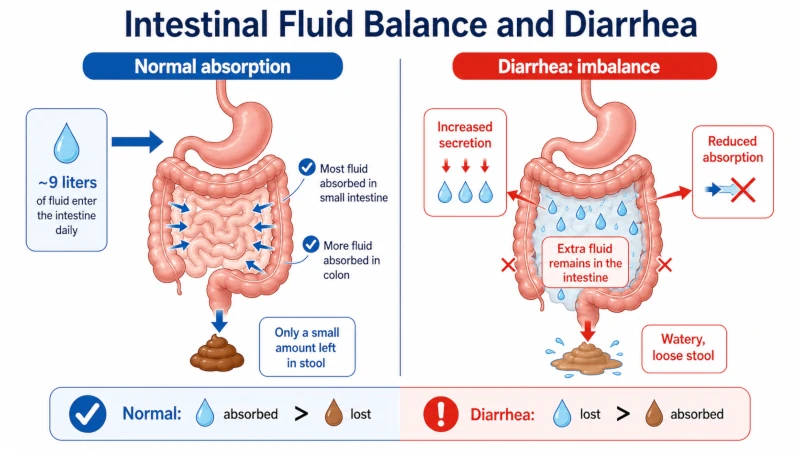
Your intestine moves a surprising amount of water. Over a single day it handles roughly 9 liters of fluid — most of it from saliva, stomach juice, bile, and pancreatic secretions rather than from what you drink — and reabsorbs nearly all of it, leaving only about 100 milliliters to leave in stool [Cheng et al., 2020]. Diarrhea happens when that balance tips: the gut secretes too much fluid, it cannot absorb what’s there, or food moves through so fast that water never gets pulled back. The watery result looks the same either way. The reason behind it is what changes everything.
How long it lasts is a clue to the cause
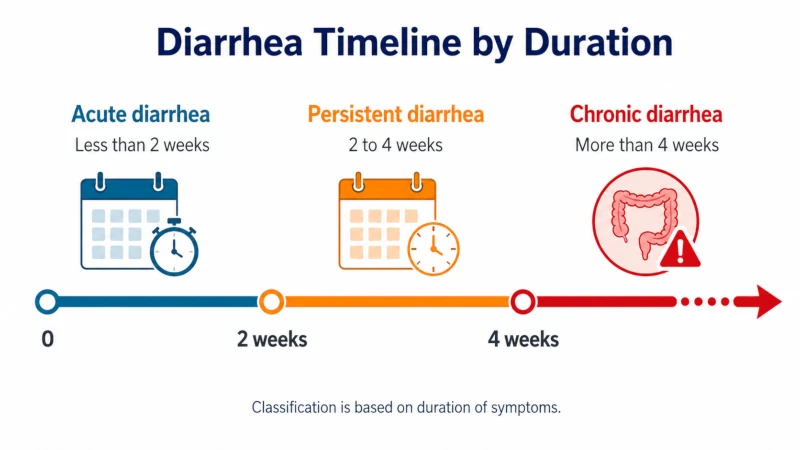
Clinicians sort diarrhea by how long it sticks around, because duration quickly narrows the list of likely causes [Mayo Clinic].
| Type | How long it lasts | Usual suspects |
| Acute | Up to 2 weeks | Viral or bacterial infection, food poisoning, a newly started medication |
| Persistent | 2 to 4 weeks | A lingering infection, a parasite such as Giardia, or gut changes left behind after an infection |
| Chronic | More than 4 weeks | IBS, inflammatory bowel disease, celiac disease, bile-acid problems, and certain long-term medications |
Sources: Mayo Clinic; National Institute of Diabetes and Digestive and Kidney Diseases.
One loose stool after a big meal isn’t diarrhea. A pattern of them — especially one that drags past a few days or keeps returning — is what’s worth paying attention to.
The most common causes of diarrhea
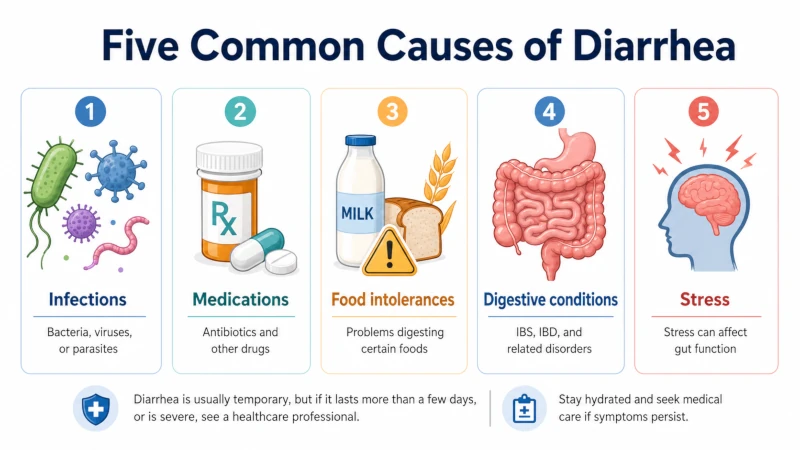
For short-term diarrhea, the list of likely causes is short. Most acute cases trace back to one of three things: an infection, something you ate or drank, or a medication you’re taking [NIDDK, 2023].
Infections
Viruses cause most acute diarrhea. Norovirus is the usual culprit in adults, and rotavirus in young children [Cleveland Clinic, 2026]. Bacteria — Salmonella, Shigella, Campylobacter, and certain strains of E. coli — usually arrive through contaminated food or water, which is why they overlap so heavily with food poisoning. Parasites such as Giardia are a less common but real cause, often from untreated water. And if you’ve recently traveled somewhere with limited clean water or sanitation, the same kinds of bacteria are behind what’s known as travelers’ diarrhea [WHO, 2024]. Whatever the organism, part of the diarrhea is simply your body flushing it out.
When a stomach bug is to blame, what you eat matters as much as rest. Our guide to foods to eat with stomach flu walks through what tends to settle an irritated gut.
Medications
Antibiotics are one of the most common medication causes. They kill the bacteria you want along with the ones you don’t, and that disruption to your gut flora can loosen stools for days [NIDDK, 2023]. Sometimes the imbalance lets a bacterium called Clostridioides difficile (C. diff) take over, producing a more stubborn and occasionally severe diarrhea that needs medical treatment. Antibiotics aren’t alone — magnesium-containing antacids, some blood pressure drugs, the diabetes medication metformin, and chemotherapy can all do it. One rule holds across the board: don’t stop a prescribed medication on your own. Ask whoever prescribed it whether a switch or a lower dose makes sense.
Food intolerances and sensitivities
When your gut can’t break down a particular food component, the undigested portion pulls water into the intestine, and diarrhea follows. Lactose intolerance is the textbook example: without enough of the enzyme lactase, milk sugar passes through undigested [NIDDK]. Fructose and sugar alcohols such as sorbitol — common in sugar-free gum and candy — do much the same in sensitive people.
Celiac disease is a different animal. It is not an intolerance but an immune reaction to gluten that damages the lining of the small intestine, and it can cause ongoing diarrhea alongside weight loss and nutrient deficiencies. It needs a real diagnosis, not a hunch — if you suspect it, get tested before cutting out gluten, since going gluten-free first can hide the disease on testing. Our list of foods to avoid with celiac disease shows what a gluten-free diet looks like day to day.
Long-term digestive conditions
Diarrhea that won’t quit usually points to a condition rather than a one-off trigger. Irritable bowel syndrome (IBS) is the most common; it doesn’t damage the gut, but it can cause recurring diarrhea that’s often tied to stress and specific foods. Inflammatory bowel disease — Crohn’s disease and ulcerative colitis — is more serious, involving genuine inflammation and sometimes blood in the stool. Microscopic colitis and trouble absorbing bile acids round out the usual list. These generally call for testing and ongoing care rather than home remedies.
Diet plays a real role in managing several of them. See our anti-inflammatory diet for IBS and our diet for ulcerative colitis for practical, food-by-food guidance.
Stress and the gut–brain connection
Your gut and brain are wired together, and stress shows it. Anxiety and acute stress can speed up the muscle contractions that move waste through the colon, leaving less time for water to be reabsorbed. The diarrhea is real, not imagined — but it’s usually brief. If stress-related diarrhea becomes a steady pattern, it’s worth ruling out IBS or another cause rather than chalking it all up to nerves.
Treating diarrhea at home
Most acute diarrhea needs no specific treatment — your body clears the cause on its own within a few days [NIDDK, 2023]. The one thing that always matters is replacing the fluid and salts you’re losing.
Oral rehydration solution (ORS) does that better than water alone. It’s a measured mix of clean water, salt, and sugar, and it costs very little; for children, the World Health Organization also recommends a short course of zinc, which shortens the episode [WHO, 2024]. Plain water, broth, and diluted juice help too, but ORS is the standard when fluid losses are heavy.
Over-the-counter options like loperamide (Imodium) or bismuth subsalicylate (Pepto-Bismol) can ease an uncomplicated case. Skip them — and call a doctor — if you have bloody stools or a high fever, because slowing the gut can trap an invasive infection. Bismuth isn’t for children or teens recovering from a viral illness because of the risk of Reye’s syndrome, and it’s off-limits if you’re allergic to aspirin.
There’s no need to starve yourself. Eat bland, easy foods while your stomach is unsettled, and return to your normal diet once your appetite comes back [NIDDK].
Probiotics get a lot of attention, so here’s the honest summary: a 2025 Cochrane review found that taking probiotics alongside antibiotics may slightly lower the risk of antibiotic-associated diarrhea, though the certainty of that evidence is only low to moderate [Cochrane, 2025]. Yogurt or a supplement containing Lactobacillus acidophilus is reasonable to try while you’re on antibiotics and is unlikely to harm a healthy adult [Mayo Clinic, 2022] — just don’t expect a cure-all.
Dehydration is the part to take seriously
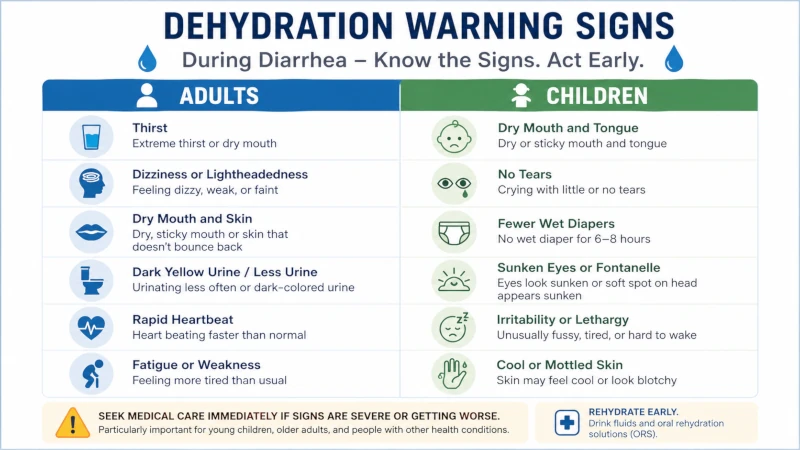
Dehydration is what turns diarrhea from a nuisance into something dangerous, and it can move fast — within a day or two in infants [NIDDK, 2023]. In adults, watch for intense thirst, a dry mouth, dark urine, urinating little or not at all, dizziness, and weakness [Mayo Clinic, 2023]. In babies and young children, the warning signs include no wet diaper for three hours or more, crying without tears, a dry mouth, sunken eyes or cheeks, and unusual drowsiness or irritability [Mayo Clinic, 2023]. Anyone very young, over 65, or living with a weakened immune system loses ground faster and should be watched more closely [WHO, 2024].
When to see a doctor
Time and a handful of specific symptoms tell you when home care isn’t enough.
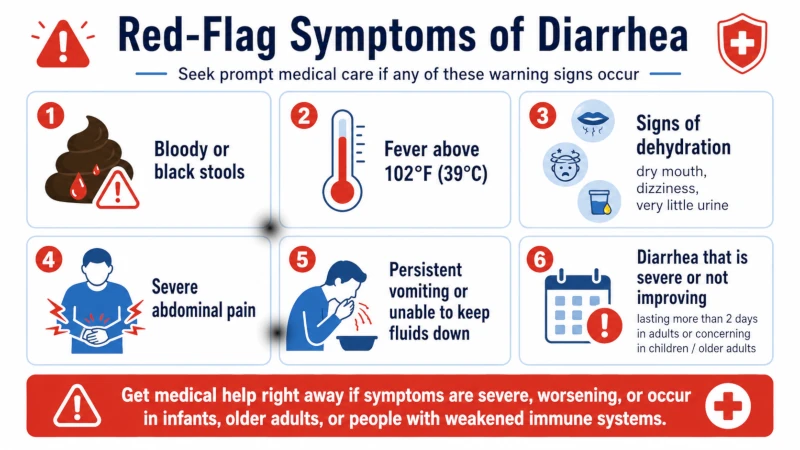
For an adult, see a doctor if [Mayo Clinic, 2023]:
- Diarrhea lasts more than two days without improving
- You have signs of dehydration — extreme thirst, dry mouth or skin, little or no urination, dizziness, or dark urine
- You have severe abdominal or rectal pain
- Your stools are bloody or black
- You have a fever above 102°F (39°C)
For a child, seek care if [Mayo Clinic, 2023]:
- Diarrhea doesn’t improve within 24 hours
- There’s no wet diaper in three or more hours
- A fever climbs above 102°F (39°C)
- Stools are bloody or black
- The mouth or tongue is dry, or there are no tears when crying
- The child is unusually sleepy, unresponsive, or irritable
- The eyes, cheeks, or abdomen look sunken, or pinched skin stays tented
Diarrhea that turns up blood or lingers also deserves a proper workup, since it can signal inflammatory bowel disease, an ongoing infection, or — less often — colon cancer, especially alongside unexplained weight loss or a change in bowel habits after age 50. Knowing your own risk helps; here’s an overview of the cancers most common in seniors.
Who should be extra careful
Some people have less margin for error. Infants and young children can become dangerously dehydrated within a day or two, so a child under 12 months with diarrhea warrants a call to the doctor sooner rather than later [NIDDK, 2023]. Adults over 65 and anyone with a weakened immune system are also higher-risk. If you’re pregnant or breastfeeding, check with your clinician before taking any anti-diarrheal or bismuth product.
| Health Disclaimer This article is for general education and information only. It is not medical advice and is not a substitute for diagnosis or treatment from a qualified healthcare professional. Diarrhea can occasionally signal a serious condition, so use your own judgment and seek care when symptoms are severe, persistent, or alarming. If you are pregnant, breastfeeding, caring for a young child, or managing a chronic illness, talk to your doctor before starting any remedy, supplement, or over-the-counter medication mentioned here. |
Frequently Asked Questions
How long does diarrhea usually last?
Acute diarrhea typically clears within a few days and almost always within two weeks. Anything longer is called persistent or chronic and is worth a doctor’s evaluation [Mayo Clinic].
What’s the fastest safe way to stop diarrhea?
Replacing lost fluids with oral rehydration solution is the most important step. For an uncomplicated case, loperamide can cut down the frequency — but avoid it if you have bloody stools or a high fever [NIDDK, 2023].
Can stress really cause diarrhea?
Yes. Through the gut–brain connection, stress and anxiety can speed up colon contractions and trigger short-lived diarrhea. If episodes keep recurring, it’s worth ruling out IBS rather than assuming it’s only nerves.
When is diarrhea a sign of something serious?
Bloody or black stools, a fever above 102°F (39°C), severe pain, signs of dehydration, or diarrhea lasting more than two days (24 hours in a child) all call for medical care [Mayo Clinic, 2023].
Should I take a probiotic while on antibiotics?
It may slightly reduce the odds of antibiotic-associated diarrhea, based on low-to-moderate-certainty evidence, and is generally safe for healthy adults [Cochrane, 2025].
References
- National Institute of Diabetes and Digestive and Kidney Diseases (NIDDK). Symptoms & Causes of Diarrhea. 2023. → View source
- Mayo Clinic. Diarrhea — Symptoms and Causes. → View source
- Mayo Clinic. Diarrhea — When to See a Doctor. Aug 11, 2023. → View source
- World Health Organization (WHO). Diarrhoeal Disease — Fact Sheet. 2024. → View source
- Cleveland Clinic. Diarrhea: Causes, Symptoms & Treatment. 2026. → View source
- Cheng HM, Mah KK, Seluakumaran K. Intestinal Fluid Handling: Absorption. In: Defining Physiology, Vol. 2. Springer; 2020. DOI 10.1007/978-3-030-62285-5_13. → View source
- Esmaeilinezhad Z, et al. Probiotics for the prevention of Clostridioides difficile-associated diarrhea in adults and children. Cochrane Database Syst Rev. 2025. DOI 10.1002/14651858.CD006095.pub5. → View source
- Mayo Clinic. Acidophilus (probiotic) — Drugs and Supplements. → View source
