Most claims about asparagus benefits fall into two piles: a short list that solid nutrition science backs, and a much longer list handed down from folk medicine that modern research has never confirmed. This guide keeps the two apart. Asparagus (Asparagus officinalis) is a low-calorie spring vegetable that delivers a striking amount of folate and vitamin K, feeds the bacteria in your gut, and fits almost any way of eating [USDA FoodData Central, 2019] [Foods, 2024]. What it won’t do is “detox” your body, cure disease, or stand in for medical care. Here’s what a serving really gives you, what the research shows, and who should be a little careful.
What’s actually in a serving of asparagus
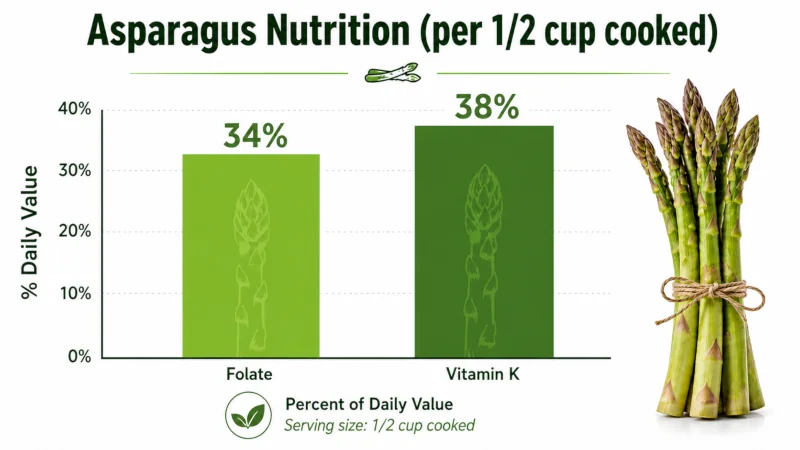
A half-cup of cooked asparagus — roughly six spears — has about 20 calories, 2 grams of fiber, and 2 grams of protein [USDA FoodData Central, 2019]. The numbers worth noticing are folate and vitamin K.
| Nutrient | Per ½ cup cooked (90 g) | % Daily Value |
| Calories | 20 | — |
| Fiber | 2 g | 6% |
| Folate (vitamin B9) | 134 mcg | 34% |
| Vitamin K | 46 mcg | 38% |
| Thiamin (vitamin B1) | 0.1 mg | 12% |
| Vitamin C | 7 mg | 8% |
| Vitamin A | 45 mcg | 5% |
| Potassium | 200 mg | 4% |
Source: [USDA FoodData Central, 2019] (cooked, boiled, drained). Daily Values rounded.
Eat a full cup and the folate roughly doubles to about two-thirds of a day’s worth. White asparagus is the same plant grown without sunlight, so it never turns green; the green spears carry a bit more of certain plant compounds [Foods, 2024].
Asparagus benefits that hold up
One of the best vegetable sources of folate
Folate (vitamin B9) helps your body build DNA and make new red blood cells [NIH ODS, 2022]. A cup of cooked asparagus covers a large share of the daily target, which makes it a genuinely useful food for getting more folate from meals. One caveat matters a lot: if you’re pregnant or could become pregnant, food folate does not replace a folic acid supplement.
The CDC recommends 400 micrograms of folic acid a day — the synthetic form, which the body absorbs more reliably — to lower the risk of neural tube defects such as spina bifida [CDC, 2025]. Those defects form in the first few weeks, often before a pregnancy is even known [CDC, 2026]. So asparagus supports your overall reproductive and prenatal nutrition intake; the supplement is the part tied to prevention.
Vitamin K for clotting and bone
That same half-cup supplies more than a third of the day’s vitamin K, which your body uses to form blood clots and which may help maintain bone strength [NIH ODS, 2021]. It’s also the one nutrient worth flagging if you take a blood thinner — more on that in the safety section.
Fiber that feeds your gut
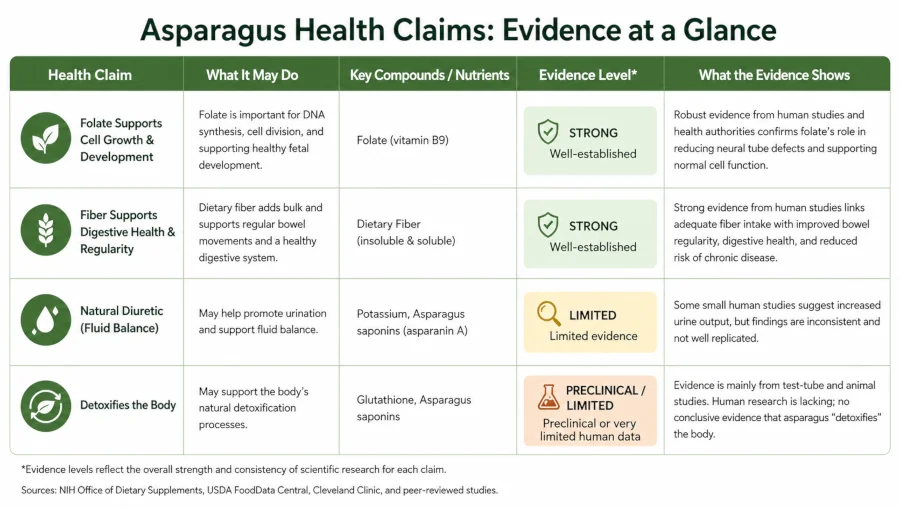
Asparagus contains inulin, a fiber your own enzymes can’t break down. It travels to the large intestine, where gut bacteria ferment it — the textbook definition of a prebiotic [Foods, 2024]. Diets higher in fiber are linked to more regular bowel movements, and the fiber in vegetables like asparagus is part of why it supports digestive health. If constipation is the issue, asparagus is one of several foods that help with constipation, though water and a varied plant-rich diet do more than any single vegetable. The stronger “laxative” claims rest mainly on animal studies, so treat asparagus as a helpful source of fiber rather than a remedy [Drugs.com, 2025].
Antioxidants and the heart
Asparagus carries antioxidant compounds — vitamin C, vitamin E, and flavonoids such as rutin — that help neutralize the reactive molecules linked to cell damage [Foods, 2024]. Its potassium and folate matter for heart health too: folate helps keep homocysteine (a marker tied to cardiovascular risk) in check, and potassium supports healthy blood pressure. None of this makes asparagus a heart drug. It’s one nutrient-dense vegetable inside an overall pattern that, taken together, supports the cardiovascular system.
Low in calories, with early signals on blood sugar
At about 20 calories a serving and high in water and fiber, asparagus is filling for very little energy, which is why it turns up on weight-management menus. Researchers have also tested whether its compounds affect blood sugar and cholesterol. Most of that work is in animals; a small 2025 exploratory trial in overweight and obese adults found that asparagus powder shifted a few glycemic and oxidative-stress markers, but the authors call the result preliminary [Mongraykang et al., 2025]. It’s an interesting signal — not a reason to expect asparagus to manage diabetes.
The claims that don’t hold up — yet
Tradition credits asparagus with “purifying the blood,” clearing eczema, and flushing toxins. There’s no good human evidence for any of it, and your liver and kidneys already handle detoxification on their own. The diuretic reputation is real in folk use and shows up in some lab and animal work, but clinical evidence in people is thin [Drugs.com, 2025]. A 2024 review put it bluntly: most of asparagus’s reported pharmacological effects have been shown in test tubes and animals, not in human trials [Foods, 2024]. Enjoy asparagus as a vegetable, and be skeptical of anything selling it as a cure.
Why asparagus makes some people’s pee smell
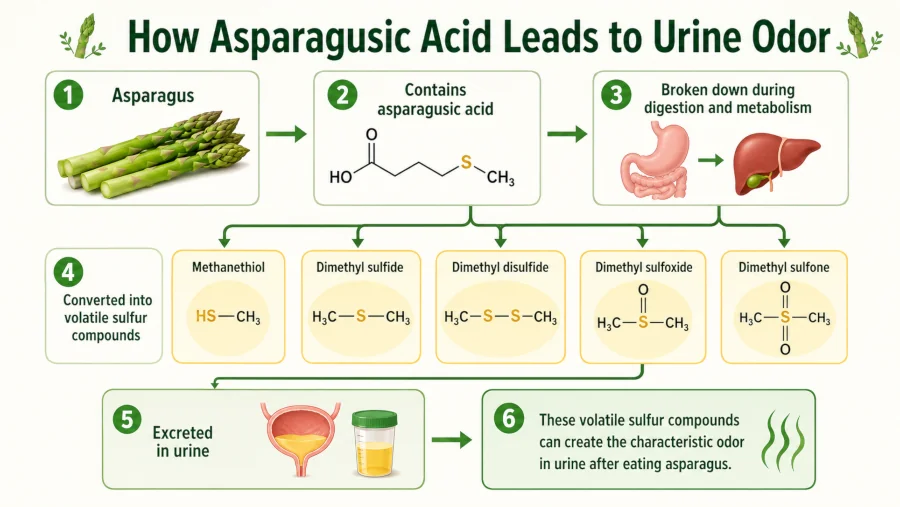
Asparagus contains asparagusic acid, a sulfur compound found in no other vegetable. As you digest it, your body breaks it into small, volatile sulfur molecules that evaporate fast — which is the distinctive odor, sometimes noticeable within 15 to 30 minutes [Cleveland Clinic, 2025]. It is completely harmless and unrelated to urinary health problems. Not everyone notices it, either: depending on the study, somewhere between a fifth and half of people report it, partly down to genetic differences in who makes or can smell the compounds [Cleveland Clinic, 2025].
Asparagus and gout: an outdated warning
Asparagus is moderately high in purines, the compounds that break down into uric acid, so older gout advice told people to limit it. That advice has aged poorly. Large studies found that purines from vegetables don’t raise uric acid or trigger gout the way purines from red meat and shellfish do, and major sources now list high-purine vegetables — asparagus included — as safe for people with gout [Mayo Clinic, 2024] [Arthritis Foundation, 2025]. If you have advanced kidney disease on a restricted diet, follow your clinician’s guidance instead.
Side effects and who should take care
Common, minor effects
The same fructans that feed your gut bacteria can cause gas and bloating, especially if you eat a large amount at once or have a sensitive gut — asparagus is a higher-FODMAP food. The harmless urine odor is the other quirk.
A real medication interaction
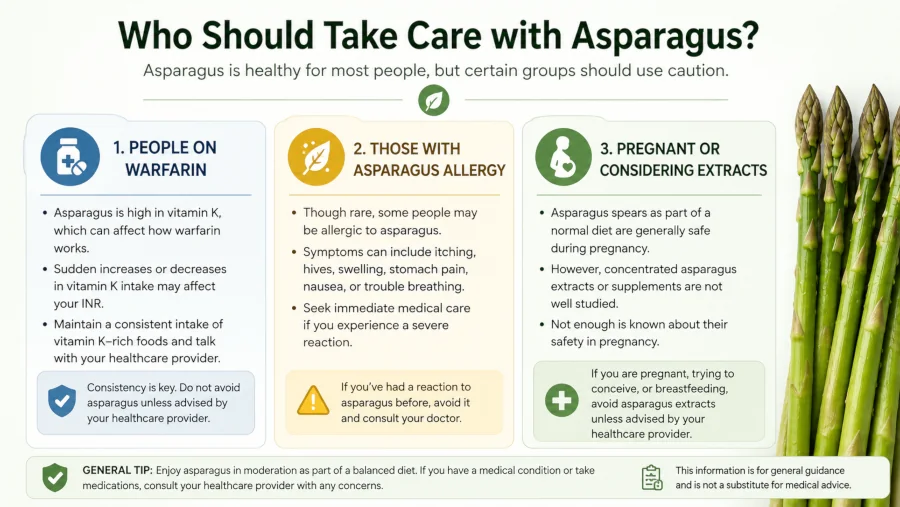
Because asparagus is rich in vitamin K, it matters if you take warfarin (Coumadin) or another vitamin K-antagonist blood thinner. You don’t have to avoid asparagus — the goal is to keep your vitamin K intake steady from day to day rather than swinging from none to a big plateful, since sudden changes can affect how the drug works [NIH ODS, 2021]. Tell whoever manages your anticoagulation about your usual vegetable habits.
Pregnancy and breastfeeding
Asparagus as a food is fine in pregnancy and a good contributor to folate intake. It does not replace a folic acid supplement, which is the part proven to prevent neural tube defects [CDC, 2025]. Concentrated asparagus extracts and “asparagus supplements” are a different matter: there isn’t enough safety data to recommend them in pregnancy or breastfeeding, so skip those unless a clinician advises otherwise [Drugs.com, 2025].
Allergy and concentrated preparations
Asparagus allergy is uncommon but real and can cause skin or respiratory reactions in sensitive people, including some who handle it at work. There’s also a historical caution against strong asparagus-root preparations during active kidney inflammation — but that’s about concentrated medicinal extracts, not the vegetable on your plate. As a food, asparagus is even low enough in potassium to fit many kidney-friendly diets. For extracts, no safe dose has been established [Drugs.com, 2025].
Getting the most from asparagus
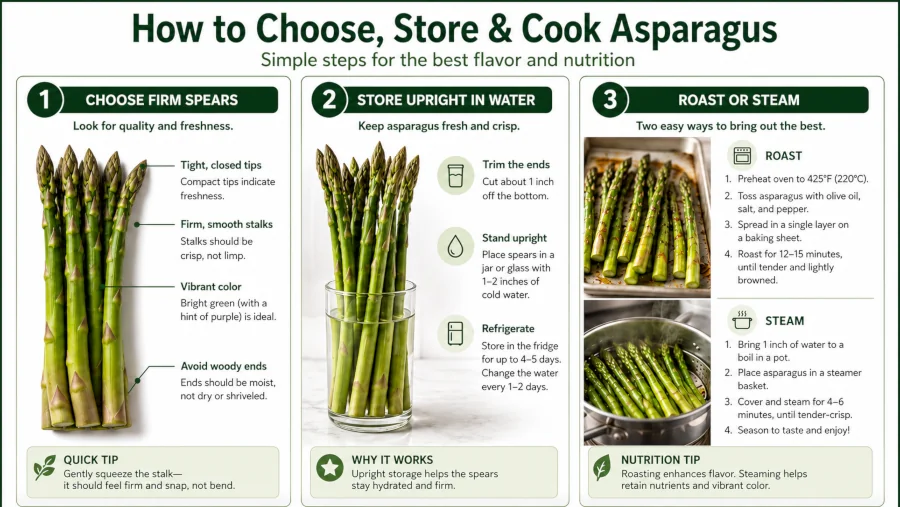
Choose firm, bright spears with tight tips, and skip any that are limp or mushy. Store them upright with the cut ends in a little water, loosely covered, and use them within a few days. Quick cooking — steaming, roasting, or a short sauté — keeps the texture and limits nutrient loss; thin spears need only a few minutes. There’s no need to peel green asparagus; just trim the woody ends. It pairs well with eggs, fish, and other nutrient-dense foods, and it’s good raw, shaved thin into a salad.
Realistic expectations and when to see a professional
Asparagus is a genuinely good vegetable — nutrient-dense, low-calorie, and versatile. It is not a treatment for any condition, and its benefits come from being part of an overall plant-rich pattern, not from any single serving. See a healthcare professional rather than relying on diet if you have swelling (edema) that doesn’t go away, blood in your urine, pain or burning when you urinate, or a reaction after eating asparagus such as hives, swelling, or trouble breathing. Constipation that doesn’t ease with more fiber and fluid also deserves a medical look.
| Health Disclaimer This article is for general education and information only. It is not medical advice and is not a substitute for diagnosis, treatment, or guidance from a qualified healthcare professional. Asparagus is a food, not a treatment for any condition. If you are pregnant or breastfeeding, take a blood thinner such as warfarin, have kidney disease, or have any ongoing medical concern, talk with your doctor, pharmacist, or a registered dietitian before making changes to your diet or using any concentrated asparagus extract or supplement. |
Frequently asked questions
Is it better to eat asparagus raw or cooked?
Both are fine. Light cooking softens the spears and makes some antioxidants easier to absorb, while raw asparagus keeps a little more vitamin C. Eating it both ways across the week covers your bases.
Does asparagus really work as a diuretic?
It has a long folk reputation as one, and some lab and animal studies point that way, but clinical evidence in people is limited. Any effect from a normal serving is mild, so don’t treat it as a substitute for prescribed water pills.
Is asparagus safe if I have gout?
For most people, yes. Despite its purine content, vegetable purines including those in asparagus haven’t been shown to raise uric acid or trigger gout the way meat and shellfish do, and major medical sources now consider it safe.
Why does my urine smell after eating asparagus?
Asparagusic acid breaks down into volatile sulfur compounds that your kidneys filter into urine. It’s harmless, and whether you notice it comes down partly to genetics — many people make the compounds but can’t smell them.
Can I rely on asparagus for folate during pregnancy?
It helps, but it isn’t enough on its own. Take a daily 400 mcg folic acid supplement as the CDC recommends; food folate from asparagus and other vegetables supports your overall intake but isn’t the part proven to prevent neural tube defects.
Does asparagus help with weight loss?
Indirectly. It’s very low in calories and high in water and fiber, so it’s filling and fits a calorie-controlled diet well. There’s nothing fat-burning about it — the benefit is that it crowds out heavier foods.
References
- U.S. Department of Agriculture, FoodData Central. Asparagus, cooked, boiled, drained. → View source
- National Institutes of Health, Office of Dietary Supplements. Folate — Fact Sheet for Health Professionals. → View source
- National Institutes of Health, Office of Dietary Supplements. Vitamin K — Fact Sheet for Health Professionals. → View source
- Centers for Disease Control and Prevention. About Folic Acid. → View source
- Centers for Disease Control and Prevention. Neural Tube Defects. → View source
- Foods (MDPI). A Review of the Pro-Health Activity of Asparagus officinalis L. and Its Components. 2024;13(2):288. → View source
- Drugs.com. Asparagus — Uses, Benefits & Dosage (medically reviewed). 2025. → View source
- Cleveland Clinic. Why Does Asparagus Make Your Pee Smell? 2025. → View source
- Mayo Clinic. Gout diet: What’s allowed, what’s not. → View source
- Arthritis Foundation. Foods to Avoid and Eat for Gout. → View source
- Mongraykang J, Padkao T, Boonla O, et al. Effects of Asparagus Powder Supplementation on Glycemic Control, Lipid Profile, and Oxidative Stress in Overweight and Obese Adults. Life. 2025;15(10):1584. → View source
- Pamplona-Roger GD. Encyclopedia of Medicinal Plants. Editorial Safeliz, 2000. (Traditional-use reference; print.)
