
Calendula’s best-supported use is a modest one: as a cream, ointment, or cooled flower infusion, it can soothe minor skin inflammation such as sunburn and help small wounds heal. European regulators accept that use on the strength of decades of safe tradition — not because clinical trials have proven it [EMA, 2018b]. Most other calendula benefits you’ll see listed online, from regulating periods to healing ulcers, rest on old herbal texts rather than human research.
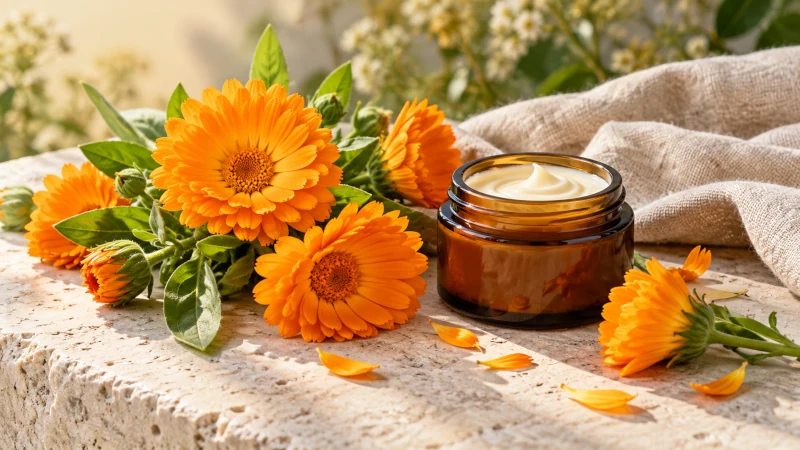
That gap is the reason for this page. Below, each use is sorted by how much evidence actually stands behind it, followed by practical directions for using calendula on your skin, who should skip it, and the signs that a cut or rash needs a doctor rather than a jar of ointment.
Calendula at a glance
| Fact | Detail |
| Botanical name | Calendula officinalis L. |
| Common names | Pot marigold, marigold, Marybud, gold-bloom [MSKCC, 2023] |
| Plant family | Asteraceae, the daisy family — the source of its main allergy risk [EMA, 2018a] |
| Part used | The flowers |
| Common forms | Creams, ointments, oil extracts, and flower infusions used for compresses or mouth rinses [EMA, 2018b] |
| EU status | Traditional herbal medicinal product for minor skin inflammation, minor wounds, and minor mouth or throat inflammation [EMA, 2018a] |
Lab research credits much of calendula’s anti-inflammatory activity to compounds called triterpenoids, and the plant also carries carotenoids such as lutein and beta-carotene [MSKCC, 2023]. That chemistry explains why people have used it on skin for centuries. It doesn’t, on its own, tell you how well it works on a real wound.
Calendula benefits, graded by the evidence
| Use | What the research shows | Evidence grade |
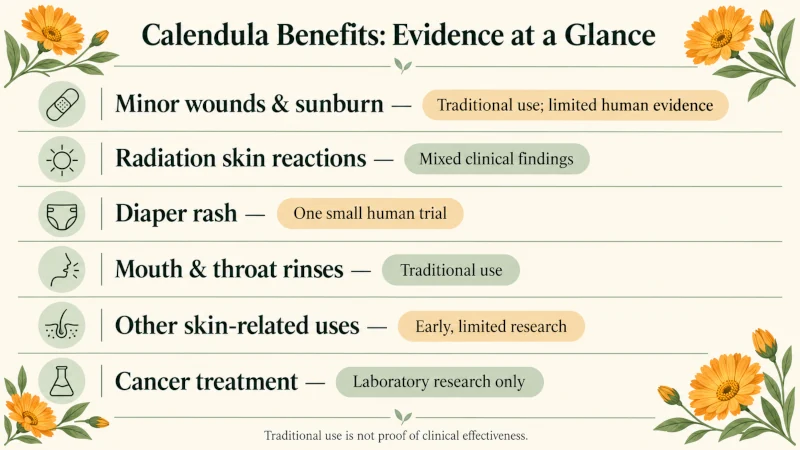
| Minor skin inflammation (e.g., sunburn) and minor wounds | Accepted in the EU on long traditional use; animal studies show faster early healing; human trials are few and mixed | Traditional use, limited human data |
| Skin reactions during radiation therapy | One large trial favored calendula over trolamine; three later trials found it no better than plain moisturizers | Mixed |
| Diaper rash | One small randomized trial in infants: calendula beat aloe | Limited |
| Mouth and throat inflammation (rinse/gargle) | Accepted in the EU on traditional use only | Traditional use |
| Vaginal yeast infections, episiotomy pain, leg and foot ulcers | Small studies; larger trials needed | Early, limited |
| Cancer | Cell-culture and mouse studies only | Preclinical only |
| Periods, liver, ulcers, warts, earaches, hemorrhoids | No reliable human trials behind these claims | Traditional claims; insufficient evidence |
Minor wounds, scrapes and sunburn
This is where calendula has the strongest footing, and even here the footing is tradition. The European Medicines Agency’s herbal committee recognizes calendula flower preparations for symptomatic relief of minor skin inflammation and as an aid to healing minor wounds, based on at least 30 years of safe use. The committee also looked at trials on leg ulcers, burns, and skin inflammation, but study-design problems kept it from drawing firm conclusions [EMA, 2018b].
A 2019 systematic review landed in a similar place. Animal studies gave moderate evidence that calendula extract shortens the inflammatory phase of healing and boosts granulation tissue, the new tissue that fills in a wound. Human results were patchier: a randomized trial in partial- to full-thickness burns found no benefit over controls, and a trial in diabetic leg ulcers found no improvement [Givol et al., 2019]. The reviewers called for larger, better-designed trials.
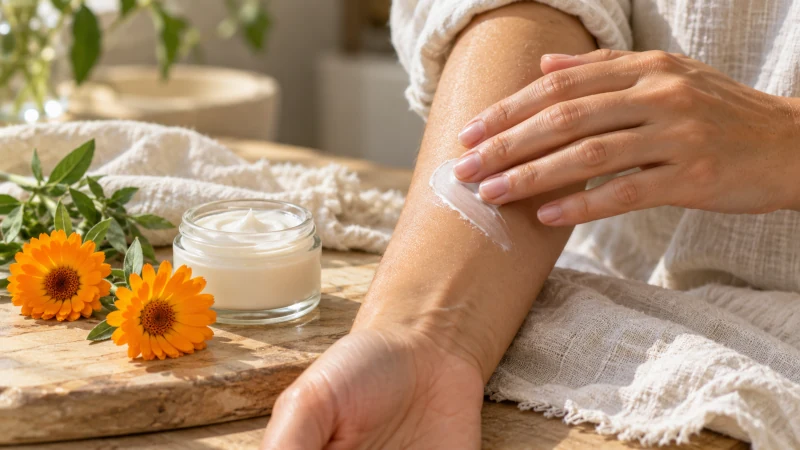
In practice, calendula is a reasonable, inexpensive thing to try on a scrape, mild sunburn, or a dry, irritated patch of skin — provided you aren’t allergic to the daisy family. It doesn’t replace cleaning a wound properly. If you’re weighing it against aloe, tea tree oil, or chamomile, our evidence-graded guide to herbs for skin issues puts them side by side.
Skin reactions during radiation therapy
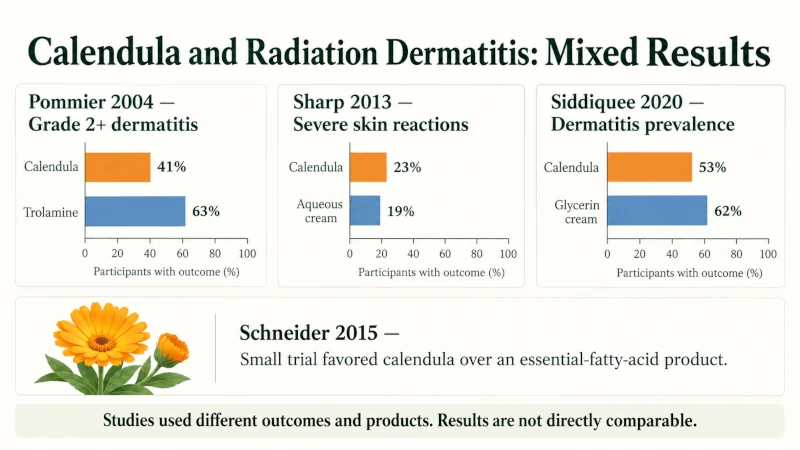
The most-quoted calendula study comes from cancer care. In a 2004 French phase III trial, 254 women having radiation after breast cancer surgery applied either calendula ointment or trolamine (Biafine) after each session. Grade 2 or higher dermatitis occurred in 41% of the calendula group versus 63% of the trolamine group, and the calendula group reported less pain and had fewer treatment interruptions. The ointment was harder to apply, but satisfaction was higher [Pommier et al., 2004].
Later trials haven’t repeated that result. A blinded Swedish trial comparing calendula cream with a plain aqueous cream found severe skin reactions in 23% versus 19% — no meaningful difference [Sharp et al., 2013]. An Australian trial against a standard glycerin cream also found no detectable difference, though it recruited fewer than half the women it planned and was underpowered [Siddiquee et al., 2020]. On the other side, a small Brazilian trial of 51 people with head and neck cancer found calendula worked better than an essential-fatty-acid product [Schneider et al., 2015].
So the evidence is genuinely mixed: calendula clearly beat one comparison cream in one large trial, but it hasn’t consistently outperformed ordinary moisturizers. If you’re having radiation therapy, ask your radiation team before putting anything on the treated skin. Many centers have their own skin-care protocol.
Diaper rash
In a double-blind trial of 66 children under age 3, calendula ointment and aloe cream both improved diaper rash over 10 days of use three times a day, and the calendula group ended with significantly fewer rash sites. Neither product caused reported side effects [Panahi et al., 2012]. That’s encouraging, but it’s one small trial.
There’s also a real disagreement to know about. The EMA doesn’t recommend calendula skin products for children under 6, because adequate safety data are lacking [EMA, 2018a]. Check with your pediatrician before using calendula on a baby, especially on broken skin.
Mouth and throat inflammation
A warm calendula infusion used as a rinse or gargle is a traditional remedy for minor inflammation in the mouth or throat. The EMA accepts this use for adolescents and adults but not for children under 12 [EMA, 2018a]. A sore throat with high fever, trouble swallowing, or symptoms lasting longer than a week needs a medical check, not another rinse.
Other uses with early research
Memorial Sloan Kettering’s integrative medicine service summarizes small studies suggesting topical calendula may help with diabetic foot and venous leg ulcers, vaginal yeast infections, and pain after episiotomy — and says larger studies are needed to confirm any of it [MSKCC, 2023]. Treat these as interesting leads, not established treatments. Vaginal symptoms in particular deserve a proper diagnosis before you try anything at home.
Calendula and cancer: lab findings only
An earlier version of this page cited a 2006 study as evidence of calendula’s anticancer potential. That study tested a specially processed calendula extract in cell cultures, where it slowed the growth of many human and mouse tumor cell lines, and in mice, where it slowed melanoma growth [Jiménez-Medina et al., 2006]. Those are early laboratory findings. No human study shows calendula prevents or treats cancer, and it should never stand in for cancer treatment.
Traditional claims the evidence doesn’t back
Older herbal encyclopedias credit calendula with a long list of internal uses: regulating menstruation and easing cramps, increasing bile flow for the liver, healing stomach and duodenal ulcers, and treating measles, smallpox, varicose veins, warts, and earaches. When the EMA reviewed calendula, the uses it recognized were minor skin, mouth, and throat inflammation — none of the internal claims made the list [EMA, 2018b].
Several of those conditions also need a diagnosis, not a home remedy. Measles is a serious infection. Ear pain, persistent stomach pain, and heavy or very painful periods all have causes a clinician should identify. We’ve removed the old advice to put calendula oil in the ears.
If painful periods brought you here, our overview of herbs for menstrual cramps covers options with more research behind them. For hemorrhoids, this evidence-ranked list of herbs for hemorrhoids starts with fiber, which has far stronger support than any flower. And for stomach complaints, our guide to foods that support gut health is a better starting point — though ulcers and gastritis still need a proper diagnosis.
How to use calendula on your skin
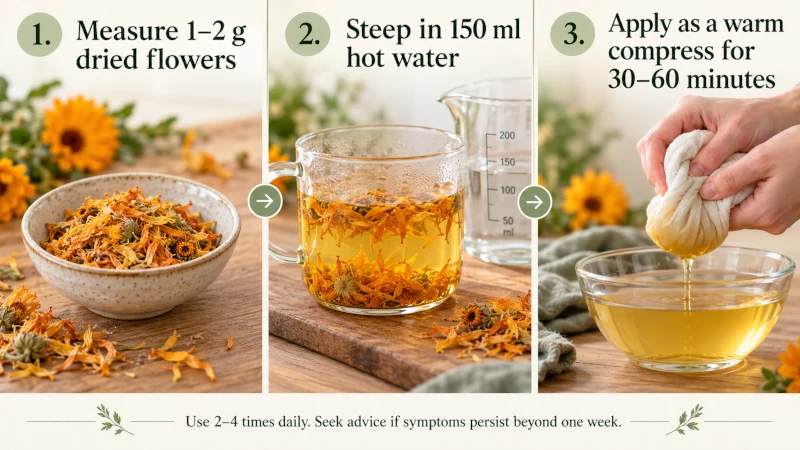
Most people simply buy a ready-made cream or ointment. In the EU, licensed calendula skin products contain the equivalent of roughly 2–10% calendula flower for most preparation types (up to 20% for some fatty-base extracts), applied as a thin layer two to four times a day [EMA, 2018a]. Here’s how the EU monograph describes the main forms:
- Cream or ointment: a thin layer on the affected area, 2–4 times a day [EMA, 2018a].
- Compress: steep 1–2 g of dried calendula flowers in 150 ml of hot water. While it’s still warm, soak a clean dressing and apply it for 30–60 minutes, 2–4 times a day [EMA, 2018a].
- Mouth rinse or gargle (age 12 and up): use the same 1–2 g in 150 ml infusion, warm, 2–4 times a day [EMA, 2018a].
- Give it a week, not a month: if symptoms persist beyond 1 week or get worse, stop and see a doctor or qualified health practitioner [EMA, 2018a].
Before you use calendula on a large area or on your face, test it on a small patch of skin first. Our guide to patch testing explains how to check a new product at home and when a dermatologist’s patch test makes more sense.
You won’t find oral doses here. Capsules, tinctures, and fluid extracts have no established effective dose, and the EU monograph covers only skin and mouth use [EMA, 2018a]. The petals are edible and are used to color soups and salads, and food or tea amounts are generally considered safe — but talk with your doctor before taking calendula as a supplement [MSKCC, 2023].
Side effects, interactions, and who should avoid calendula
Applied to the skin, calendula is usually well tolerated. The main known risk is skin sensitization — an allergic rash — and how often it happens isn’t known [EMA, 2018a]. Because calendula belongs to the daisy family, anyone allergic to Asteraceae plants shouldn’t use it [EMA, 2018a].
Avoid calendula, or check with a clinician first, if you:
- Are allergic to plants in the daisy (Asteraceae) family [EMA, 2018a].
- Are pregnant or breastfeeding. Safety hasn’t been established, and both the EMA and MSKCC advise against medicinal use [EMA, 2018a]; [MSKCC, 2023].
- Are treating a child under 6 (skin products) or under 12 (mouth rinses) — the EMA doesn’t recommend use at these ages for lack of data [EMA, 2018a].
- Are having radiation therapy and haven’t cleared it with your radiation team.
- Have eczema or very sensitive skin. Read our evidence-graded guide to herbs for eczema before putting any botanical on irritated skin.
Interactions: the EMA lists no reported interactions for skin or mouth use [EMA, 2018a]. Data on calendula supplements taken by mouth are thin, and herbal supplements can affect how other medicines work, so tell your doctor or pharmacist about any you take [MSKCC, 2023].
When to see a doctor instead
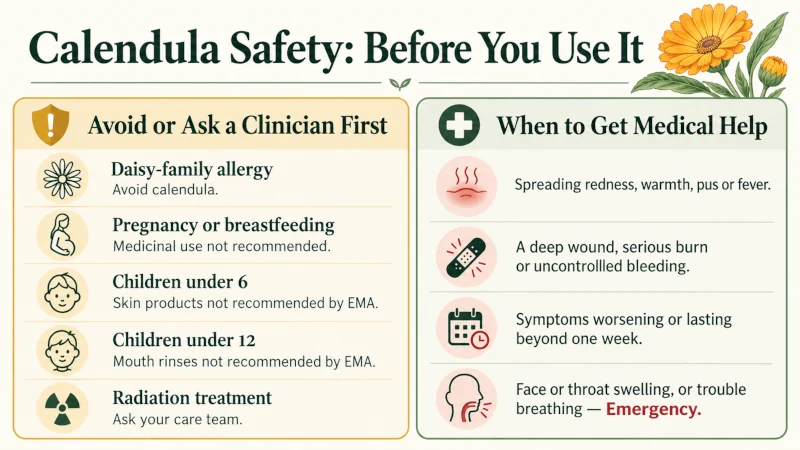
Calendula is for minor problems. Stop using it and get medical care if you notice:
- Signs of infection — spreading redness, warmth, swelling, pus, or fever — or symptoms that worsen while you’re using it [EMA, 2018a].
- A wound or rash that hasn’t improved after a week [EMA, 2018a].
- A deep, gaping, or puncture wound, an animal or human bite, or bleeding that won’t stop.
- A burn that blisters over a large area or involves the face, hands, feet, or genitals.
- A new rash or itching where you applied calendula — a possible allergy.
Get emergency help right away for swelling of the face, lips, or throat, or trouble breathing.
| HEALTH DISCLAIMER: This article is for general education and isn’t a substitute for diagnosis, treatment, or personal advice from a qualified clinician. Calendula is a traditional remedy for minor skin and mouth complaints; the evidence for most other uses is limited or absent, and it doesn’t treat any serious medical condition.Don’t use calendula if you’re allergic to daisy-family plants. If you’re pregnant or breastfeeding, treating a child, having cancer treatment, taking prescription medicines, or managing a chronic condition, talk with your doctor or pharmacist before using it. Seek medical care for wounds that are deep, infected, or not healing, and get emergency help for swelling of the face or throat or trouble breathing. |
Frequently Asked Questions
What is calendula good for?
Its best-supported use is on the skin: soothing minor inflammation such as sunburn and helping small wounds heal, plus rinses for minor mouth or throat inflammation. Those uses are accepted in the EU on the basis of long, safe tradition, not strong clinical trials [EMA, 2018b].
Does calendula help with radiation burns?
The evidence is mixed. One large trial found calendula ointment prevented more severe skin reactions than trolamine [Pommier et al., 2004], but later trials found it no better than plain moisturizing creams [Sharp et al., 2013]; [Siddiquee et al., 2020]. Ask your radiation team before using anything on treated skin.
Is calendula safe for babies?
One small trial found calendula ointment improved diaper rash in children under 3 without reported side effects [Panahi et al., 2012]. The EMA, however, doesn’t recommend calendula skin products for children under 6 because safety data are limited [EMA, 2018a]. Ask your pediatrician first.
Can I drink calendula tea?
Food and tea amounts are generally considered safe [MSKCC, 2023], but there’s no good evidence that drinking it helps any condition. Skip it if you’re pregnant or breastfeeding, and check with your doctor before taking calendula supplements.
How long does calendula take to work?
For minor skin complaints, you should see improvement within about a week. If symptoms last longer or get worse, stop and see a doctor [EMA, 2018a].
References
- European Medicines Agency, Committee on Herbal Medicinal Products. View source
- European Medicines Agency. Calendulae flos — herbal medicinal product. View source
- Memorial Sloan Kettering Cancer Center. Calendula — About Herbs, Botanicals & Other Products. View source
- Givol O, Kornhaber R, Visentin D, Cleary M, Haik J, Harats M. A systematic review of Calendula officinalis extract for wound healing. View source
- Pommier P, Gomez F, Sunyach MP, D’Hombres A, Carrie C, Montbarbon X. Phase III randomized trial of Calendula officinalis compared with trolamine for the prevention of acute dermatitis during irradiation for breast cancer. View source
- Sharp L, Finnilä K, Johansson H, Abrahamsson M, Hatschek T, Bergenmar M. No differences between Calendula cream and aqueous cream in the prevention of acute radiation skin reactions — results from a randomised blinded trial. View source
- Siddiquee S, McGee MA, Vincent AD, Giles E, Clothier R, Carruthers S, Penniment M. Efficacy of topical Calendula officinalis on prevalence of radiation-induced dermatitis: a randomised controlled trial. View source
- Schneider F, Danski MTR, Vayego SA. Usage of Calendula officinalis in the prevention and treatment of radiodermatitis: a randomized double-blind controlled clinical trial. View source
- Panahi Y, Sharif MR, Sharif A, Beiraghdar F, Zahiri Z, Amirchoopani G, Marzony ET, Sahebkar A. A randomized comparative trial on the therapeutic efficacy of topical aloe vera and Calendula officinalis on diaper dermatitis in children. View source
- Jiménez-Medina E, Garcia-Lora A, Paco L, Algarra I, Collado A, Garrido F. A new extract of the plant Calendula officinalis produces a dual in vitro effect: cytotoxic anti-tumor activity and lymphocyte activation. View source


