
Cherimoya is a genuinely nutritious fruit. One fruit gives you about a third of a day’s vitamin B6 and vitamin C and a quarter of your fiber, with almost no fat or sodium [USDA, 2016] [FDA, n.d.]. That is the honest core of cherimoya health benefits: the ordinary, reliable good that comes from eating more whole fruit. What cherimoya is not is a treatment for heart failure, ulcers, or any other disease, and no human trials have tested it as one. The single most useful thing to know before you buy one: eat the pulp, never the seeds.
What is cherimoya?
Cherimoya (Annona cherimola) is the fruit of a small tree, about 5 to 9 meters tall, in the custard apple family, Annonaceae. It is believed to be native to the inter-Andean valleys of Ecuador, Colombia, and Bolivia, where it grows naturally at roughly 1,400 to 2,000 meters. Whether Peru is part of its original range is disputed [Morton, Purdue NewCROP].
The tree took well to cooler subtropical climates outside the Andes. In Spain’s Granada province, cherimoya plantings took off in the 1940s and 1950s, partly replacing orange groves that had failed [Morton, Purdue NewCROP].
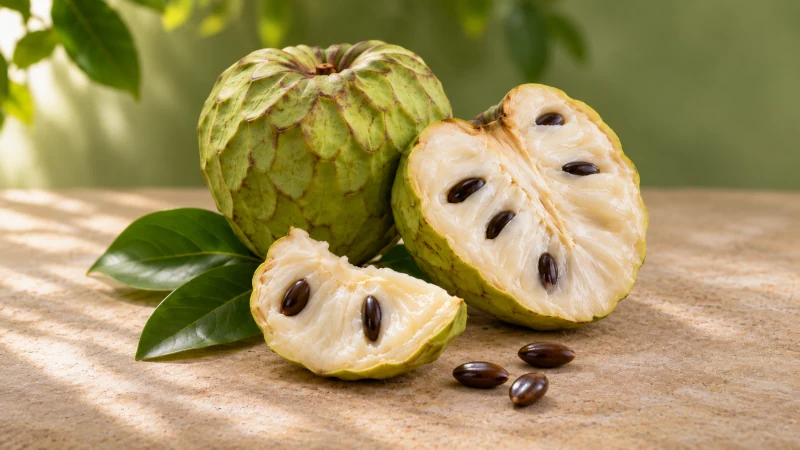
The fruit is rounded or heart-shaped, with green skin patterned in overlapping scales or bumps. Most weigh 150 to 500 grams, though exceptional fruits pass 2.7 kilograms [Morton, Purdue NewCROP]. Inside is white, custard-soft pulp dotted with hard, glossy, bean-like seeds. The flavor is famously hard to describe. People reach for comparisons to banana, strawberry, and pineapple, and none of them quite lands.
Cherimoya nutrition facts
The figures below come from the USDA’s laboratory analysis of raw cherimoya [USDA, 2016]. A cup of pieces weighs about 160 grams; one fruit, without skin and seeds, about 235 grams. Percent Daily Values use the FDA’s label references [FDA, n.d.].
| Nutrient | Per 100 g | Per cup (160 g) | Per fruit (235 g) | % DV per fruit |
| Calories | 75 kcal | 120 kcal | 176 kcal | — |
| Carbohydrate | 17.7 g | 28.3 g | 41.6 g | — |
| Total sugars | 12.9 g | 20.6 g | 30.2 g | — |
| Fiber | 3.0 g | 4.8 g | 7.1 g | 25% |
| Protein | 1.6 g | 2.5 g | 3.7 g | — |
| Fat | 0.7 g | 1.1 g | 1.6 g | — |
| Vitamin B6 | 0.26 mg | 0.41 mg | 0.60 mg | 36% |
| Vitamin C | 12.6 mg | 20.2 mg | 29.6 mg | 33% |
| Riboflavin (B2) | 0.13 mg | 0.21 mg | 0.31 mg | 24% |
| Thiamin (B1) | 0.10 mg | 0.16 mg | 0.24 mg | 20% |
| Folate | 23 µg DFE | 37 µg DFE | 54 µg DFE | 14% |
| Potassium | 287 mg | 459 mg | 674 mg | 14% |
| Calcium | 10 mg | 16 mg | 24 mg | 2% |
| Sodium | 7 mg | 11 mg | 16 mg | 1% |
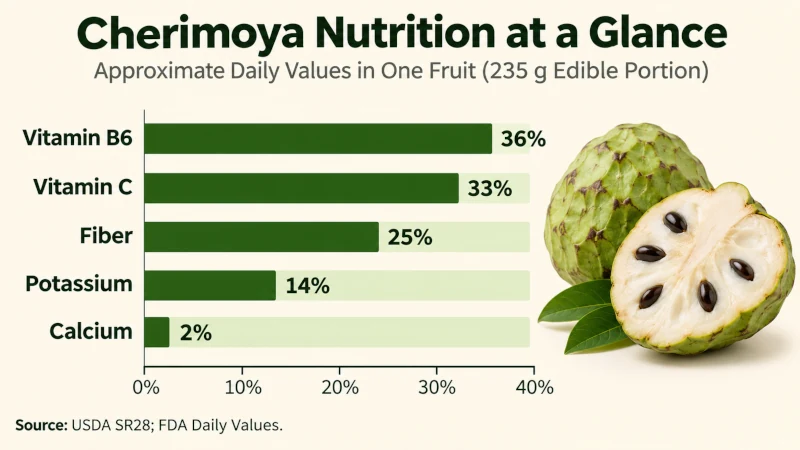
Source: USDA SR28, NDB 09062, Cherimoya, raw. Cup and fruit amounts are scaled from the per-100 g values; % Daily Value calculated against FDA reference amounts.
Two numbers stand out. Vitamin B6 and vitamin C are the strongest contributions, at roughly 36% and 33% of the Daily Value per fruit. And the calories are moderate: 75 per 100 grams in the USDA analysis, so a whole fruit comes to about 176. Higher figures circulate online, but they don’t match the USDA data.
Calcium is where popular claims and the data part ways. Cherimoya contains about 10 mg per 100 grams, so even a whole fruit covers only around 2% of the Daily Value [USDA, 2016]. It is not a meaningful calcium source.
Cherimoya health benefits: what the evidence supports
Published research on cherimoya consists mostly of nutrient analyses, lab studies of extracts, and safety work. We found no human trials that tested the fruit itself for a health outcome. So every benefit below rests on what the fruit contains, not on studies of people eating cherimoya.
A useful source of vitamin B6 and vitamin C
Vitamin B6 helps enzymes carry out more than 100 reactions involved in metabolism and supports immune function [NIH ODS, Vitamin B6]. Vitamin C protects cells from free-radical damage, is needed to make the collagen your body uses to heal wounds, and improves how well you absorb iron from plant foods [NIH ODS, Vitamin C].
One cherimoya supplies about 0.6 mg of B6 and 30 mg of vitamin C [USDA, 2016]. Adults need 1.3 to 1.7 mg of B6 a day [NIH ODS, Vitamin B6] and 75 mg (women) or 90 mg (men) of vitamin C [NIH ODS, Vitamin C], so a single fruit makes a real dent in both. It also adds smaller amounts of riboflavin, thiamin, and folate.
Evidence: Strong for the nutrient content; the fruit itself has not been studied for any health outcome.
Fiber that counts toward your daily total
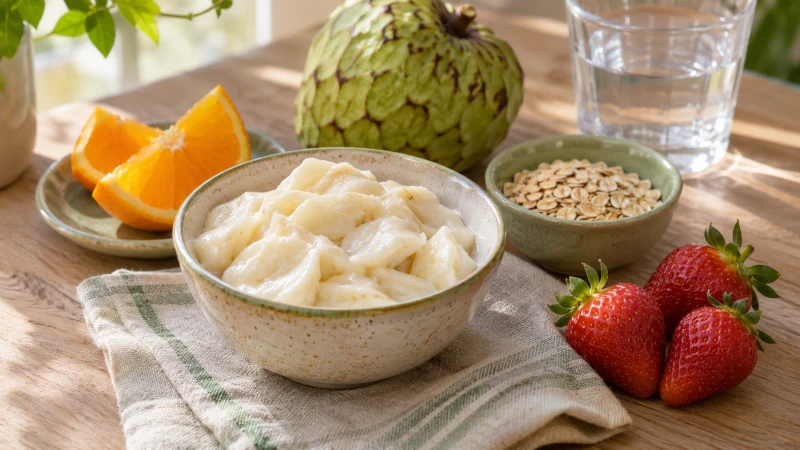
With about 7 grams of fiber per fruit, cherimoya covers a quarter of the 28-gram Daily Value [USDA, 2016] [FDA, n.d.]. That puts it among the more fiber-rich fruits you can eat with a spoon. If you’re working on regularity or gut health, it fits alongside the other fiber-rich foods for healthy digestion.
Evidence: Strong for fiber as a nutrient; no cherimoya-specific digestive studies.
Potassium, with almost no sodium
A whole cherimoya provides about 674 mg of potassium and only around 16 mg of sodium [USDA, 2016]. Getting more potassium from food is linked to lower blood pressure: trials of potassium generally show modest reductions, larger in people who already have high blood pressure, though the NIH describes the overall evidence as not yet conclusive [NIH ODS, Potassium]. Cherimoya is one way to add potassium, not a blood-pressure treatment. For the bigger picture, see our guide to foods for healthy arteries.
Evidence: Moderate for dietary potassium and blood pressure; not studied for cherimoya.
A filling, low-fat dessert
Cherimoya tastes like dessert but behaves like fruit: water, natural sugar, fiber, and very little fat. A large 300-gram fruit comes to roughly 225 calories by the USDA figures [USDA, 2016], which compares well with a bowl of ice cream or a pastry. No studies have tested cherimoya for weight loss, so treat it as a better-for-you swap rather than a weight-loss food. Our article on foods to eat to lose weight covers what actually helps with fullness.
Evidence: Insufficient for weight loss; the swap logic rests on calorie and fat content alone.
Antioxidants: real, but mostly in the parts you don’t eat
A Portuguese laboratory analysis of four cherimoya cultivars measured antioxidant activity in the pulp, peel, and seeds. The peel scored highest for antioxidant capacity and flavonoids, and the researchers concluded the fruit’s antioxidant value lies especially in its by-products [Albuquerque et al., 2016]. That is a finding about lab extracts, with no human participants, and it mostly concerns peel and seeds that people don’t eat.
Evidence: Early-stage, lab-only.
Claims that go further than the evidence
Some herbal and natural-health sources recommend cherimoya for heart failure, for gastritis and stomach ulcers, or as a diuretic. None of these uses has been tested in people.
Heart failure. No study supports eating cherimoya to treat or ease heart failure. The idea that its B vitamins fuel a “tired heart” is a theory, not a finding. There’s also a practical catch: many people with heart failure take ACE inhibitors, ARBs, or spironolactone, which can raise blood potassium, and the NIH advises monitoring potassium intake with these drugs [NIH ODS, Potassium]. A daily potassium-rich fruit is something to clear with your care team, not a substitute for it.
Gastritis and ulcers. The creamy texture may feel gentle, but no research shows cherimoya has an antacid effect or helps ulcers heal. Persistent stomach pain needs a diagnosis, because ulcers are often caused by an infection or medication that a doctor can treat.
Diuretic effect. We found no human data showing cherimoya increases urine output in any clinically meaningful way.
Cancer. This claim is usually attached to soursop (graviola), a close relative, rather than cherimoya. Memorial Sloan Kettering’s review says there is no proof graviola benefits cancer patients and that human studies are lacking [MSK, 2026].
Cherimoya safety: seeds, allergies, and the neurotoxin question
Never eat, chew, or blend the seeds
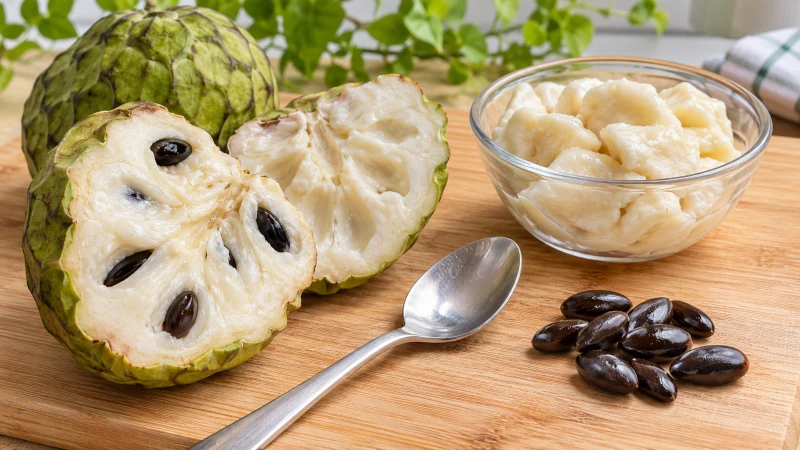
Cherimoya seeds contain alkaloids and are crushed in some places for use as an insecticide. In one reported case, swallowing a small amount (0.15 g) of seed resin caused dilated pupils and vomiting, with effects described as resembling atropine poisoning [Morton, Purdue NewCROP]. The seeds are also a known source of annonaceous acetogenins, compounds studied as possible neurotoxins [Le Ven et al., 2014].
The practical rules are simple. Pick the seeds out before eating or blending, never put whole fruit with seeds into a blender, and remove seeds before giving cherimoya to children. Other fruits carry their own seed hazards too; loquat seeds are a well-known example.
If someone chews or swallows seeds and feels unwell, call the Poison Help line at 1-800-222-1222 in the United States, which connects you to your local poison center [HRSA, Poison Help]. If the person has trouble breathing, has a seizure, or collapses, call 911.
Allergy and latex-fruit syndrome
Cherimoya allergy is uncommon but real. Anaphylaxis after eating cherimoya has been documented in a published case report, which PubMed indexes alongside latex hypersensitivity and cross-reactions [Sánchez-Guerrero et al., 2000]. In a study of the latex-fruit syndrome, cherimoya was one of the fruits containing proteins that cross-react with latex allergens [Diaz-Perales et al., 1999].
If you have a latex allergy, or react to related fruits such as banana, avocado, or kiwi, talk to an allergist before trying cherimoya. Stop eating it and seek urgent care if you notice swelling of the lips, tongue, or throat, hives that spread, wheezing, or trouble breathing.
The Annonaceae and atypical parkinsonism question
This is the most debated safety issue, and the evidence is genuinely mixed. In Guadeloupe, a 1999 case-control study of 87 patients with parkinsonism linked an unusual form of the disease to regular consumption of fruit and herbal tea from two relatives of cherimoya, soursop (Annona muricata) and sweetsop (Annona squamosa) [Caparros-Lefebvre & Elbaz, 1999]. A 2026 comparison found that Caribbean Parkinson’s patients, nearly all of whom had eaten Annonaceae fruits such as soursop, had more severe motor and cognitive symptoms than patients in mainland France [Ribeyron et al., 2026]. Both studies show associations; neither proves the fruits caused the disease.
For cherimoya specifically, the findings point in different directions. A screen of Spanish cherimoya pulp found it was not a source of exposure to these neurotoxins [Guillopé et al., 2011]. A later analysis detected more than 80 acetogenins in a commercial cherimoya-based alcoholic drink, and its authors argued the species should be treated as a risk factor [Le Ven et al., 2014].
A reasonable reading: occasional servings of ripe cherimoya pulp appear to be low risk on current evidence, while seeds, leaf teas, concentrated extracts, and large daily amounts deserve real caution. If you have Parkinson’s disease or another movement disorder, it’s sensible to keep Annona fruits occasional and mention them to your neurologist.
Diabetes, kidney disease, and medications
Diabetes. A cup of cherimoya carries about 28 grams of carbohydrate, around 21 of them sugar [USDA, 2016]. It fits in a diabetes eating plan when you count it as a fruit serving and keep portions in check.
Kidney disease. People with chronic kidney disease may not clear potassium well, which raises the risk of high blood potassium. The NIH advises them to ask a physician or dietitian about potassium intake [NIH ODS, Potassium].
Potassium-raising medicines. ACE inhibitors, ARBs, and potassium-sparing diuretics such as spironolactone can raise blood potassium [NIH ODS, Potassium]. Eating cherimoya now and then is unlikely to matter, but check with your clinician before making it a daily habit.
Supplements. Annona leaf or fruit extracts sold as supplements are a different matter from the fresh fruit. MSK notes possible additive effects with blood-sugar and blood-pressure medications, and that supplements are stronger than the herbs used in cooking [MSK, 2026].
Pregnancy and breastfeeding
There are no studies of cherimoya in pregnancy or breastfeeding. Ripe pulp eaten as ordinary food is not known to be harmful. Avoid the seeds, leaf teas, and any Annona supplements during pregnancy and while nursing, since their safety hasn’t been established, and ask your obstetrician or midwife if you eat Annona fruits often.
When to talk to a healthcare professional
- Right away (call 911 or go to the emergency room): throat or tongue swelling, trouble breathing, or fainting after eating cherimoya.
- Call Poison Help (1-800-222-1222): seeds were chewed or swallowed, especially by a child, or seed juice got into someone’s eyes.
- Soon: you have kidney disease, take potassium-raising medicines, or have diabetes and want to add cherimoya regularly.
- Don’t self-treat: stomach pain that persists, heart-failure symptoms such as swelling or breathlessness, or new tremor or stiffness. These need a diagnosis, not a fruit.
How to choose, ripen, and eat cherimoya
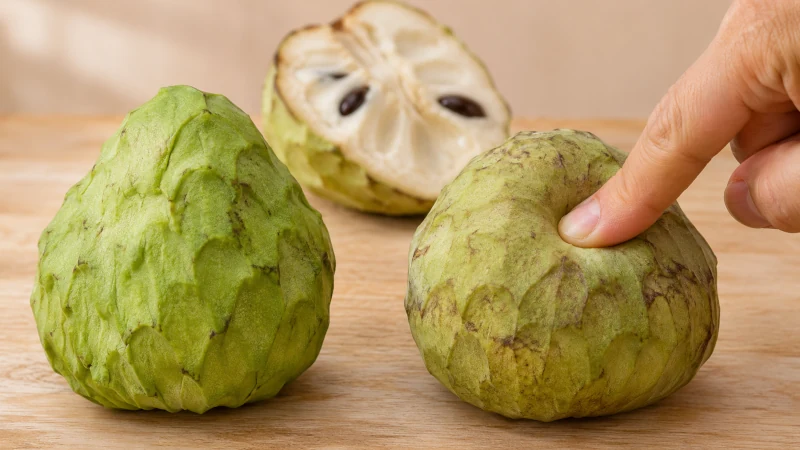
Cherimoyas are picked while still firm. Left at room temperature, they soften and are ready to eat in about three to four days; once ripe, move them to the refrigerator if you aren’t eating them right away [Morton, Purdue NewCROP]. A ripe fruit gives slightly when you press it gently, much like an avocado.
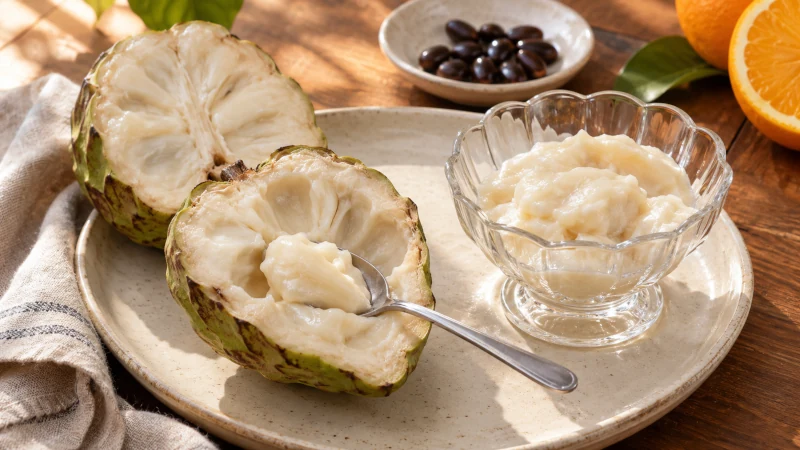
To eat one, cut it in half or into quarters and scoop the pulp with a spoon, picking out the seeds as you go. Skip the skin. The pulp is traditionally eaten raw, added to fruit salads, or made into sherbet and ice cream, and in Colombia the strained juice is turned into a soft drink [Morton, Purdue NewCROP]. For a smoothie, remove every seed first, then blend the pulp with milk or orange juice.
Cherimoya vs. soursop and sugar apple
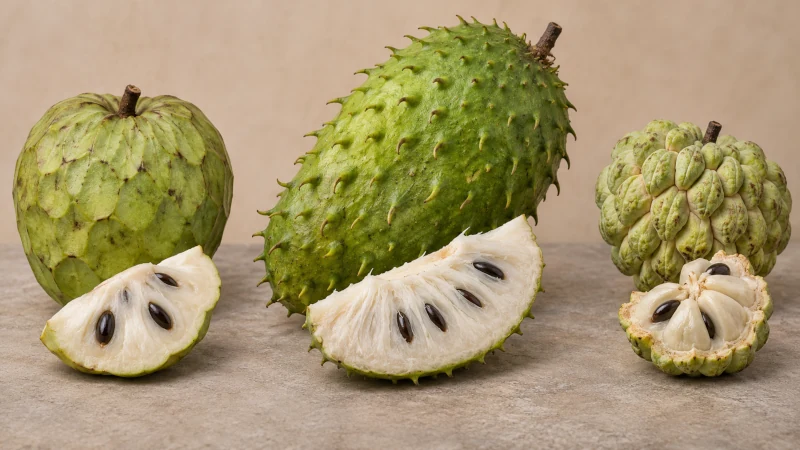
Shops and websites often blur the Annona fruits together. Even “custard apple” is ambiguous: MSK lists it as a common name for graviola, which is soursop [MSK, 2026]. When you read a health claim, check which species it is about.
| Fruit | Species | What to know |
| Cherimoya | Annona cherimola | Highland fruit, eaten fresh. Spanish pulp tested negative for acetogenin exposure in one screen; seeds are toxic [Guillopé et al., 2011] [Morton, Purdue NewCROP]. |
| Soursop (graviola) | Annona muricata | The fruit most linked to atypical parkinsonism in Guadeloupe; heavily marketed as a cancer supplement without human evidence [Caparros-Lefebvre & Elbaz, 1999] [MSK, 2026]. |
| Sugar apple (sweetsop) | Annona squamosa | Also implicated in the Guadeloupe case-control study [Caparros-Lefebvre & Elbaz, 1999]. |
| HEALTH DISCLAIMER: This article is for general education and is not a substitute for advice, diagnosis, or treatment from a qualified healthcare professional. Cherimoya is a food, not a treatment for any disease. If you are pregnant or breastfeeding, have kidney disease, heart failure, diabetes, a latex or fruit allergy, or a movement disorder, or you take prescription medicines, talk with your doctor or pharmacist before making cherimoya or any Annona product a regular part of your diet. |
Frequently Asked Questions
Is cherimoya good for you?
Yes, as a fruit. One cherimoya provides about a third of the Daily Value for vitamin B6 and vitamin C, a quarter of your fiber, and useful potassium, with very little fat or sodium [USDA, 2016] [FDA, n.d.]. It hasn’t been studied as a treatment for any disease.
Are cherimoya seeds poisonous?
Yes. The seeds contain alkaloids, and a small amount of seed resin has caused vomiting and atropine-like symptoms [Morton, Purdue NewCROP]. Remove all seeds before eating or blending, and call Poison Help (1-800-222-1222) if someone chews or swallows them and feels unwell [HRSA, Poison Help].
Can people with diabetes eat cherimoya?
Usually, yes, counted as a fruit serving. A cup has about 28 grams of carbohydrate, so watch portion size and check how it affects your blood sugar [USDA, 2016].
Is cherimoya the same as soursop or custard apple?
No. They are related Annona fruits. Soursop is Annona muricata and sugar apple is Annona squamosa. “Custard apple” is used loosely for several of them, so check the species before trusting a health claim [MSK, 2026].
Does cherimoya help with heart failure or stomach ulcers?
There is no evidence that it does. These conditions need medical care. People with heart failure who take potassium-raising medicines should ask their clinician before eating potassium-rich fruit daily [NIH ODS, Potassium].
How do I know when a cherimoya is ripe?
It yields slightly to gentle pressure. Firm fruit ripens at room temperature in about three to four days; refrigerate it once ripe [Morton, Purdue NewCROP].
References
- U.S. Department of Agriculture, Agricultural Research Service. National Nutrient Database for Standard Reference, View source
- U.S. Food and Drug Administration. Daily Value on the Nutrition and Supplement Facts Labels. View source
- Morton J. Cherimoya. In: Fruits of Warm Climates. Hosted by Purdue University Center for New Crops & Plant Products (NewCROP). View source
- NIH Office of Dietary Supplements. Potassium: Fact Sheet for Health Professionals. View source
- NIH Office of Dietary Supplements. Vitamin B6: Fact Sheet for Consumers. View source
- NIH Office of Dietary Supplements. Vitamin C: Fact Sheet for Consumers. View source
- Albuquerque TG, Santos F, Sanches-Silva A, Oliveira MB, Bento AC, Costa HS. View source
- Sánchez-Guerrero IM, Escudero AI, Tortosa JA, Lombardero M. Anaphylaxis to cherimoya. Allergy. View source
- Diaz-Perales A, Collada C, Blanco C, et al. Cross-reactions in the latex-fruit syndrome: View source
- Caparros-Lefebvre D, Elbaz A; Caribbean Parkinsonism Study Group. Possible relation of atypical parkinsonism in the French West Indies with consumption of tropical plants: a case-control study. View source
- Guillopé R, Escobar-Khondiker M, Guérineau V, Laprévote O, Höglinger GU, Champy P. Kaurenoic acid from pulp of Annona cherimolia in regard to Annonaceae-induced Parkinsonism. View source
- Le Ven J, Schmitz-Afonso I, Lewin G, Brunelle A, Touboul D, Champy P. Identification of the environmental neurotoxins annonaceous acetogenins in an Annona cherimolia Mill. alcoholic beverage using HPLC-ESI-LTQ-Orbitrap. View source
- Ribeyron L, Petit A, Edragas R, et al. The clinical effect of Annonaceae fruit consumption on Caribbean Parkinson’s disease severity. View source
- Memorial Sloan Kettering Cancer Center. About Herbs: Graviola. View source
- U.S. Health Resources and Services Administration. View source


