
Cedar nut oil pressed from the Siberian pine is a pleasant, fat-dense culinary oil containing one genuinely unusual compound — pinolenic acid. Human research on it exists, and some of it is interesting. But nearly all of that research used a chemically modified form of the oil, delivered in delayed-release capsules, measured over a single afternoon. Siberian pine nut oil in a bottle, taken by the spoonful, is not the thing that was tested.
That gap between what was studied and what is sold explains most of the confusion around this oil. Below is what the evidence supports, what it does not, and how to use the oil sensibly if you want to try it.
What Siberian pine nut oil is
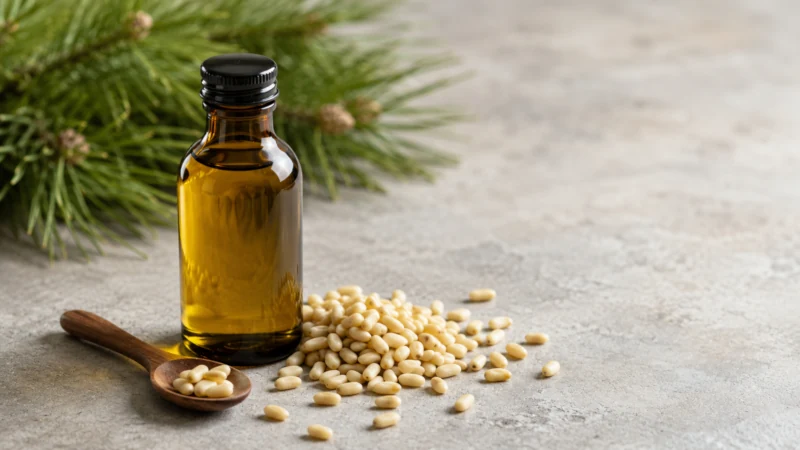
It is the oil pressed from the kernels of Pinus sibirica, the Siberian pine — often called the Siberian cedar, though it is not a true cedar. The oil is mostly linoleic and oleic acid, the same fatty acids that dominate sunflower and olive oil. What sets it apart is pinolenic acid, which makes up somewhere in the range of 14 to 20 percent of the fatty acids in pine nut oil [Baker, Miles & Calder review, Progress in Lipid Research, 2021] [Sørensen et al., Clinical Nutrition, 2021].
Pinolenic acid is uncommon in the food supply, and it behaves differently from ordinary fats in the gut. That is the entire scientific basis for the health claims attached to this oil. Everything else follows from it.
Sellers often emphasize traditional cold-pressing on wooden equipment. That may matter for craft and for flavor. No published human research shows that press material changes the oil’s effect on your body. What does matter, practically, is freshness: polyunsaturated oils go rancid, and a bottle that smells sharp, waxy, or like old crayons belongs in the trash.
The species on the label matters
Three pines dominate the pine nut trade, and they are not interchangeable. Italian stone pine (Pinus pinea) contains roughly 1 percent pinolenic acid; Korean pine (Pinus koraiensis) contains about 15 percent [Pasman et al., Lipids in Health and Disease, 2008]. Siberian pine sits at the higher end, near 20 percent [Sørensen et al., Clinical Nutrition, 2021]. A third species, Pinus armandii, carries almost no benefit claims but is the one most consistently linked to a strange taste side effect covered further down.
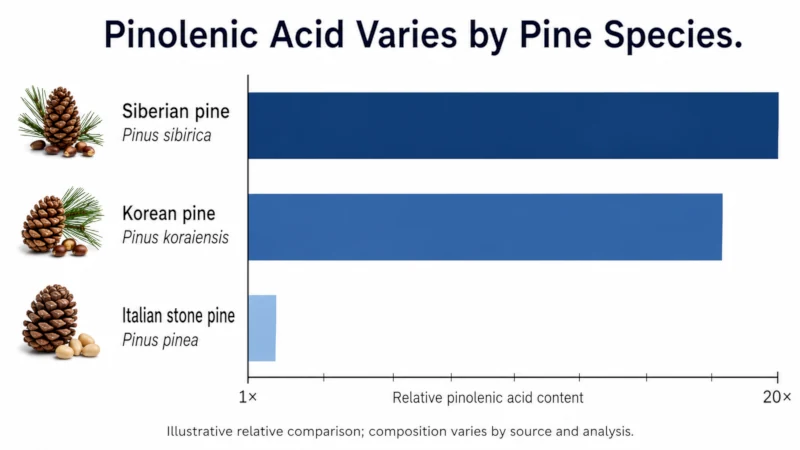
This matters when you read study results. Much of the appetite research was done on Korean pine oil, not Siberian. The two Danish trials described next are the exception, and they are the most directly relevant human evidence there is.
Appetite and weight: the strongest evidence, and its limits
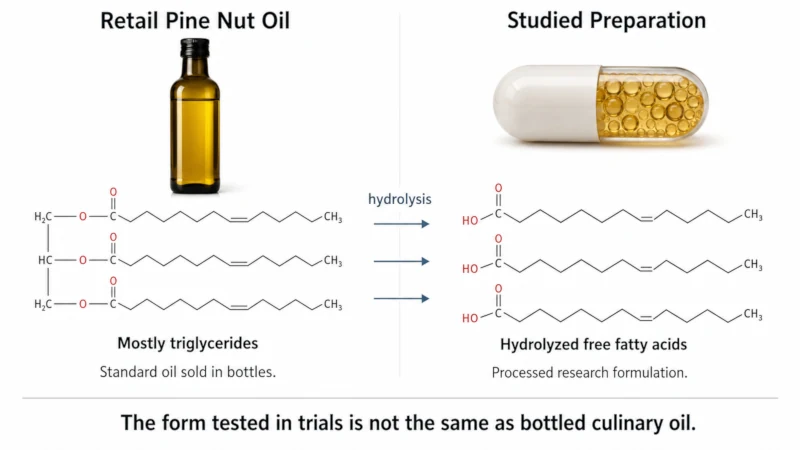
Two small crossover trials from Danish research groups tested hydrolyzed Siberian pine nut oil — the free-fatty-acid form — in delayed-release capsules designed to open in the small intestine. In eight healthy non-obese adults and ten overweight adults, 3 to 6 grams taken 30 minutes before a glucose tolerance test raised GLP-1 and lowered ghrelin in the later hours after eating. In the overweight group, that came with more reported satiety and fullness and less anticipated hunger [Sørensen et al., Clinical Nutrition, 2021]. A follow-up in nine overweight adults found the same pattern with 6 grams [Sørensen et al., Nutrients, 2021].
Older work on Korean pine oil points the same direction. In 18 overweight postmenopausal women, 3 grams of the free-fatty-acid form raised total cholecystokinin over four hours by about 60 percent versus an olive oil placebo, and GLP-1 by about 25 percent. Anticipated food intake dropped 36 percent at the 30-minute mark. Hunger, fullness, and desire to eat did not budge [Pasman et al., Lipids in Health and Disease, 2008].
In a separate trial of 42 overweight women, 2 grams of the free-fatty-acid form 30 minutes before a buffet lunch cut food eaten by 9 percent by weight. The drop in calories — about 7 percent, roughly 50 kcal — did not reach statistical significance, and none of the three triglyceride doses tested (2, 4, and 6 grams) reduced intake at all [Hughes et al., Lipids in Health and Disease, 2008].
Read those results carefully and three limits jump out.
- The form is not the one in your kitchen. Bottled oil is the triglyceride form. The measurable effects on food intake belonged to the hydrolyzed free-fatty-acid form, usually in capsules built to bypass the stomach. In the one trial that tested plain triglyceride oil against a real meal, nothing happened.
- Every trial was acute. One dose, one afternoon, a few hours of blood draws. No study has followed body weight over weeks or months.
- Two of the trials were funded by the company selling the ingredient. Both papers disclose this openly, which is to their credit — but it belongs in your reading of the results.
There is also plain arithmetic. A tablespoon of any pure oil carries roughly 120 calories. If the best-case published reduction was about 50 calories at one meal, a spoonful of oil taken beforehand does not obviously come out ahead. If your goal is fat loss, the unglamorous levers still do the heavy lifting — see our guide to losing stubborn belly fat.
Cholesterol, inflammation, and immunity: early-stage findings
A 2004 laboratory study concentrated pinolenic acid from Korean pine nut oil and found it increased LDL uptake in human liver cells grown in a dish [Lee et al., Lipids, 2004]. That is a plausible mechanism for lowering LDL cholesterol. It is not evidence that the oil lowers anyone’s cholesterol. Cells in a dish and people are not the same experiment.
The same caution applies to inflammation and immune function. Two major reviews of the literature conclude that pinolenic acid shows anti-inflammatory activity and may improve lymphocyte function, but that the work sits almost entirely in cell culture and animal models [Xie, Miles & Calder review, Journal of Functional Foods, 2016] [Baker, Miles & Calder review, Progress in Lipid Research, 2021]. A later review reaches similar conclusions [Takala, Ramji & Choy review, International Journal of Molecular Sciences, 2023]. Encouraging is the right word. Proven is not.
Digestion, reflux, and the prebiotic claim
Siberian cedar nut oil has a long history as a folk remedy for stomach complaints in Russia, and that history is real. The clinical backing is not. I could find no human trials showing that pine nut oil treats gastritis, reflux, or H. pylori, and no evidence that it functions as a prebiotic. Prebiotics are substrates that gut bacteria selectively feed on; dietary fats are largely absorbed in the small intestine, which makes them poor candidates for that role.
One more thing worth knowing if reflux is your reason for trying it: the studied mechanism of pine nut oil involves gut hormones that slow gastric emptying [Pasman et al., Lipids in Health and Disease, 2008]. Slower emptying and a fatty meal are not usually what you want when acid is coming back up. Some people tolerate it fine; others find oils make heartburn worse. Our guide to foods that tend to help or aggravate reflux covers that ground more usefully.
What is actually in the bottle
A published analysis of Korean pine nut oil found roughly 45 percent linoleic acid, 27 percent oleic acid, 15 percent pinolenic acid, and 7 percent saturated fat [Pasman et al., Lipids in Health and Disease, 2008]. Siberian pine oil runs somewhat higher in pinolenic acid [Sørensen et al., Clinical Nutrition, 2021].
Pine nut oil is also described in marketing as a source of protein, amino acids, minerals, and B vitamins. It is not, in any meaningful amount. Pressing separates the fat from the kernel; the protein, fiber, and most minerals stay behind in the press cake. If you want the full nutrition of pine nuts, eat the nuts.
The vitamin E comparison deserves a flag. Pine nut oil does contain tocopherols, but published values for both pine nut oil and olive oil vary widely with species, harvest, and extraction method, and they overlap. The common claim that Siberian pine nut oil beats olive oil on vitamin E is not supported by any analysis I could verify. Treat it as a marketing line rather than a measured fact.
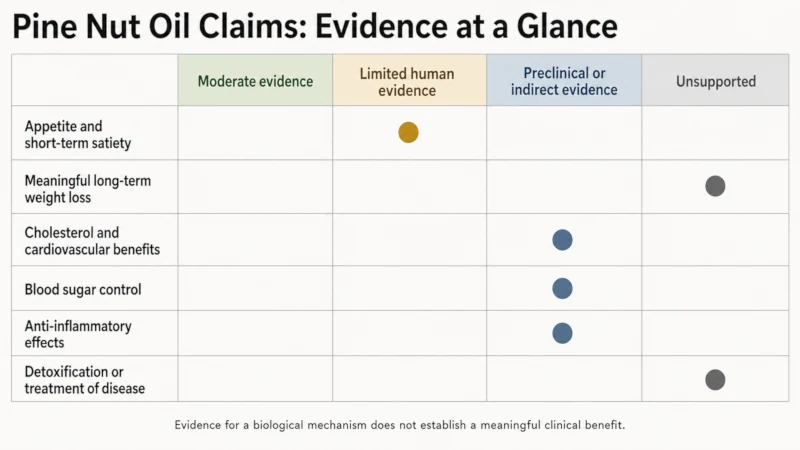
Evidence at a glance
| Claim | What the research shows | Strength |
| Reduces appetite | Small acute human trials show more satiety hormones and less anticipated hunger — using hydrolyzed oil in delayed-release capsules, not bottled oil. | Limited but real, in a form most people are not buying |
| Causes weight loss | One trial found 9% less food eaten at a single meal; the calorie reduction was not statistically significant. No trial has measured body weight over time. | Insufficient |
| Lowers LDL cholesterol | Increased LDL uptake by human liver cells in culture. No human trial. | Early-stage laboratory evidence only |
| Reduces inflammation | Anti-inflammatory activity in cell and animal studies, summarized in several reviews. No human outcome trials. | Promising in the lab, untested in people |
| Acts as a prebiotic; treats gastritis or reflux | Long traditional use. No human trials support the prebiotic or treatment claims. | Traditional use only |
| More vitamin E than olive oil | Values for both oils vary widely and overlap. No verified analysis establishes an advantage. | Not supported |
| Strengthens immunity | Signals in animal and cell studies. Nothing measured in human immune outcomes. | Insufficient |
How to use it, realistically
There is no established dose for Siberian pine nut oil. Published trials used 2 to 6 grams, taken about 30 minutes before eating, mostly as hydrolyzed oil in capsules [Hughes et al., Lipids in Health and Disease, 2008] [Sørensen et al., Clinical Nutrition, 2021]. Bottled oil does not match that, and no one has established what a food-form equivalent would be.
- Use it as a finishing oil. One teaspoon to one tablespoon, drizzled over vegetables, grains, or salad. It has a distinctive resinous, buttery flavor.
- Do not fry with it. It is polyunsaturated-heavy and better unheated.
- Store it cool, dark, and tightly capped, and use it within a few months of opening.
- Count the calories. It is a fat, at roughly 120 calories per tablespoon, and it adds to your day rather than replacing anything.

Side effects and safety
In the published trials, pine nut oil was well tolerated. The 42-woman trial reported no adverse events attributable to the product, and the postmenopausal trial reported none caused by treatment [Hughes et al., Lipids in Health and Disease, 2008] [Pasman et al., Lipids in Health and Disease, 2008]. Those were short studies in small groups, so they tell you about a few hours, not about daily use for a year.
Practical issues to expect:
- Digestive upset. Any oil taken in quantity on an empty stomach can cause nausea, loose stools, or a heavy feeling. Start small.
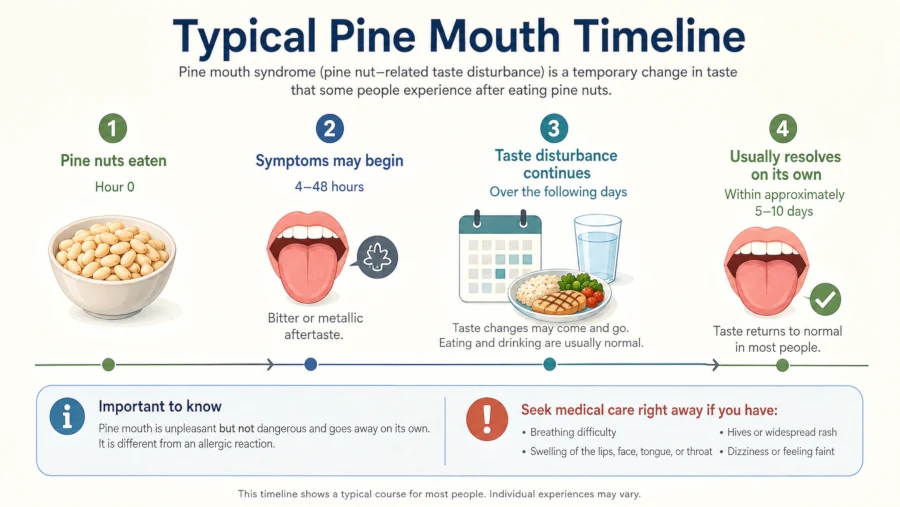
- Pine mouth. Between July 2008 and November 2010, the U.S. Food and Drug Administration received 197 consumer reports of a persistent bitter or metallic taste beginning 4 to 48 hours after eating pine nuts. The taste returned with anything the person ate, lasted 5 to 10 days on average, and resolved without lasting harm in every case [FDA researchers on pine mouth, Clinical and Translational Allergy, 2011]. It has been linked mainly to Pinus armandii, though cases involving other species have been published. Unpleasant, not dangerous.
- Allergy. Pine nuts are tree nuts. Anyone with a pine nut or tree nut allergy should avoid the oil entirely.
- Rancidity. Oxidized oil tastes harsh and is worth discarding rather than pushing through.
Who should be cautious
- Anyone with a tree nut or pine nut allergy — avoid it.
- Pregnant or breastfeeding. Pine nut oil as a food is food. Concentrated supplement doses have not been studied in pregnancy or lactation, so there is no safety data to lean on. Skip the supplements.
- Taking diabetes or weight-management medication, particularly GLP-1 based drugs. The studied mechanism overlaps with how those medications work. That does not prove an interaction, but it is worth raising with your prescriber.
- Living with gastroparesis or any condition where slowed stomach emptying is a problem.
- Reflux or GERD that flares with fatty foods.
- Children. Supplemental doses have not been studied in this group.
- Scheduled for surgery. Tell your care team about every supplement you take, including this one.
On drug interactions, the honest answer is that no well-documented interactions have been established for pine nut oil. That is not the same as none existing — it means the question has not been studied. Dietary supplements are not reviewed by the FDA for safety or effectiveness before they go on sale, so the burden of caution sits with you and your clinician [FDA, Dietary Supplements, 2022]. The same reasoning applies to most botanicals; we take the same approach to how the evidence for ashwagandha actually stacks up.
When to talk to a healthcare professional
Bring it up with your primary care clinician or pharmacist before you start if you take prescription medication, manage a chronic condition, or are pregnant or breastfeeding. Mention it at routine visits too — supplements can shift lab results in ways that are easy to miss.
Some symptoms should not wait for a supplement conversation:
- Call 911 for signs of a severe allergic reaction: trouble breathing, tightness in the throat, swelling of the lips, tongue, or face, faintness, or hives spreading over the body.
- Call 911 for chest pain or pressure, especially with shortness of breath, sweating, or pain moving into the arm or jaw. Do not assume it is heartburn.
- See a clinician promptly for trouble or pain when swallowing, vomiting blood, black or tarry stools, unintended weight loss, or abdominal pain that keeps coming back.
- Book a primary care visit if heartburn happens more than twice a week, or you have been using over-the-counter acid reducers for more than two weeks without lasting relief. Urgent care is a reasonable stop when your regular office cannot see you and symptoms are not emergencies.
| Health Disclaimer: This article is general health information, not medical advice, and it cannot account for your history, medications, or conditions. Siberian pine nut oil is a food and a dietary supplement, not a treatment for any disease. Talk with your doctor, pharmacist, or another licensed clinician before using it, especially if you are pregnant or breastfeeding, take prescription medication, or manage a condition such as diabetes, reflux, or delayed gastric emptying. Avoid it entirely if you have a tree nut or pine nut allergy. Stop using it and seek medical care if you develop symptoms of an allergic reaction, and call 911 for trouble breathing, throat tightness, or facial swelling. |
Frequently Asked Questions
Does Siberian pine nut oil really suppress appetite?
Partly, and less dramatically than advertised. Small human trials found that pine nut oil raises satiety hormones and lowers anticipated hunger — but they used a hydrolyzed form in delayed-release capsules, and one trial that tested ordinary triglyceride oil against a real buffet meal found no reduction in food eaten.
How much should I take?
There is no established dose. Trials used 2 to 6 grams of a modified form in capsules about 30 minutes before eating. For culinary use, a teaspoon to a tablespoon of unheated oil is reasonable. More is not better, and the oil adds roughly 120 calories per tablespoon.
Is it safe during pregnancy or breastfeeding?
Pine nut oil used as a cooking oil is a food. Concentrated supplement doses have not been studied in pregnancy or lactation, so there is no safety data supporting them. Ask your obstetric clinician before taking any supplement form.
Can it help acid reflux or gastritis?
There is a long tradition of using cedar nut oil this way, but no human trials support it. The oil’s studied mechanism involves slowing stomach emptying, which can make reflux worse for some people rather than better.
Does it lower cholesterol?
Not proven. Pinolenic acid increased LDL uptake in human liver cells grown in a laboratory, which is a promising mechanism. No trial has tested whether the oil lowers cholesterol in people.
References
- Sørensen KV, Korfitzen SS, Kaspersen MH, et al. Acute effects of delayed-release hydrolyzed pine nut oil on glucose tolerance, incretins, ghrelin and appetite in healthy humans. Clinical Nutrition. 2021;40(4):2169–2179. → View source
- Sørensen KV, Kaspersen MH, Ekberg JH, et al. Effects of Delayed-Release Olive Oil and Hydrolyzed Pine Nut Oil on Glucose Tolerance, Incretin Secretion and Appetite in Humans. Nutrients. 2021;13(10):3407. → View source
- Pasman WJ, Heimerikx J, Rubingh CM, et al. The effect of Korean pine nut oil on in vitro CCK release, on appetite sensations and on gut hormones in post-menopausal overweight women. Lipids in Health and Disease. 2008;7:10. → View source
- Hughes GM, Boyland EJ, Williams NJ, et al. The effect of Korean pine nut oil (PinnoThin) on food intake, feeding behaviour and appetite: a double-blind placebo-controlled trial. Lipids in Health and Disease. 2008;7:6. → View source
- Lee JW, Lee KW, Lee SW, Kim IH, Rhee C. Selective increase in pinolenic acid (all-cis-5,9,12-18:3) in Korean pine nut oil by crystallization and its effect on LDL-receptor activity. Lipids. 2004;39(4):383–387. PMID 15357026. → View source
- Xie K, Miles EA, Calder PC. A review of the potential health benefits of pine nut oil and its characteristic fatty acid pinolenic acid. Journal of Functional Foods. 2016;23:464–473. → View source
- Baker EJ, Miles EA, Calder PC. A review of the functional effects of pine nut oil, pinolenic acid and its derivative eicosatrienoic acid and their potential health benefits. Progress in Lipid Research. 2021;82:101097. PMID 33831456. → View source
- Takala R, Ramji DP, Choy E. The Beneficial Effects of Pine Nuts and Its Major Fatty Acid, Pinolenic Acid, on Inflammation and Metabolic Perturbations in Inflammatory Disorders. International Journal of Molecular Sciences. 2023;24(2):1171. → View source
- Kwegyir-Afful E, DeJager L, Begley T, Luccioli S (U.S. Food and Drug Administration). Pine mouth syndrome — an emerging food hypersensitivity? Clinical and Translational Allergy. 2011;1(Suppl 1):P25. → View source
- U.S. Food and Drug Administration. FDA 101: Dietary Supplements. Updated 2022. → View source
