
Feijoa benefits earn their reputation on two things the evidence actually backs: it’s one of the more fiber-rich fruits you can eat, and it’s a respectable source of vitamin C. Beyond that, feijoa contributes folate and — depending on where it grew — a surprising amount of iodine. What feijoa is not is a cure for anything, and a couple of the bolder claims floating around about it don’t hold up. Here’s the honest version.
What is feijoa?
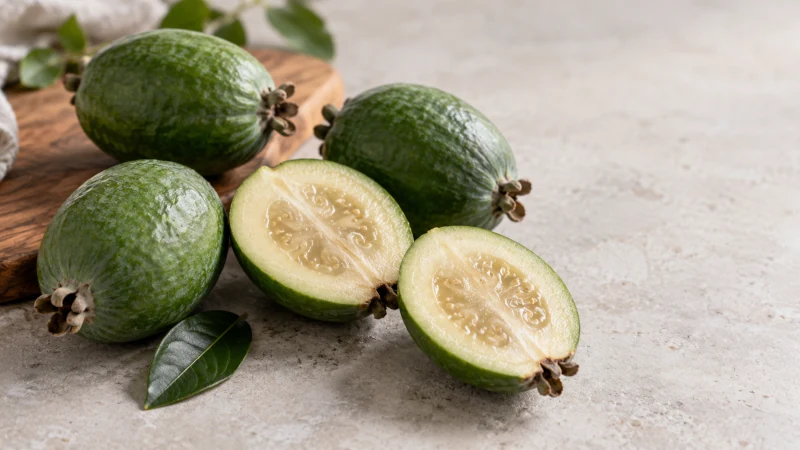
Feijoa (Acca sellowiana, once Feijoa sellowiana) is a small green egg-shaped fruit with fragrant, cream-colored flesh and a soft, jelly-like center dotted with tiny edible seeds. The taste lands somewhere between pineapple, guava, and mint — no accident, since feijoa belongs to the same botanical family as guava, the Myrtaceae [Wikipedia]. You’ll also see it sold as pineapple guava or guavasteen.
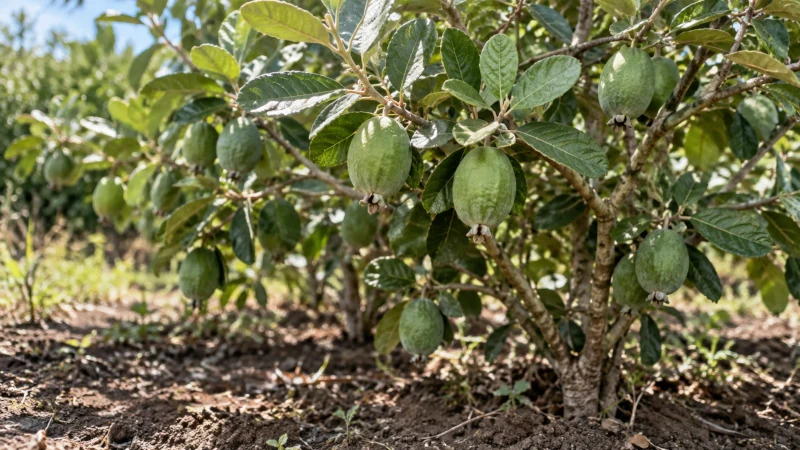
It’s native to the highlands of southern Brazil, Uruguay, and northern Argentina, and it’s now grown widely in New Zealand, Australia, California, and parts of the Mediterranean. If you’ve eaten one, there’s a good chance it came from a backyard tree — feijoa is hardy and productive, and the fruit bruises easily, so it doesn’t ship well.
If you like feijoa for its flavor, you may also enjoy reading about its close relative in our guava tree benefits guide.
Feijoa nutrition at a glance
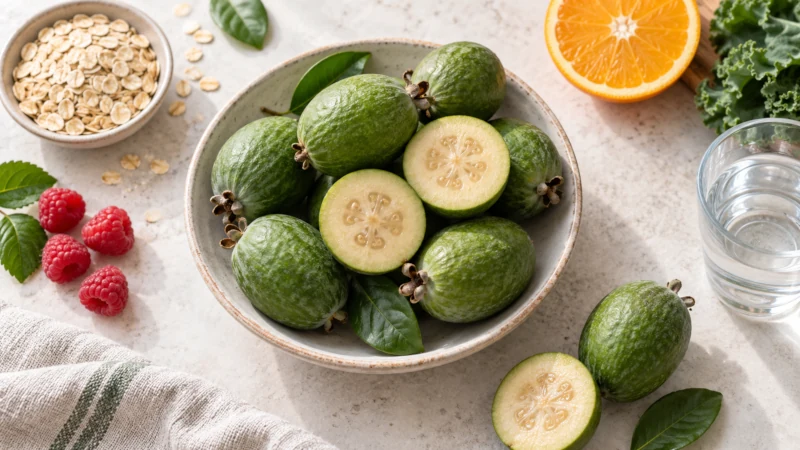
Two things to know first. Values shift with cultivar, ripeness, and whether you eat the peel. And a medium feijoa yields only about 40–50 g of edible flesh, so per-fruit amounts are roughly half of what you see per 100 g.
| Per 100 g (raw flesh) | Amount | Notes |
| Calories | 61 | Low |
| Carbohydrate | 15.2 g | Includes ~8 g natural sugars |
| Dietary fiber | 6.4–6.8 g | High for a fruit |
| Protein | 0.7 g | Minimal |
| Fat | 0.4 g | Minimal |
| Vitamin C | 33 mg (up to ~63 mg) | Good source; peel richer |
| Folate | 23 µg DFE | Modest |
| Potassium | 172–255 mg | Modest |
| Iodine | ~80 µg (Australian fruit) | Unusual for a fruit; soil-dependent |
Sources: USDA Standard Reference; Phan et al., Foods (2019).
The real benefits of feijoa, graded by evidence
A genuinely high-fiber fruit (strong evidence)
This is feijoa’s standout. At roughly 6–7 g of fiber per 100 g [USDA]; [Phan et al., 2019], it out-fibers most common fruits gram for gram. Dietary fiber adds bulk and softness to stool and supports regularity, which is why fiber-rich foods are a first-line, low-risk approach to occasional constipation. A couple of feijoas won’t hit your daily fiber target on their own, but they’re a real contribution — and they pair well with other high-fiber fruits like kiwi (see our kiwi health benefits guide, where the constipation evidence is stronger still). If you’re not used to much fiber, add it gradually and drink water alongside, or you may feel bloated.
A solid source of vitamin C (strong evidence)
Feijoa supplies meaningful vitamin C — about 33 mg per 100 g in USDA data, and higher in some cultivars, with the peel richer than the pulp [USDA]; [Phan et al., 2019]. For context, the adult RDA is 90 mg for men and 75 mg for women [NIH ODS]. So one feijoa covers a useful slice of the day’s needs, not all of it.
Vitamin C is worth having from food. It’s required to build collagen, it works as an antioxidant that helps limit free-radical damage, and it supports normal immune function [NIH ODS]. Keep the claim in proportion, though: getting enough vitamin C helps your body work as it should — that’s not the same as eating a feijoa “boosting immunity” in any dramatic sense.
Folate for blood cells and pregnancy (moderate — contributory, not a headline)
Folate helps your body make and mature red blood cells; a shortfall can cause a form of anemia [NIH ODS]. It also matters enormously before and during early pregnancy, when adequate folate helps prevent neural tube defects [NIH ODS].
Here’s where a lot of feijoa content overreaches. Feijoa is not “among the richest fruits in folate” — at about 23 µg DFE per 100 g [USDA], it’s a modest contributor, roughly 6% of the 400 µg adult RDA [NIH ODS]. It counts toward your intake, but it’s nowhere near a leading source. If folate is your goal, see our roundup of foods high in folate.
One point that matters for anyone trying to conceive: food folate alone is not considered enough to prevent neural tube defects. Health authorities advise women who could become pregnant to take 400 µg of folic acid from a supplement or fortified foods, on top of a varied diet [NIH ODS]. Feijoa can be part of that varied diet — it even appears in our list of foods for reproductive health — but it doesn’t replace the supplement.
Iodine for the thyroid — with a real caveat (promising but variable)
Your thyroid needs iodine to make the hormones that regulate metabolism, and goiter is often the earliest visible sign of iodine deficiency [NIH ODS]. Feijoa is unusual among fruits here: Australian-grown feijoa tested at around 80 µg of iodine per 100 g [Phan et al., 2019], a substantial fraction of the 150 µg adult RDA [NIH ODS].
The catch is that iodine in produce tracks the soil it grew in, so a feijoa from one region can differ sharply from another. Treat feijoa as a possible bonus source of iodine, not a reliable one — and don’t lean on it to correct a diagnosed deficiency. Iodized salt, dairy, eggs, and seafood remain the dependable dietary sources.
Antioxidants and antimicrobial compounds (early / mostly laboratory)
Feijoa — especially the peel — is rich in plant polyphenols, with total phenolic content measured around 515 mg gallic acid equivalents per 100 g and compounds including catechin and ellagic acid [Phan et al., 2019]. In the lab, methanolic peel extracts have shown antimicrobial activity against organisms such as Staphylococcus aureus and Candida albicans [Phan et al., 2019].
Read those findings for what they are: measurements of the fruit’s chemistry and test-tube activity, not proof that eating feijoa fights infections in people. It’s a reason the fruit is interesting, not a health claim.
What feijoa can’t do (and where the evidence stops)
A recurring online claim is that feijoa “fights cancer.” That traces to early laboratory work — for example, a study reporting that a feijoa-derived flavone triggered cell death in cancer cell lines and inhibited certain enzymes (see reference 7; full text unverified). Cell and test-tube results are a starting point for research, not evidence that a food prevents or treats cancer in humans. There are no human trials showing feijoa does anything of the kind, so treat “anti-cancer feijoa” as unproven.
The same restraint applies across the board: feijoa is a nutritious fruit that contributes to a good diet. It doesn’t cure, reverse, or treat any disease on its own.
Safety, side effects, and who should be careful
For most people, feijoa is a safe food eaten in normal amounts. A few situations deserve a second thought:
| Situation | What to know |
| Too much fiber, too fast | Can cause gas or loose stools — build up gradually and drink water. |
| Thyroid conditions / thyroid meds | Feijoa can carry meaningful iodine; keep intake sensible and check with your clinician. |
| Managing blood sugar | Contains ~8 g natural sugar per 100 g; account for it like any fruit. |
| Allergies | Reactions are possible; stop and seek care for swelling or trouble breathing. |
| Pregnancy / breastfeeding | Fine as a food, but does not replace prenatal folic acid; discuss with your provider. |
When to talk to a healthcare professional
Food is not a treatment for medical conditions. Talk to a professional before relying on feijoa (or any fruit or remedy) if you’re pregnant or breastfeeding, have a thyroid or kidney condition, take prescription medication, or are managing diabetes. Seek urgent care for any sign of a severe allergic reaction — swelling of the lips, tongue, or throat, or trouble breathing — after eating it.
How to eat and prepare feijoa
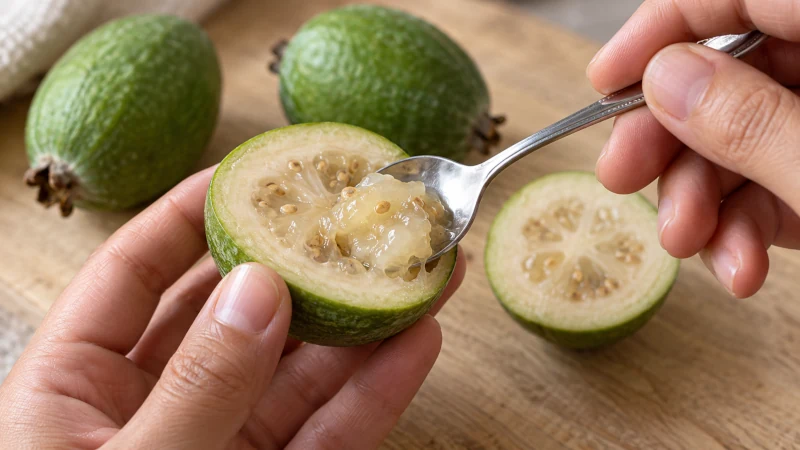
- Raw, scooped: Cut in half and scoop the flesh with a spoon — the simplest way, and it skips the slightly bitter skin. Pick fruit that gives slightly to gentle pressure; underripe feijoa tastes gritty and tart.
- Peeled and sliced: Peel and slice into fruit salads or over yogurt and oatmeal.
- Cooked: Feijoa holds up well in compotes, chutneys, jams, and baking, and blends smoothly into smoothies. Cooking reduces vitamin C and jams add sugar, so the cooked forms are more about flavor than nutrition.
| Health Disclaimer: This article is for general educational and informational purposes only and is not a substitute for professional medical advice, diagnosis, or treatment. Feijoa is a food, not a medicine, and nothing here should be taken as a recommendation to treat or prevent any condition with it. If you are pregnant or breastfeeding, have a thyroid, kidney, or other medical condition, take any medication, or have questions about your diet, talk to a qualified healthcare professional before making changes. Never disregard or delay professional medical advice because of something you read here. |
Frequently Asked Questions
Is feijoa good for you?
Yes, as part of a varied diet. It’s low in calories, high in fiber, and a good source of vitamin C, with smaller amounts of folate, potassium, and (depending on soil) iodine. It’s a nutritious fruit, not a treatment for any condition.
Can I eat feijoa during pregnancy?
Feijoa is fine as a food in normal amounts and contributes some folate and iodine. But it does not replace prenatal folic acid, which authorities recommend at 400 µg daily for anyone who could become pregnant. Check your overall diet and supplements with your maternity provider.
Does feijoa have more vitamin C than guava?
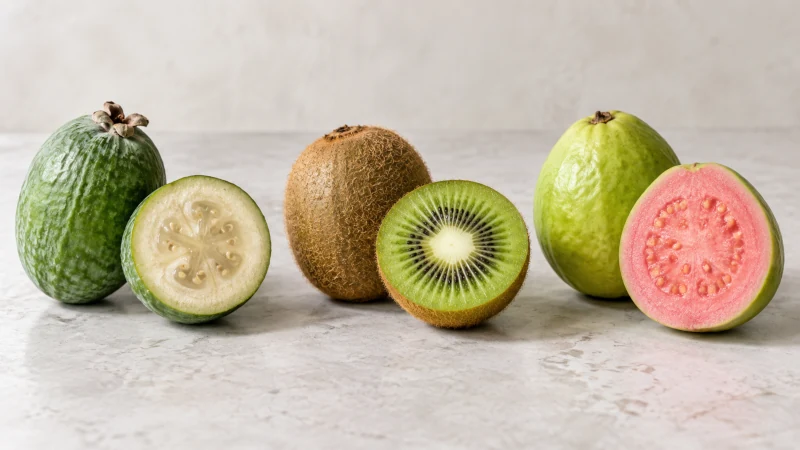
No. Guava is dramatically higher in vitamin C than feijoa. Feijoa is still a good source — roughly 33 mg per 100 g in USDA data — but guava outclasses it.
Is feijoa good for the thyroid?
It can supply iodine, which the thyroid needs, and some feijoa tests notably high. But iodine content swings with growing soil, so feijoa isn’t a dependable iodine source — and anyone with a thyroid condition should talk to their clinician before using it that way.
Can you eat feijoa skin?
Yes, the skin is edible and actually concentrates more of the fruit’s vitamin C and polyphenols than the flesh. Many people find it slightly bitter and astringent, so it’s a taste preference.
Does feijoa help with constipation?
Its high fiber content supports regularity, and fiber-rich foods are a sensible first step for occasional constipation. Feijoa can help as part of an overall fiber- and fluid-adequate diet, but it isn’t a treatment for persistent constipation — see a professional if symptoms continue.
References
- U.S. Department of Agriculture, FoodData Central — Feijoa, raw (Standard Reference). Per 100 g: 61 kcal; 6.4 g fiber; 32.9 mg vitamin C; 23 µg DFE folate; 172 mg potassium. View source
- Phan ADT, Chaliha M, Sultanbawa Y, Netzel ME. “Nutritional Characteristics and Antimicrobial Activity of Australian Grown Feijoa (Acca sellowiana).” Foods. 2019;8(9):376. View source
- NIH Office of Dietary Supplements. “Vitamin C: Fact Sheet for Health Professionals.” View source
- NIH Office of Dietary Supplements. “Folate: Fact Sheet for Health Professionals.” View source
- NIH Office of Dietary Supplements. “Iodine: Fact Sheet for Health Professionals.” View source
- Wikipedia. “Myrtaceae.” Used only for botanical family classification. View source
- Bontempo P, et al. “Feijoa sellowiana derived natural Flavone exerts anti-cancer action displaying HDAC inhibitory activities.” Int J Biochem Cell Biol. 2007. PMID 17604209. View source


