
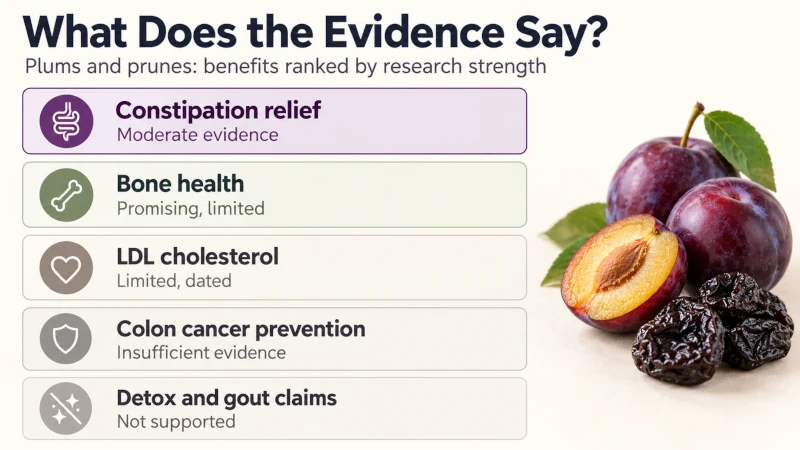
If you came here wondering whether prunes really help you go, the short answer is yes — and the evidence for that is better than for almost any other food remedy. The rest of the plum health benefits you’ll read about are a mixed bag. Bone protection looks promising in two year-long trials. A cholesterol effect showed up once, in 1991, and it was small. Claims that plums detoxify the body or treat gout and liver disease have no real support.
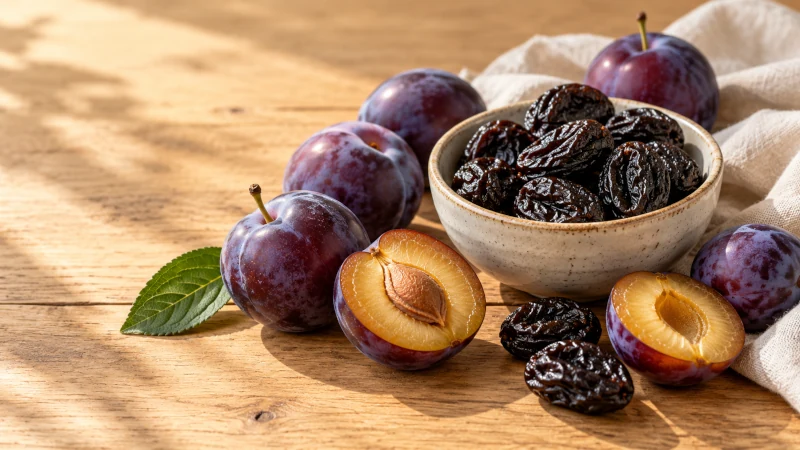
Nearly all the research is on prunes — dried plums — not fresh ones. That matters, because drying concentrates the fiber and sugar alcohols that do most of the work.
Plum Health Benefits at a Glance
| Claim | What the evidence shows | Strength |
| Relieves constipation | Two randomized trials: more frequent bowel movements and heavier stools; beat psyllium in one small trial | Moderate |
| Slows bone loss after menopause | Two 12-month trials in postmenopausal women; better bone density at some sites; high dropout | Promising but limited |
| Lowers LDL cholesterol | One 8-week trial in 41 men; LDL about 5% lower | Limited and dated |
| Prevents colon cancer | Lower levels of one fecal bile acid in a single trial; cancer itself never studied | Insufficient |
| Diuretic, “detox,” treats gout or liver disease | No human evidence found | Not supported |
| Fresh plums, beyond basic nutrition | Very little direct human research | Insufficient |
Prunes vs. Fresh Plums: Why the Dried Fruit Does More
What’s in a plum and a prune
Most prunes come from European plums, Prunus domestica — the same species as the prized greengage, which the French call Reine Claude after Queen Claude, Duchess of Brittany [Wikipedia, Greengage]. Drying removes water, so everything left over is packed tighter.
| Per 100 g | Fresh plums | Prunes |
| Calories | 46 | 240 |
| Fiber | 1.4 g | 7.1 g |
| Sugars | 9.9 g | 38.1 g |
| Potassium | 157 mg | 732 mg |
| Vitamin K | 6.4 mcg | 59.5 mcg |
| Copper | 0.057 mg | 0.28 mg |
| Iron | 0.17 mg | 0.93 mg |
| Vitamin C | 9.5 mg | 0.6 mg |
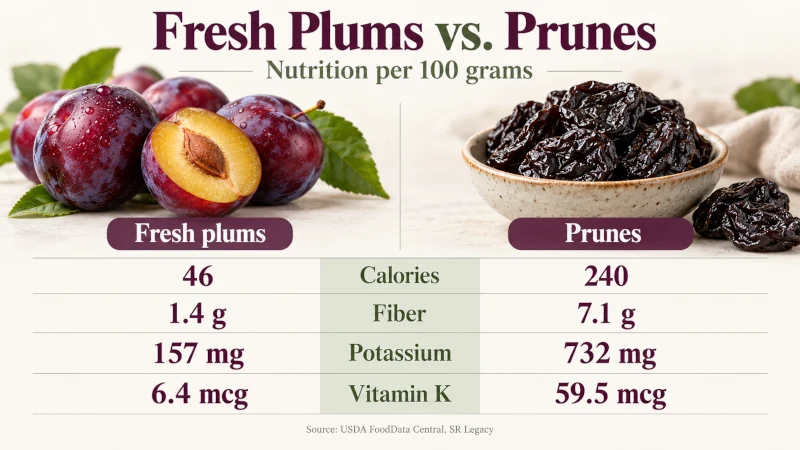
Source: USDA FoodData Central, SR Legacy — plums, raw (FDC 169949); plums, dried (prunes), uncooked (FDC 168162) [USDA, 2026].
Weight for weight, prunes carry about five times the fiber of fresh plums, and a lot more calories: 100 g, roughly 12 prunes, comes to 240. They’re a useful source of copper and vitamin K. Iron is another story. Older sources, including an earlier version of this page, credited prunes with a quarter of your daily iron; USDA data puts it under 1 mg per 100 g, which is a small share of what adults need. Fresh plums, for their part, keep vitamin C that drying mostly destroys.
Why prunes work as a laxative
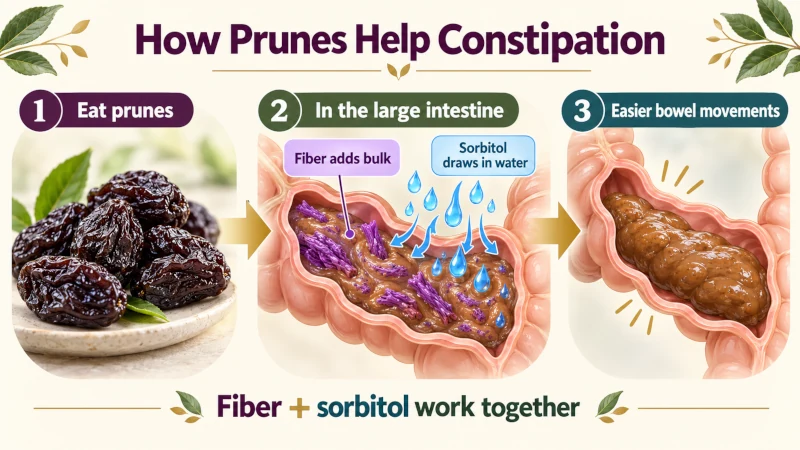
Three things seem to act together [Stacewicz-Sapuntzakis, 2001]. Fiber — about 6 to 7 g per 100 g, split among hemicellulose, pectin, and cellulose [Lever, 2019] — adds bulk and holds water. Then there’s sorbitol, the part most articles skip. Prunes contain roughly 14.7 g of this sugar alcohol per 100 g, and prune juice about 6.1 g. Much of it isn’t absorbed, so it pulls water into the bowel and gets fermented by gut bacteria [Monash University, 2016]. Phenolic compounds such as chlorogenic acid may add a little, though that piece is less certain.
You can drop “dihydroxyphenylisatin” (oxyphenisatin) from the explanation. Older books, and earlier versions of this article, credited it with prunes’ laxative action. It was reported in prunes once, decades ago, from a crude color test, and a major review found it had never actually been isolated from any plant [Stacewicz-Sapuntzakis, 2001]. Oxyphenisatin itself was a drug laxative that has since been withdrawn [DrugBank], after reports linking it to chronic hepatitis [Reynolds, 1971 — UNVERIFIED original]. Prunes don’t need it to work.
Constipation: The Best-Supported Benefit
Two randomized trials carry most of the weight here.
In the first, 40 adults with chronic constipation — almost all women — took prunes and psyllium, a standard fiber supplement, for three weeks each. On prunes (six, twice a day), complete spontaneous bowel movements rose from 1.7 to 3.5 a week. On psyllium they rose to 2.8 [Attaluri, 2011]. Stool consistency improved; straining and overall symptom scores didn’t differ between the two. The trial was small, unblinded, and industry-funded, so read “prunes beat psyllium” as a reasonable finding, not a settled one.
The second, from King’s College London, enrolled 120 healthy adults who ate little fiber [Lever, 2019]. For four weeks they had 80 g or 120 g of prunes a day with 300 ml of water, or water alone. Compared with the water group, stool weight rose by about 22 g a day on the lower dose and 33 g on the higher one, and bowel movements got more frequent. Transit time didn’t change, though it was already normal at the start. The trade-off was more gas and a bit more acid reflux.
Taken together, that’s moderate evidence that prunes help mild constipation, particularly if your diet runs low on fiber. For perspective, the British Dietetic Association’s 2025 constipation guidelines backed kiwifruit, rye bread, and high-mineral water, along with psyllium and magnesium oxide supplements — and found generic “eat more fiber” advice weakly supported [King’s College London, 2025]. Our guide to foods that help with constipation ranks prunes against those options. Apples help too, but more gradually.
One old claim needs retiring: that prunes can “re-educate the bowel” or be used for years without concern. No study has tested that. Eating prunes regularly as food isn’t known to cause harm for most people, but if you need them every day just to go, tell your doctor rather than managing it on your own indefinitely.
Bone Health: Promising, Not Proven
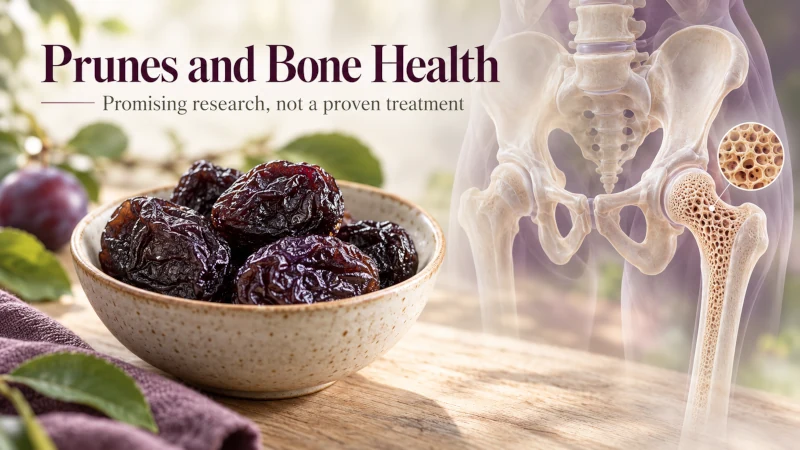
This is the most interesting newer research, and so far it applies to postmenopausal women.
In one 12-month trial, 160 postmenopausal women with low bone density ate either 100 g of prunes or 75 g of dried apple a day, plus calcium and vitamin D. The prune group gained more bone density at the forearm and spine, and markers of bone breakdown fell only in that group [Hooshmand, 2011]. More than a third of participants didn’t finish.
A larger trial, the Prune Study, followed 235 postmenopausal women for a year [De Souza, 2022]. Women eating 50 g of prunes a day — about six — lost 0.3% of hip bone density, against 1.1% in the control group. The 100 g group didn’t show the same benefit, and 41% of them quit, which tells you something about how hard that much fruit is to keep eating.
So prunes may slow bone loss modestly. Neither trial counted fractures, and neither replaces calcium, vitamin D, strength training, or osteoporosis medication when you need it. If you’re postmenopausal, five or six prunes a day is a reasonable, low-risk habit — not a treatment.
Cholesterol: A Small, Old Signal
The cholesterol claim traces to one study. Forty-one men with mildly raised cholesterol added 12 prunes (100 g) a day to their usual diet for eight weeks, and the researchers compared that with a grape-juice period. LDL came out at 3.9 mmol/L after prunes versus 4.1 after control — about 5% lower [Tinker, 1991].
That’s real but small, from a short study, in men only, more than 30 years ago. Prunes fit comfortably into a cholesterol-friendly diet. For the foods with stronger LDL evidence, see our guide to foods for healthy arteries.
Colon Cancer: What the Evidence Can and Can’t Say
The same 1991 trial found stools about 20% heavier after the prune period, and lower levels of lithocholic acid, a bile acid that researchers have studied as a possible contributor to colon cancer [Tinker, 1991]. That’s a shift in a marker. No study has tested whether eating prunes lowers colorectal cancer risk.
The broader picture on fiber is more encouraging. The American Institute for Cancer Research reports that each extra 10 g of daily fiber is linked to about 7% lower colorectal cancer risk, and recommends at least 30 g a day [AICR, 2018]. Prunes can be one source of that fiber. They aren’t a substitute for screening, and a family history of polyps or colon cancer is a reason to talk with your doctor about colonoscopy timing. There’s more on what the evidence supports in our guide to foods that fight cancer.
Claims That Don’t Hold Up
- Diuretic, “depurative,” or detoxifying. We found no human research supporting this. Your liver and kidneys do that job.
- Treating gout or high uric acid. There’s no evidence prunes change uric acid. If you’re managing gout, the dietary factors that matter are covered in what actually triggers a gout flare.
- Helping liver disease, hardened arteries, or arthritis. Being low in fat, protein, and sodium doesn’t make a food a therapy. These conditions need medical care.
- “The laxative of choice” for children and older adults. Prunes are a sensible first step for mild constipation in many people, but infants and young children need different handling (see below), and older adults taking several medications should check with a clinician first.
How to Eat Prunes for Regularity
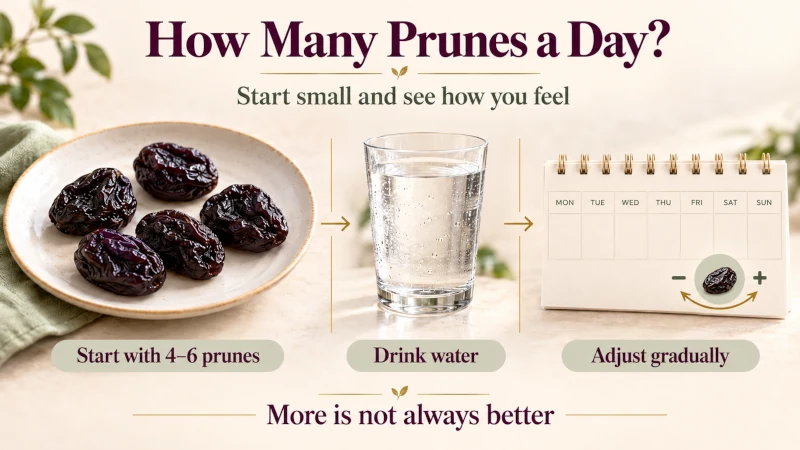
The constipation trials used roughly 80 to 120 g a day — about 10 to 14 prunes, or six twice a day. You don’t have to start there, and most people shouldn’t.
- Start with 4 to 6 prunes a day for a week and see how your gut responds. Jumping straight to a dozen is how people end up bloated.
- Drink water with them. Fluids help fiber work, and adding fiber a little at a time lets your body adjust [NIDDK]. NIDDK suggests most adults aim for 22 to 34 g of fiber a day.
- Soaked or stewed is fine. Soaking prunes overnight or stewing them is a traditional way to soften them, and many people find them easier to eat that way. No trial has tested whether it makes them work better.
- Prune juice keeps the sorbitol (about 6 g per 100 g) but loses most of the fiber [Stacewicz-Sapuntzakis, 2001].
- Fresh plums count too; you just get far less fiber and sorbitol per bite. Eat them ripe.
- A good breakfast pairing: prunes with plain yogurt and a slice of rye or other whole-grain bread. Rye bread is one of the foods the BDA guidelines back for constipation.
Side Effects and Who Should Be Careful
- Gas and bloating. In the King’s College trial, flatulence was clearly more common on prunes, and acid reflux slightly so [Lever, 2019]. Starting low helps.
- Irritable bowel syndrome. Sorbitol is a polyol, one of the FODMAPs that commonly trigger bloating, pain, and changes in bowel habits in IBS [Monash University, 2016]. Try a small amount, or skip prunes if they set you off.
- Calories and sugar. 100 g of prunes has 240 calories and about 38 g of sugar [USDA, 2026]. If you manage diabetes or your weight, count them like any dried fruit and work portions out with your care team.
- Warfarin. 100 g of prunes holds about 60 mcg of vitamin K [USDA, 2026] — roughly half to two-thirds of an adult’s adequate daily intake. People on warfarin need to keep vitamin K intake consistent [NIH ODS], so don’t start or stop a daily prune habit without telling whoever manages your anticoagulation.
- Kidney disease. Prunes and prune juice are higher-potassium foods [National Kidney Foundation, 2023]. If you’ve been told to limit potassium, ask your dietitian how they fit.
- Babies and young children. Uncooked dried fruit is a choking hazard for young children [CDC]; chop or purée prunes. For a constipated infant, ask your pediatrician before giving prune juice or purée.
- Pregnancy and breastfeeding. We found no specific concerns about prunes eaten as food, and they’re a common choice for pregnancy constipation. Concentrated prune extracts or supplements are a different matter and haven’t been studied for this — check with your clinician first.
- Medication timing. If you take a medicine that must be taken on an empty stomach, ask your pharmacist how to space it around fiber-rich foods.
- The pits. Don’t crack or eat plum pits; the kernels are toxic [Medical News Today, 2025].
When Constipation Needs a Doctor
Food helps with ordinary, occasional constipation. See a doctor right away if constipation comes with any of these [NIDDK]:
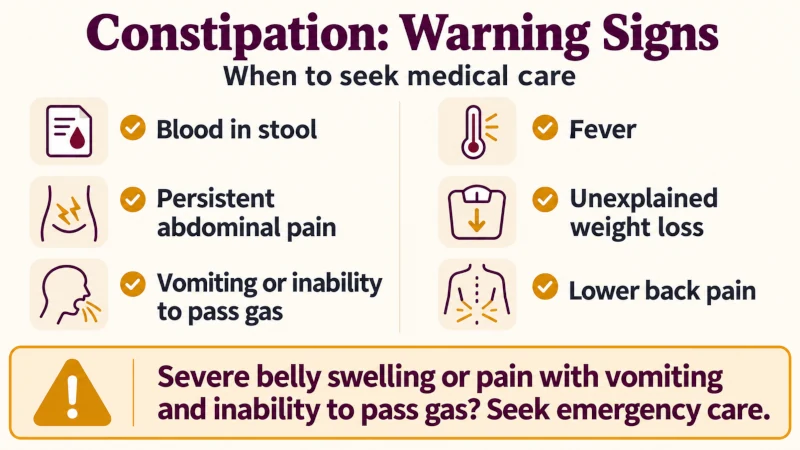
- Rectal bleeding or blood in your stool
- Persistent abdominal pain
- Being unable to pass gas, or vomiting
- Fever
- Lower back pain
- Unexplained weight loss
Also book an appointment if self-care isn’t working, or if you have a family history of colon or rectal cancer. A swollen, painful belly with vomiting and no gas passing can mean a blockage — go to urgent care or an emergency department rather than waiting.
| HEALTH DISCLAIMER: This article is for general education and is not medical advice, diagnosis, or treatment. It does not replace a conversation with a qualified healthcare professional. Talk with your doctor or a registered dietitian before making significant dietary changes if you are pregnant or breastfeeding, take warfarin or other prescription medication, or manage diabetes, kidney disease, IBS, osteoporosis, or another chronic condition. Ask a pediatrician before using prunes or prune juice for an infant. Seek prompt care for any of the warning signs listed above. |
Frequently Asked Questions
Are prunes better than fresh plums for constipation?
Yes, gram for gram. Prunes have about five times the fiber of fresh plums plus a large dose of sorbitol, and they’re what the clinical trials actually tested. Fresh plums still contribute, just more gently.
How many prunes should I eat a day?
Start with 4 to 6 and adjust. Trials for constipation used roughly 80 to 120 g a day (about 10 to 14 prunes), and the bone study that worked best used 50 g, about six. More isn’t automatically better; gas and bloating rise with the dose.
How quickly do prunes work?
There’s no reliable answer from research — the trials measured results over weeks, not hours. Give a steady daily amount several days, with enough water, before deciding whether it helps.
Is prune juice as good as whole prunes?
It’s different. Prune juice keeps much of the sorbitol, which draws water into the bowel, but loses most of the fiber. Whole prunes are the form that was tested in the main trials.
Can prunes help prevent osteoporosis?
They may slow bone loss a little. In postmenopausal women, about six prunes a day reduced hip bone loss over a year in one trial. No study has shown fewer fractures, so prunes complement — not replace — calcium, vitamin D, exercise, and any treatment your doctor recommends.
References
- Lever E, Scott SM, Louis P, Emery PW, Whelan K. The effect of prunes on stool output, gut transit time and gastrointestinal microbiota: → View source
- Attaluri A, Donahoe R, Valestin J, Brown J, Rao SS. Randomised clinical trial: dried plums (prunes) vs. psyllium for constipation. → View source
- Tinker LF, Schneeman BO, Davis PA, Gallaher DD, Waggoner CR. Consumption of prunes as a source of dietary fiber in men with mild hypercholesterolemia. → View source
- Stacewicz-Sapuntzakis M, Bowen PE, Hussain EA, Damayanti-Wood BI, Farnsworth NR. Chemical composition and potential health effects of prunes: → View source
- Hooshmand S, Chai SC, Saadat RL, Payton ME, Brummel-Smith K, Arjmandi BH. → View source
- De Souza MJ, Strock NCA, Williams NI, et al. Prunes preserve hip bone mineral density in a 12-month randomized controlled trial in postmenopausal women: → View source
- DrugBank. Oxyphenisatin (DB04823). → View source
- Reynolds TB, Peters RL, Yamada S. Chronic active and lupoid hepatitis caused by a laxative, oxyphenisatin. → View source
- U.S. Department of Agriculture, Agricultural Research Service. FoodData Central, SR Legacy: Plums, dried (prunes), uncooked (FDC 168162); → View source
- National Institutes of Health, Office of Dietary Supplements. Vitamin K: Fact Sheet for Health Professionals. → View source
- National Kidney Foundation. Potassium in Your CKD Diet. → View source
- Centers for Disease Control and Prevention. Choking Hazards — Infant and Toddler Nutrition. → View source
- National Institute of Diabetes and Digestive and Kidney Diseases. Symptoms & Causes of Constipation. → View source
- National Institute of Diabetes and Digestive and Kidney Diseases. Eating, Diet, & Nutrition for Constipation. → View source
- Barrett J, Collins L. What are the polyols? Monash University FODMAP blog. → View source
- American Institute for Cancer Research. Get your facts right on fiber and whole grains. → View source
- King’s College London. Kiwis could help manage chronic constipation (news release on BDA guidelines). → View source
- British Dietetic Association. Gastroenterology Specialist Group guidelines — chronic constipation in adults → View source
- Medical News Today. Plum nutrition facts, benefits, and risks. → View source
- Wikipedia. Greengage. → View source


