
The foods that cause gout have less to do with how rich a meal looks and more to do with three things: animal purines, alcohol, and sugar. Gout is a form of inflammatory arthritis that flares when uric acid builds up in the blood and hardens into needle-sharp crystals inside a joint — often the base of the big toe, where an attack can wake you at 2 a.m. with hot, swollen, throbbing pain.
Diet is one of the few levers you can adjust yourself. But the old rule — avoid anything containing purines — turned out to be mostly wrong. Some purine-heavy foods barely move uric acid, while a couple of everyday drinks matter more than the steak on your plate. Here is what the evidence actually supports, and which foods you can stop fearing.
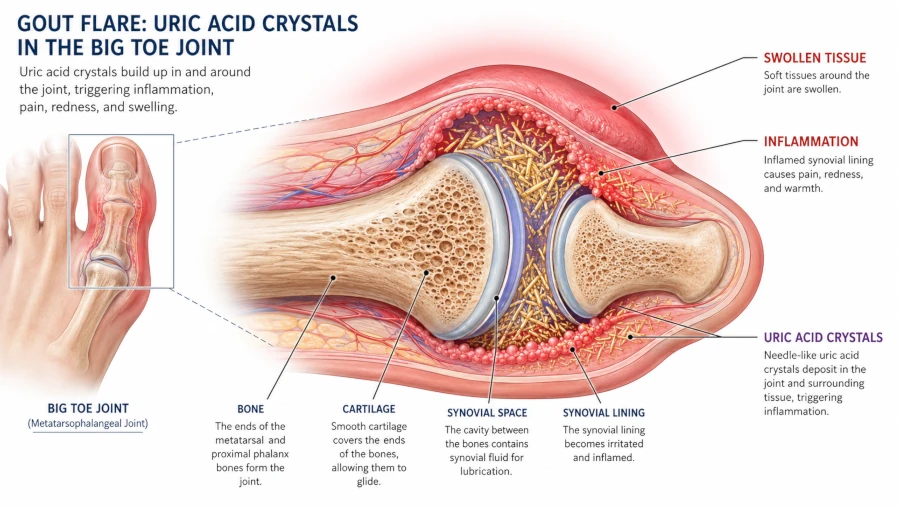
Gout isn’t only an older man’s problem anymore
Picture someone with gout and you probably imagine an older man. That image is dated. In a Global Burden of Disease analysis, gout among adults aged 15 to 39 rose from roughly 39 to 46 new cases per 100,000 people between 1990 and 2019, and about 5.2 million young adults were living with it by the end of that period [Global Burden of Disease, 2019]. Men still account for around 80% of cases, but rates are climbing in women too, and excess body weight is the single largest contributor [Global Burden of Disease, 2019]. More than 9 million U.S. adults have gout in total [Academy of Nutrition and Dietetics, 2023].
How food actually raises uric acid
Your body makes uric acid when it breaks down purines, compounds found in your own cells and in many foods. Most of the uric acid in your blood is produced internally; diet contributes a smaller share. That is why food works at the margins — it can tip someone who is already prone to gout over the edge, but for most people it won’t single-handedly cause or cure the disease. Three dietary factors carry the most weight.
- Animal purines. Purines from meat and seafood raise uric acid more than purines from plants — a distinction the older advice missed entirely.
- Alcohol. It interferes with the kidneys’ ability to clear uric acid, and beer adds a purine load on top.
- Fructose. It is the one sugar that pushes uric acid up as the body processes it. A 2022 review traced how a fructose-heavy diet drives hyperuricemia and gout [Frontiers in Nutrition, 2022].
The foods most likely to trigger a flare
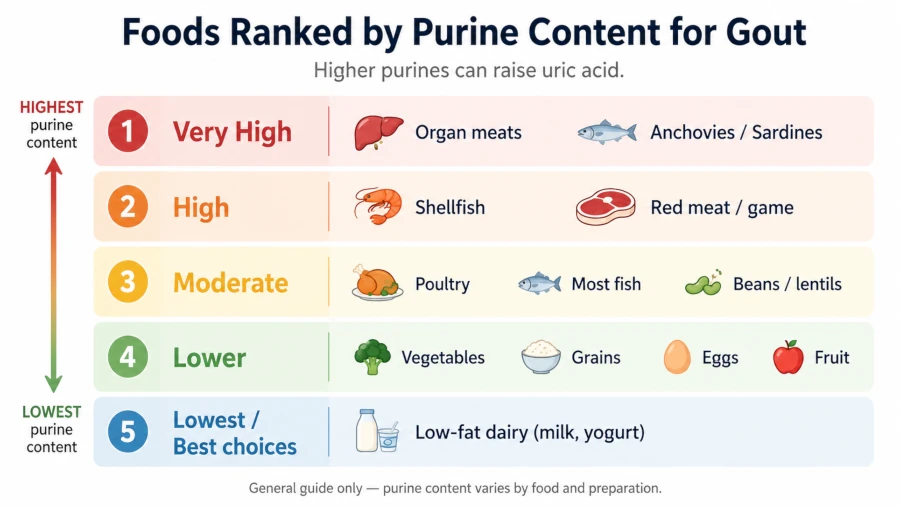
The clearest evidence comes from a 12-year study of about 47,000 men that recorded 730 new gout cases. Men eating the most meat had a 41% higher risk than those eating the least; for seafood, the highest intake carried a 51% higher risk [NEJM, 2004]. Organ meats and certain oily fish sit at the very top of the purine scale [USDA ARS].
Red meat and organ meats
Beef, lamb, and pork raise risk steadily with intake, and organ meats — liver, kidney, sweetbreads — are the worst offenders by purine content. You don’t have to swear off meat; the goal is smaller portions, less often. Lean poultry, eggs, tofu, and beans cover protein with far less impact.
Anchovies, sardines, and shellfish
Sardines and anchovies top the seafood purine list, with mussels, scallops, and herring close behind [USDA ARS]. There is a real trade-off here: oily fish also carry heart benefits, so the Arthritis Foundation suggests limiting high-purine shellfish while keeping moderate amounts of fish like salmon or trout [Arthritis Foundation, 2026]. If you eat seafood, watch the portion size more than the calendar.
Beer and spirits
Alcohol is one of the strongest modifiable triggers, and beer is the worst because it combines alcohol with purines. Spirits raise risk too; wine appears gentler in moderation but is not free. During an active flare, cutting alcohol entirely is one of the fastest things you can do to settle it down.
Sugary drinks and high-fructose foods
Regular soda, sweetened juice, sports drinks, and anything made with high-fructose corn syrup feed uric acid production directly [Frontiers in Nutrition, 2022]. This is often the single biggest hidden trigger for younger adults, who may not drink much alcohol but go through sweetened drinks all day. Whole fruit is fine — the fiber and volume change how the body handles its sugar.
The table below sorts common foods by purine load and, more usefully, by what the research says about each one.
| Food | Purine / sugar load | What the evidence says |
| Organ meats (liver, kidney) | Very high | The strongest single dietary trigger; limit or avoid [USDA; AND 2023] |
| Red meat (beef, lamb, pork) | High | ~41% higher risk at the highest intake [NEJM, 2004] |
| Anchovies, sardines, mussels, scallops | High | ~51% higher risk for seafood at the highest intake [NEJM, 2004] |
| Beer and spirits | Blocks excretion | Raises risk even at moderate intake; beer is worst |
| Soda, juice, HFCS foods | Fructose | Fructose raises uric acid directly [Frontiers, 2022] |
| Spinach, asparagus, mushrooms | Moderate | No meaningful rise in gout risk [Mayo; NEJM] |
| Beans, lentils, tofu, soy | Moderate | Safe; soy may even lower risk [AND, 2023] |
| Low-fat milk and yogurt | Low | Protective — ~44% lower risk at the highest intake [NEJM, 2004] |
Foods you can stop avoiding
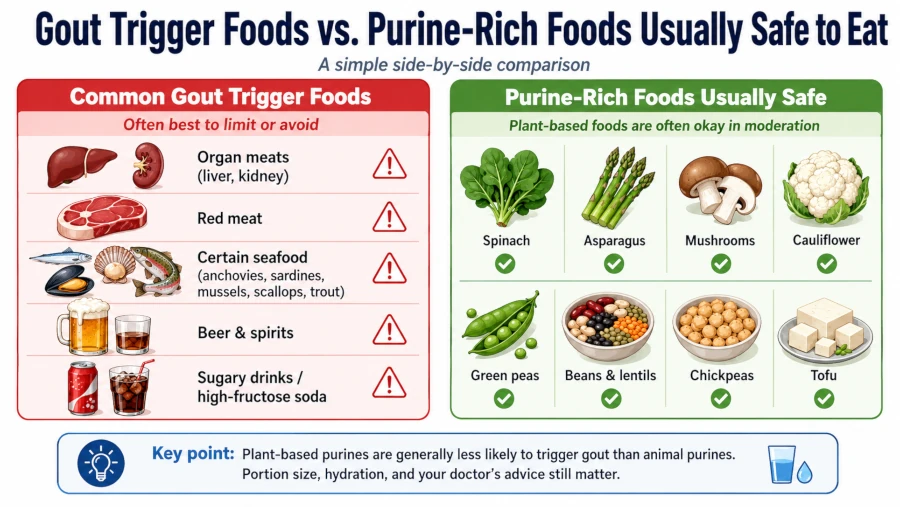
This is where most old gout diets went wrong. Plant foods that happen to be high in purines do not behave like meat and seafood in the body. In the same 47,000-man study, purine-rich vegetables and total protein were not linked to higher gout risk [NEJM, 2004], and the Mayo Clinic now states plainly that high-purine vegetables such as peas, asparagus, and spinach don’t raise the risk [Mayo Clinic, 2025].
- Spinach, asparagus, cauliflower, mushrooms — fine to eat normally.
- Beans, lentils, peas, tofu, and other soy foods — safe, and soy is linked to a slightly lower risk [AND, 2023].
- Whole grains and most fruit — helpful, not harmful.
The one small caveat: during an active flare, some clinicians suggest trimming moderate-purine vegetables like asparagus, cauliflower, mushrooms, and spinach to about half a cup a day until it settles [Academy of Nutrition and Dietetics, 2023]. Outside a flare, there’s no good reason to restrict them.
The “it depends” foods
Coffee
Coffee is not a trigger for most people. Moderate intake is linked to lower uric acid, with the clearest effect in men; results in women are mixed [Academy of Nutrition and Dietetics, 2023]. The problem isn’t the caffeine — it’s the sugar. Sweetened energy drinks and syrupy cold brews carry the fructose load that plain black coffee doesn’t.
Brewer’s yeast and yeast extracts
Yeast extracts — Marmite, Bovril, some “nutritional” supplements — are genuinely high in purines [USDA ARS], so they’re worth limiting, especially in concentrated supplement form. This is a small category, but it surprises people who assume “plant-based” always means low risk.
What to eat instead
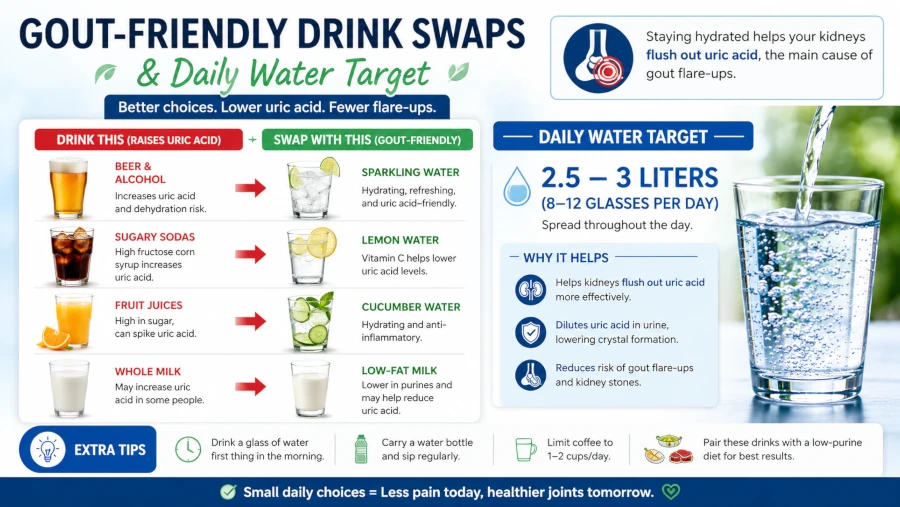
A gout-friendly plate looks a lot like general healthy eating, with a few targeted choices. Low-fat dairy stands out: in the same long-term study, the men who ate the most had about 44% lower gout risk [NEJM, 2004]. Build meals around these and you cover the protective bases.
- Protein: low-fat milk and yogurt, eggs, tofu, beans, and lean poultry.
- Produce: cherries, berries, citrus, and plenty of vegetables. Some studies link cherries and tart cherry juice to fewer flares, though the evidence isn’t definitive [Mayo Clinic, 2025].
- Carbohydrates: oats, brown rice, quinoa, and whole-grain bread support steady weight, which matters because excess weight is the largest driver of gout.
- Drinks: water first, plus black coffee and herbal tea.
Hydration does real work: water helps the kidneys flush uric acid. The Arthritis Foundation suggests at least 8 glasses of nonalcoholic fluid a day, rising toward 16 during a flare [Arthritis Foundation, 2026]. (Kidney disease is an exception — see the safety section.) For a fuller list of swaps, see our guide to gout-friendly foods, and if joint inflammation is a recurring theme for you, our roundup of anti-inflammatory foods covers the broader picture.
Does changing your diet actually work?
Yes, but keep expectations realistic. In a 2024 study of 626 gout patients, two weeks on a low-purine diet produced a measurable drop in blood uric acid, with the biggest reductions in people whose bodies overproduce it [Eur J Med Res, 2024]. The change is meaningful but modest. The Mayo Clinic is blunt about the ceiling: diet usually won’t lower uric acid enough to treat gout on its own [Mayo Clinic, 2025]. Major guidelines treat purine restriction as a conditional, supporting measure rather than a cure [Academy of Nutrition and Dietetics, 2023].
The honest framing: diet, weight, and alcohol are how you reduce how often attacks happen. For people with frequent flares or joint damage, urate-lowering medication is what brings uric acid down to target. The two work together — one isn’t a substitute for the other.
Safety: when to see a doctor
Most gout is managed in everyday life, but a few situations need prompt medical attention rather than diet tweaks.
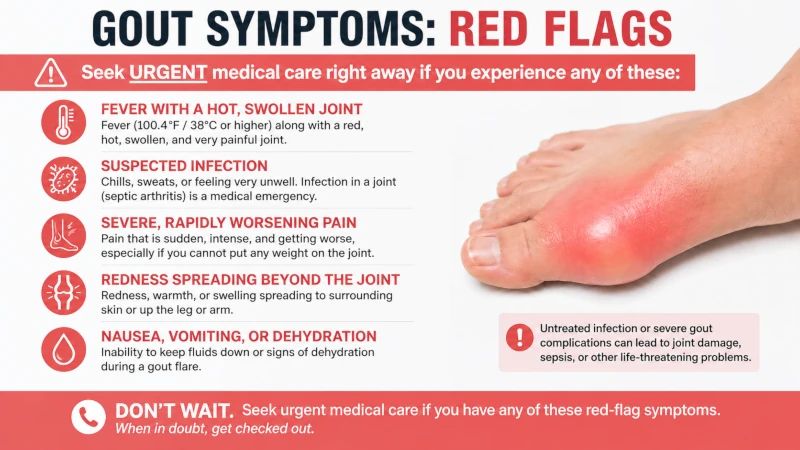
Seek same-day care if:
- A joint is suddenly hot, red, and swollen and you have a fever or feel unwell. A joint infection can look exactly like gout and is an emergency.
- It’s your first severe attack — getting it properly diagnosed matters, because other conditions mimic gout.
- Redness spreads rapidly up a limb, or you feel generally sick.
Make an appointment if:
- Attacks are getting more frequent, lasting longer, or spreading to new joints.
- You notice hard lumps under the skin (tophi) or have a history of kidney stones.
- You’re having more than one or two attacks a year — that’s usually the signal to discuss urate-lowering therapy.
Who should take extra care
- People on certain blood-pressure pills (thiazide or loop diuretics) or low-dose aspirin: these can nudge uric acid up. Don’t stop them on your own — ask your prescriber about alternatives.
- People with kidney disease: the “drink more water” advice has limits, and fluid targets should be set with your care team.
- Anyone pregnant or breastfeeding: several gout medications aren’t recommended, so get tailored advice before taking anything.
- Anyone trying to lose weight fast: crash diets and fasting can briefly raise uric acid and set off a flare. Aim for gradual loss.
None of this replaces personalized care. If you’re unsure how your medications, kidney health, or diet fit together, talk with a doctor, pharmacist, or registered dietitian who can look at your full picture.
| Health Disclaimer This article is for general information and education only. It is not a substitute for professional medical advice, diagnosis, or treatment. Always talk with a qualified healthcare professional before changing your diet, starting a supplement, or adjusting any medication — especially if you have an existing condition, take prescription drugs, or are pregnant or breastfeeding. Never delay or disregard medical advice because of something you read here. |
Frequently Asked Questions
What is the number-one food that triggers gout?
By purine content, organ meats and high-purine seafood like anchovies and sardines top the list. Day to day, though, alcohol — especially beer — and sugary drinks often do more to set off flares.
Can I eat tomatoes, spinach, or mushrooms with gout?
Yes. Purine-rich vegetables don’t meaningfully raise gout risk [Mayo; NEJM]. You only need to ease off slightly during an active flare.
Is coffee bad for gout?
No — moderate black coffee is linked to lower uric acid, especially in men [AND, 2023]. The real problem is sweetened energy drinks and sugary cold brews.
How fast can diet lower uric acid?
A two-week low-purine diet measurably lowered uric acid in a 2024 study, but the drop is modest and varies from person to person [Eur J Med Res, 2024]. Diet supports treatment rather than replacing medication.
Does drinking water help?
Staying hydrated helps the kidneys clear uric acid; the Arthritis Foundation suggests about 8 glasses a day, more during a flare [Arthritis Foundation, 2026]. People with kidney disease should set fluid targets with their doctor.
Are cherries proven to help?
Some studies link cherries and tart cherry juice to fewer flares [Mayo Clinic, 2025]. The evidence is promising but not conclusive, so treat them as a helpful addition, not a treatment.
References
- Choi HK, Atkinson K, Karlson EW, Willett W, Curhan G. Purine-Rich Foods, Dairy and Protein Intake, and the Risk of Gout in Men. New England Journal of Medicine. 2004;350(11):1093–1103. → View source
- Academy of Nutrition and Dietetics. Is a Purine-Restricted Diet Still Recommended for Gout? 2023. → View source
- Mayo Clinic. Gout diet: What’s allowed, what’s not. Reviewed 2025. → View source
- Arthritis Foundation. Gout Diet Dos and Don’ts. → View source
- U.S. Department of Agriculture, Agricultural Research Service. Purine Content of Foods. → View source
- Chen Y, et al. Effect of low-purine diet on the serum uric acid of gout patients in different clinical subtypes: a prospective cohort study. European Journal of Medical Research. 2024;29:449. → View source
- Zhang X, et al. The Interaction Between Dietary Fructose and Gut Microbiota in Hyperuricemia and Gout. Frontiers in Nutrition. 2022;9:890730. → View source
- Global, regional and national burdens of gout in the young population (aged 15–39) from 1990 to 2019: a population-based study. → View source
