
Soybeans deliver something few plant foods can: protein close to animal-food quality, packaged with fiber, iron, potassium, and mostly unsaturated fat. That nutrition is the most dependable of all soybean health benefits. Beyond it, swapping soy in for other protein can nudge LDL cholesterol down a little, and soy isoflavones ease hot flashes for some women. The bigger promises you may have seen — that soy prevents cancer, reverses hardened arteries, or works as a natural hormone replacement — run well ahead of the evidence.
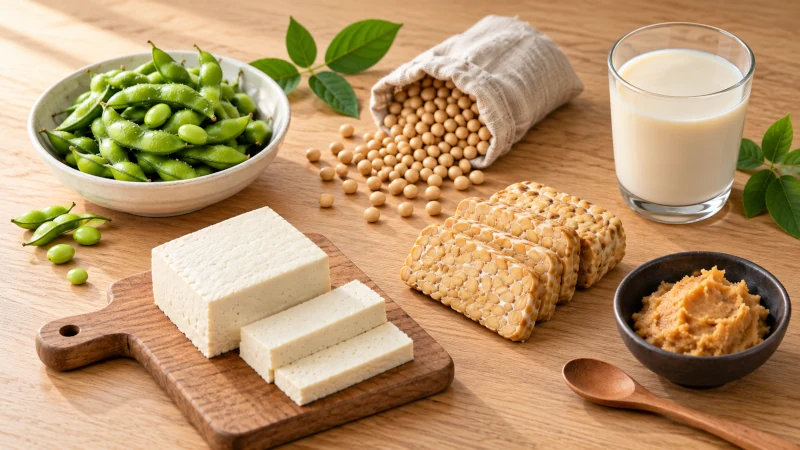
Here’s what the research shows, how strong each finding is, and who should be careful.
Soybean nutrition at a glance
A half cup of cooked mature soybeans (about 86 grams) packs a lot into a small serving [USDA FoodData Central, cooked soybeans]:
| Nutrient | Per ½ cup, cooked | Why it matters |
| Calories | 148 | Higher than most beans, because soybeans carry more fat |
| Protein | 15.7 g | Unusually high for a plant food |
| Fiber | 5.2 g | About 18% of the Daily Value |
| Fat | 7.7 g (1.1 g saturated) | Mostly unsaturated, including some plant omega-3 |
| Carbohydrate | 7.2 g | Low for a legume |
| Iron | 4.4 mg | About a quarter of the Daily Value; absorbs better with vitamin C |
| Potassium | 443 mg | Part of a blood-pressure-friendly diet |
| Magnesium | 74 mg | About 18% of the Daily Value |
| Folate | 46 mcg | About 12% of the Daily Value |
| Calcium | 88 mg | Modest; calcium-set tofu and fortified soy milk carry more |
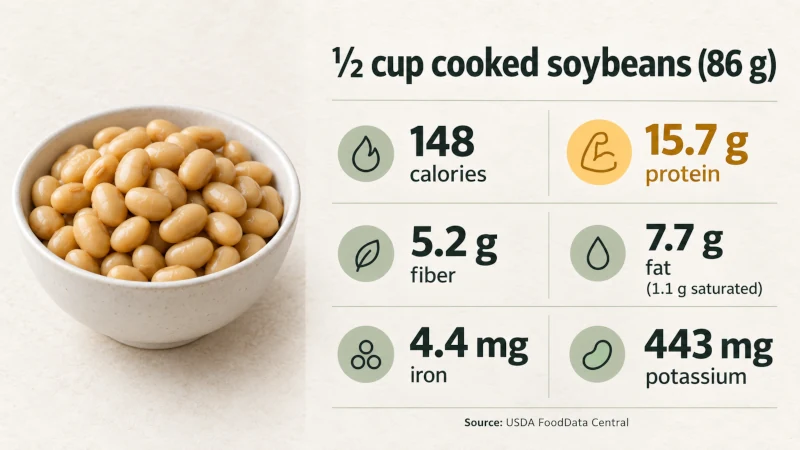
Protein is the headline. Soy protein scores higher on protein-quality measures than other plant proteins and lands close to animal protein [Messina, Nutrients, 2016], which makes it genuinely useful if you eat little or no meat.
What soybeans don’t give you: vitamin B12 or vitamin D (the same USDA entry lists zero for both). If you lean heavily on plant foods, fortified soy milk or a supplement covers those gaps.
The soybean health benefits with the best evidence
A small drop in LDL cholesterol
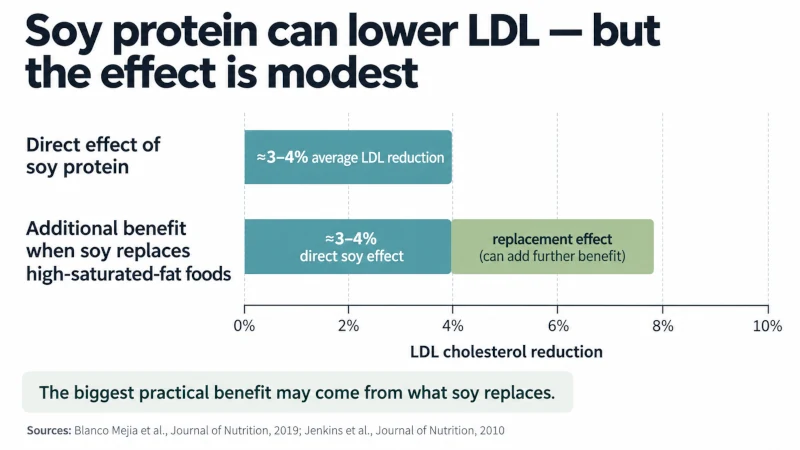
This is the most studied benefit, and it’s real but modest. A 2019 meta-analysis pooled the 46 controlled trials the FDA was reviewing and found soy protein lowered LDL (“bad”) cholesterol by roughly 3% to 4% in adults [Blanco Mejia et al., Journal of Nutrition, 2019]. Soy appears to work two ways: directly, and by pushing foods high in saturated fat off the plate [Jenkins et al., Journal of Nutrition, 2010] — which is how most people actually use it.
That small effect explains the regulatory tug-of-war. Since 1999, the FDA has let qualifying foods carry a heart-health claim tied to 25 grams of soy protein a day, and that rule is still on the books [eCFR, 21 CFR 101.82, 2026]. In 2017, though, the FDA proposed revoking it because newer studies were inconsistent [Federal Register, FDA proposed rule, 2017]. Both things are true: soy protein helps a little, and it isn’t a cholesterol treatment on its own.
So use soy as a swap. Tofu instead of sausage, edamame instead of chips, unsweetened soy milk instead of whole milk. If your LDL is high, soy belongs inside a broader heart-healthy diet — it doesn’t replace one, and it doesn’t replace a statin your doctor prescribed.
Fewer, milder hot flashes — for some women
Soy contains isoflavones, mainly genistein and daidzein, plant compounds that bind weakly to estrogen receptors. Whether they help with hot flashes depends on which experts you ask.
The case for: a 2012 meta-analysis of 17 randomized trials found isoflavone supplements — a median 54 mg a day, taken for six weeks to a year — cut hot flash frequency by about 21% and severity by about 26% compared with placebo [Taku et al., Menopause, 2012]. For scale, a cup of soy milk carries roughly 56 to 83 mg of isoflavones [Mayo Clinic on soy and breast cancer risk], though most of the trials used supplements rather than food. One co-author of that analysis consults for soy companies, which is worth knowing.
The case against: The Menopause Society’s 2023 position statement does not recommend soy foods or soy extracts for hot flashes, rating the evidence as limited or inconsistent [The Menopause Society, 2023]. The NIH’s complementary-health center sits in between: soy may help, but the effect may be small and results have been mixed [NCCIH: Soy].
If you like soy foods, eating them daily through menopause is reasonable and low-risk. Expect a partial easing over weeks at best, not the relief hormone therapy gives. If hot flashes are wrecking your sleep, talk with your doctor — effective prescription options exist — and see our guide to natural remedies for night sweats for what else has evidence.
Soy and cancer: what the research shows
For years, people worried that soy’s estrogen-like compounds might feed hormone-sensitive cancers. Human research has largely put that fear to rest, while stopping short of proving soy prevents cancer.
Breast cancer
The American Cancer Society says a large body of evidence supports soy foods as safe, and that eating them is linked to lower or unchanged cancer risk [American Cancer Society, 2025]. The early scare came mostly from rodent studies, and rodents process isoflavones differently than people do. The strongest hints of protection come from East Asian studies, where eating one to two servings of soy foods a day has been linked to lower breast cancer risk [AICR, 2024].
If you’ve had breast cancer, the news is reassuring. Current evidence indicates soy foods are safe for women who have had breast cancer or are at high risk [NCCIH clinical digest on menopausal symptoms]. The American Institute for Cancer Research notes that population studies show no increased risk of recurrence, and some suggest a possible benefit, though it rates that evidence as limited [AICR, 2024].
Food and pills are different, though. The American Cancer Society does not recommend soy supplements for cancer prevention because they can deliver far more isoflavones than food [American Cancer Society, 2025]. If you’ve had breast cancer, ask your oncologist before taking any isoflavone product.
Prostate cancer
Men who eat more soy tend to have lower rates of prostate cancer. A 2018 meta-analysis of 30 observational studies found the highest soy intake was linked to about 29% lower risk than the lowest [Applegate et al., Nutrients, 2018]. The link was weaker in the more reliable cohort studies, and soy showed no association with advanced prostate cancer. These studies show a pattern, not proof that soy causes the lower risk.
If cancer prevention is your goal, soy is one reasonable piece of a bigger eating pattern. Our guide to a cancer-preventing diet ranks the foods and habits with the strongest evidence.
Bones, blood pressure, and blood sugar: promising, not settled
According to the NIH, soy isoflavones probably help bone density in postmenopausal women and may modestly lower blood pressure. People who eat soy-rich diets may have a lower risk of type 2 diabetes, but it’s uncertain whether soy improves blood sugar control once diabetes is present [NCCIH: Soy].
“Probably” and “may” are doing real work there. Soy makes sense in a bone-friendly or blood-pressure-friendly diet; it isn’t a treatment for osteoporosis or hypertension. For bones specifically, calcium-set tofu earns its spot for the calcium alone — see our list of the best foods for osteoporosis.
Two soy myths worth retiring
“Soy feminizes men”
The clinical evidence says no. A 2021 meta-analysis of nearly 40 clinical studies found no effect of soy protein or isoflavones on testosterone, free testosterone, or estrogen levels in men, whatever the dose or study length [Reed et al., Reproductive Toxicology, 2021]. One author consults for soy companies, but the result matches earlier reviews.
“Soy wrecks your thyroid”
For most people, it doesn’t. A review of trials in healthy adults found little evidence that soy foods or isoflavones harm thyroid function in people who get enough iodine [Messina & Redmond, Thyroid, 2006]. The real question is narrower: whether soy interferes with thyroid medication. That same review found some evidence that soy can reduce levothyroxine absorption and raise the dose a person needs, while other sources describe the effect mainly in infants fed soy formula [Susan G. Komen soy fact sheet, 2026]. Either way, the fix is simple — keep your soy intake steady and take your pill well apart from soy foods. Iodine matters here too; our guide to iodine and your thyroid explains why.
How strong is the evidence? A quick scorecard
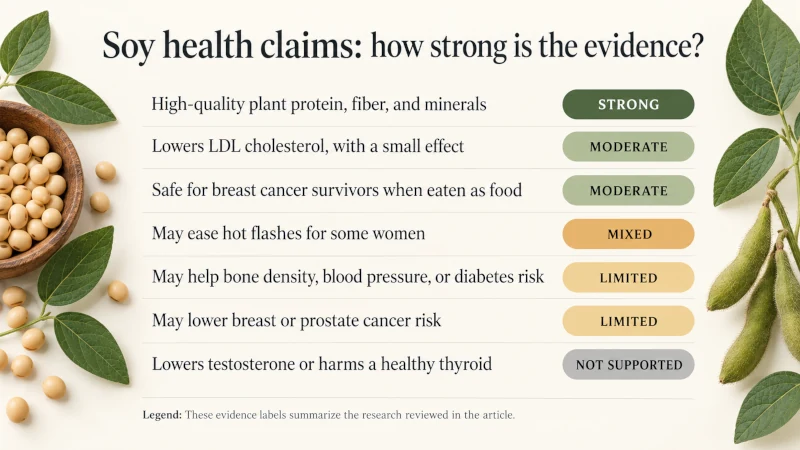
| Claim | Strength of evidence | What it means for you |
| Good source of high-quality plant protein, fiber, and minerals | Strong (nutrient data) | A useful protein swap, especially on plant-forward diets |
| Lowers LDL cholesterol | Moderate; small effect (about 3%–4%) | Works best when soy replaces foods high in saturated fat |
| Eases hot flashes | Mixed | Some women notice fewer, milder hot flashes; major menopause guidelines don’t recommend it |
| Safe for breast cancer survivors (as food) | Moderate, consistent | No need to avoid tofu or soy milk; ask before using supplements |
| Lowers breast or prostate cancer risk | Limited (observational) | A possible benefit, not proven prevention |
| Helps bone density, blood pressure, diabetes risk | Limited to moderate | Promising; not a substitute for treatment |
| Lowers testosterone or harms a healthy thyroid | Not supported | Exception: soy may affect levothyroxine absorption |
How to eat more soy
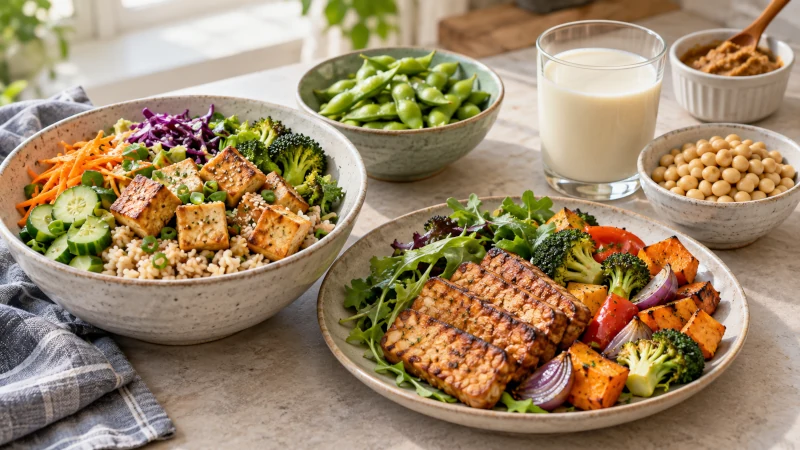
Whole and lightly processed soy foods bring the protein and fiber along with the isoflavones.
- Edamame. Young soybeans, steamed in the pod. An easy snack or salad topper.
- Tofu. Look for “calcium sulfate” on the label; calcium-set tofu is one of the best non-dairy calcium sources. Our guide to foods high in calcium compares it with dairy.
- Tempeh. Fermented, firm, and nutty. Holds up well in stir-fries and sandwiches.
- Soy milk. Pick unsweetened and fortified with calcium, vitamin D, and B12 if it’s replacing dairy milk.
- Cooked soybeans. Soak dried soybeans and cook them thoroughly, like any dried bean. Canned soybeans save time.
- Miso and soy sauce. Big on flavor, but high in sodium. Treat them as seasonings, not protein sources.
Soybeans also contain oligosaccharides, carbohydrates that feed gut bacteria [Messina, Nutrients, 2016]. That’s part of why beans cause gas. Start with small portions and build up.
Safety: who should be careful with soy
Soy foods are safe for most people. These are the exceptions.
Soy allergy. Soy is one of the nine major food allergens in the United States, and packaged foods must declare it on the label [FDA: Food Allergies]. If you’re allergic, avoid it entirely and watch for soy protein, soy flour, and similar ingredients.
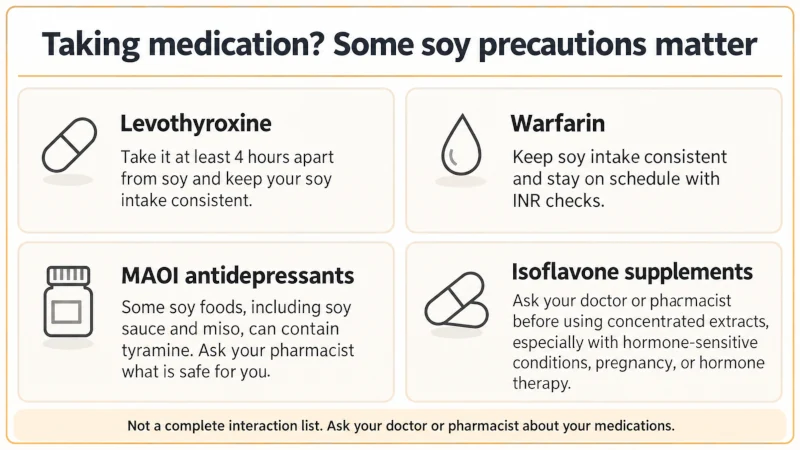
Thyroid medication. If you take levothyroxine, take it at least four hours apart from soy, keep your soy intake consistent, and tell your doctor if that changes [Susan G. Komen soy fact sheet, 2026].
Warfarin. Soy has been reported to reduce warfarin’s effect. Keep your soy intake steady and stay on schedule with INR checks [Susan G. Komen soy fact sheet, 2026].
MAOI antidepressants. Some soy products, including soy sauce, miso, and tofu, can contain tyramine, which can push blood pressure dangerously high in people taking MAOIs. Ask your pharmacist which soy foods are safe for you [Susan G. Komen soy fact sheet, 2026].
Isoflavone supplements. Concentrated extracts aren’t the same as food. They appear safe short-term, but long-term use has been linked to thickening of the uterine lining [NCCIH clinical digest on menopausal symptoms]. Talk to your doctor or pharmacist before starting one — especially if you’ve had a hormone-sensitive cancer, take tamoxifen or another hormone therapy, or are pregnant or breastfeeding.
Pregnancy and breastfeeding. Soy foods in everyday amounts are a normal part of diets around the world. Skip concentrated isoflavone supplements unless your doctor recommends them.
Babies. Regular soy milk is not infant formula. Soy-based formula is meant for specific situations, so choose any formula with your pediatrician.
When to get medical help
- Call 911 for trouble breathing, swelling of the lips, tongue, or throat, or fainting after eating soy. These are signs of a severe allergic reaction.
- See a doctor promptly for vaginal bleeding after menopause (especially if you’ve taken isoflavone supplements), a new breast lump, or hot flashes that come with fever, unexplained weight loss, or drenching night sweats.
- Check in with your doctor if your thyroid levels shift after you start eating more soy, or if hot flashes are disrupting your sleep or daily life.
| Health Disclaimer: This article is for general education and isn’t a substitute for advice from your doctor or a registered dietitian. Soy foods can be part of a healthy diet, but they don’t treat high cholesterol, menopause symptoms, cancer, or any other condition on their own. If you take prescription medication — especially levothyroxine, warfarin, an MAOI, or hormone therapy — have had a hormone-sensitive cancer, are pregnant or breastfeeding, or are considering an isoflavone supplement, talk with your doctor or pharmacist first. If you think you’re having a severe allergic reaction, call 911. |
Frequently Asked Questions
How much soy is safe to eat each day?
For most adults, one to two servings of soy foods a day is a moderate amount — the level linked to lower breast cancer risk in East Asian studies [AICR, 2024]. Concentrated isoflavone supplements are a different matter and deserve a conversation with your doctor.
Does soy raise estrogen levels?
Soy isoflavones bind weakly to estrogen receptors, but they aren’t the same as the estrogen your body makes. In men, a 2021 meta-analysis of nearly 40 clinical studies found no change in estrogen or testosterone levels [Reed et al., Reproductive Toxicology, 2021].
Can I eat soy if I’ve had breast cancer?
Yes, as food. Current evidence indicates soy foods are safe for breast cancer survivors [NCCIH clinical digest on menopausal symptoms]. Check with your oncologist before using isoflavone supplements.
Is soy good for your heart?
It helps modestly. Soy protein lowers LDL cholesterol by about 3% to 4% on average [Blanco Mejia et al., Journal of Nutrition, 2019], and more when it replaces foods high in saturated fat.
Are edamame and mature soybeans the same thing?
They’re the same plant picked at different stages. Edamame are harvested young and green, while mature soybeans are dried and used for tofu, soy milk, and cooked beans.
References
- U.S. Department of Agriculture, Agricultural Research Service. “Soybeans, mature cooked, boiled, without salt” (FDC ID 174271). FoodData Central. View source
- Messina M. “Soy and Health Update: Evaluation of the Clinical and Epidemiologic Literature.” Nutrients. 2016;8(12):754. View source
- Blanco Mejia S, Messina M, Li SS, et al. “A Meta-Analysis of 46 Studies Identified by the FDA Demonstrates that Soy Protein Decreases Circulating LDL and Total Cholesterol Concentrations in Adults.” Journal of Nutrition. 2019;149(6):968–981. View source
- Jenkins DJA, Mirrahimi A, Srichaikul K, et al. “Soy Protein Reduces Serum Cholesterol by Both Intrinsic and Food Displacement Mechanisms.” Journal of Nutrition. 2010;140(12):2302S–2311S. View source
- U.S. Food and Drug Administration. “21 CFR 101.82 — Health claims: Soy protein and risk of coronary heart disease.” eCFR, View source
- U.S. Food and Drug Administration. “Food Labeling: Health Claims; Soy Protein and Coronary Heart Disease” View source
- Taku K, Melby MK, Kronenberg F, Kurzer MS, Messina M. “Extracted or synthesized soybean isoflavones reduce menopausal hot flash frequency and severity: systematic review and meta-analysis of randomized controlled trials.” Menopause. 2012;19(7):776–790. doi:10.1097/gme.0b013e3182410159. PMID 22433977. View source
- Mayo Clinic. “Does soy really affect breast cancer risk?” View source
- The North American Menopause Society (The Menopause Society). “The 2023 nonhormone therapy position statement of The North American Menopause Society.” Menopause. 2023;30(6):573–590. PMID 37252752. View source
- National Center for Complementary and Integrative Health. “Soy: Usefulness and Safety.” View source
- American Cancer Society. “Soy and Cancer Risk: Our Expert’s Advice.” View source
- American Institute for Cancer Research. “Soy and Breast Cancer: Myths and Misconceptions.” View source
- National Center for Complementary and Integrative Health. “Menopausal Symptoms and Complementary Health Approaches: What the Science Says.” NCCIH Clinical Digest. View source
- Applegate CC, Rowles JL 3rd, Ranard KM, Jeon S, Erdman JW. “Soy Consumption and the Risk of Prostate Cancer: An Updated Systematic Review and Meta-Analysis.” Nutrients. 2018;10(1):40. View source
- Reed KE, Camargo J, Hamilton-Reeves J, Kurzer M, Messina M. “Neither soy nor isoflavone intake affects male reproductive hormones: An expanded and updated meta-analysis of clinical studies.” Reproductive Toxicology. 2021;100:60–67. View source
- Messina M, Redmond G. “Effects of soy protein and soybean isoflavones on thyroid function in healthy adults and hypothyroid patients: a review of the relevant literature.” Thyroid. 2006;16(3):249–258. doi:10.1089/thy.2006.16.249. PMID 16571087. View source
- Susan G. Komen. “Soy” (complementary therapies fact sheet), accessed September 2026. View source
- U.S. Food and Drug Administration. “Food Allergies.” View source


