
Peanuts are good for most people — just not for everyone. Eaten regularly in modest amounts, they are linked in large studies to lower rates of heart disease and longer life, and a single ounce supplies a real share of your daily niacin, vitamin E, magnesium and protein. The peanut health benefits are well supported for heart health and reasonably supported for overall mortality. Claims about curing skin conditions are not. And for the roughly 1 to 2 percent of U.S. children with peanut allergy, even a trace can be dangerous [FDA, 2017].
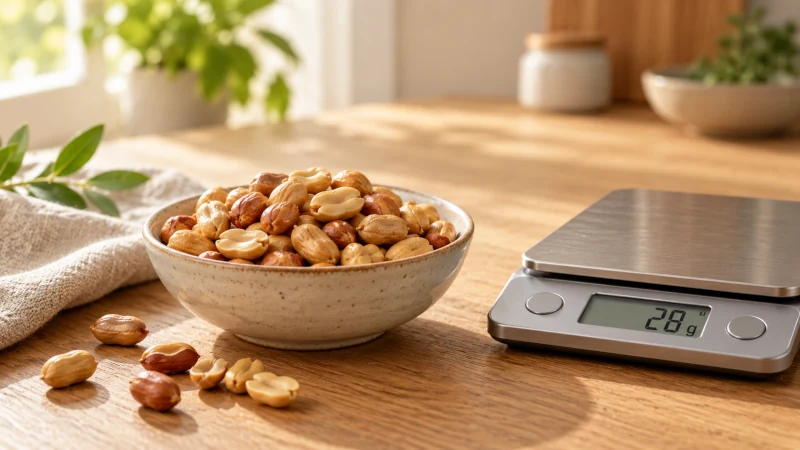
Here is what peanuts actually do, how strong the evidence is for each claim, and how to eat them in a way that helps rather than hurts.
Peanut nutrition at a glance
One ounce of dry-roasted, unsalted peanuts is about a small handful — roughly 28 grams. Here is what it holds [USDA data via University Hospitals]:
| Nutrient (per 1 oz / 28 g, dry-roasted, unsalted) | Amount | Notes |
| Calories | 166 kcal | Energy-dense; portion size matters |
| Protein | 6.7 g | Comparable to an egg by weight of protein |
| Total fat | 14.1 g | Mostly unsaturated |
| — Monounsaturated / polyunsaturated / saturated | 7.0 g / 4.5 g / 2.0 g | About 6 parts unsaturated to 1 saturated |
| Carbohydrate / fiber | 6.1 g / 2.3 g | Low in sugar (1.2 g) |
| Niacin (vitamin B3) | 3.8–4.2 mg | About a quarter of the Daily Value [NIH ODS, 2022] |
| Vitamin E (alpha-tocopherol) | 2.0–2.2 mg | About 15% of the Daily Value [NIH ODS, 2021] |
| Magnesium | 50 mg | Roughly 12% of an adult’s needs |
| Folate | 41 mcg DFE | |
| Potassium / sodium | 187 mg / 2 mg | Salted versions add a lot of sodium — check the label |
| Vitamin A, vitamin C, cholesterol | 0 | Peanuts contain none of these |
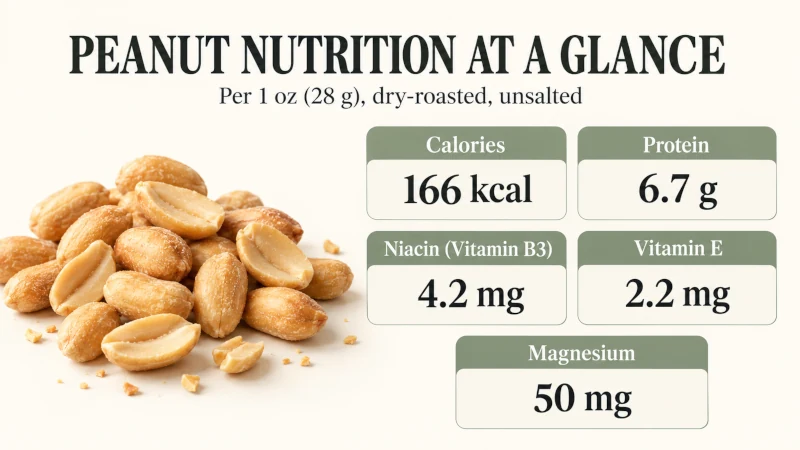
Two things jump out. Niacin is the standout: an ounce of peanuts carries about 4.2 mg, a quarter of the Daily Value, which puts peanuts near the top of plant foods for this vitamin [NIH ODS, 2022]. Vitamin E is respectable but not exceptional — sunflower seeds (7.4 mg) and almonds (6.8 mg) supply roughly three times as much per ounce [NIH ODS, 2021]. If vitamin E is your goal, sunflower seeds and almonds do more of the work.
You may have read that peanuts contain vitamins A and C, or beat meat for calcium. They don’t. USDA data list zero vitamin A and zero vitamin C, and only about 15 mg of calcium per ounce.
A legume that eats like a nut
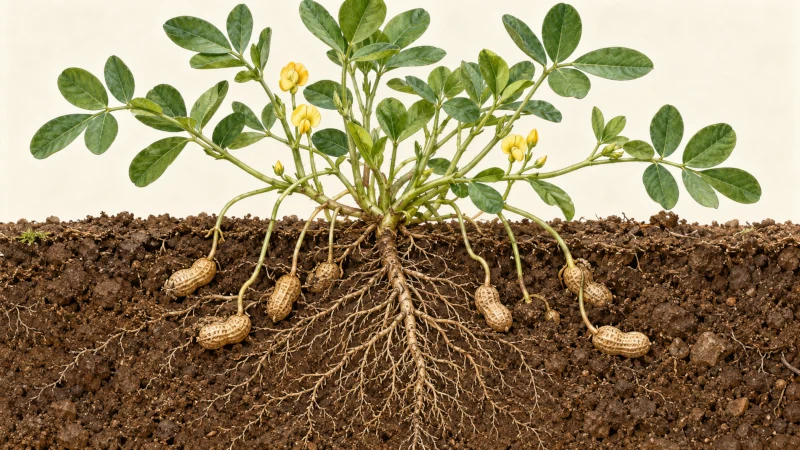
Peanuts are a strange plant. After the flower is fertilized, its stalk bends down and pushes the developing pod into the soil, where it matures underground. That makes the peanut a legume — a relative of beans and peas — not a tree nut, even though nutritionally it behaves much like one. The difference matters most for allergies, covered below.
Peanut health benefits for your heart
This is where the evidence is strongest, though nearly all of it comes from observational studies — large groups of people followed over years — rather than trials that randomly assign peanuts. Those studies show association, not proof of cause.
What the large studies found
A 2016 meta-analysis pooled 20 prospective studies with up to 819,448 participants. Each extra 28 grams of nuts a day was linked to a 29% lower risk of coronary heart disease, 21% lower risk of cardiovascular disease and 22% lower risk of death from any cause [Aune et al., 2016]. Peanuts were analyzed separately, and their results were similar to tree nuts. Peanut eaters in these studies also had lower stroke risk — something tree nuts did not show [Aune et al., 2016].
Two details make this practical. First, most of the benefit appeared by about 15 to 20 grams a day — less than a full ounce — with little further gain beyond that [Aune et al., 2016]. Second, peanut butter did not show the same clear dose-response pattern, and the authors suggested added salt or sugar in some brands might blunt the effect [Aune et al., 2016].
Much earlier nut research focused on affluent, mostly white populations. A 2015 study changed that by following predominantly low-income Black and white Americans in the southeastern U.S. and adults in Shanghai, where nut intake was almost entirely peanuts [Luu et al., 2015]. People in the highest quarter of intake had 17–21% lower total mortality and 23–38% lower cardiovascular mortality than those in the lowest [Vanderbilt University Medical Center, 2015]. The researchers pointed out that peanuts are far cheaper than tree nuts, which makes this one of the more affordable heart-friendly swaps available.
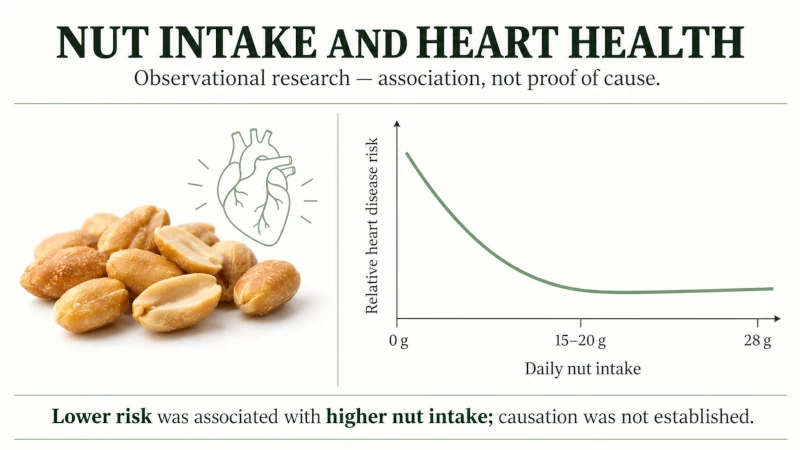
The honest caveat: people who eat nuts tend to smoke less, exercise more and eat more produce. Researchers adjust for those factors, and the associations held up, but some confounding can’t be ruled out [Aune et al., 2016]. The likely mechanism is plausible, though — peanuts are rich in unsaturated fat and fiber, and nut-feeding trials consistently lower LDL cholesterol. Peanuts work best as part of a broader pattern; see our guide to foods for healthy arteries for how that pattern fits together.
The FDA’s cautious nod
In 2003 the FDA allowed peanuts, along with several tree nuts, to carry a qualified heart-health claim. The approved wording says scientific evidence suggests but does not prove that eating 1.5 ounces a day of most nuts, as part of a diet low in saturated fat and cholesterol, may reduce the risk of heart disease [FDA, 2024] [FDA, 2003]. “Qualified” is the key word: the agency judged the evidence credible but short of scientific consensus. Walnuts later received their own claim, which our walnut health benefits guide covers.
Niacin, vitamin E, and your skin
Older articles — including the earlier version of this page — called niacin “vitamin B6.” It is vitamin B3. Your body turns it into coenzymes that more than 400 enzymes depend on to release energy from food [NIH ODS, 2022].
Severe niacin deficiency causes pellagra: a rough, sunburn-like rash on sun-exposed skin, digestive problems such as diarrhea, and neurological symptoms that can progress to confusion and memory loss [NIH ODS, 2022]. Pellagra is now rare in industrialized countries [NIH ODS, 2022]. Peanuts are a good dietary source of niacin, so in the narrow sense that they help prevent deficiency, they support healthy skin.
That is as far as the evidence goes. No good-quality study shows that eating peanuts treats eczema, dermatitis or dry skin in people who already get enough niacin, and the original claim that peanuts are “highly recommended” for skin conditions has been removed. The same applies to rubbing peanut oil on the skin, which carries its own allergy risk.
A reassuring point: no adverse effects have been reported from niacin that occurs naturally in food [NIH ODS, 2022]. High-dose niacin pills are a different matter — see our guide to B complex vitamins for why the supplement version can cause flushing and liver problems.
Weight and calories: what’s realistic
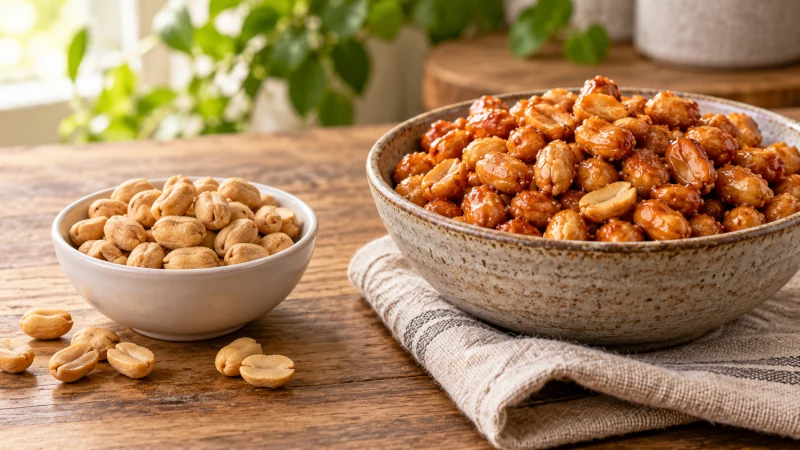
At about 166 calories an ounce, peanuts are easy to overeat. Even so, in observational studies nut eaters have tended to gain less weight over time, not more, and the heart associations held up after accounting for body weight [Aune et al., 2016]. The difference between “helps” and “hurts” is usually substitution: a handful of peanuts in place of chips or a pastry is a good trade; a jar of honey-roasted peanuts on top of your usual snacks is not.
Evidence scorecard
| Claim | Evidence type | Verdict |
| Lower risk of heart disease | Large meta-analyses of prospective cohorts; FDA qualified claim | Moderate–strong (association, not proven cause) |
| Lower overall mortality | Prospective cohorts across U.S., Europe and Asia | Moderate (association) |
| Good source of niacin and vitamin E | Direct nutrient analysis (USDA / NIH) | Well established |
| Prevents niacin deficiency (pellagra) | Nutrient science | Established, but deficiency is rare |
| Lower stroke risk | Peanut subgroup in one meta-analysis | Limited |
| Helps weight control | Observational studies | Limited; depends on substitution |
| Treats eczema or skin disease | No supporting human studies found | Not supported |
| Early feeding prevents peanut allergy in high-risk babies | One large randomized trial (LEAP) | Strong for that group; FDA calls it limited to one study |
Peanut allergy: the risk that matters most
Peanut allergy affects up to about 2% of U.S. children in recent studies, and the FDA notes it is the leading cause of deaths from food-triggered anaphylaxis in the United States [FDA, 2017]. It is usually lifelong. Because peanuts are legumes, peanut allergy is not the same as tree-nut allergy, but many allergists advise caution with both because of cross-contact in processing. Our overview of foods that cause allergies explains how the major allergens differ.
Signs of a reaction and when to call 911
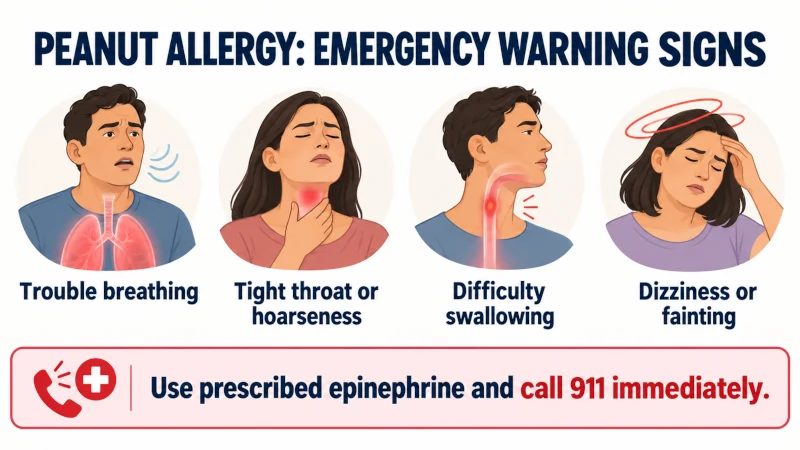
Milder symptoms include hives, red itchy skin, a runny nose, sneezing, itchy eyes, vomiting, stomach cramps, diarrhea or swelling [FDA, 2017]. Call 911 and use prescribed epinephrine right away if any of these appear after eating peanuts [FDA, 2017]:
- Trouble breathing, wheezing, or a tight throat
- Hoarseness or difficulty swallowing
- Flushed skin with dizziness, fainting or a weak pulse (signs of low blood pressure or shock)
Symptoms can return after they seem to settle, so emergency evaluation is still needed even if epinephrine helps.
Babies, early introduction, and choking
For years parents were told to delay peanuts. That advice reversed. In the LEAP trial, 640 infants with severe eczema, egg allergy or both were randomly assigned to eat or avoid peanut foods until age 5 [Du Toit et al., 2015]. Among babies who were not already sensitized, 13.7% of the avoidance group developed peanut allergy versus 1.9% of the eating group [Du Toit et al., 2015]. Across both groups, early eating cut peanut allergy by about 81% [NIAID, n.d.]. U.S. guidelines were rewritten in 2017 to recommend early introduction [NIAID, n.d.].
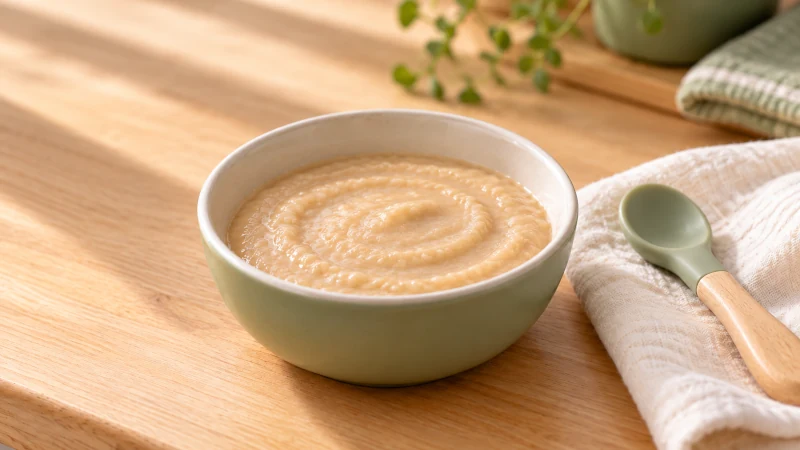
Three cautions keep this safe. First, if your baby has severe eczema or egg allergy, talk to your pediatrician before offering peanut — some of these infants need testing first, and the FDA’s own claim tells parents to check with a healthcare provider [FDA, 2017]. Second, the evidence is strongest for that high-risk group; a trial of earlier introduction in the general population did not reach statistical significance [FDA, 2017]. Third, form matters: whole peanuts are a choking hazard for children under 5, and peanut butter should not be given from a spoon or in lumps to children under 4 [FDA, 2017]. Thinned smooth peanut butter or peanut powder mixed into a familiar food is the usual approach.
Other safety considerations
Aflatoxins. Certain molds that grow on peanuts, corn and tree nuts produce aflatoxins, which are linked to liver cancer [NCI, 2024]. The FDA tests peanuts and peanut butter, and no aflatoxin illness outbreak has been reported in the U.S. [NCI, 2024]. You can reduce exposure further by buying major commercial brands and throwing away nuts that look moldy, discolored or shriveled [NCI, 2024].
Salt and added sugar. Unsalted peanuts have almost no sodium [USDA data via University Hospitals]; salted, honey-roasted and candy-coated versions change that substantially. If you watch your blood pressure, choose unsalted and read labels on peanut butter.
Medications. Peanuts as a food have no well-documented drug interactions. Do not confuse dietary niacin with prescription or high-dose niacin, which does interact with diabetes and other medicines and can harm the liver [NIH ODS, 2022].
Pregnancy and breastfeeding. If you are not allergic, there is no reason to avoid peanuts. The American Academy of Pediatrics found that current evidence does not support restricting the mother’s diet during pregnancy or breastfeeding to prevent allergies in the child [Greer et al., AAP, 2019].
Who should avoid peanuts: anyone with a diagnosed peanut allergy; anyone who has had a reaction to peanuts and hasn’t been evaluated; children under 5 (whole peanuts) and under 4 (spoonfuls or lumps of peanut butter). People with severe eczema or egg allergy in infancy, and anyone with a tree-nut allergy, should get individual advice from a clinician or allergist.
When to talk to a professional: before introducing peanuts to a high-risk baby; after any suspected reaction, even a mild one; and if you are using nuts as part of a plan to manage cholesterol, heart disease or weight, so they fit with any prescribed treatment.
How to eat peanuts well
- Aim for about a handful. Most of the benefit in studies showed up by 15–20 g a day; the FDA claim uses 1.5 ounces (about 42 g) for nuts in general.
- Pick dry-roasted or raw-roasted, unsalted. Fried, salted and sugar-coated versions add calories and sodium.
- Choose peanut butter with short ingredients. Peanuts and maybe salt. Skip brands with added sugar or hydrogenated oils.
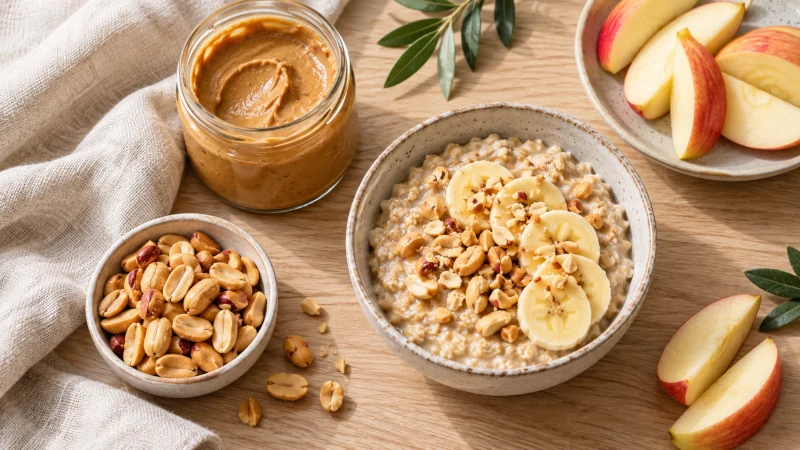
- Swap, don’t stack. Use peanuts in place of chips, crackers or sweets, or on oatmeal, salads and stir-fries.
- Store them cool and dry. Discard any that smell off or look moldy.
| HEALTH DISCLAIMER: This article is for general educational purposes and is not a substitute for professional medical advice, diagnosis or treatment. Peanuts are a food, not a medicine, and do not cure or treat any disease. Peanut allergy can cause severe, life-threatening reactions. Talk to your doctor, pediatrician, allergist or registered dietitian before introducing peanuts to an infant with eczema or egg allergy, after any suspected allergic reaction, or before making major diet changes if you have a chronic condition, are pregnant or breastfeeding, or take prescription medication. If you or someone else has trouble breathing, throat tightness, swelling or fainting after eating peanuts, use prescribed epinephrine and call 911 immediately. |
Frequently Asked Questions
How many peanuts should I eat a day?
About a small handful. In a large meta-analysis, most of the lower heart and mortality risk appeared by 15–20 grams a day, with little extra benefit beyond that [Aune et al., 2016]. An ounce (28 g) is a reasonable upper everyday amount for most adults.
Is peanut butter as healthy as whole peanuts?
It has the same basic nutrients, but studies have not shown as clear a benefit, possibly because of added sugar and salt in some brands [Aune et al., 2016]. Choose one made from peanuts with little or nothing else.
Are peanuts nuts?
Botanically, no. Peanuts are legumes that mature underground. Nutritionally they resemble tree nuts, and researchers usually study them together. For allergy purposes, peanut and tree-nut allergy are different conditions, though many people are advised to be cautious with both.
Are peanuts good for your skin?
Only indirectly. They are a good source of niacin, and severe niacin deficiency causes a pellagra rash [NIH ODS, 2022]. There is no good evidence that peanuts or peanut oil treat eczema or dermatitis.
When can my baby have peanuts?
Many babies can start peanut foods in infancy once they are eating solids, using thinned peanut butter or peanut powder — never whole peanuts. If your baby has severe eczema or egg allergy, ask your pediatrician first [FDA, 2017] [NIAID, n.d.].
Do peanuts cause cancer because of aflatoxin?
Aflatoxin exposure is linked to liver cancer, but the FDA tests U.S. peanuts and peanut butter, and no aflatoxin outbreak has been reported in the U.S. Buying major brands and discarding moldy-looking nuts lowers exposure further [NCI, 2024].
References
- University Hospitals Health & Wellness Library. Nutrition Facts: Peanuts, all types, dry-roasted, without salt, 1 oz View source
- National Institutes of Health, Office of Dietary Supplements. Niacin: Fact Sheet for Health Professionals. View source
- National Institutes of Health, Office of Dietary Supplements. Vitamin E: Fact Sheet for Health Professionals. View source
- Aune D, Keum N, Giovannucci E, et al. Nut consumption and risk of cardiovascular disease, total cancer, all-cause and cause-specific mortality: a systematic review and dose-response meta-analysis of prospective studies. View source
- Luu HN, Blot WJ, Xiang YB, et al. Prospective evaluation of the association of nut/peanut consumption with total and cause-specific mortality. JAMA Internal Medicine. View source
- Vanderbilt University Medical Center News. VU study finds peanut consumption associated with decreased mortality and mortality from cardiovascular diseases. View source
- U.S. Food and Drug Administration. Qualified Health Claims: Letters of Enforcement Discretion. View source
- U.S. Food and Drug Administration. Letter of enforcement discretion: Qualified Health Claim — Nuts and Coronary Heart Disease (Docket 02P-0505). View source
- U.S. Food and Drug Administration. Petition for a Qualified Health Claim for Ground Peanuts and Reduced Risk of Developing Peanut Allergy View source
- National Institute of Allergy and Infectious Diseases. Guidelines for Clinicians and Patients for Diagnosis and Management of Food Allergy in the United States. View source
- Du Toit G, Roberts G, Sayre PH, et al.; LEAP Study Team. Randomized trial of peanut consumption in infants at risk for peanut allergy. New England Journal of Medicine. View source
- Greer FR, Sicherer SH, Burks AW; AAP Committee on Nutrition, Section on Allergy and Immunology. The effects of early nutritional interventions on the development of atopic disease in infants and children. View source
- National Cancer Institute. Aflatoxins. View source


