
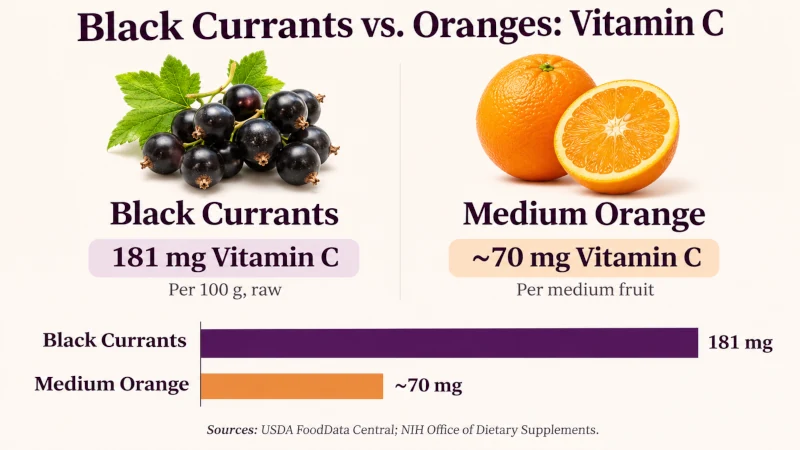
Black currants are one of the most concentrated fruit sources of vitamin C you can buy. A 100-gram serving of the raw berries holds about 181 mg, roughly twice what an adult man needs in a day [USDA FoodData Central, n.d.; NIH ODS, n.d.]. That part of the black currant benefits story is solid. Most of the rest, from easier joints to protecting your eyes to a better race time, comes from small trials that used seed oil or concentrated extracts rather than a bowl of berries. Here is what holds up, what doesn’t, and who should be careful with supplements.
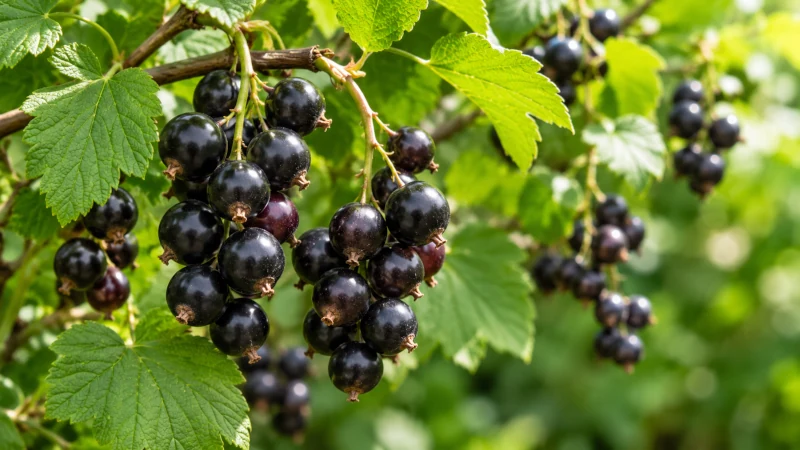
What black currants are
Black currant (Ribes nigrum) is a shrub in the gooseberry family, Grossulariaceae [Garbacki et al., 2004]. It is native to central Europe and northern Asia. Poland, Ukraine, and the United Kingdom grow the most today, and the French name, cassis, shows up on syrups and liqueurs [Savanna Institute/UW-Madison, n.d.]. It is a different species from the red currant, though the two share a genus and a sweet-tart reputation.
If you live in the US and rarely see fresh black currants, there is a reason. Growing them was banned federally in 1911 because some Ribes species carry white pine blister rust, a fungus that kills five-needle pines. The ban was lifted in 1966 after new cultivars were developed [Savanna Institute/UW-Madison, n.d.], but the crop never caught up with blueberries or raspberries.
Black currant nutrition
Per 100 grams of raw European black currants [USDA FoodData Central, n.d.]:
| Nutrient | Amount per 100 g |
| Calories | 63 kcal |
| Carbohydrate | 15.4 g |
| Protein | 1.4 g |
| Fat | 0.4 g |
| Vitamin C | 181 mg |
| Potassium | 322 mg |
| Calcium | 55 mg |
| Magnesium | 24 mg |
| Iron | 1.54 mg |
Vitamin C is the standout. Adults need 90 mg a day (men) or 75 mg (women), and a medium orange provides about 70 mg [NIH ODS, n.d.]. Gram for gram, oranges trail black currants by a wide margin. If you want to see how a fruit’s vitamin C number turns into a real serving, the acerola cherry vs orange comparison walks through the math.
The berries’ deep purple comes from anthocyanins, the same pigment family found in blueberries and blackberries. That pigment is behind most of the research interest in black currants.
Black currant benefits: what the research shows
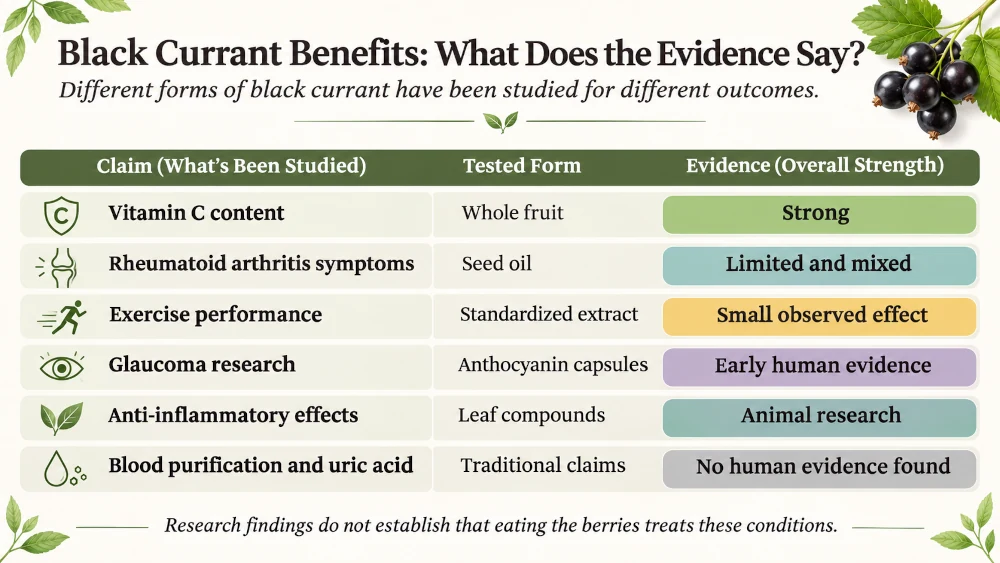
The claims below aren’t equally strong. The biggest difference is what was actually tested: the whole fruit, oil pressed from the seeds, compounds from the leaves, or standardized capsules.
| Claim | What was tested | Evidence |
| Excellent vitamin C source | Nutrient analysis of raw fruit | Strong |
| Eases rheumatoid arthritis | Seed oil capsules; two small trials | Limited and mixed |
| Anti-inflammatory (leaves) | Leaf compounds injected into rats | Animal only |
| Slows glaucoma | 50 mg/day anthocyanin capsules; 38 patients | Early: one small trial |
| Better sport performance | NZ blackcurrant extract; 9 pooled studies | Small effect; moderate quality |
| Inflammation, blood sugar | Mostly lab and short-term studies | Early-stage |
| Purifies blood, lowers uric acid, protects arteries | Traditional claims | No human trials found |
Vitamin C and plant iron
Black currants contain 1.54 mg of iron per 100 g [USDA FoodData Central, n.d.]. That is a modest amount, and it is nonheme iron, the plant form. Vitamin C improves how well your body absorbs nonheme iron [NIH ODS, n.d.], and black currants deliver both in the same bite. They also make a good partner for iron-rich plant foods like lentils, beans, and spinach.
One thing vitamin C won’t do is stop you catching colds. Taking at least 200 mg a day doesn’t lower how often most people catch one, though it may shorten colds a little in people who take it regularly [NIH ODS, n.d.].
Joint pain and rheumatoid arthritis
This is the claim black currants are best known for, and it is mostly about the seed oil. Black currant seed oil is about 17% gamma-linolenic acid (GLA), an omega-6 fat, and 13% alpha-linolenic acid (ALA), an omega-3 [Versus Arthritis, n.d.].
In a 24-week trial in people with active rheumatoid arthritis, seed oil reduced some signs and symptoms of disease activity compared with placebo. Overall clinical response, though, was no better than placebo. Participants had to swallow 15 large capsules a day (10.5 g), and only half of the seed-oil group finished [Leventhal et al., 1994; Versus Arthritis, n.d.]. A second trial, at 3 g a day for six weeks, improved morning stiffness. That benefit had gone six weeks after treatment stopped, and there was no effect on pain or physical function [Versus Arthritis, n.d.]. Versus Arthritis, the UK charity, describes the evidence as small and says the oil may not be effective for RA [Versus Arthritis, n.d.].
The leaves have a reputation of their own. Proanthocyanidins extracted from black currant leaves reduced paw swelling in rats by up to 63% [Garbacki et al., 2004]. However, they were injected, not eaten. The researchers compared them with the anti-inflammatory drug indomethacin and found they acted through a different mechanism [Garbacki et al., 2004]. That is interesting lab science. It isn’t evidence that eating the fruit treats arthritis.
If you have RA, food can support your treatment but not replace it. Our rheumatoid arthritis diet guide covers the eating changes with better evidence behind them.
Eye health and glaucoma
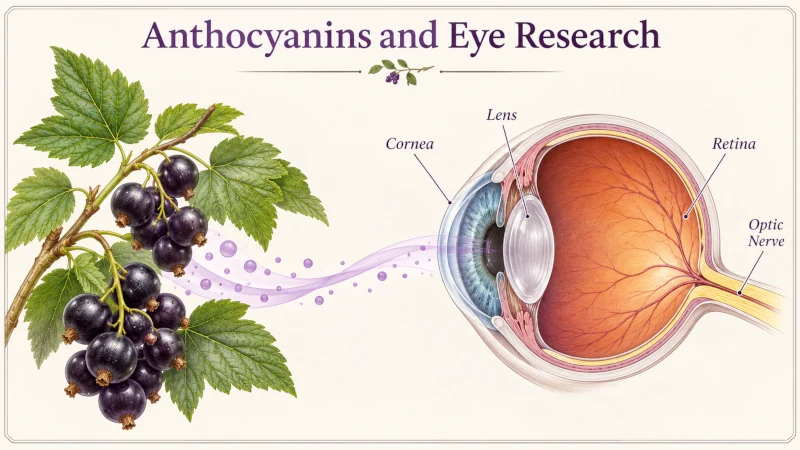
A Japanese trial gave 38 people with open-angle glaucoma either 50 mg a day of black currant anthocyanins or a placebo for two years. Everyone also kept using their usual eye drops. Visual field loss was smaller in the anthocyanin group (the study’s main measure; p = 0.039), and blood flow to the eye was higher. Eye pressure didn’t change [Ohguro et al., 2012].
That is encouraging, but it is a single trial of 38 people using a concentrated supplement. It isn’t a reason to change glaucoma care. If you are curious, raise it with your eye doctor, and never stop prescribed drops in favor of a supplement.
Exercise performance
A 2020 meta-analysis pooled nine trials of New Zealand blackcurrant extract and found a small but real improvement in performance. Outcomes included time trials, time to fatigue, and climbing hang time, and the size of the effect was similar to caffeine’s in the same analysis [Braakhuis et al., 2020]. Most studies used 105–210 mg of anthocyanins a day for about a week, with the last dose one to two hours before exercise.
The caveats are real. Most participants were sub-elite athletes. Industry-funded studies were rated high risk for bias, and side effects weren’t collected systematically [Braakhuis et al., 2020]. Fresh black currants contain roughly 130–460 mg of anthocyanins per 100 g depending on the fruit [Braakhuis et al., 2020], but the trials used standardized extract, so there is no evidence that a bowl of berries does the same thing.
Inflammation, blood sugar, and the older claims
A 2019 review concluded that black currants have potential for conditions linked to inflammation and blood-sugar regulation [Cortez & Gonzalez de Mejia, 2019]. Potential is the key word. That research hasn’t yet shown that eating black currants prevents diabetes or heart disease.
Some older herbal books describe black currants as blood-purifying, say they lower uric acid, or say they protect arteries from hardening. I couldn’t find human trials supporting any of those claims. Treat them as tradition, not evidence.
Fruit, juice, or supplement?
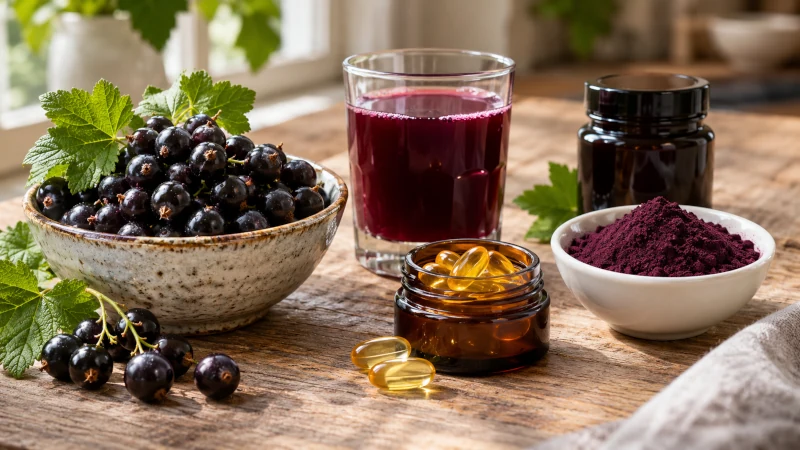
The form you choose changes both what you get and how careful you need to be.
| Form | What you get | Watch for |
| Fresh or frozen berries | The full nutrient profile in the table above | Very tart raw; few cautions apply at food amounts |
| Jam, baked goods, cooked sauces | Flavor and some nutrients | Heat and long storage reduce vitamin C [NIH ODS, n.d.]; check added sugar |
| Juice and cordials | Vitamin C, if the product is mostly black currant | Added sugar; actual black currant content varies |
| Seed oil capsules | GLA and ALA, not vitamin C | Where most of the safety cautions apply (see below) |
| Extract powders and capsules | Concentrated anthocyanins | No established dose; strength varies by maker [WebMD, n.d.] |
How to eat black currants
Raw black currants are sharp and musky, so most people mix them with something. Stir a handful into yogurt or oatmeal, blend frozen berries into a smoothie, or simmer them into a quick sauce for pork, duck, or pancakes. They are classic in jams, crumbles, and summer pudding. To make the most of their vitamin C, eat them alongside an iron-rich plant food like lentils, beans, or spinach.
Safety, side effects, and interactions
None of the sources reviewed here flag problems with eating black currants in normal food amounts. The cautions below are about seed oil and concentrated supplements.
- Side effects. The GLA in seed oil can cause headache, diarrhea, and gas or belching. Allergy is rare [WebMD, n.d.]. In the exercise trials, a few people reported minor stomach upset [Braakhuis et al., 2020].
- Bleeding. Black currant may slow blood clotting. People with a bleeding disorder should avoid it, and you should stop at least two weeks before scheduled surgery [WebMD, n.d.].
- Medication interactions. Possible interactions include blood thinners and antiplatelet drugs such as warfarin, apixaban, rivaroxaban, dabigatran, heparin, clopidogrel, prasugrel, ticagrelor and aspirin, NSAIDs such as ibuprofen and naproxen, and other supplements that slow clotting, such as ginger, clove, angelica and Panax ginseng [WebMD, n.d.]. Combining it with phenothiazine antipsychotics may raise seizure risk in some people [WebMD, n.d.].
- The sources disagree on how big that risk is. WebMD lists these as interactions. Versus Arthritis says effects on other medicines haven’t been well studied [WebMD, n.d.; Versus Arthritis, n.d.]. Most of the bleeding concern is based on how GLA works rather than on reported cases. Treat it as a reason to check with a pharmacist, not as a proven danger.
- Pregnancy and breastfeeding. WebMD’s guidance is to avoid black currant products to be safe [WebMD, n.d.]. Ask your midwife or doctor before using any supplement.
- Dose. No optimal dose has been established for any condition, and quality varies widely between manufacturers [WebMD, n.d.].
- Vitamin C ceiling. The upper limit for adults is 2,000 mg a day [NIH ODS, n.d.]. You won’t reach that from berries, but it matters if you stack black currant extract with other vitamin C supplements.
Who should skip black currant supplements (or clear them with a clinician first): anyone with a bleeding disorder, anyone taking a blood thinner, antiplatelet drug or phenothiazine, anyone with surgery coming up, and anyone who is pregnant or breastfeeding.
When to talk to a doctor
- Before starting seed oil or extract if you take any prescription medicine. A pharmacist can check interactions in a few minutes.
- If you have RA or glaucoma and want to try black currant alongside treatment. Don’t use it instead of treatment.
- Get same-day care for sudden eye pain, sudden blurred or lost vision, or halos around lights with headache or nausea.
- Get prompt care for a joint that suddenly becomes hot, red and swollen, especially with a fever. The same goes for unusual bruising, bleeding gums, or black stools while taking a blood thinner.
| HEALTH DISCLAIMER: This article is for general education and isn’t a substitute for advice, diagnosis, or treatment from a qualified healthcare professional. Black currant supplements can interact with medicines and aren’t right for everyone. Talk to your doctor or pharmacist before using them, especially if you are pregnant or breastfeeding, take a blood thinner or other prescription medicine, have a bleeding disorder, or have surgery scheduled. Don’t stop or change a prescribed treatment because of anything you read here. |
Frequently Asked Questions
Are black currants healthy to eat every day?
As a fruit, yes for most people. They are low in calories and very high in vitamin C, and the reviewed sources raise no specific concerns about normal food amounts [USDA FoodData Central, n.d.; WebMD, n.d.]. The cautions apply to seed oil and concentrated supplements.
Do black currants have more vitamin C than oranges?
Yes, by a lot. 100 g of raw black currants has about 181 mg of vitamin C, compared with about 70 mg in a whole medium orange [USDA FoodData Central, n.d.; NIH ODS, n.d.].
Does black currant seed oil help arthritis?
The evidence is thin. Two small rheumatoid arthritis trials found modest or short-lived improvements, and overall response in the larger one was no better than placebo [Leventhal et al., 1994; Versus Arthritis, n.d.]. I found no human trials of it for osteoarthritis or gout.
Can I take black currant supplements with blood thinners?
Check with your doctor or pharmacist first. Black currant seed oil may slow clotting, and WebMD lists interactions with warfarin, apixaban, rivaroxaban, clopidogrel and other anticoagulant or antiplatelet drugs [WebMD, n.d.].
Is black currant juice as good as the berries?
Not usually. Heat and storage reduce vitamin C [NIH ODS, n.d.], and many juice drinks add sugar or contain only a small share of black currant. Check the label for both.
Why are black currants hard to find in the US?
Growing them was federally banned from 1911 to 1966 because some Ribes species spread white pine blister rust, a fungus that kills five-needle pines [Savanna Institute/UW-Madison, n.d.].
References
- U.S. Department of Agriculture, Agricultural Research Service. Currants, European black, raw View source
- National Institutes of Health, Office of Dietary Supplements. Vitamin C: Fact Sheet for Health Professionals. View source
- Cortez RE, Gonzalez de Mejia E. Blackcurrants (Ribes nigrum): A Review on Chemistry, Processing, and Health Benefits. View source
- Garbacki N, Tits M, Angenot L, Damas J. Inhibitory effects of proanthocyanidins from Ribes nigrum leaves on carrageenin acute inflammatory reactions induced in rats. View source
- Leventhal LJ, Boyce EG, Zurier RB. Treatment of rheumatoid arthritis with blackcurrant seed oil. View source
- Versus Arthritis. Blackcurrant seed oil (Complementary and alternative treatments). View source
- Braakhuis AJ, Somerville VX, Hurst RD. The effect of New Zealand blackcurrant on sport performance and related biomarkers: a systematic review and meta-analysis. View source
- Ohguro H, Ohguro I, Katai M, Tanaka S. Two-year randomized, placebo-controlled study of black currant anthocyanins on visual field in glaucoma. View source
- WebMD. Black Currant: Overview, Uses, Side Effects, Precautions, Interactions, Dosing and Reviews. View source
- Savanna Institute. Black Currant (Ribes nigrum) fact sheet. Hosted by University of Wisconsin-Madison Division of Extension, Crops & Soils. View source


