Most searches for natural remedies for eye problems come from people dealing with the same small handful of complaints: tired and dry eyes from screens, an itchy eyelid, a tender stye, puffy mornings, watery or red eyes during allergy season. Many of these respond well to simple, low-cost home care. A few do not, and trying to treat them at home can cost you vision.
This guide separates the two. It covers the home remedies that have real support — warm and cool compresses, lid hygiene, screen breaks, eye-healthy foods, and lubricating drops — and is honest about the ones that don’t have much evidence or that carry safety concerns, including some of the herbs commonly recommended online. It also lists the red flags that mean you should skip home care and call an eye doctor today.
When to skip home care and see an eye doctor

Some eye symptoms can look mild but signal something urgent. The American Academy of Ophthalmology and National Eye Institute list several signs that should send you to an eye doctor or emergency room rather than a kitchen-cabinet remedy. [AAO, 2024] [NEI, 2024]
Get same-day care for any of the following:
- Sudden vision loss, even briefly, in one or both eyes
- Sudden double vision, curtain across vision, or a shower of new floaters or flashes of light
- Eye pain with redness, especially with light sensitivity, nausea, or a hard-feeling eyeball
- A yellow tint to the white of the eye (sclera) — this can signal liver disease and is not a home-remedy problem
- Bulging eye, an eye that suddenly looks different from the other, or eyelid swelling with fever
- Chemical splash, foreign object stuck in the eye, or any eye injury
- Pus-like discharge in a newborn, or any eye redness in a baby under 3 months
- Contact-lens-related pain, redness, or blurry vision that does not clear within an hour of removing the lens
If you are not sure how serious your symptom is, call an ophthalmology or optometry office and describe it. They will tell you whether to be seen today, this week, or whether a simple home approach is reasonable. For sudden vision changes after age 50, do not wait — conditions like retinal artery occlusion are time-sensitive. [AAO, 2023]
Home care that actually helps
For everyday irritation, eye strain, mild dryness, allergy itch, styes, and clogged eyelid glands, a few simple measures do most of the work. They cost almost nothing and are backed by mainstream eye care guidance.
Warm compresses
A clean washcloth soaked in warm (not hot) water, wrung out, and held over closed eyelids for about 5 to 10 minutes, twice a day, is the standard first step for styes, chalazia, blepharitis, and the most common form of dry eye, which is caused by clogged oil glands in the eyelid margins (meibomian gland dysfunction). Re-wet the cloth as it cools. Gentle massage of the closed eyelid afterward can help express the softened oils. [Mayo Clinic, 2023]
Cool compresses
For itchy, allergy-flared eyes, puffy eyelids, and the irritation that follows hay-fever exposure, a cool damp cloth or a chilled gel mask helps. The cold dampens histamine-driven itch and constricts surface vessels for a short period. Use clean cloths each time, and never share them.
The 20-20-20 rule for screen time
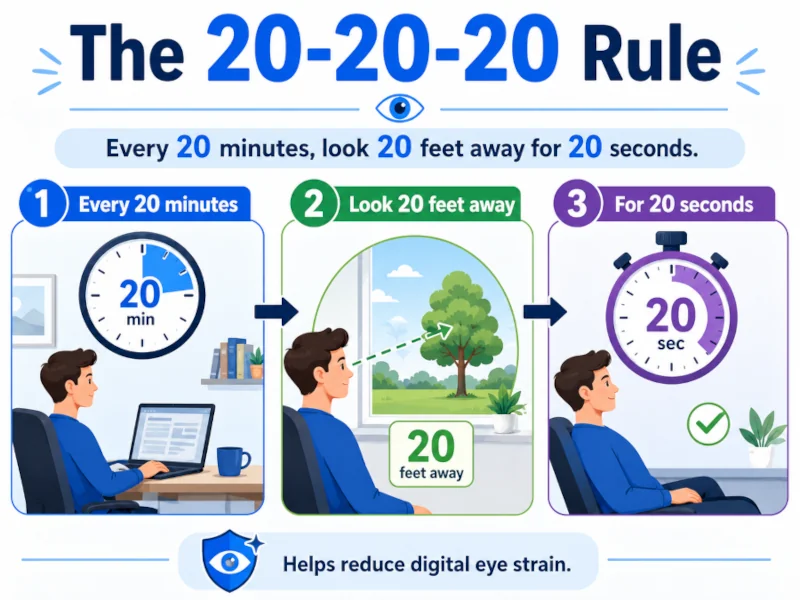
Every 20 minutes of screen work, look at something about 20 feet away for at least 20 seconds. People blink up to 60 percent less while staring at screens, which is the main reason eyes feel gritty, achy, or blurry after a long workday. The American Academy of Ophthalmology endorses this break pattern as a simple anti-strain habit, alongside frequent conscious blinking, lubricating drops, and screen distance of roughly 25 inches. [AAO, 2024]
Lubricating drops (artificial tears)
Over-the-counter preservative-free artificial tears are the most reliable home remedy for mild dry eye and screen-related discomfort. Use them up to four times a day; if you need them more often than that, switch to a preservative-free brand to avoid irritation from preservatives. Avoid “redness-relief” drops with vasoconstrictors (tetrahydrozoline, naphazoline) for daily use — they can cause rebound redness when stopped.
Eyelid hygiene
Crusting at the lash line, recurring styes, and chronically itchy or burning lid margins usually point to blepharitis. The accepted home routine is a warm compress for several minutes, followed by gentle scrubbing of the closed lash line with a few drops of diluted baby shampoo on a clean fingertip or a commercial lid wipe, then rinsing. Do this once or twice a day during a flare and a few times a week as maintenance. The hordeolum and chalazion guide on this site covers the difference between a stye and a chalazion and when each needs a doctor.
Sleep, hydration, and air quality
Eyelid puffiness, dark circles, and that gritty morning feeling often track with sleep debt, dehydration, salt-heavy meals, and dry indoor air. None of those are dramatic causes, and none of them needs an herbal product. A consistent sleep schedule, a glass of water with each meal, lower-sodium evenings, and a small humidifier in winter help more than most supplements.
Eye-healthy nutrition: what the evidence supports
Diet plays a real, if gradual, role in eye health. The National Eye Institute recommends a balanced diet rich in leafy greens (spinach, kale, collards) and oily fish (salmon, tuna, sardines) as part of basic eye care, alongside not smoking, controlling blood sugar and blood pressure, and getting regular dilated eye exams. [NEI, 2024] [AOA, 2024]
Foods with the most consistent eye-health evidence:
| Nutrient | Why it matters for eyes | Best food sources |
| Lutein and zeaxanthin | Carotenoids concentrated in the macula; help filter blue light and protect retinal tissue | Kale, spinach, collards, egg yolks, corn, orange peppers |
| Omega-3 fatty acids (EPA/DHA) | May support tear film quality; evidence is mixed for dry eye but the dietary pattern is sound | Salmon, sardines, mackerel, herring, walnuts, flax |
| Vitamin A / beta-carotene | Required for the retinal pigment that lets you see in low light; severe deficiency causes night blindness | Carrots, sweet potato, butternut squash, liver, eggs |
| Vitamin C and E | Antioxidants in the AREDS2 formula shown to slow intermediate age-related macular degeneration | Citrus, berries, peppers, almonds, sunflower seeds |
| Zinc | Helps move vitamin A from the liver to the retina; part of the AREDS2 formula | Oysters, beef, pumpkin seeds, chickpeas, lentils |
About AREDS2 supplements
The AREDS2 formula — vitamin C, vitamin E, lutein, zeaxanthin, zinc, and copper — is the one eye supplement with strong clinical-trial evidence behind it. The NIH-funded AREDS and AREDS2 trials showed it can slow the progression of intermediate or late age-related macular degeneration by roughly 25 percent over five years. [NEI, 2022] It is not a general vision booster. People without AMD do not get a measurable benefit, and AREDS-style high-dose zinc is not appropriate for everyone. Talk with your ophthalmologist before starting it. [NEI, 2023]
A word on mega-dose vitamins
Some older guides recommend very high daily doses of vitamins A, C, and E for eye health. Routine megadosing isn’t well supported and can cause harm. Vitamin A above roughly 10,000 IU per day from supplements can be toxic and is dangerous in pregnancy. The original AREDS formula contained 15 mg of beta-carotene, which was later removed from AREDS2 because it raised lung cancer risk in current and former smokers. [NEI, 2022] High-dose vitamin C and E supplements have not been shown to prevent or reverse cataracts, dry eye, or glaucoma. Get these nutrients primarily from food.
Herbs and traditional remedies — what evidence shows
Eye-related herbs sit in three buckets: a few with at least some research, several with mainly historical use, and a small number that are actively risky for the eye-care use you might see suggested online. The guide to herbs for eye health on this site covers the broader list; here is a brief, honest look at the most-asked-about ones.
Eyebright (Euphrasia officinalis)
Eyebright has been used for centuries as a topical eye wash and oral tea for irritated eyes, conjunctivitis, and styes. Modern clinical evidence is limited — small open-label studies and traditional use, not large randomized trials. As an eye wash, homemade preparations are not sterile and can introduce bacteria onto the eye surface, so this is one to skip in favor of sterile saline or artificial tears. Oral eyebright tea is gentler but should still be avoided in pregnancy and in children unless cleared with a clinician.
Bilberry (European blueberry)
Bilberry contains anthocyanins, plant pigments studied for their effect on small blood vessels and antioxidant activity. The often-repeated story that British Royal Air Force pilots used bilberry jam to improve night vision in World War II is not supported by good evidence, and modern randomized trials have not shown a clear effect on night vision in healthy adults. Bilberry is generally safe in food amounts. As a supplement it is studied for eye fatigue and circulation, with modest and inconsistent results. See the longer bilberry overview for details.
Chamomile, green tea, and witch hazel compresses
Cool, well-strained chamomile tea or used (cooled) green tea bags applied over closed eyelids are common folk treatments for tired, puffy eyes. The benefit is mostly the cool compress effect plus mild astringents from the tea — pleasant, but not a treatment for infection or for true allergic conjunctivitis. Make sure anything you apply is clean, cool, and not allowed to drip into the eye. People with a ragweed allergy can also react to chamomile (both are in the Asteraceae family).
Goldenseal eye washes — be cautious
Older home-remedy books recommend goldenseal root tea as an eye wash for discharge or mild infection. Two cautions matter here. First, homemade plant teas are not sterile and can worsen an eye infection. Second, goldenseal contains berberine, which is not safe in pregnancy or in newborns — it can displace bilirubin and contribute to jaundice in infants. If you suspect an eye infection, especially in a child, see a clinician for proper diagnosis. The natural remedies for conjunctivitis article covers safer steps for pink eye.
Herbs to avoid for eye problems
Chaparral (Larrea tridentata) is sometimes recommended in older naturopathic texts for diabetic eye damage or as a general “eye tonic.” Don’t use it. The NIH LiverTox database lists chaparral as a known cause of drug-induced liver injury, with case reports of severe hepatitis and acute liver failure requiring transplant; the FDA has issued safety warnings. [NIH LiverTox, 2022] Tansy and yarrow eye washes recommended in some folk medicine texts also carry risk: tansy contains thujone (neurotoxic in higher doses), and yarrow can cause allergic skin and eye reactions.
Do not try “liver flushes” or apple-juice-and-olive-oil protocols for yellow eyes. Yellowing of the sclera (jaundice) is a medical sign — most commonly of liver disease, bile duct blockage, or red blood cell breakdown — and needs an evaluation, not a kitchen remedy. The myth that drinking olive oil and citrus passes gallstones has been studied; the “stones” people see afterward are soap-like complexes that form from the oil itself, not gallstones.
Common eye complaints and what to actually do
Dry, gritty, or burning eyes

Most chronic dryness is evaporative — the oil layer of your tears is thin, usually from clogged lid glands. Combine warm compresses twice daily, preservative-free artificial tears, the 20-20-20 rule at screens, and a small humidifier. Cut back on overhead fans and forced-air vents pointed at your face. Smokers should add stopping smoking to the list — tobacco smoke is a major dry-eye irritant. If you still have symptoms after a few weeks, see an eye doctor; options like prescription drops, punctal plugs, or in-office gland-clearing devices help when home care isn’t enough.
Oral omega-3 supplements are widely recommended but have mixed evidence. A 2018 NIH-funded randomized trial of 535 adults (the DREAM study) found that 3 grams a day of fish-derived omega-3 worked no better than an olive oil placebo for moderate-to-severe dry eye over one year. [Asbell et al., NEJM, 2018] Some smaller studies suggest omega-3 may help as an add-on for meibomian gland dysfunction. Eat a couple of fish meals a week regardless; do not expect a supplement alone to fix the problem. See the dry tear ducts article if your eyes are watery rather than dry — that often means the drainage system, not tear production.
Stye or eyelid bump
A stye (hordeolum) is a small, tender, red bump at the lash line, usually caused by a staph infection of an oil gland. A chalazion is a firm, usually painless lump from a blocked gland. Both respond to the same first step: warm compresses, 5 to 10 minutes, three to four times a day, for one to two weeks. Do not squeeze it. See a doctor if the lump grows, the eyelid becomes very swollen, vision changes, or the bump hasn’t resolved after a month — a small in-office procedure may be needed.
Itchy, watery eyes (allergies)
Bilateral itching with watery, stringy discharge is almost always allergic. Cool compresses, preservative-free artificial tears (refrigerated for extra relief), and an over-the-counter antihistamine eye drop such as ketotifen or olopatadine work quickly for most people. Rinse pollen off skin and hair before bed in allergy season. If your itch is one-sided, comes with pus-like discharge, or involves significant pain, see a doctor — it’s likely not allergy.
Tired, strained eyes from screens
Digital eye strain is uncomfortable but not damaging. Move the monitor about an arm’s length away, set the top of the screen at or just below eye level, increase font size, and follow the 20-20-20 rule. Blue-light-blocking glasses have not been shown to reduce eye strain in well-controlled trials; if you wear computer glasses, a focal-distance prescription matters more than the tint.
Puffy eyes and dark circles
These are mostly about sleep, salt, alcohol, and genetics. A cool compress in the morning for ten minutes reduces puffiness for a few hours. Sleeping with the head slightly elevated, lowering evening sodium, and limiting alcohol the night before help with morning swelling. Dark circles often run in families and reflect thin skin and pigmentation — no tea bag will erase them, though good sleep and a quality sunscreen on the under-eye area can soften them over months. New, persistent, asymmetric, or worsening swelling — especially with redness or pain — needs a clinician’s eye, not a cucumber slice.
Discharge or “mucus” in the eye
Crusty or sticky discharge often comes from blepharitis or mild conjunctivitis. Lid hygiene, warm compresses, and clean hands are first steps. Yellow-green or thick pus, especially with a red, painful eye, points toward bacterial infection and needs evaluation — prescription antibiotic drops are usually quick to work. If you wear contact lenses and develop discharge with pain or blurry vision, take the lenses out and call an eye doctor today; contact-related corneal infections can scar quickly. The what can be mistaken for pink eye article lists conditions that look like conjunctivitis but aren’t.
Habits that protect your eyes (and ones that don’t help)
These steps have solid evidence:
- Wear sunglasses that block 99–100% of UVA and UVB whenever you’re outside, even on cloudy days
- Wear safety glasses for yard work, power tools, racquet sports, and any chemicals
- Don’t sleep in contact lenses — overnight wear sharply raises the risk of microbial keratitis, a corneal infection that can scar
- Wash hands before touching eyes, and don’t share towels, eye drops, or eye makeup
- Quit smoking — tobacco is a strong, independent risk factor for cataracts, AMD, and dry eye
- Control diabetes and blood pressure, the two largest drivers of vision loss in adults
- Get a comprehensive dilated eye exam on the schedule your doctor recommends (often every 1–2 years over age 40)
These are commonly repeated but not well supported:
- “Eye exercises” to improve refractive error or replace glasses — vision therapy has narrow uses for binocular disorders, not for nearsightedness or aging eyes
- Vegetable-juice fasts, coffee enemas, or “liver flushes” for eye conditions
- High-dose vitamin protocols for general vision improvement
- Tobacco abstinence by replacing cigarettes with vaping — vaping is not a safe substitute for eye-surface health
- Tinted sunglasses without UV protection — color doesn’t equal UV blocking; check the label
Who should be extra cautious
Anything you put in or near your eyes — or any supplement you swallow — interacts with the rest of your health. A few groups should be more careful than average:
- People who are pregnant or breastfeeding. Many herbs that look gentle (goldenseal, chaparral, large amounts of vitamin A, eyebright) are not safe in pregnancy. Stick with diet, warm/cool compresses, and OTC artificial tears unless your obstetrician approves something else.
- Children, especially newborns. Eye discharge in a baby under 3 months is a doctor visit, not a home-remedy situation. Do not use herbal eye washes on infants.
- Contact lens wearers. Anything that puts non-sterile liquid (tea, juice, homemade saline) on the eye risks infection of the cornea, which is a sight-threatening problem. Use sterile products only.
- People with diabetes, glaucoma, or AMD. Coordinate any supplements — including the AREDS2 formula — with your ophthalmologist. Some herbs interact with blood-thinners or blood-sugar drugs.
- People on warfarin, DOACs, or aspirin. Bilberry, ginkgo, and high-dose vitamin E can increase bleeding risk.
- People with liver or kidney disease. Avoid chaparral, comfrey, and any herb with documented hepatotoxicity. Tell your specialist about every supplement you take.
Realistic expectations
Most minor eye complaints — strain, occasional dryness, mild allergy itch, a stye that’s just appeared — improve within a few days to a couple of weeks with the basics above. Chronic problems (long-standing dry eye, recurrent blepharitis, blurry vision, floaters that don’t fade) need a clinician’s eye, not a longer list of home remedies.
No herb, juice, or vitamin protocol has been shown to reverse cataracts, regrow optic nerve fibers lost to glaucoma, or restore lost macular vision. What lifestyle and nutrition do offer — and this is meaningful — is slowing the rate of common age-related eye change, reducing strain symptoms day-to-day, and supporting the medical treatments your eye doctor prescribes. The glaucoma overview on this site goes into why prescribed drops are non-negotiable for that specific condition.
| Health Disclaimer This article is for general education only and is not medical advice, diagnosis, or treatment. Eye problems can range from minor irritation to sight-threatening emergencies, and an in-person exam is the only way to tell them apart. Always speak with a qualified eye care professional — an ophthalmologist or optometrist — before starting or stopping any supplement, herb, eye wash, or home routine. Seek urgent care for sudden vision loss, eye pain, eye injury, chemical exposure, flashes and floaters, a yellow tint to the white of the eye, or any vision change you can’t explain. If you are pregnant, breastfeeding, taking prescription medication, or have an existing eye condition, get individualized advice before trying anything described here. |
Frequently asked questions
Are natural remedies enough to treat an eye infection?
Sometimes for very mild irritation, but often not. Bacterial conjunctivitis, corneal infections, and styes that don’t drain usually need a clinician’s evaluation and may need prescription antibiotic drops. Home care helps comfort and prevention; it does not replace antibiotics when an infection is established. When in doubt, get it checked.
Can carrots, blueberries, or bilberry actually improve my vision?
They can support eye health, especially long-term, but they will not sharpen vision in someone who is already well-nourished. Severe vitamin A deficiency causes night blindness, and that does reverse with diet or supplementation. In well-fed adults, eating more carrots will not let you stop wearing glasses. The benefit is slower age-related decline, not visual zoom.
Is it safe to rinse my eyes with herbal tea or saline at home?
Sterile, single-use saline (the kind sold for contact lens use or as eye-wash) is fine for flushing dust or pollen. Homemade tea or salt water is not sterile and can introduce bacteria onto the eye surface, especially if you have any break in the cornea. Stick to sterile products.
Should I take an AREDS2 supplement to prevent macular degeneration?
The trial evidence supports AREDS2 for people who already have intermediate or late AMD in at least one eye. It is not a general prevention pill, and high-dose zinc isn’t right for everyone. Ask your ophthalmologist whether you fit the profile that benefits. [NEI, 2023]
How often should an adult get an eye exam?
The American Academy of Ophthalmology recommends a baseline comprehensive eye exam by age 40, with the frequency afterward set by your eye doctor based on risk factors. Most adults over 60 should be examined every 1 to 2 years, sooner if they have diabetes, family history of glaucoma or AMD, or any change in vision. [NEI, 2024]
References
- National Eye Institute. Keep Your Eyes Healthy. NIH; 2024. → View source
- National Eye Institute. 8 Things You Can Do Right Now to Protect Your Vision. NIH; 2024. → View source
- American Academy of Ophthalmology. Computers, Digital Devices, and Eye Strain. AAO; 2024. → View source
- American Academy of Ophthalmology. Eye Symptoms List. AAO; 2024. → View source
- American Academy of Ophthalmology. Top 10 Eye Emergencies. YO Info; 2023. → View source
- American Optometric Association. Diet and Nutrition. AOA; 2024. → View source
- National Eye Institute. AREDS 2 Supplements for Age-Related Macular Degeneration. NIH; 2023. → View source
- Chew EY et al. NIH study confirms benefit of supplements for slowing age-related macular degeneration. National Eye Institute; 2022. → View source
- Asbell PA et al. n−3 Fatty Acid Supplementation for the Treatment of Dry Eye Disease (DREAM Study). N Engl J Med. 2018;378(18):1681–1690. → View source
- National Institutes of Health. Omega-3s in fish oil supplements no better than placebo for dry eye. NIH News; 2018. → View source
- Mayo Clinic. Dry Eyes — Diagnosis and Treatment. Mayo Clinic; 2023. → View source
- LiverTox: Clinical and Research Information on Drug-Induced Liver Injury. Chaparral. National Institute of Diabetes and Digestive and Kidney Diseases; updated 2022. → View source
