
A painful, pimple-like bump right at the edge of your eyelid is most likely a stye. A firm, mostly painless lump a little farther back in the lid is more likely a chalazion. Doctors call these two conditions hordeolum and chalazion, and for the first day or two they can look almost identical. Their causes differ, though: a hordeolum is usually a bacterial infection of an eyelid gland, while a chalazion is a blocked oil gland with no infection behind it [Merck Manual on chalazion and hordeolum, 2026].
The reassuring part: both usually clear up on their own, and the same simple home care helps both. Knowing which one you have mostly matters for knowing when to stop waiting.
Hordeolum and chalazion at a glance
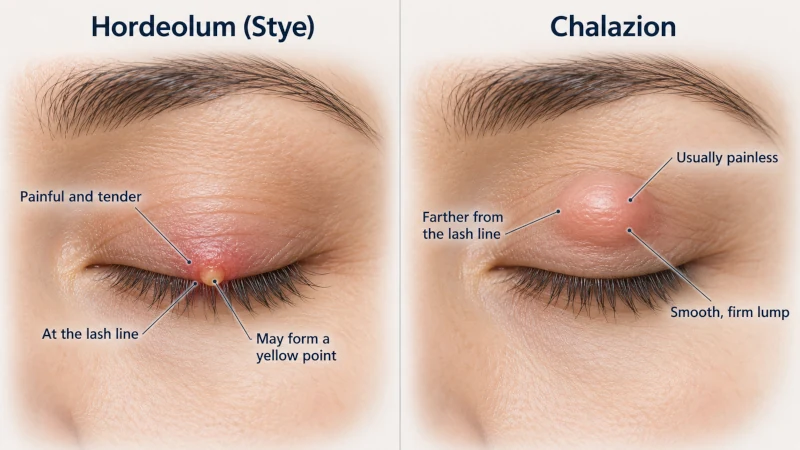
| Hordeolum (stye) | Chalazion | |
| What causes it | Usually a bacterial infection, most often Staphylococcus aureus | A blocked meibomian (oil) gland; not an infection |
| Pain | Painful and tender | Often sore at first, then a painless lump |
| Where it sits | At the lash line (external) or on the inside of the lid (internal) | In the body of the lid, often a little back from the edge |
| What it looks like | Red, swollen bump, often with a yellow point of pus | Smooth, firm, round lump |
| How long it lasts | Most clear within 1 to 2 weeks | Often drains or fades in 2 to 8 weeks; sometimes longer |
| First-line care | Warm compresses, clean lids, hands off | Warm compresses, clean lids, gentle massage |
Sources: [Merck Manual, 2026], [StatPearls on hordeolum, 2024], [Mayo Clinic on styes, 2025].
What a hordeolum (stye) is
A hordeolum is a sudden infection of one of the small glands in your eyelid. Roughly 90% to 95% of them are caused by Staphylococcus aureus, a bacterium that commonly lives on skin [StatPearls, 2024]. That’s why a stye often looks and feels like a small boil.
External vs. internal styes
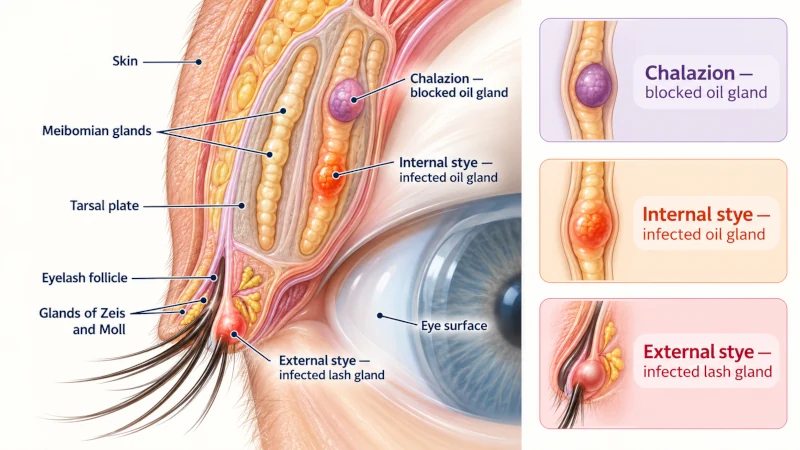
Most styes are external. They start in an eyelash follicle and the tiny glands beside it, called the glands of Zeis and Moll. Within a day or two, a yellowish point usually forms at the base of a lash. The spot then tends to break open and drain within 2 to 4 days, and the pain eases as it does [Merck Manual, 2026].
An internal stye starts in a meibomian gland, one of the oil glands lined up inside the eyelid. It sits deeper, so the swelling is more spread out and it rarely drains on its own. Internal styes can be more inflamed and occasionally come with fever or chills [Merck Manual, 2026].
What raises your risk
Styes are linked to blepharitis (ongoing inflammation of the eyelid edges), rosacea, seborrheic dermatitis, diabetes, contact lens wear, and old or contaminated eye makeup [American Optometric Association on hordeolum, n.d.]. Touching your eyes with unwashed hands and sleeping in eye makeup raise the odds too [Mayo Clinic, 2025]. Once you’ve had one, another is fairly common, especially when blepharitis or rosacea is in the background [StatPearls, 2024].
What a chalazion is
A chalazion isn’t an infection. Your meibomian glands make the oily layer of your tears, which slows evaporation and keeps your eyes comfortable. When one of those glands gets plugged, the trapped oil leaks into the surrounding eyelid tissue and sets off a slow, localized inflammatory reaction. That reaction is the lump you feel [Merck Manual, 2026].
Anything that thickens gland oil makes this more likely, including meibomian gland dysfunction and rosacea [Merck Manual, 2026]. Inflammation from meibomian gland dysfunction can set up both styes and chalazia [AAPOS on meibomian gland dysfunction, 2023], and a stye that never fully clears can leave a chalazion behind [National Eye Institute on blepharitis, 2024].
At first, the whole lid may be swollen and a bit tender. After a day or two, it usually settles into a small, painless nodule. Most chalazia drain through the inner surface of the lid or are reabsorbed within 2 to 8 weeks; a few last longer. A large one can press on the front of the eye and blur vision slightly until it shrinks [Merck Manual, 2026].
How to tell which one you have
Three questions sort out most cases:
- Does it hurt? A stye stays painful and tender. A chalazion usually stops hurting once the early swelling settles.
- Where is it? A stye usually points at the lash line. A chalazion tends to sit in the body of the lid.
- How fast did it change? A stye comes to a head over a few days. A chalazion forms and fades more slowly.
One honest caveat: in the first couple of days, even an eye doctor may not be able to tell them apart, and an internal stye can look a lot like a chalazion [Merck Manual, 2026]. Early home care is the same for both, so you don’t need a label to start.
If the whole eye is red, gritty, or discharging rather than one lid having a single lump, something else may be going on. Our guide to what can be mistaken for pink eye walks through the look-alikes and the signs that need a same-day exam.
How to treat a hordeolum or chalazion at home
Warm compresses: the step that matters most
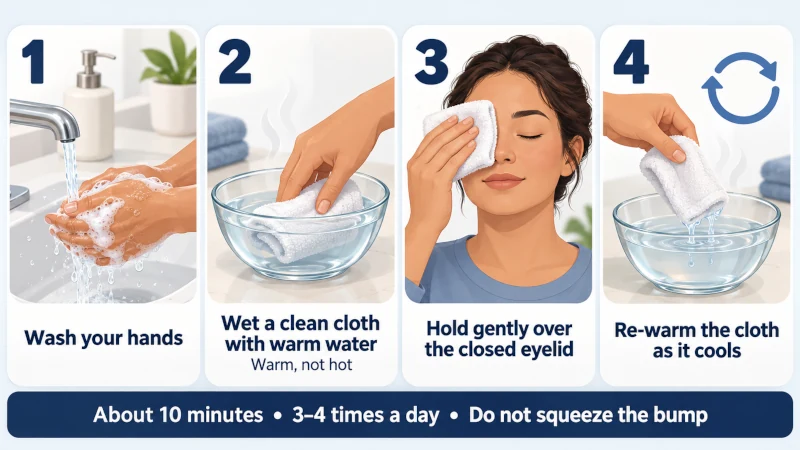
Heat softens thickened gland oil and helps a blocked gland drain. It’s the first-line treatment for both conditions [Merck Manual, 2026].
- Wash your hands.
- Soak a clean washcloth in warm, not hot, water and wring it out.
- Close your eye and hold the cloth gently against the lid.
- Re-warm the cloth whenever it cools.
Sources differ on timing. Mayo Clinic suggests 5 to 10 minutes several times a day [Mayo Clinic, 2025], while StatPearls suggests 10 to 15 minutes, 3 to 4 times a day [StatPearls, 2024]. About 10 minutes, three or four times a day, fits both. Keep going for several days; stopping too soon is a common mistake [StatPearls, 2024].
How strong is the evidence? Warm compresses are standard advice and low risk, but they haven’t been well tested. A Cochrane review looking for randomized trials of compresses, lid scrubs, antibiotics, or steroids for acute internal styes found none that qualified, and concluded there was no evidence for or against these treatments [Cochrane review, 2017]. Compresses are recommended on expert experience, not proven by trials.
Gentle massage and lid cleaning
For a chalazion, gently massaging around the lump with a clean fingertip after a compress may help the gland clear [American Academy of Ophthalmology on chalazion and stye treatment, n.d.]. Keep the pressure light.
Clean the lash line once a day while you heal. The National Eye Institute suggests warm water mixed with a gentle cleanser such as baby shampoo, a fresh cloth or cotton swab for each eye, and a rinse with clean water afterward [National Eye Institute, 2024]. If your lids are often crusty or your eyes feel gritty, oil-gland problems may be part of the picture; our article on dry tear ducts and eyelid gland problems covers that routine in more detail.
What not to do
- Don’t squeeze or pop it. Leave draining to time, heat, or a doctor [American Optometric Association, n.d.].
- Skip eye makeup until it’s healed, and throw out eye makeup you used while it was active [American Optometric Association, n.d.].
- Take a break from contact lenses until the eye has healed, or as your eye doctor advises [StatPearls, 2024].
- Don’t put anything in or on your eye that wasn’t made for eyes. Homemade washes, teas, and food poultices aren’t sterile, and your eyelid is already irritated.
- Don’t reach for leftover prescription drops, especially anything containing a steroid. Steroids used around the eye can raise eye pressure and belong under an eye doctor’s supervision [StatPearls, 2024].
Medical treatment when home care isn’t enough
Most people never need more than compresses. When you do, a doctor has a few options.
Antibiotics. An uncomplicated stye usually doesn’t need them. There’s little evidence that antibiotic ointment helps an isolated stye, and oral antibiotics are generally reserved for infection spreading into the surrounding eyelid tissue, called preseptal cellulitis [StatPearls, 2024]. For an internal stye, antibiotic drops and ointments are usually ineffective; oral antibiotics, sometimes with drainage, are the standard approach [Merck Manual, 2026]. A chalazion isn’t an infection, so it doesn’t need antibiotics [StatPearls, 2024].
Drainage. A stye that won’t settle, or a large chalazion that hasn’t budged after several weeks, can be opened and drained [Merck Manual, 2026]. This is usually a short procedure done in the office with local anesthetic [American Academy of Ophthalmology, n.d.].
Steroid injection. For a large or persistent chalazion, an ophthalmologist may inject a corticosteroid such as triamcinolone directly into the lump to shrink it [Merck Manual, 2026]. Ask about side effects for your eye and skin before you agree to one.
Biopsy for lumps that keep coming back. A chalazion that doesn’t respond to treatment, or keeps returning in the same spot, should be biopsied. Rarely, an eyelid cancer called sebaceous gland carcinoma can look like a stubborn chalazion or stye [Merck Manual, 2026] [StatPearls, 2024]. A lump that isn’t tender, changes the skin color, or makes lashes fall out also deserves a closer look [StatPearls, 2024].
Do natural remedies work for styes and chalazia?
Plenty of home remedies circulate for eyelid bumps. Most have never been studied for this purpose, and a few carry real risks.
| Remedy | What the evidence shows | Safety notes |
| Plain warm-water compress | Standard first-line care from major eye-care sources, though not tested in trials | Warm, not hot; clean cloth each time |
| Chamomile tea compress | No studies for styes or chalazia; any benefit likely comes from the warmth | Chamomile near the eyes can cause irritation, and people allergic to ragweed, daisies, or marigolds are more likely to react [NCCIH on chamomile, 2024]. See our German chamomile guide |
| Potato, carrot, or tea-bag poultices | No evidence; any comfort likely comes from warmth or cool contact | Food isn’t sterile; keep it off irritated eyelids |
| Homemade salt, boric acid, or herbal eye washes | No evidence for styes or chalazia | Not sterile; use only products made for eyes, and only as your eye doctor directs |
| Echinacea by mouth | Research points to a possible modest benefit for colds only; it hasn’t been shown to treat eyelid infections. Our echinacea evidence review covers what it can and can’t do | Daisy-family plant with allergy risk; ask a pharmacist about interactions if you take prescription medicine |
| Eating extra garlic | No evidence it treats eyelid infections | Raw garlic can irritate or burn skin, so never apply it near the eye. More in our garlic evidence guide |
| Vitamin A supplements | Not part of standard treatment for either condition; true vitamin A deficiency is uncommon in the US [NIH Office of Dietary Supplements, 2025] | The adult upper limit for preformed vitamin A is 3,000 mcg RAE (10,000 IU) a day. Too much can cause liver problems and birth defects, and beta-carotene supplements are linked to higher lung cancer risk in smokers [NIH ODS, 2025]. Our Bitot’s spots guide explains what real deficiency looks like |
| Zinc supplements | Not part of standard treatment in major clinical references [Merck Manual, 2026] [StatPearls, 2024] | Don’t take high doses on your own; ask a pharmacist or doctor first |
The pattern is simple. Warmth and clean lids help. Anything that goes into or onto the eye needs to be sterile. Supplements are not a treatment for a stye, and high-dose vitamin A can do real harm, especially if you’re pregnant or could become pregnant.
How to keep styes and chalazia from coming back
- Keep your hands away from your eyes, and wash them before you touch your lids or contacts [Mayo Clinic, 2025].
- Take eye makeup off at bedtime, don’t share it, and replace it about every three months [American Optometric Association, n.d.].
- Keep contact lenses clean and don’t overwear them [American Optometric Association, n.d.].
- Treat blepharitis as a long-term routine. Daily lid cleaning keeps it in check, though it usually doesn’t go away completely [National Eye Institute, 2024].
- Use warm compresses regularly if you’re prone to styes; doing so may help prevent new ones [Mayo Clinic, 2025].
- Ask about underlying conditions if they keep recurring. Rosacea, meibomian gland dysfunction, and diabetes are all linked to repeat styes, and blood sugar testing is recommended for people with recurrent or severe ones [StatPearls, 2024].
When to see a doctor, and when it’s urgent
Make an appointment with your primary care doctor, optometrist, or ophthalmologist if:
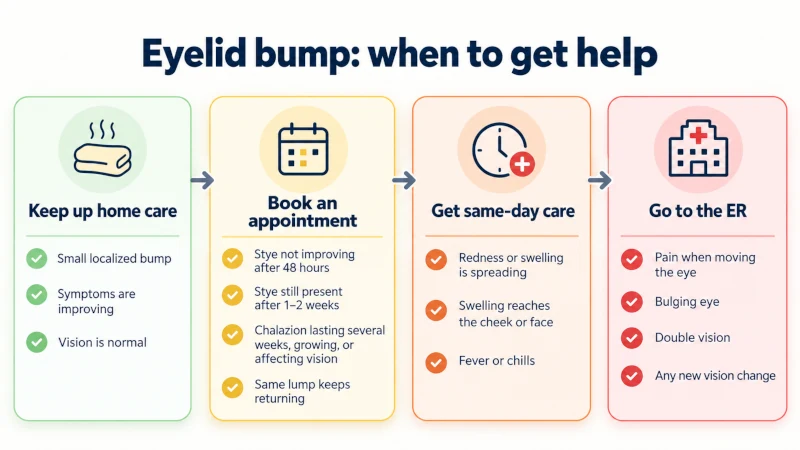
- A stye hasn’t started to improve after 48 hours of home care [Mayo Clinic, 2025].
- A stye isn’t gone after 1 to 2 weeks [StatPearls, 2024].
- A chalazion is still there after several weeks of compresses, is growing, or is blurring your vision [Merck Manual, 2026].
- A lump keeps coming back in the same place, isn’t tender, changes the color of the skin, or makes lashes fall out [StatPearls, 2024].
Get same-day care at urgent care, or call your eye doctor right away, if:
- Redness and swelling spread across the whole eyelid or into your cheek or other parts of your face [American Optometric Association, n.d.] [Mayo Clinic, 2025].
- You have fever or chills along with a swollen eyelid [Merck Manual, 2026].
Go to the ER, or call 911 if you can’t get there safely, if a swollen eyelid comes with pain when you move your eye, a bulging eye, double vision, or any change in your vision. These can be signs that infection has spread behind the eyelid into the eye socket (orbital cellulitis), which needs emergency treatment [StatPearls, 2024].
| Health Disclaimer: This article is for general education only and is not a substitute for medical advice, diagnosis, or treatment. Eyelid lumps that look alike can have different causes, and only an in-person exam can tell them apart with confidence. Don’t use this page to delay care. If you have eye pain, vision changes, spreading redness or swelling, or fever, contact a doctor promptly. Talk with your doctor or pharmacist before taking supplements or herbal products, especially if you’re pregnant, breastfeeding, or take prescription medicine. |
Frequently Asked Questions
Can a stye turn into a chalazion?
Yes. A stye that doesn’t fully clear can block the gland’s normal drainage and leave a firm, painless chalazion behind [National Eye Institute, 2024] [StatPearls, 2024]. Keeping up warm compresses until the stye is completely gone may help.
How long does a chalazion last?
Most drain or are reabsorbed within 2 to 8 weeks, though a few hang on longer [Merck Manual, 2026]. If one is still there after several weeks of home care, a doctor can drain it or inject it.
Should I pop a stye?
No. Let it drain on its own with warm compresses, or have a doctor drain it [American Optometric Association, n.d.].
Do I need antibiotic drops for a stye?
Usually not. Most styes clear with compresses alone, and antibiotic ointments have little evidence behind them for an uncomplicated stye. Oral antibiotics are typically used when infection spreads into the surrounding eyelid [StatPearls, 2024].
Why do I keep getting chalazia or styes?
Repeat eyelid bumps often trace back to blepharitis, meibomian gland dysfunction, or rosacea, all of which thicken or inflame the eyelid’s oil glands [Merck Manual, 2026]. Daily lid care helps. A lump that keeps returning in exactly the same place should be checked by an eye doctor and may need a biopsy.
References
- Allen RC. Chalazion and Hordeolum (Stye). Merck Manual Professional Version. View source
- Gurnani B, Guier CP, Patel BC. Hordeolum (Stye). StatPearls. StatPearls Publishing; NCBI Bookshelf NBK459349; PMID 29083787. View source
- Lindsley K, Nichols JJ, Dickersin K. Non-surgical interventions for acute internal hordeolum. Cochrane Database of Systematic Reviews. 2017;1(1):CD007742. doi:10.1002/14651858.CD007742.pub4. PMID 28068454; PMCID PMC5370090. View source
- American Academy of Ophthalmology. Chalazia and Stye Treatment. EyeSmart. View source
- American Academy of Ophthalmology. What Is the Difference Between a Stye and a Chalazion? EyeSmart. View source
- American Optometric Association. Hordeolum (stye). View source
- Mayo Clinic Staff. Stye (sty): Symptoms & causes. View source
- National Eye Institute. Blepharitis. National Institutes of Health; View source
- American Association for Pediatric Ophthalmology and Strabismus. Meibomian Gland Dysfunction and Treatment. View source
- NIH Office of Dietary Supplements. Vitamin A and Carotenoids: Fact Sheet for Health Professionals. View source
- National Center for Complementary and Integrative Health. Chamomile: Usefulness and Safety. View source


