
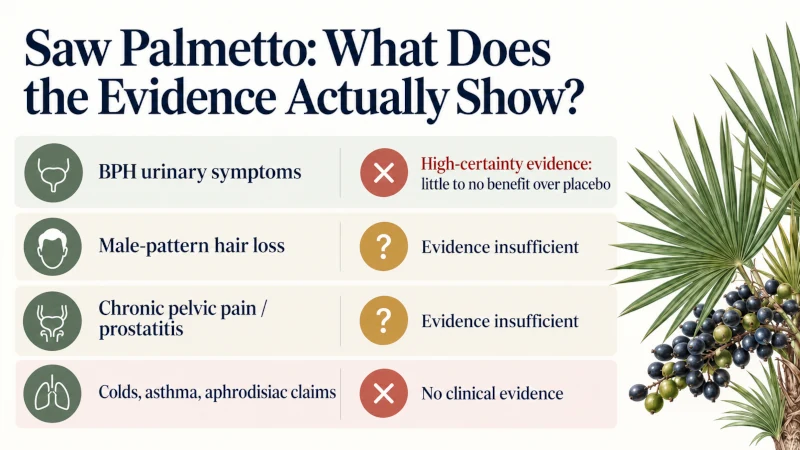
Here is the short, honest version of the palmetto shrub health benefits story: the berry of this small American palm — sold everywhere as saw palmetto — has been studied more than almost any other prostate supplement, and when the best trials are pooled, it works about as well as a placebo for the urinary symptoms of an enlarged prostate. It’s also well tolerated, which is why it remains one of the most popular men’s supplements despite that result. Both of those things can be true at once, and this page is about holding them together instead of picking whichever one sells better.
If you’re weighing whether to try it, or you’re already taking it and want to know if you should keep going, keep reading. The evidence is more settled than the marketing suggests, but there are still a few situations where a conversation with your doctor matters more than anything on a label.
What the palmetto shrub is
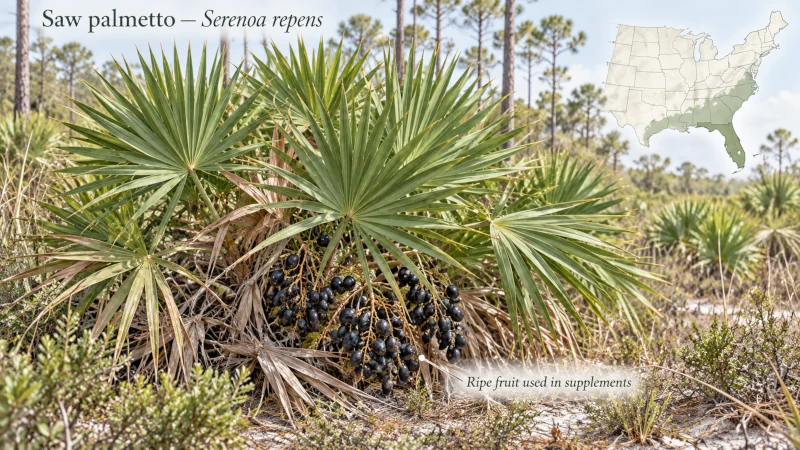
Saw palmetto (Serenoa repens, older botanical name Sabal serrulata) is a low palm native to the southeastern United States, especially Florida, and the West Indies. Its dark berries were a food and folk medicine for Indigenous peoples of the region, and the ripe fruit is the part used today: it grows to roughly 6 to 10 feet, and its berries have long been used for health purposes [NCCIH, 2025]. Modern supplements are made from a fatty (lipidosterolic) extract of those berries, standardized to a set percentage of fatty acids and plant sterols.
Palmetto shrub health benefits, graded by the evidence
Enlarged prostate (BPH) urinary symptoms — the main use
This is the reason saw palmetto exists on shelves. Benign prostatic hyperplasia (BPH) is the non-cancerous prostate growth that’s almost a fact of aging: it affects roughly 5–6% of men aged 40–64 and about a third of men 65 and older, and it can squeeze the urethra enough to cause a weak stream, trouble starting, dribbling, urgency, frequency, and waking at night to urinate [NIDDK, 2024].
The most reliable summary of whether it helps is the 2023 Cochrane review, which pooled 27 randomized trials in 4,656 men. Limiting the analysis to the most rigorous studies, it found that saw palmetto alone results in little to no difference in urinary tract symptoms or quality of life compared with placebo at three to six months, with similar results at 12 to 17 months [Cochrane, 2023].
That finding was rated high-certainty — about as strong as evidence in this field gets. The U.S. National Center for Complementary and Integrative Health puts it plainly: saw palmetto is probably not helpful for urinary symptoms associated with prostate enlargement [NCCIH, 2025]. Two large NIH-funded trials — one at a standard 320 mg daily dose, one at up to three times that — both found no improvement over placebo [NCCIH, 2025].
Why so many people still swear by it
If the good trials are negative, why do so many men feel better on it? A few honest reasons. Earlier and smaller studies, several industry-funded and done in Europe, did report modest symptom relief, and that older literature is what most product pages still quote. BPH symptoms also swing on their own, and the placebo response in these trials is large.
The debate isn’t entirely closed, either: a 2025 systematic review of recent studies reported that signals of benefit showed up more consistently with specific standardized preparations, while explicitly calling for larger, better-designed trials before drawing conclusions [Drugs in Context, 2025] (abstract confirmed; full text could not be independently opened, so treat this as preliminary). It doesn’t overturn the high-certainty finding that the herb, as generally used, doesn’t beat placebo — and when Cochrane reviewers looked specifically at hexane-extracted products, they found no difference from other products [NCCIH, 2025].
Hair loss, chronic pelvic pain, and other claims
Because saw palmetto is thought to nudge the same hormone pathway targeted by hair-loss drugs, it’s marketed for male-pattern baldness and appears in many herbal hair-loss formulas. The evidence there is thin: the few small studies are too limited to allow conclusions. For chronic prostatitis / chronic pelvic pain syndrome, a 2022 review of five studies found no significant benefit, and for other conditions there isn’t enough evidence to say it helps [NCCIH, 2025].
What it does not do
A few claims that circulate widely — including in older versions of this article — are worth retiring. Saw palmetto has not been shown to stop or shrink prostate growth in a way that reliably relieves symptoms; the symptom trials are what matter, and they’re negative. It is not a treatment for prostate cancer, and a large study found it doesn’t lower prostate cancer risk [MSKCC, 2023]. And there is no clinical evidence behind the traditional uses for coughs, colds, bronchitis, asthma, or sore throats. That last point carries a small irony: some over-the-counter cold and cough remedies (decongestants and antihistamines) can actually worsen the urinary symptoms of an enlarged prostate [NIDDK, 2024].
How saw palmetto is thought to work
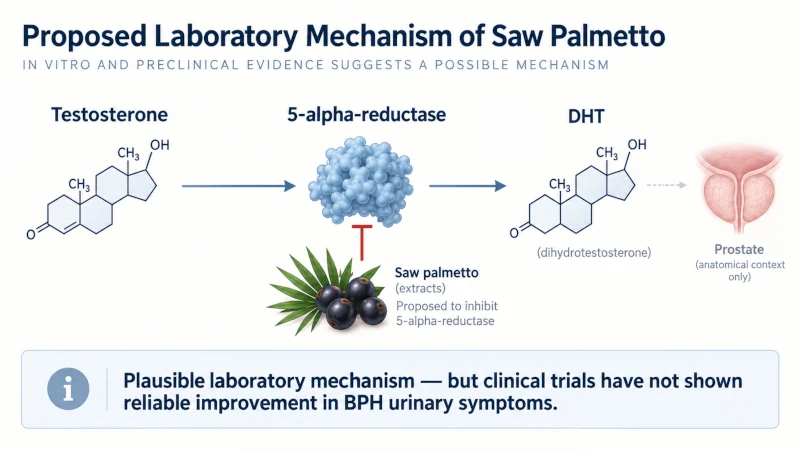
The proposed mechanism is real biology, mostly worked out in the lab. Berry extracts reduce tissue uptake of testosterone and its more potent form, dihydrotestosterone (DHT), and inhibit 5-alpha-reductase — the same enzyme blocked by the prescription drug finasteride — while also damping inflammatory pathways in prostate tissue [MSKCC, 2023]. The gap between this tidy mechanism and the flat symptom results is the whole story of saw palmetto: a plausible way to help does not guarantee help you can feel. One practical upside — unlike finasteride, saw palmetto does not appear to change PSA blood-test readings, even at higher doses, so it’s less likely to mask a result your doctor is watching [NCCIH, 2025].
How it’s used and the dose that’s actually been studied
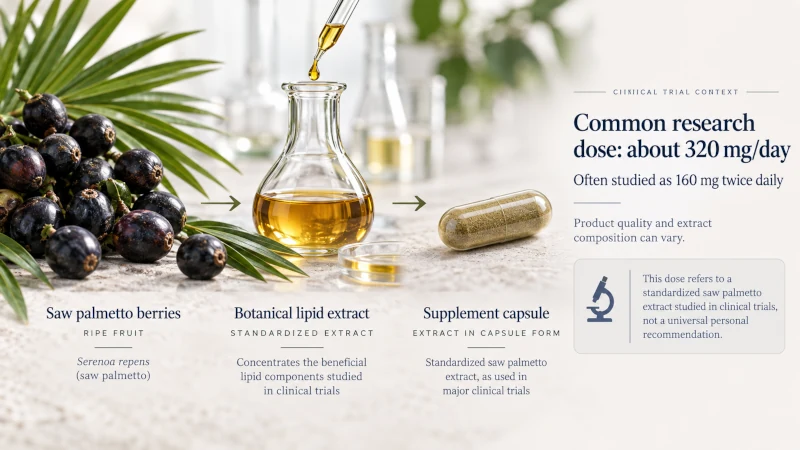
Traditional herbals describe teas and tinctures from dried berries. If you’re going to try saw palmetto, though, the version that’s actually been tested is a standardized lipidosterolic extract at about 320 mg per day, often split as 160 mg twice daily — the dose used across the major trials, taken safely in research for up to three years [NCCIH, 2025]; [MSKCC, 2023].
Supplements aren’t approved by the FDA before sale, and independent testing has repeatedly found that berry content and quality vary between brands, so a product labeled “saw palmetto” isn’t guaranteed to match what was studied [NCCIH, 2025]. Give any trial a fair, consistent run of a couple of months and judge it by your symptoms — not by the promise on the bottle. Nettle root is the herb most often paired with it in prostate formulas; see our note on stinging nettle for how that evidence stacks up.
Side effects and safety
Common side effects
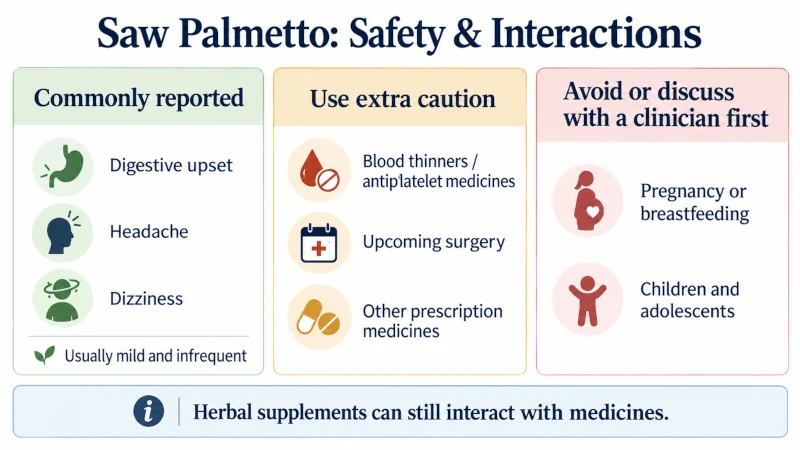
The reassuring part of the record is safety. Across trials, saw palmetto is well tolerated, and adverse effects are mild and infrequent; they may include digestive symptoms, dizziness, and headache [NCCIH, 2025]. Reported effects also include mild GI upset, diarrhea, fatigue, decreased libido, and a runny nose — mostly at rates close to placebo [MSKCC, 2023].
Serious problems are rare and come mainly from isolated case reports rather than controlled studies: bleeding during surgery, blood accumulation around the heart in a man also on a blood thinner, acute pancreatitis, and severe liver injury have each been reported in single patients [MSKCC, 2023]. Rare isn’t impossible, so unusual symptoms — especially abdominal pain or yellowing of the skin or eyes — are worth stopping the supplement and calling a professional over.
Drug interactions
The interaction picture is genuinely mixed, and it’s fair to say so. Saw palmetto may add to the effect of blood thinners: it’s been reported to prolong bleeding time, and case reports describe bleeding events in people taking it alongside anticoagulants (warfarin, rivaroxaban) or antiplatelet drugs [MSKCC, 2023]. Some references judge this interaction doubtful given how little hard evidence exists, but the potential consequence is serious enough that caution wins.
In the lab it also inhibits certain drug-metabolizing enzymes (CYP3A4, 2D6, 2C9 and UGT), though whether that matters in real patients is unknown [MSKCC, 2023]. The safe move: if you take any medicine, talk with your provider before using any herbal product, because some herbs and medicines interact in harmful ways [NCCIH, 2025].
Who should avoid it
- are pregnant or breastfeeding — it may be unsafe then, and its hormonal activity is a real concern (NCCIH, 2025);
- take anticoagulant or antiplatelet drugs (warfarin, apixaban, rivaroxaban, clopidogrel) or regular NSAIDs;
- have surgery scheduled — tell your surgeon and follow their advice on stopping beforehand;
- are a child or adolescent, or would be giving it to one — case reports link saw palmetto in children to hormonal effects.
(Cautions drawn from [MSKCC, 2023] and [NCCIH, 2025].)
Evidence at a glance
| Claim / use | What the evidence shows | Verdict |
| Enlarged prostate (BPH) urinary symptoms | 27-trial Cochrane review + 2 NIH trials: no better than placebo | Strong — no benefit |
| Hair loss (male-pattern) | Few small studies, too limited | Insufficient |
| Chronic pelvic pain / prostatitis | 2022 review of 5 studies: no significant benefit | Insufficient |
| Specific standardized extracts | A 2025 review saw more consistent signals; calls for better trials | Mixed / preliminary |
| Colds, cough, asthma, aphrodisiac | No clinical evidence; traditional use only | Not supported |
| Safety / tolerability | Well tolerated; mild, infrequent side effects | Strong — reassuring |
When to see a doctor (and the red flags that mean now)
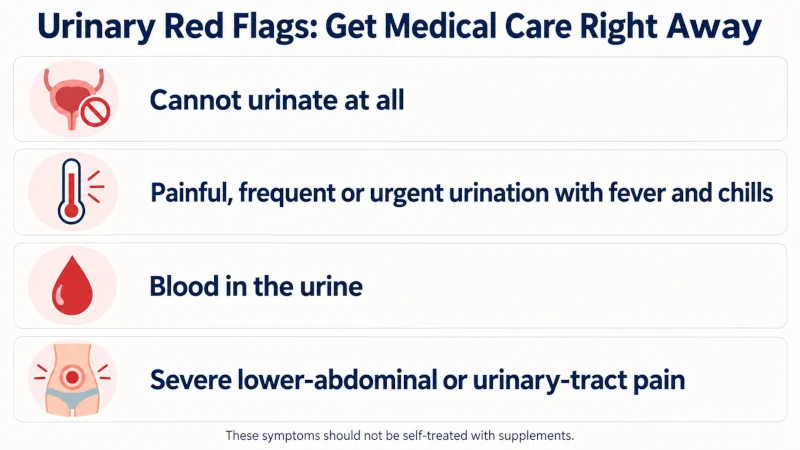
The biggest risk with any prostate supplement isn’t the supplement — it’s using it to postpone care that would help. Urinary symptoms can come from BPH, but also from infection, bladder problems, or prostate cancer, so new or worsening symptoms deserve a proper evaluation [NIDDK, 2024]. Effective, well-studied treatments exist when symptoms affect your life, from lifestyle changes to alpha blockers, 5-alpha-reductase inhibitors, and minor procedures. For another gentle, traditional urinary remedy and where it fits, see our guide to corn silk, part of our wider urinary health coverage.
| Get medical care right away if you: cannot urinate at all (this is an emergency);have painful, frequent, urgent urination together with fever and chills;see blood in your urine;feel severe pain or discomfort in your lower abdomen or urinary tract. Source: NIDDK, Enlarged Prostate (BPH), 2024. |
| Health disclaimer: This article is for general education and information only. It is not a substitute for diagnosis, treatment, or advice from a doctor who knows your medical history. Saw palmetto is a dietary supplement, not an approved treatment for any condition, and nothing here should replace care for an enlarged prostate or any other problem. If you are pregnant or breastfeeding, take prescription medicine (especially a blood thinner), have surgery planned, or are managing another condition, talk with your doctor or pharmacist before starting it. If you suddenly cannot urinate, or you have blood in your urine or severe lower-abdominal pain, seek medical care right away. |
Frequently Asked Questions
Does saw palmetto actually shrink the prostate or stop it growing?
No. The best evidence — a 2023 Cochrane review of 27 trials in 4,656 men — found it works about as well as a placebo for the urinary symptoms of an enlarged prostate, at both 3–6 months and 12–17 months. It hasn’t been shown to reliably shrink the prostate or beat a dummy pill.
Is saw palmetto safe to take?
For most healthy adults, it’s well tolerated. Side effects are usually mild — digestive upset, headache, dizziness — and it’s been used safely in studies for up to three years. The main cautions are pregnancy and breastfeeding, blood thinners, and upcoming surgery.
Does saw palmetto affect a PSA test?
It doesn’t appear to. Unlike finasteride, saw palmetto has not been shown to change PSA readings, even at higher-than-usual doses, so it’s less likely to mask a result your doctor is monitoring.
What dose is used, and how long before I’d know if it works?
Trials generally used a standardized lipidosterolic extract at about 320 mg a day (often 160 mg twice daily). Give it a consistent couple of months and judge by your symptoms. Because supplements aren’t FDA-approved before sale and quality varies, look for a standardized extract from a reputable brand.
Can saw palmetto regrow hair?
There’s not enough evidence to say. The few small studies on saw palmetto for male-pattern hair loss are too limited to draw conclusions.
Can it interact with my medications?
Possibly. It may add to the effect of blood thinners and antiplatelet drugs (the evidence is mostly case reports but the risk is taken seriously), and it inhibits some drug-metabolizing enzymes in the lab. Check with your doctor or pharmacist before combining it with any prescription medicine.
References
- Franco JVA, Trivisonno L, Sgarbossa NJ, et al. Serenoa repens for the treatment of lower urinary tract symptoms due to benign prostatic enlargement. Cochrane Database of Systematic Reviews. 2023;6(6):CD001423. DOI: 10.1002/14651858.CD001423.pub4. View source
- National Center for Complementary and Integrative Health. Saw Palmetto: Usefulness and Safety. NIH/NCCIH. Last Updated April 2025. View source
- National Center for Complementary and Integrative Health. Spotlight on Saw Palmetto (Clinical Digest). NIH/NCCIH. July 2019. View source
- National Institute of Diabetes and Digestive and Kidney Diseases. Enlarged Prostate (Benign Prostatic Hyperplasia). NIH/NIDDK. Last Reviewed June 2024. View source
- Memorial Sloan Kettering Cancer Center. Saw Palmetto (About Herbs). Last Updated October 16, 2023. View source
- Efficacy and safety of Serenoa repens in benign prostatic disorders: a systematic review of recent clinical evidence. Drugs in Context. 2025. PubMed 42157952; PMC13182888. View source


