
Most people leave the doctor’s office with one instruction about food: cut the fat. It’s easy to remember and it feels like it should work. It’s also not what the best guidance actually says.
A gallbladder diet that holds up to scrutiny looks unglamorous. Plenty of fiber. A moderate amount of good fat, not zero. Meals you eat on time instead of skipping. And, if you need to lose weight, losing it slowly — because losing it fast is one of the few dietary decisions that reliably raises your risk of gallstones [NIDDK, 2017].
Here’s what to eat, what to be careful with, and the point at which food stops being the answer.
What a gallbladder diet is actually for
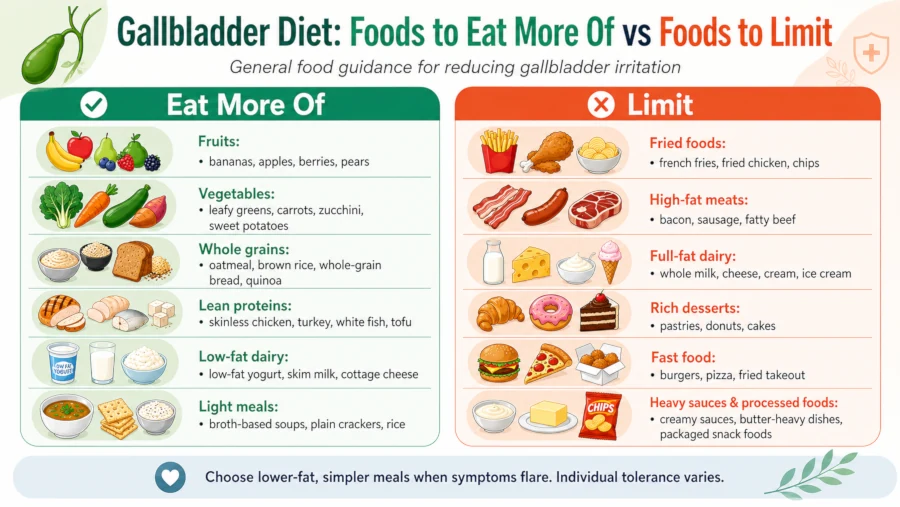
Your gallbladder is a small pouch under the liver. It stores bile, concentrates it, and squeezes it into the small intestine when fat shows up. Bile breaks fat apart the way dish soap cuts grease.
Two things go wrong. Stones form — usually when bile carries too much cholesterol, or when the gallbladder doesn’t empty often enough. Or the gallbladder simply doesn’t squeeze properly. Gallstones are common: they affect 10 to 15 percent of people in the United States, roughly 25 million adults, and most never feel a thing [NIDDK, 2017].
Be clear about what diet can and can’t do here. No food dissolves a gallstone you already have. What food can do is lower the odds of forming new ones, and reduce how often the ones you have make you miserable. That’s a real benefit. It just isn’t a cure, and anyone selling it as one is selling something.
Start with fiber, not with subtraction
The clearest dietary lever is also the least exciting. Federal guidance is to eat more high-fiber food — fruit, vegetables, beans, peas, and whole grains like oats, brown rice and whole wheat bread — and to cut back on refined carbohydrates and sugar [NIDDK guidance on eating and gallstones, 2017]. The same agency lists a diet that is high in calories and refined carbohydrates and low in fiber as a risk factor for developing stones in the first place [NIDDK, 2017].
Grade this honestly: it rests on population studies and expert consensus, not on a trial that randomized people to fiber and counted surgeries. It’s strong enough to act on. It is not a guarantee.
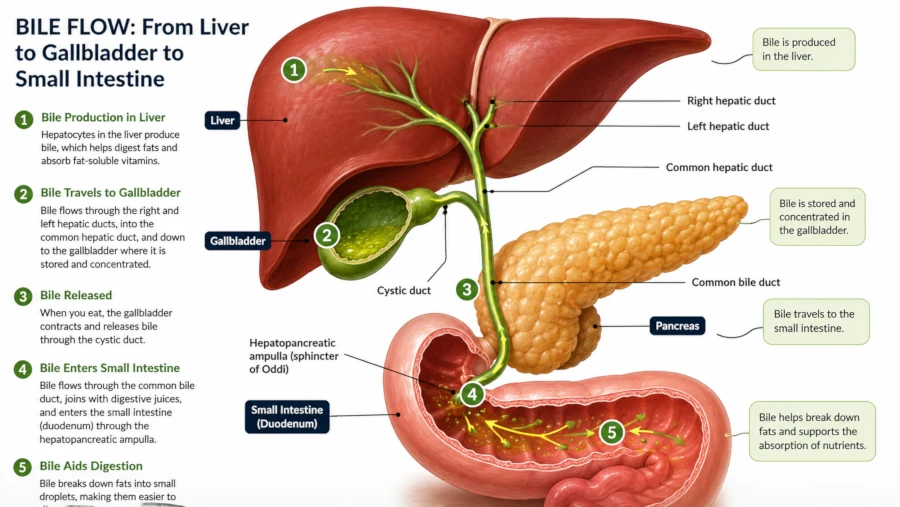
Don’t fear fat. Choose it.
This is where most gallbladder diet advice goes wrong. Fat is the signal that tells your gallbladder to contract. A gallbladder that never contracts is a gallbladder where bile sits still, thickens, and concentrates — which is how stones start. So the official advice is not no fat. It’s to eat healthy fats, like olive oil and the fat in oily fish, so the gallbladder empties on a regular basis, and to cut back on the fats found in fried food and desserts [NIDDK, 2017].
NHS dietitians go further. Their patient guidance states plainly that a low-fat diet doesn’t suit everyone with gallstones and that there is little evidence to support it — and warns that stripping fat out can cause rapid weight loss and nutritional deficiencies. Their recommendation is a balanced diet with moderate amounts of fat [Cambridge University Hospitals NHS dietary advice for gallstones, 2025].
That said, if fatty meals reliably set off your pain, cutting back is reasonable — as a personal experiment, not a life sentence. The same NHS guidance suggests trialling a lower-fat approach to see whether it helps: check labels and favour foods under 3 g of fat per 100 g, grill, steam, poach or microwave instead of frying, trim visible fat from meat, and use oil and butter sparingly. Keep a note of what actually triggers you. Most people find it’s a shorter list than they feared.
Meal timing is the underrated half of the gallbladder diet
Skipping meals hurts you twice. Fasting reduces gallbladder emptying, which raises the risk of stones forming or growing, so NHS dietitians advise regular meals and eating breakfast soon after you wake — cholesterol concentrations are highest in the bile made overnight [Cambridge University Hospitals NHS, 2025]. NIDDK describes the same mechanism from the other end: go a long stretch without eating and the liver releases extra cholesterol into the bile [NIDDK, 2017].
If big meals leave you uncomfortable, eat smaller ones more often. That’s a genuinely useful adjustment and it costs you nothing.
The weight-loss trap
Carrying excess weight raises gallstone risk, especially in women. But losing it too fast raises the risk as well, and this catches people out constantly. Very low-calorie diets, weight-loss surgery, and weight cycling — losing and regaining, over and over — all push the odds up, and the more weight you lose and regain in a cycle, the higher those odds go [NIDDK on dieting and gallstones, 2017].
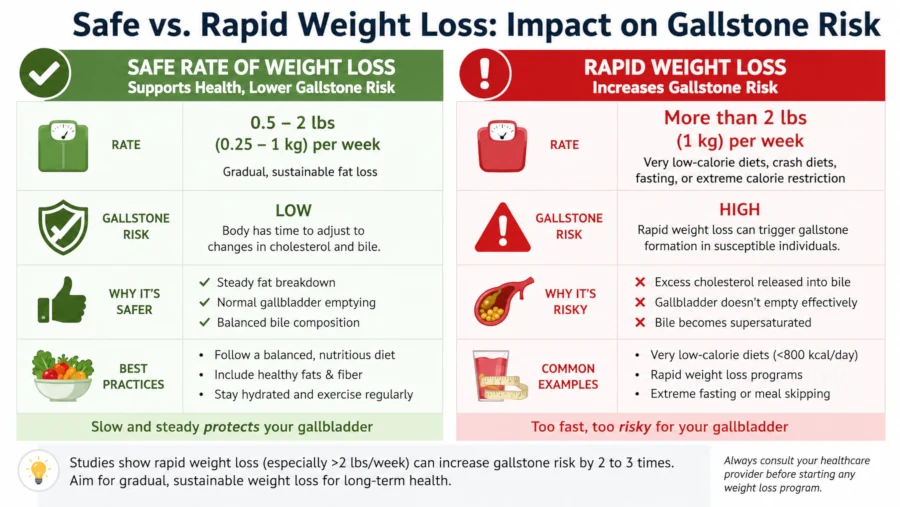
So the target is slow. NIDDK suggests starting with 5 to 10 percent of your starting weight over about six months, plus at least 150 minutes a week of moderate activity. NHS guidance puts a number on the ceiling: losing more than 1 kg (about 2 lb) a week is not recommended. If you’re about to start a very low-calorie diet or have bariatric surgery, ask your doctor about ursodiol — it can be prescribed specifically to prevent gallstones during rapid weight loss.
If you take one thing from this page, take that one. It’s the most actionable item here, and it’s the one nobody mentions.
The bitter foods with a long reputation — and what the evidence shows
Artichoke, chicory, endive, radish, dandelion. Bitter plants have been used across Europe for centuries to move bile, and the vocabulary survives: a choleretic makes the liver produce more bile; a cholagogue prompts the gallbladder to empty. Our roundup of gallbladder-friendly foods goes through the traditional list in more detail.
How much of it holds up?
Artichoke is the best-studied of the group — but the research is on the leaf extract, not the vegetable on your plate. A double-blind trial randomized 247 adults with functional dyspepsia to artichoke leaf extract (320 mg, two capsules three times daily) or placebo for six weeks. The extract group improved more, on both symptoms and quality of life [Holtmann et al., Alimentary Pharmacology & Therapeutics, 2003]. Worth being precise about what that means: functional dyspepsia is the bloated, heavy, fat-intolerant feeling after eating. It is not gallstone disease. And the professional monograph on artichoke concludes that clinical data are lacking to support its use for any indication [Drugs.com natural products monograph, 2025]. Both of those things are true at once. The fair reading: promising for post-meal heaviness, unproven for gallbladder disease.
Eating artichokes as a vegetable is a different question, and an easy one — they’re low in fat, high in fiber, and they taste good. Our page on the health benefits of artichokes covers the plant itself.
Chicory, Belgian endive, radish, eggplant, papaya and tamarind sit on traditional ground. They appear in the herbal literature as gentle bile-movers, and I could find no controlled human trials testing any of them against gallbladder outcomes. That doesn’t make them useless. It means: eat them because they’re vegetables and fruit and they fit the pattern that does have evidence behind it — not because you’re treating anything.
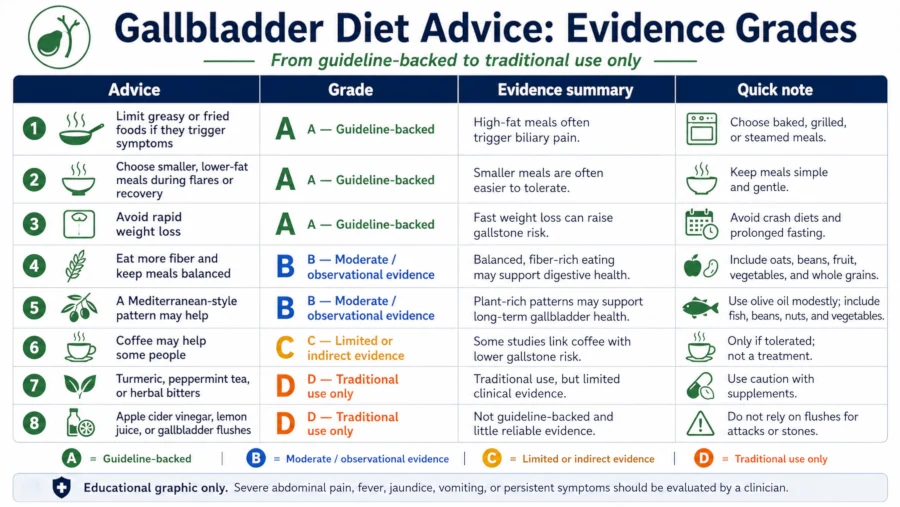
Here’s the honest scorecard.
| What you do | What it’s claimed to do | Strength of evidence | Source |
| Higher fiber, fewer refined carbs and less sugar | Lowers gallstone risk | Guideline / observational | NIDDK, 2017 |
| Moderate healthy fat (olive oil, oily fish) | Keeps the gallbladder contracting and emptying | Guideline | NIDDK, 2017 |
| Regular meals, breakfast, no long fasts | Reduces stone formation and enlargement | Guideline / mechanistic | CUH NHS, 2025 |
| Slow weight loss if you need to lose weight | Lowers risk; rapid loss raises it | Strong and consistent | NIDDK, 2017; CUH NHS, 2025 |
| Blanket low-fat diet for everyone with gallstones | Little evidence; may cause rapid weight loss | Weak / not recommended | CUH NHS, 2025 |
| Artichoke leaf extract for post-meal heaviness | Improved dyspepsia symptoms vs placebo in one RCT | Limited and mixed | Holtmann et al., 2003; Drugs.com, 2025 |
| Chicory, endive, radish, eggplant, papaya, tamarind for the gallbladder | Traditionally used as bitter, bile-moving foods | Traditional use only | No controlled human trials located |
| Any food that dissolves an existing gallstone | No such food | No evidence | — |
Bile-stimulating supplements: who should be careful
There’s a real hazard hiding in the logic of “stimulate more bile.” If a duct is blocked, pushing more bile at it is exactly the wrong move. Artichoke preparations are contraindicated in bile duct obstruction and in gallstones, and the Expanded Commission E monographs warn against using them in any bile duct pathology precisely because of that choleretic action [Drugs.com, 2025]. The same caution applies to any concentrated cholagogue — we go through them one by one in our guide to herbs for the gallbladder and liver.
Side effects and interactions worth knowing
- Common side effects: bloating and flatulence, usually mild and short-lived.
- Allergy: artichoke is in the daisy family. If ragweed, chrysanthemums, marigolds or daisies bother you, be careful. Reactions including anaphylaxis and asthma have been reported.
- Medication interaction: artichoke may raise blood levels of colchicine.
- Liver: one case of liver injury has been reported in connection with a commercial artichoke product.
- Pregnancy and breastfeeding: artichoke heads are recognized as safe as food. For the leaf extract, safety data in pregnancy and breastfeeding are lacking — caution is warranted, which in practice means don’t, unless a clinician says otherwise.
All of the above from the Drugs.com artichoke monograph, updated December 2025.
Skip the supplement and talk to a doctor first if you
- have known gallstones or a bile duct blockage
- are pregnant or breastfeeding
- have liver disease, or take colchicine, or take several prescription medicines
- are allergic to plants in the daisy family
- are under 18
When food isn’t the answer: the “lazy gallbladder”
Some people have all the symptoms and no stones. That can be biliary dyskinesia — a functional disorder where the gallbladder doesn’t move bile out properly even though nothing is physically blocking it. It’s diagnosed after other causes are excluded, using a HIDA scan with cholecystokinin to measure how much bile the gallbladder ejects when it contracts. An ejection fraction under 40 percent supports the diagnosis [Cleveland Clinic, 2022], though the exact cut-off is disputed and different centres use figures between roughly 33 and 40 percent.
This is the part that gets soft-pedalled online, so I’ll say it directly: there is no evidence that any diet fixes biliary dyskinesia. The only treatment with good evidence behind it is removing the gallbladder, which resolves symptoms in around 90 percent of people who meet the full diagnostic criteria [Cleveland Clinic, 2022]. Smaller meals and less fat can make the episodes less frequent. That is symptom management, and it’s worth doing. It is not a cure, and delaying a diagnosis while you work through a food list is a bad trade.
If stones are the issue, our page on foods to eat with gallstones covers that territory specifically.
After gallbladder removal: you probably don’t need a special diet
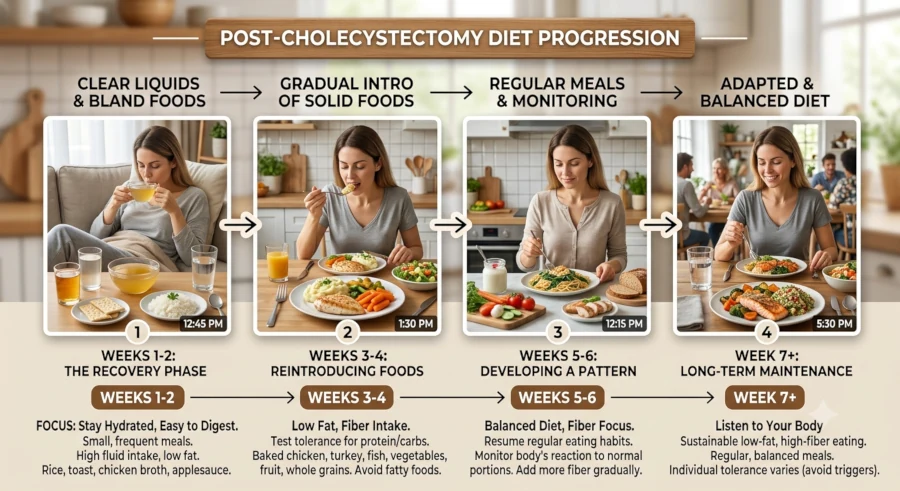
A lot of people brace for a lifetime of dry chicken. They don’t need to. After the gallbladder comes out, the liver keeps making bile exactly as before — it just drips continuously into the bowel instead of being stored between meals. NHS guidance is unambiguous: you do not need to follow a low-fat diet after gallbladder removal, and there is no evidence to suggest one is needed [Cambridge University Hospitals NHS, 2025].
The first few weeks are the exception. Your digestion takes a little time to adjust, so it’s sensible to go easy on fried and fatty food at first and to bring whole grains, vegetables and legumes back in gradually rather than all at once, which helps avoid gas and bloating [Cleveland Clinic, 2022].
If you develop persistent diarrhea after surgery, don’t try to fix it by eating less and less. Tell your doctor — it can be investigated and treated [Cambridge University Hospitals NHS, 2025].
Red flags: stop and get help
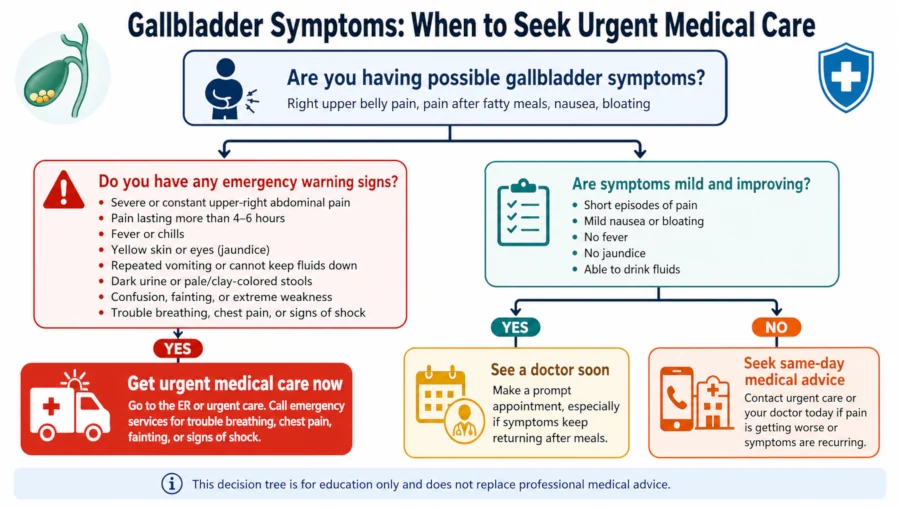
A gallbladder attack that doesn’t settle can become an emergency quickly. Get medical care right away if, during or after an attack, you have any of the following [NIDDK on gallstone symptoms, 2017]:
- Abdominal pain that lasts several hours
- Nausea and vomiting
- Fever — even a low-grade one — or chills
- Yellowing of the skin or the whites of the eyes (jaundice)
- Tea-colored urine and light-colored stools
Those can signal serious infection or inflammation of the gallbladder, liver or pancreas. If a bile duct stays blocked and it isn’t treated, it can be fatal. This is not a wait-and-see situation.
Two more worth flagging. Pale, oily or foul-smelling stools that float suggest you aren’t absorbing fat properly, and need a doctor or dietitian rather than a diet tweak. And if you are underweight or losing weight without meaning to, standard “eat less fat” advice may be the wrong advice for you entirely [Cambridge University Hospitals NHS, 2025].
Where to start this week
Pick the three that apply and leave the rest. Eat breakfast. Add a fiber source to two meals a day — beans, oats, whatever you’ll actually eat. Keep the olive oil. If you’re losing weight, slow down to a kilo a week or less. And write down what genuinely triggers your pain, because that list belongs to you, not to a generic food chart.
| Health Disclaimer: This article is for education and information only. It is not medical advice, and it is not a substitute for diagnosis or treatment by a qualified clinician. Food and supplements can interact with prescription medicines, and some are not safe in pregnancy, in breastfeeding, or with certain conditions. Do not stop or change any prescribed treatment based on what you read here. If you have gallbladder symptoms — pain in the upper right abdomen, jaundice, fever with chills, persistent vomiting, or pale stools with dark urine — speak to a doctor before changing your diet or taking any supplement, and seek urgent care if symptoms are severe or getting worse. |
Frequently Asked Questions
Can a gallbladder diet dissolve gallstones?
No. No food or eating pattern has been shown to dissolve an existing gallstone. Diet works on the odds — reducing the chance of forming new stones and reducing how often existing ones cause symptoms. Medication (ursodiol) can dissolve some cholesterol stones slowly in selected people, and that’s a conversation with a doctor, not a grocery list.
Do I have to eat a low-fat diet if I have gallstones?
Not necessarily, and it may backfire. NHS dietetic guidance notes there is little evidence to support a blanket low-fat diet for everyone with gallstones, and that stripping fat out can cause rapid weight loss and nutritional deficiencies [Cambridge University Hospitals NHS, 2025]. If fatty meals clearly trigger your pain, reduce fat and see whether it helps. If they don’t, a balanced diet with moderate fat is the better target.
Is intermittent fasting bad for my gallbladder?
Long gaps without eating reduce gallbladder emptying, which raises the risk of stones forming or getting bigger, and going a long time without food prompts the liver to release extra cholesterol into bile [Cambridge University Hospitals NHS, 2025]; [NIDDK, 2017]. If you already have stones or are at high risk, discuss any fasting protocol with your doctor first.
How fast is too fast to lose weight?
More than about 1 kg (2 lb) a week is generally considered too fast where gallstones are a concern, and yo-yo dieting carries its own risk [Cambridge University Hospitals NHS, 2025]. A reasonable target is 5 to 10 percent of your starting weight over six months [NIDDK, 2017].
Is an artichoke supplement safe if I have gallstones?
Not without medical advice. Artichoke preparations are contraindicated in gallstones and bile duct obstruction, because increasing bile flow against a blockage is the wrong direction [Drugs.com, 2025]. Eating artichokes as a vegetable is a different matter and is generally fine.
What should I eat right after gallbladder surgery?
For the first few weeks, go easy on fried and fatty foods and reintroduce fiber gradually to limit gas and bloating [Cleveland Clinic, 2022]. After that, a normal balanced diet — you do not need a permanent low-fat diet, and there’s no evidence one helps [Cambridge University Hospitals NHS, 2025].
References
- National Institute of Diabetes and Digestive and Kidney Diseases (NIDDK). Eating, Diet, & Nutrition for Gallstones. NIH, last reviewed November 2017. → View source
- NIDDK. Dieting & Gallstones. NIH, last reviewed November 2017. → View source
- NIDDK. Symptoms & Causes of Gallstones. NIH, last reviewed November 2017. → View source
- NIDDK. Definition & Facts for Gallstones. NIH, last reviewed November 2017. → View source
- Cambridge University Hospitals NHS Foundation Trust, Nutrition and Dietetics. Dietary advice for patients with gallstones or inflammation of the gallbladder. Approved 4 September 2025 (v6). → View source
- Cleveland Clinic. Biliary Dyskinesia: Symptoms, Causes & Treatment. Medically reviewed, last updated 24 July 2022. → View source
- Drugs.com / Wolters Kluwer. Artichoke — Uses, Benefits & Dosage (natural products monograph). Medically reviewed, last updated 22 December 2025. → View source
- Holtmann G, Adam B, Haag S, Collet W, Grünewald E, Windeck T. Efficacy of artichoke leaf extract in the treatment of patients with functional dyspepsia: a six-week placebo-controlled, double-blind, multicentre trial. Aliment Pharmacol Ther. 2003 Dec;18(11-12):1099–105. PMID 14653829; DOI 10.1046/j.1365-2036.2003.01767.x. → View source (PubMed)
