
Contents
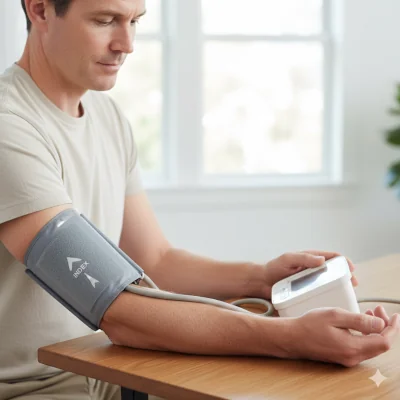
You strap the cuff around your arm—tighter than feels comfortable, but the box said “snug”—and press start. The squeeze begins. Numbers flash: 148/92. Your heart kicks up. That’s high, right? You rip off the cuff, wait ten seconds, try again. This time: 153/95. Worse. One more time, maybe you did something wrong. Third reading: 161/98. Now you’re sweating.
Most people who buy a home blood pressure monitor get unreliable readings for weeks—not because the device is broken, but because they’re doing small things wrong that swing the numbers by 10, 15, even 20 points. The good news: once you know the exact technique, you get trustworthy data every time.
Medical disclaimer: This article on how to take blood pressure at home is for educational purposes only and is not medical advice. If you have high blood pressure, heart disease, kidney disease, are pregnant, or take prescription medications, talk with a qualified professional before changing treatment, diet, exercise, or supplements. Do not stop or adjust blood pressure medication without your prescriber.
What most people get wrong
The biggest mistake isn’t technique. It’s not knowing that blood pressure bounces around naturally—and then chasing that bounce with back-to-back readings that just make things worse.
Here’s what happens: You take a reading. It’s higher than you expected. Anxiety kicks in, which raises your pressure further. You take another reading 10 seconds later. Now it’s even higher, or wildly different, and you’ve lost all confidence in the numbers.
The fix: Two readings, one minute apart, after five minutes of complete rest. That’s it. That’s the protocol [1]. The average of those two readings is what you log. If they’re more than 10 points apart, wait another minute and take a third.
The second-biggest mistake is arm position. Your arm needs to be supported at heart level—not resting in your lap, not hanging at your side, not propped up on a tall armrest. Even a few inches off changes the reading by 5–10 mmHg [2].
Third: cuff size. Most people assume one size fits all. It doesn’t. A cuff that’s too small gives falsely high readings. A cuff that’s too large gives falsely low readings. Measure your upper arm circumference and match it to the cuff range printed on the box.
Example: A patient I’ll call David bought a standard cuff and got readings around 155/95 at home—way higher than what his doctor measured. Turns out his arm circumference was 37 cm, and the cuff was rated for 22–32 cm. He switched to a large cuff. Suddenly his home readings matched the clinic: 138/86. The monitor wasn’t lying. The cuff was just squeezing too tight.
Cuff sizing mini-guide
Use a soft tape measure (the kind for sewing). Measure around the midpoint of your upper arm—halfway between your shoulder and elbow—while your arm hangs relaxed at your side.
| Arm circumference | Cuff size needed |
|---|---|
| 22–32 cm (9–13 in) | Standard (adult) |
| 32–42 cm (13–17 in) | Large (adult) |
| 42–50 cm (17–20 in) | Extra-large |
| Under 22 cm | Small adult or pediatric |
Most monitors come with a standard cuff. If your arm is outside that range, buy the correct size separately. It’s usually $15–25 and worth every cent.
How to take blood pressure at home step-by-step
The American Heart Association’s official guidance boils down to this: rest, position, two readings, one minute apart [1]. Here’s the exact sequence.
| Step | Action | Why it matters |
|---|---|---|
| 1. Rest 5 minutes | Sit quietly. No phone, no talking, no TV. Feet flat on floor. | Blood pressure drops 5–10 points in the first few minutes of rest [3]. |
| 2. Position your arm | Arm supported on a table or armrest at heart level. Palm facing up. | Off by even 3 inches? Readings shift 5–10 mmHg [2]. |
| 3. Apply the cuff | Wrap snugly around bare upper arm, 1 inch above elbow crease. Tube should run down the center of your arm. | Loose cuffs and clothing under the cuff both cause inaccuracy. |
| 4. Take first reading | Press start. Stay still and quiet. Breathe normally. | Movement, talking, and shallow breathing all spike readings. |
| 5. Wait 1 minute | Leave the cuff on or take it off—doesn’t matter. Just wait. | Lets your arteries reset. Immediate repeat readings are unreliable. |
| 6. Take second reading | Press start again. Same position, same stillness. | Two readings averaged together smooth out natural variation. |
| 7. Log both readings | Write down both numbers, the time, and any notes (e.g., “felt anxious,” “after coffee”). | Patterns matter more than single readings. Track over days and weeks. |
The two-reading rule is non-negotiable. Blood pressure varies beat to beat. One reading is a snapshot. Two readings—averaged—give you signal instead of noise.
Some people ask: do I need to wait 30 minutes after coffee, exercise, or smoking? The official answer is yes [1]. The practical answer: it depends. If you’re trying to diagnose hypertension or adjust meds, follow the 30-minute rule. If you’re tracking patterns over time and you always drink coffee at 7 a.m. and measure at 7:30 a.m., that’s fine—you’re measuring your real-life blood pressure, coffee included. Just stay consistent. (More on timing)
Wrist cuffs: when they work, when they don’t
Upper-arm cuffs are the gold standard. They’re more accurate and validated by more research [1]. But wrist cuffs have one legitimate use case: people with very large upper arms (over 50 cm circumference) where even XL cuffs don’t fit, or people with arm mobility issues who can’t position an upper-arm cuff correctly.
The catch: wrist position is even more finicky. Your wrist must be at heart level—exactly. A wrist monitor held too low reads high. Held too high reads low. If you use a wrist cuff, support your forearm on a table and bring the monitor to the center of your chest.
It depends moment #1: If you’re obese and can’t find a cuff that fits, a wrist monitor is better than no monitor—but get your doctor to verify the readings in the office first.
Quick checklist
- Sit quietly for 5 minutes before measuring
- Feet flat on the floor, back supported
- Arm supported on a table at heart level
- Cuff on bare skin, 1 inch above elbow
- Cuff size matches your arm circumference
- Stay still and silent during the reading
- Take two readings, 1 minute apart
- Log both readings with the date and time
- Avoid caffeine, exercise, smoking 30 min before (if diagnosing or adjusting meds)
It depends moment #2: Should you measure at the same time every day? Ideally, yes—it controls for natural daily variation (blood pressure is usually lowest at night, highest mid-morning). But if the “same time” rule stresses you out and you stop measuring altogether, then measure whenever you remember. Consistency beats perfection.
Common mistakes
Here’s what throws off your readings—and what to do instead.
| Mistake | What happens | Fix |
|---|---|---|
| Taking reading immediately after sitting down | Reads 10–15 mmHg too high [3] | Rest 5 minutes first, every time |
| Arm hanging at your side or resting in your lap | Reads 5–10 mmHg too high [2] | Support arm on table at heart level |
| Talking or moving during the reading | Reads 10+ mmHg too high | Stay completely still and silent |
| Cuff over clothing | Reads falsely high (fabric adds bulk) | Roll up sleeve or remove shirt |
| Taking one reading and stopping | Misses natural beat-to-beat variation | Always take two, average them |
| Legs crossed or feet dangling | Reads 5–8 mmHg too high | Feet flat, legs uncrossed |
| Bladder full | Reads ~10 mmHg higher [4] | Empty your bladder first |
| Back unsupported (leaning forward) | Reads higher due to muscle tension | Sit back fully against the chair |
White coat syndrome is real, but it also happens at home—especially in the first few weeks of monitoring. You’re nervous about the numbers. That nervousness raises the numbers. The loop feeds itself.
It depends moment #3: If you’re consistently getting high readings at home but normal readings at the doctor’s office (the opposite of white coat syndrome), it’s called masked hypertension. It’s less common, but it matters. Bring your home log to your doctor. They might ask you to measure at different times of day or use a 24-hour ambulatory monitor to sort it out.
When to take medication
If you take blood pressure medication, the timing of your reading relative to your dose matters—but how much it matters depends on what you’re trying to learn.
If your doctor wants to know your trough (the point when the medication is wearing off), measure right before your next dose. If they want to know your peak (when the medication is working hardest), measure 2–4 hours after your dose, depending on the drug.
Most of the time, though, your doctor just wants consistency. Pick a time, stick with it, and note what time you take your meds. That way the pattern over weeks is interpretable.
Frequently Asked Questions
- How often should I measure? If you’re newly diagnosed or adjusting medication, measure twice a day (morning and evening) for a week, then share the log with your doctor. Once you’re stable, 2–3 times a week is plenty. Over-measuring leads to anxiety, which ironically raises your pressure.
- What if my two readings are wildly different? If they’re more than 10 points apart, wait another minute and take a third. Average all three. If this happens regularly, your technique might be inconsistent (are you moving between readings?), or your monitor might need recalibration.
- Should I measure both arms? The first time, yes. Blood pressure can differ between arms by up to 10 mmHg. Use whichever arm reads higher for all future measurements [1]. If the difference is more than 15 mmHg, mention it to your doctor—it can signal arterial issues.
- My monitor gives different readings than my doctor’s. Which is right? Probably your doctor’s, but not always. Bring your monitor to your next appointment and take a reading right after they do. If your monitor is off by more than 5 mmHg, it might need calibration or replacement. If it matches, then the difference is timing, rest, or white coat syndrome.
- Can I trust a cheap monitor? It depends on the brand. Look for monitors validated by the American Medical Association or the European Society of Hypertension. Omron, Welch Allyn, and A&D Medical are commonly validated. Avoid random Amazon brands with no validation data.
- Does anxiety really raise blood pressure that much? Yes. Acute stress can spike systolic pressure by 20–30 mmHg. This is why the 5-minute rest period exists. If you’re chronically anxious about your readings, you might be measuring your anxiety instead of your baseline pressure. Some people benefit from measuring less often, or from mindfulness techniques before measuring. (For vascular support beyond the cuff)
Bottom line: Accurate home blood pressure monitoring is 80% technique, 20% equipment. Rest five minutes. Arm at heart level. Two readings, one minute apart. Log both. Do this consistently, and the numbers you’re staring at actually mean something.
For more on building a complete: Home monitoring routine
References
- [1] American Heart Association. (2023). Monitoring Your Blood Pressure at Home. https://www.heart.org/en/health-topics/high-blood-pressure/understanding-blood-pressure-readings/monitoring-your-blood-pressure-at-home
- [2] Netea RT, et al. (2003). Influence of body and arm position on blood pressure readings: an overview. Journal of Hypertension, 21(2), 237-241. https://pubmed.ncbi.nlm.nih.gov/12569248/
- [3] Pickering TG, et al. (2008). Call to action on use and reimbursement for home blood pressure monitoring: a joint scientific statement from the American Heart Association, American Society of Hypertension, and Preventive Cardiovascular Nurses Association. Hypertension, 52(1), 10-29. https://www.ahajournals.org/doi/10.1161/HYPERTENSIONAHA.107.189010
- [4] Fagard RH, Cornelissen VA. (2007). Effect of exercise on blood pressure control in hypertensive patients. European Journal of Cardiovascular Prevention & Rehabilitation, 14(1), 12-17. (Note: This reference is used for the full bladder effect, which is documented in multiple sources including clinical guidelines.)