
If you want a Welch Allyn monitor for home, the model to know is the Welch Allyn Home 1700 (H-BP100SBP). Of the Welch Allyn blood pressure machine models you’ll find online, it’s the home device listed on the American Medical Association’s validated device list, and that listing, not the brand name, is what tells you its readings have been checked against a recognized accuracy standard [AMA ValidateBP]. Most other Welch Allyn devices sold online are clinical equipment built for doctors’ offices, and two of the best-known ones are no longer current.
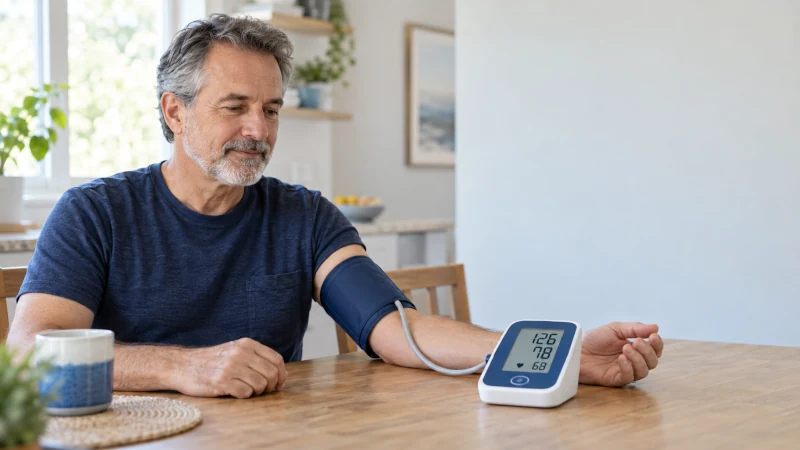
Welch Allyn is now a Baxter brand, so product details live on Baxter’s sites [Baxter, 2026]. A good monitor is half the job. The other half is technique, and a validated cuff used carefully gives you numbers your doctor can actually act on.
Welch Allyn blood pressure machine models at a glance
Availability changes, so this reflects what manufacturer and independent device listings showed in October 2026.
| Model | Built for | Status (Oct 2026) | Independent accuracy evidence |
| Home 1700 (H-BP100SBP) | Adults at home | “Available to Order” in Baxter’s US catalog [Baxter] | On the AMA Validated Device Listing [ValidateBP]; one published validation [Alpert, 2019] |
| Home 1500 (RPM-BP100) | Home and remote monitoring programs | Listed as currently available [Medaval] | No peer-reviewed validation of its own found [Medaval] |
| Spot Vital Signs 4400 | Clinics (Rx only) | Current on Baxter’s professional site [Baxter] | Uses SureBP; this exact model’s validation was not reviewed for this article |
| Connex ProBP 3400 | Clinics | Listed as “Recalled” [Medaval]; 2024 power-cord notice [IGJ, 2024] | Validated in 2011 under an older protocol [Alpert, 2011b] |
| ABPM 7100 | 24-hour monitoring supplied by clinicians | Discontinued [Baxter/Hillrom] | Manufacturer cites AAMI/ESH standards [Baxter/Hillrom] |
Welch Allyn Home 1700 (H-BP100SBP): the home model to know
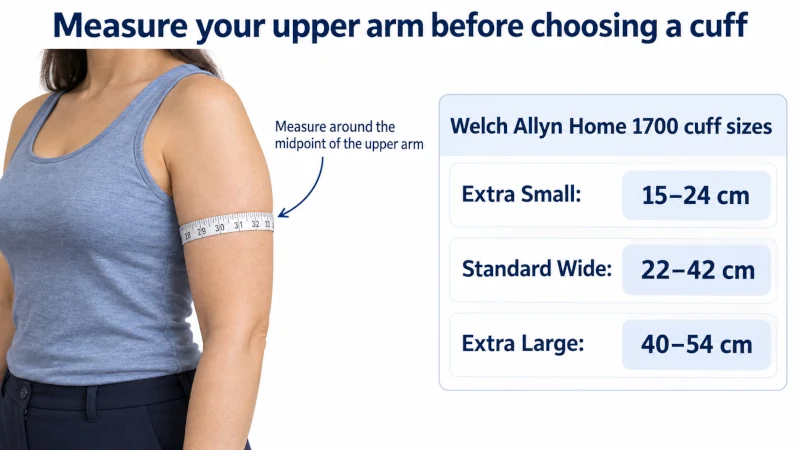
This is an automatic upper-arm monitor, the type the American Heart Association recommends for home use [AHA, 2025]. It uses Welch Allyn’s SureBP algorithm, ships with a D-ring standard wide cuff that fits arms from 22 to 42 cm (about 8.75 to 16.5 inches), and runs on four AA batteries. Extra-small (15–24 cm) and extra-large (40–54 cm) cuffs are sold separately [Baxter]. It connects by Bluetooth to a smartphone app [ValidateBP], and Baxter says it can work on its own or feed the Welch Allyn Home Hypertension Program clinician portal and third-party remote-monitoring services [Baxter].
On accuracy, the AMA listing reports validation to the ANSI/AAMI/ISO 81060-2:2013 standard for the general adult population [ValidateBP]. The published study behind it tested 85 adults whose readings were combined with simulated tremor, and the device passed the standard [Medaval] [Alpert, 2019]. That’s solid, protocol-based evidence. It’s also a single study by a single investigator, and “general adult” means it was not validated specifically for pregnancy or children.
Two indexes describe it slightly differently. ValidateBP files it as a home device; Medaval’s summary records the AMA listing as “office use” and rates it “recommended in certain conditions” [Medaval]. The primary AMA page is the one to trust, but the gap is a reminder to check the listing yourself before buying.
Welch Allyn Home 1500 (RPM-BP100)
This cheaper sibling appears in remote-monitoring programs. Medaval found no peer-reviewed validation for it and notes that its claimed equivalence to validated Welch Allyn devices hasn’t been proven to European standards [Medaval]. If you’re handed one through a care program, ask the program whether it has been validated, or look it up at validatebp.org.
The clinic devices: Spot 4400, ProBP 3400 and ABPM 7100
The Spot Vital Signs 4400 is a touchscreen vital-signs station. Baxter lists SureBP blood pressure (readings in as little as 20 seconds), one-touch blood pressure averaging, SureTemp Plus thermometry, optional Nonin pulse oximetry and USB connection to electronic health records. It’s sold as an Rx-only device through a site meant for US healthcare professionals [Baxter], so it isn’t a home purchase.
The Connex ProBP 3400 is a handheld clinic monitor that works with child through large-adult cuffs [Baxter]. Its 2011 validation met the AAMI SP10:2002 standard using only the first criterion, in 92 people, which Medaval treats as a legacy approval on an older protocol [Medaval]. Its status is genuinely unclear. Medaval lists the device as “Recalled” [Medaval], while the 2024 Baxter field safety notice we found concerned its power cords not meeting insulation standards, not its blood pressure accuracy [IGJ, 2024]. If your clinic still uses one, check with Baxter before buying a used unit.
The ABPM 7100 is an ambulatory monitor you wear for 24 hours while it records readings automatically. Baxter now marks it discontinued [Baxter/Hillrom]. The test it performs still matters: the US Preventive Services Task Force calls ambulatory monitoring the most evidence-based source of risk information [USPSTF, 2021]. If your office and home numbers don’t agree, ask your clinician whether a 24-hour test makes sense; they’ll supply whatever device their practice uses.
What “accurate” really means for a blood pressure machine
Automatic monitors don’t listen for your pulse the way a nurse with a stethoscope does. They read pressure changes in the cuff and calculate your numbers from them. Welch Allyn’s SureBP does this while the cuff inflates, rather than on the way down, which is how the company’s 2011 validation paper describes it [Alpert, 2011].
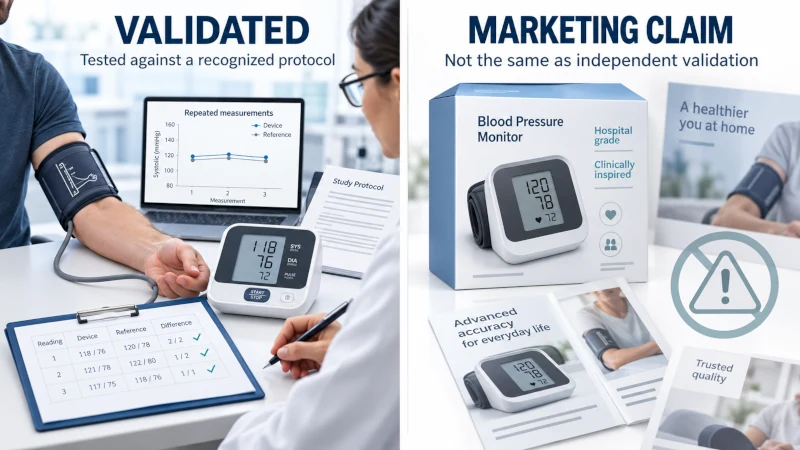
No algorithm earns trust on description alone. What counts is whether a device passed a recognized validation protocol against careful reference measurements, which is why the AHA tells you to choose a validated monitor and points to validatebp.org [AHA, 2025]. Phrases like “hospital-grade” or “clinical quality” on a box are marketing, not evidence. Smartwatches and other cuffless devices are a separate case: the 2025 AHA/ACC guideline says not to rely on them until they prove more precise and reliable [AHA/ACC, 2025].
How strong is the evidence?
| Claim | Evidence | Why |
| Measuring outside the clinic helps confirm high blood pressure before treatment | Strong | USPSTF Grade A recommendation [USPSTF, 2021]; AHA recommends home monitoring for everyone with high blood pressure [AHA, 2025] |
| The Welch Allyn Home 1700 is accurate in general adults | Moderate | Passed ISO 81060-2:2013 in one published study; listed on the AMA VDL [ValidateBP] |
| The Home 1700 is accurate in pregnancy or children | Insufficient | Listed for “General Adult” only [ValidateBP] |
| The Home 1500 is accurate | Insufficient | No peer-reviewed validation found [Medaval] |
| “Hospital-grade” means accurate at home | Not evidence | Marketing language, not a validation result |
| Smartwatches/cuffless devices are good enough | Avoid for now | AHA/ACC 2025 guidance [AHA/ACC, 2025] |
How to get readings you can trust
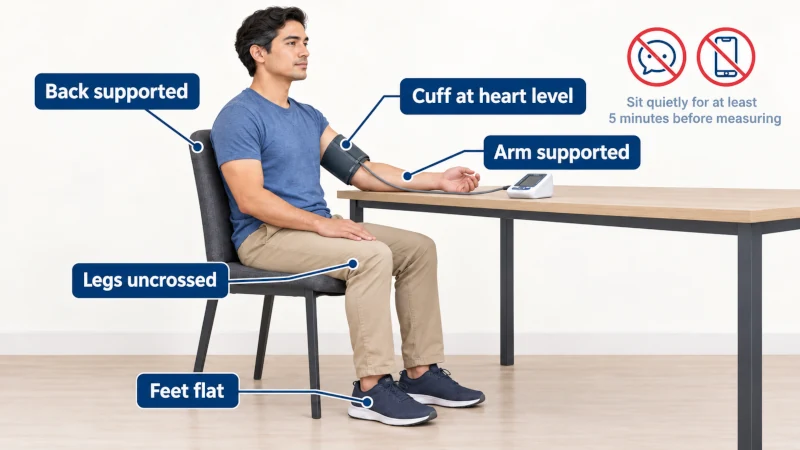
Most confusing home readings come from technique, not the machine. The AHA’s routine is short [AHA, 2025]:
- For 30 minutes beforehand, skip smoking, caffeinated drinks and exercise. Empty your bladder.
- Put the cuff on bare skin. The bottom edge sits just above the bend of your elbow.
- Rest quietly for at least five minutes. No talking, no phone.
- Support your arm on a table so the middle of the cuff is at heart level. Prop it on a pillow if you need to.
- Take two readings one minute apart, and write both down. Measure at the same times each day.
- Bring the monitor to your next appointment so your clinician can check your technique and compare it with office equipment, then plan to recheck it about once a year.
Cuff size deserves its own mention, because the wrong size gives an inaccurate reading [AHA, 2025]. Measure around the middle of your upper arm before you buy. If you’re above 42 cm (16.5 inches), the Home 1700’s standard cuff won’t fit, and you’ll need the extra-large one [Baxter].
One reading is a snapshot; a week of readings is a picture. Our guide to building a home blood pressure log your doctor can use walks through a seven-day routine, and the step-by-step guide to taking blood pressure at home covers the common errors that quietly inflate numbers.
Who should take extra care
- Pregnancy, children and older adults. The AHA says to make sure a monitor is validated for the specific person using it [AHA, 2025]. The Home 1700’s listing covers general adults [ValidateBP], so if you’re pregnant, ask your obstetric team which device and which numbers they want.
- Irregular heart rhythm. If you have a known arrhythmia or your monitor often flags one, ask your clinician whether your home readings can be relied on and which device to use.
- Anyone on blood pressure medication. Home readings help your clinician adjust treatment, but don’t stop or change medication based on your numbers alone [AHA, 2025].
- Clinic users of the Spot 4400’s pulse oximeter. The FDA has warned that pulse oximeters can read inaccurately with poor circulation, dark skin pigmentation, thick skin, tobacco use, cool skin, dark nail polish or artificial nails [American Lung Association, 2026]. Treat a surprising oxygen number as a prompt to recheck, not a verdict.
If your readings do run high, the changes with the best evidence are lifestyle ones: a heart-healthy eating pattern such as DASH, less sodium, more dietary potassium, regular activity, weight management and less alcohol [AHA/ACC, 2025]. We cover how sodium, potassium and magnesium affect blood pressure and research-backed ways to lower blood pressure naturally. Herbs are a much smaller lever; our review of the evidence on herbs for high blood pressure explains why they’re an add-on at most.
When a reading needs a doctor, or 911
| Category | Systolic (top) | Diastolic (bottom) | |
| Normal | Less than 120 | and | Less than 80 |
| Elevated | 120–129 | and | Less than 80 |
| Stage 1 hypertension | 130–139 | or | 80–89 |
| Stage 2 hypertension | 140 or higher | or | 90 or higher |
| Severe hypertension | Higher than 180 | and/or | Higher than 120 |
Categories from the American Heart Association [AHA, 2025]. Only a doctor can confirm a diagnosis.
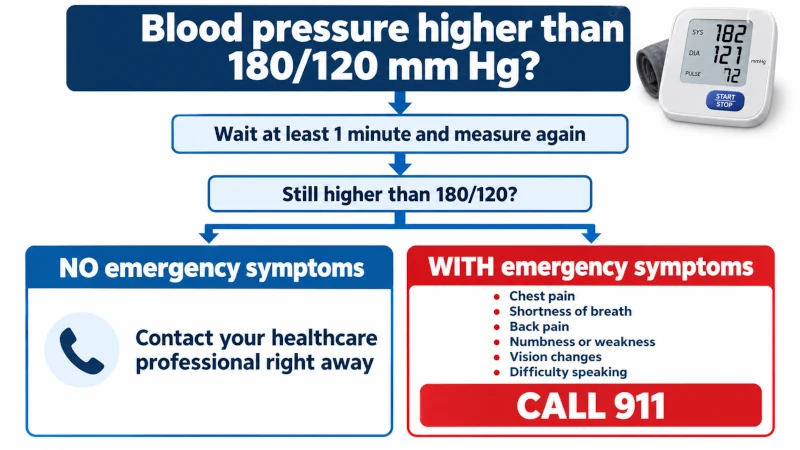
A single high reading isn’t an emergency. Take it again and write both numbers down. If your readings are suddenly higher than 180/120 mm Hg, wait at least a minute and retest; if they’re still that high, contact your healthcare professional right away [AHA, 2025].
Call 911 if your blood pressure is higher than 180/120 mm Hg and you have chest pain, shortness of breath, back pain, numbness, weakness, a change in vision or difficulty speaking. Don’t wait to see whether it comes down on its own [AHA, 2025].
Short of an emergency, book an appointment if your weekly average sits at or above 130/80 or above the target your clinician set. The 2025 AHA/ACC guideline puts the treatment goal for most adults below 130/80 [AHA/ACC, 2025].
| Health Disclaimer: This article is for general education and is not medical advice. It can’t diagnose you or account for your history, medications or risk. Blood pressure devices and treatment decisions should be guided by a qualified healthcare professional who knows you. If you are pregnant, have heart or kidney disease, an irregular heart rhythm, or take blood pressure medication, talk with your clinician before relying on home readings or changing treatment. Never stop or adjust medication on your own. If you have a reading above 180/120 mm Hg with chest pain, shortness of breath, back pain, numbness, weakness, vision changes or difficulty speaking, call 911. |
Frequently Asked Questions
Is the Welch Allyn Home 1700 clinically validated?
Yes, for general adults. It appears on the AMA’s Validated Device Listing with validation to ANSI/AAMI/ISO 81060-2:2013 [ValidateBP], based on a published study in 85 adults [Alpert, 2019]. It hasn’t been validated specifically for pregnancy or children.
Can I buy a Spot 4400 or ProBP 3400 for home use?
Why don’t my home readings match my doctor’s office?
Often because they’re measuring different situations. Readings high in the office but normal at home suggest white coat hypertension; normal in the office but high at home is masked hypertension, which tends to go unnoticed [USPSTF, 2021]. Bring your monitor and your log to your next visit so both can be compared.
Does the Welch Allyn app send my readings to my doctor?
It can, if your clinic uses it. Baxter says the Home 1700 can connect to the Welch Allyn Home Hypertension Program clinician portal or third-party remote-monitoring services [Baxter]. Ask your practice whether it accepts that data; otherwise, a printed or written log works fine.
Is a wrist monitor or smartwatch good enough?
The AHA doesn’t recommend wrist or finger monitors because they give less reliable readings [AHA, 2025], and the 2025 guideline says not to rely on cuffless devices such as smartwatches yet [AHA/ACC, 2025].
References
- American Heart Association. Home Blood Pressure Monitoring. View source
- American Heart Association. Top Things to Know: 2025 High Blood Pressure Guideline. View source
- US Preventive Services Task Force. Hypertension in Adults: Screening. View source
- American Medical Association. ValidateBP: Welch Allyn Home Blood Pressure Monitor, 1700 Series (H-BP100SBP), AASN-224. View source
- Baxter US Catalog. Home Monitoring Blood Pressure w/ SBP, item H-BP100SBP. View source
- Alpert BS. Validation of the Welch Allyn Home blood pressure monitor with professional SureBP algorithm with a special feature of accuracy during involuntary (tremor) patient movement. Blood Press Monit. 2019;24(2):89–92. doi:10.1097/MBP.0000000000000365. PMID 30724792. View source
- Alpert BS. Validation of the Welch Allyn SureBP (inflation) and StepBP (deflation) algorithms by AAMI standard testing and BHS data analysis. Blood Press Monit. 2011;16(2):96–98. doi:10.1097/MBP.0b013e328345232f. PMID 21412074. View source
- Alpert BS. Validation of the Welch Allyn ProBP 3400: a device for modern medical practice. Blood Press Monit. View source
- Medaval. Hillrom Home 1700 (H-BP100SBP). View source
- Medaval. Hillrom 1500 (RPM-BP100). View source
- Medaval. Welch Allyn Connex ProBP 3400 with SureBP. View source
- Baxter US Catalog. Connex ProBP 3400 Digital Blood Pressure Device. View source
- Inspectie Gezondheidszorg en Jeugd (Netherlands). Welch Allyn, Inc., FA-2024-017, ProBP 3400, Spot Vision Screener. View source
- Baxter Pro US. Welch Allyn Spot Vital Signs 4400 Device. View source
- Baxter/Hillrom. ABPM 7100 Ambulatory Blood Pressure Monitor (discontinued). View source
- American Lung Association. Pulse Oximetry. View source


