
Your blood pressure isn’t one fixed number. It moves with what you eat, how you sleep, whether you just climbed a flight of stairs or sat through a stressful meeting. What matters for your health is the pattern over time — and for almost half of American adults, that pattern runs too high.
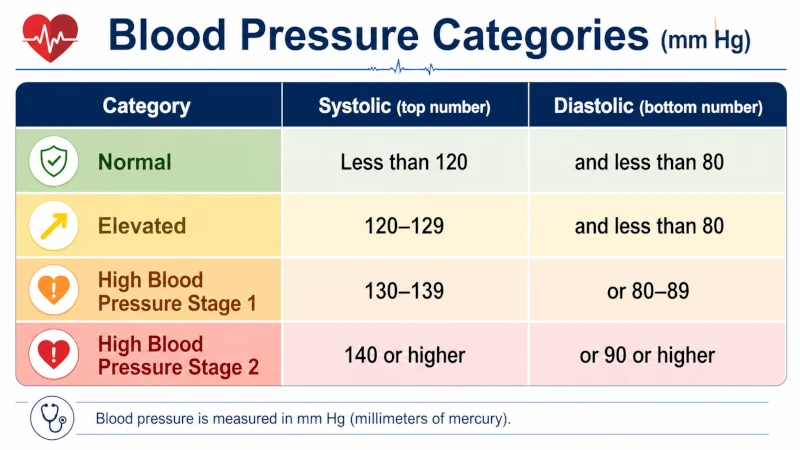
High blood pressure, or hypertension, means the force of blood against your artery walls is consistently elevated: a systolic reading (the top number) of 130 mm Hg or higher, or a diastolic reading (the bottom number) of 80 mm Hg or higher, on repeated checks [NHLBI, What Is High Blood Pressure?, 2024]. It rarely causes symptoms on its own, which is part of why it’s done so much quiet damage — it’s a primary or contributing cause of nearly 700,000 deaths a year in the United States, and roughly 1 in 3 people who have it don’t know it [CDC, High Blood Pressure Facts, 2026]. Worldwide, an estimated 1.4 billion adults aged 30 to 79 are living with hypertension [WHO, Hypertension fact sheet, 2025].
Diet and lifestyle drive most of that risk. Too much sodium, not enough potassium, carrying extra weight, staying sedentary, and smoking are the biggest modifiable pieces [CDC, High Blood Pressure Risk Factors, 2024]. The good news: those same levers work in reverse. Lifestyle changes are the first-line treatment your doctor will recommend, and for some people, a handful of nutrients — taken through food first, and supplements second — can meaningfully add to that effort.
None of what follows replaces blood pressure medication if you’ve been prescribed it, and none of it is a substitute for a conversation with your doctor, especially if you’re pregnant, have kidney disease, or take medication that affects your heart, blood pressure, or electrolytes.
Lower Blood Pressure Naturally: Lifestyle Comes First
Before any supplement, the interventions with the strongest evidence are still the unglamorous ones: a heart-healthy eating pattern such as the DASH diet, regular physical activity, weight loss if you carry excess weight, cutting back on sodium and alcohol, and quitting smoking [NHLBI, What Is High Blood Pressure?, 2024]. If you haven’t already made these changes, they matter more than anything on this list. Supplements work best as an addition to that foundation, not a replacement for it.
With that said, here’s what the research shows about six nutrients that come up most often in conversations about lowering blood pressure naturally.
Magnesium
Magnesium is involved in hundreds of processes in the body, including the relaxation of blood vessel walls. The theory is simple: more magnesium supports nitric oxide production and vascular relaxation, which should translate into lower pressure.
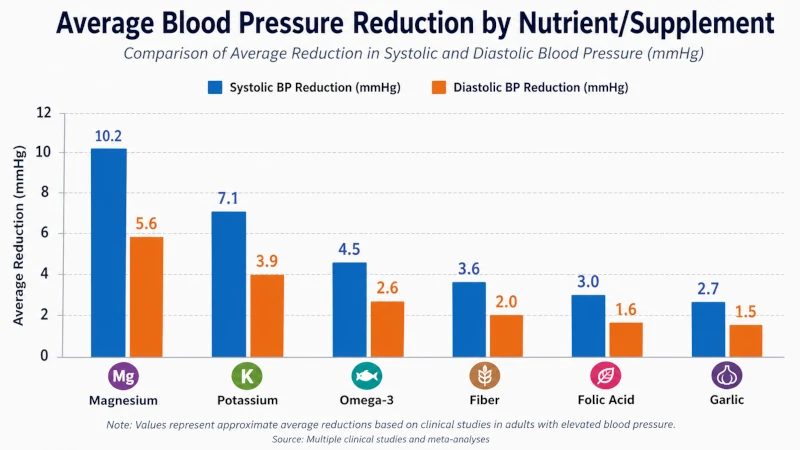
The evidence backs a modest version of that idea. A 2016 meta-analysis of 34 randomized, double-blind, placebo-controlled trials (2,028 participants) found that magnesium supplementation — a median dose of 368 mg per day for a median of three months — reduced systolic blood pressure by about 2.0 mm Hg and diastolic blood pressure by about 1.8 mm Hg compared with placebo [Zhang et al., Hypertension, 2016]. That’s a real but small effect, and the researchers noted the trials varied a lot in dose, duration, and the magnesium compound used, which limits how confident anyone can be about an exact number.
Magnesium also plays a role in insulin sensitivity, so it comes up in discussions of blood sugar management as well, though that’s a separate question from blood pressure specifically.
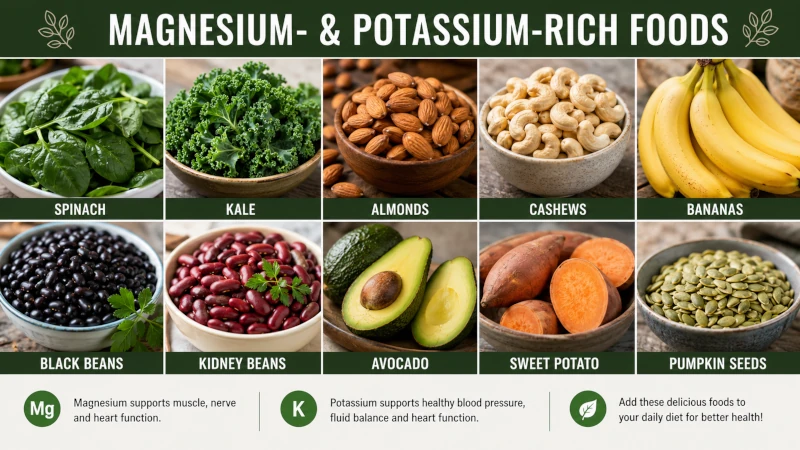
Practical notes: Food sources — leafy greens, nuts, seeds, legumes, whole grains — are the first place to look. If you supplement, magnesium citrate and glycinate are generally better absorbed and gentler on digestion than magnesium oxide. High doses can cause diarrhea and cramping, and magnesium can build up to dangerous levels in people with reduced kidney function, so anyone with kidney disease should not supplement without medical supervision. Magnesium can also interact with certain antibiotics and bisphosphonates by reducing their absorption, so space doses apart if you take those medications.
Potassium
Potassium works against sodium. It helps the kidneys excrete more sodium through urine and eases tension in blood vessel walls, both of which lower blood pressure [American Heart Association, How Potassium Can Help Prevent or Treat High Blood Pressure, 2025]. For adults who are otherwise healthy, the American Heart Association recommends 3,500 to 5,000 mg of potassium a day, ideally from food — bananas, potatoes, beans, leafy greens, and dairy are all good sources [American Heart Association, 2025].
That “from food” qualifier matters. Potassium supplements and potassium-based salt substitutes can help some people, but they’re not automatically safe. Too much potassium is dangerous for anyone with kidney disease, and it can build to harmful levels in people taking ACE inhibitors, ARBs, or potassium-sparing diuretics — common blood pressure medications. Symptoms of excess potassium include nausea, irregular heart rate, and muscle weakness [American Heart Association, 2025]. Talk to your doctor before adding a potassium supplement or switching to a potassium-based salt substitute, particularly if you’re already on blood pressure medication.
Omega-3 Fatty Acids
Omega-3s — the EPA and DHA found in fatty fish, and the ALA found in flaxseed and walnuts — support vascular health partly by helping blood vessels dilate. A 2022 dose-response meta-analysis of randomized controlled trials found that omega-3 supplementation lowered systolic blood pressure by about 1.2 mm Hg and diastolic pressure by about 0.9 mm Hg on average, with the biggest benefit clustering around 2 to 3 grams per day of combined EPA and DHA [Zhang et al., Journal of the American Heart Association, 2022]. Higher doses didn’t reliably add more benefit and raise other considerations, including bleeding risk.
Fish oil is the most common supplemental source; krill oil and cod liver oil also supply omega-3s, though cod liver oil adds vitamin A and D, which have their own upper limits.
Practical notes: Omega-3 supplements can thin the blood, so they should be used cautiously — and only with medical guidance — alongside blood thinners like warfarin or before scheduled surgery. High doses have occasionally been linked to a modest increase in atrial fibrillation risk in people already prone to it. Fish oil can also cause mild digestive upset or a fishy aftertaste; taking it with food usually helps.
Dietary Fiber
Fiber’s connection to blood pressure is less about a single mechanism and more about the overall pattern: higher fiber intake tends to travel with a healthier diet generally, but there’s also a direct effect. A meta-analysis of 24 randomized, placebo-controlled trials found that fiber supplementation — an average of about 11.5 grams per day — lowered diastolic blood pressure by roughly 1.3 mm Hg, with a smaller and statistically inconclusive effect on systolic pressure [Streppel et al., Archives of Internal Medicine, 2005]. The benefit was more consistent in people who were older or already had hypertension.
Most people fall well short of the recommended daily fiber intake, so getting there — through vegetables, fruit, legumes, and whole grains, or a supplement like psyllium or methylcellulose if food sources alone aren’t enough — is a reasonable, low-risk step that helps cholesterol and digestion regardless of its effect on blood pressure specifically.
Practical notes: Increase fiber gradually and drink enough water with it, or it can cause bloating, gas, and constipation instead of relieving it. Fiber supplements can interfere with the absorption of some medications, so take them a couple of hours apart from prescription drugs unless your pharmacist tells you otherwise.
Folic Acid (Vitamin B9)
Folic acid’s link to blood pressure is real but modest, and it’s better documented in people who already have cardiovascular disease than in the general population. A 2023 systematic review and dose-response meta-analysis pooling 22 studies and more than 41,000 participants found that folic acid supplementation reduced systolic blood pressure by about 1.1 mm Hg and diastolic pressure by about 0.2 mm Hg [Asbaghi et al., Critical Reviews in Food Science and Nutrition, 2023]. Those are small numbers, and the authors noted the effect varied by dose, treatment duration, and the population studied — this isn’t a nutrient to reach for as a primary blood-pressure strategy, but the evidence for a modest supporting role is genuine.
Leeks, leafy greens, legumes, and citrus fruits are natural sources of folate, the form of vitamin B9 found in food. Leeks in particular carry more folic acid than most alliums.
Practical notes: High-dose folic acid supplementation can mask the symptoms of vitamin B12 deficiency, which matters most for older adults and anyone on long-term metformin, since B12 deficiency left unaddressed can cause nerve damage. If you’re taking folic acid at doses well above what’s in a standard multivitamin, ask your doctor about checking your B12 status.
Garlic
Garlic has one of the more consistent evidence bases on this list, at least for people who already have high blood pressure. A meta-analysis of 17 randomized controlled trials found that garlic supplements reduced systolic blood pressure by about 3.75 mm Hg and diastolic pressure by about 3.39 mm Hg compared with placebo overall — and the systolic effect was significant specifically in people with hypertension (about a 4.4 mm Hg reduction), not in people with normal blood pressure [Wang et al., Journal of Clinical Hypertension, 2015]. Garlic supplementation has also been studied for cholesterol and general cardiovascular support, though those are separate outcomes from blood pressure specifically.
Practical notes: Garlic supplements can increase bleeding risk, especially in combination with blood thinners like warfarin or aspirin, and should generally be stopped at least a week or two before scheduled surgery — ask your surgeon for specific timing. High doses of raw garlic can also irritate the digestive tract. Garlic is generally considered safe in food amounts during pregnancy and breastfeeding, but supplement-level doses haven’t been well studied in pregnant or breastfeeding women, so check with your doctor first.
Who Should Be Especially Careful
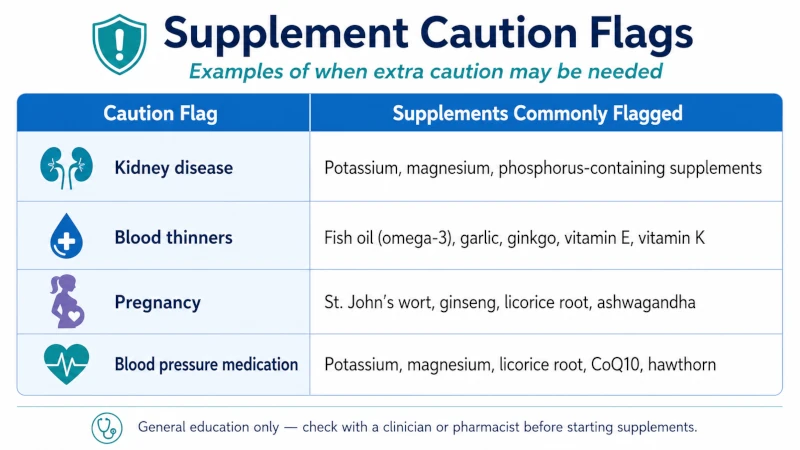
A few groups need to be more cautious with any of the nutrients above, beyond the medication interactions already noted:
- People with kidney disease: Magnesium and potassium are both cleared by the kidneys. Reduced kidney function makes it easier for either to build up to dangerous levels.
- People on blood thinners: Omega-3s and garlic both affect clotting. Combining them with warfarin, clopidogrel, or even regular aspirin raises bleeding risk and needs medical oversight.
- People who are pregnant or breastfeeding: Food-level amounts of these nutrients are generally fine, but supplement doses above what’s in a standard prenatal vitamin should be cleared with an OB or midwife first, since the safety data for higher doses in pregnancy is limited.
- Anyone already on blood pressure medication: Several of these nutrients — potassium especially — can push blood pressure lower than intended or interact directly with common antihypertensive drugs. Don’t add a new supplement without telling the prescriber.
When to Seek Care Right Away
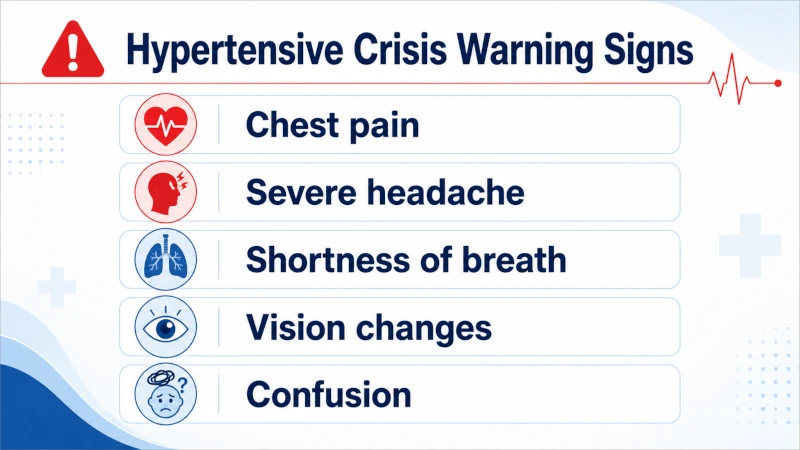
Most high blood pressure has no symptoms, which is exactly why routine checks matter more than waiting to feel something wrong. But a blood pressure reading of 180/120 mm Hg or higher is a hypertensive crisis, and if it comes with chest pain, shortness of breath, severe headache, vision changes, confusion, or difficulty speaking, that’s an emergency — call 911 or get to an emergency room rather than waiting to see if it comes down on its own [WHO, 2025] [NHLBI, 2024].
If your readings are consistently elevated but you’re not in crisis, that’s still a reason to talk to a healthcare provider about a full plan — one that may include these nutrients, but will very likely include the diet, activity, and weight changes that have the strongest evidence behind them, and possibly medication.
| HEALTH DISCLAIMER: This article is for educational purposes and isn’t a substitute for individual medical advice, diagnosis, or treatment. Blood pressure management should be guided by a healthcare professional who knows your health history, current medications, and lab results. If you’re pregnant, breastfeeding, managing kidney disease, or taking blood pressure medication, blood thinners, or diabetes medication, talk to your doctor before starting any new supplement — several of the nutrients discussed here can interact with those conditions and medications in ways that matter. |
Frequently Asked Questions
Can I lower my blood pressure with supplements alone, without changing my diet?
Not reliably. The effect sizes in the research above are modest — a few mm Hg at most for any single nutrient — and they were studied as an addition to, not a replacement for, a healthy diet. Sodium reduction, weight management, and physical activity have larger and better-established effects [NHLBI, 2024].
How long does it take to see a difference from magnesium or other supplements?
In the studies above, effects were measured after roughly one to three months of consistent use. Individual results vary, and blood pressure should be tracked with a home monitor or regular provider visits rather than by how you feel, since hypertension usually has no symptoms.
Is it safe to take more than one of these supplements at once?
Not necessarily. Combining potassium and magnesium supplements, for instance, compounds the kidney-related risks of each. Stacking omega-3s and garlic increases bleeding risk more than either alone. If you want to try more than one, do it with your doctor’s knowledge so they can watch for interactions and adjust any medications if needed.
Do potassium-based salt substitutes work as well as a potassium supplement?
They can help lower blood pressure by reducing sodium intake while adding potassium, but they carry the same kidney-related cautions as potassium supplements and shouldn’t be used without checking with a healthcare professional first, especially if you take medication that affects potassium levels [American Heart Association, 2025].
What blood pressure reading counts as an emergency?
180/120 mm Hg or higher, especially with symptoms like chest pain, severe headache, shortness of breath, or vision changes. That combination needs emergency care right away, not a wait-and-see approach [WHO, 2025].
References
- National Heart, Lung, and Blood Institute (NHLBI). “What Is High Blood Pressure?” NHLBI, NIH. Updated April 25, 2024. https://www.nhlbi.nih.gov/health/high-blood-pressure
- Centers for Disease Control and Prevention (CDC). “High Blood Pressure Facts.” CDC. Reviewed June 2, 2026. https://www.cdc.gov/high-blood-pressure/data-research/facts-stats/index.html
- Centers for Disease Control and Prevention (CDC). “High Blood Pressure Risk Factors.” CDC. December 13, 2024. https://www.cdc.gov/high-blood-pressure/risk-factors/index.html
- World Health Organization (WHO). “Hypertension.” WHO Fact Sheets. September 25, 2025. https://www.who.int/news-room/fact-sheets/detail/hypertension
- American Heart Association (AHA). “How Potassium Can Help Prevent or Treat High Blood Pressure.” Heart.org. Reviewed August 14, 2025. https://www.heart.org/en/health-topics/high-blood-pressure/changes-you-can-make-to-manage-high-blood-pressure/how-potassium-can-help-control-high-blood-pressure
- Zhang X, Li Y, Del Gobbo LC, Rosanoff A, Wang J, Zhang W, Song Y. “Effects of Magnesium Supplementation on Blood Pressure: A Meta-Analysis of Randomized Double-Blind Placebo-Controlled Trials.” Hypertension. 2016;68(2):324–333. DOI: 10.1161/HYPERTENSIONAHA.116.07664. PMID: 27402922.
- Wang HP, Yang J, Qin LQ, Yang XJ. “Effect of Garlic on Blood Pressure: A Meta-Analysis.” Journal of Clinical Hypertension (Greenwich). 2015;17(3):223–231. DOI: 10.1111/jch.12473. PMID: 25557383.
- Zhang X, Ritonja JA, Zhou N, Chen BE, Li X. “Omega-3 Polyunsaturated Fatty Acids Intake and Blood Pressure: A Dose-Response Meta-Analysis of Randomized Controlled Trials.” Journal of the American Heart Association. 2022;11(11):e025071. DOI: 10.1161/JAHA.121.025071. PMID: 35647665.
- Streppel MT, Arends LR, van ’t Veer P, Grobbee DE, Geleijnse JM. “Dietary Fiber and Blood Pressure: A Meta-Analysis of Randomized Placebo-Controlled Trials.” Archives of Internal Medicine. 2005;165(2):150–156. DOI: 10.1001/archinte.165.2.150. PMID: 15668359.
- Asbaghi O, Salehpour S, Rezaei Kelishadi M, Bagheri R, Ashtary-Larky D, Nazarian B, Mombaini D, Ghanavati M, Clark CCT, Wong A, Naeini AA. “Folic Acid Supplementation and Blood Pressure: A GRADE-Assessed Systematic Review and Dose-Response Meta-Analysis of 41,633 Participants.” Critical Reviews in Food Science and Nutrition. 2023;63(13):1846–1861. DOI: 10.1080/10408398.2021.1968787. PMID: 34478339
