Ceanothus Americanus – botanically written Ceanothus americanus – is better known as New Jersey tea or red root. It has genuine historical use as a beverage and traditional remedy, but the medical evidence is thin. Reliable human evidence does not establish it as a treatment for bronchitis, asthma, sore throat, mouth ulcers, or other diseases. A 1997 laboratory study did find compounds from a methanol extract that inhibited several oral bacteria, but a laboratory extract is not the same thing as a cup of tea, gargle, or tincture. [Li, Cai & Wu, 1997]
| Quick evidence check: Historical use: well documented. Laboratory evidence: one relevant in-vitro oral-bacteria study. Human treatment evidence: insufficient to support disease-treatment claims. Therapeutic dose: not established by reliable clinical evidence. |
What is Ceanothus americanus?
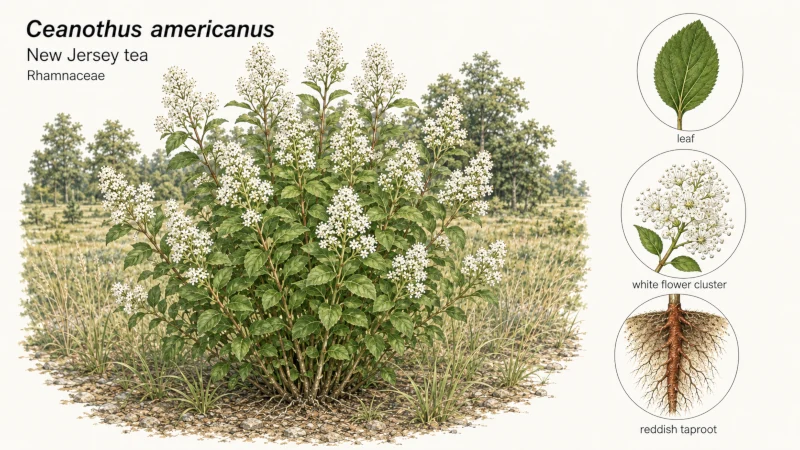
Ceanothus americanus is a deciduous native shrub in the buckthorn family, Rhamnaceae. USDA describes it as an upright, multi-stemmed plant about three feet tall, with oblong-to-ovate leaves, clusters of small white flowers, and a deeply anchored reddish taproot – the feature behind the common name “red root.” [USDA NRCS, Wynia 2010]
NC State Extension lists New Jersey tea and mountain snowbell among its common names and describes the species as native across much of eastern and central North America. The dried leaves can be made into tea. [NC State Extension plant profile]
| Fact | What is supported |
| Scientific name | Ceanothus americanus L. |
| Family | Rhamnaceae (buckthorn family) |
| Common names | New Jersey tea, red root; NC State also lists mountain snowbell |
| Growth habit | Native, deciduous shrub; roughly 2-3 feet tall in the NC State profile |
| Historically used parts | Leaves as tea; roots/root bark also appear in traditional and historical use |
| Clinical evidence | Limited; historical and laboratory data are stronger than human treatment data |
Traditional uses of Ceanothus americanus
The traditional record is substantial enough to take seriously as history, but it should not be mistaken for proof of effectiveness. The USDA plant fact sheet records that Missouri River tribes used the leaves for tea, while Great Lakes peoples used the plant for bowel complaints. The same fact sheet notes that colonists used the leaves as a tea substitute during the Revolutionary War and that the leaves contained no caffeine. [USDA NRCS, 2010]
NC State Extension also records Native American use of New Jersey tea for respiratory tract infections. That tells us the plant had a place in traditional practice; it does not tell us that it treats an infection by modern clinical standards. [NC State Extension]
For readers comparing respiratory herbs more broadly, see herbs for the lungs and what the evidence shows. Evidence differs substantially from one plant and preparation to another.
What does modern research show?
The 1997 oral-bacteria laboratory study
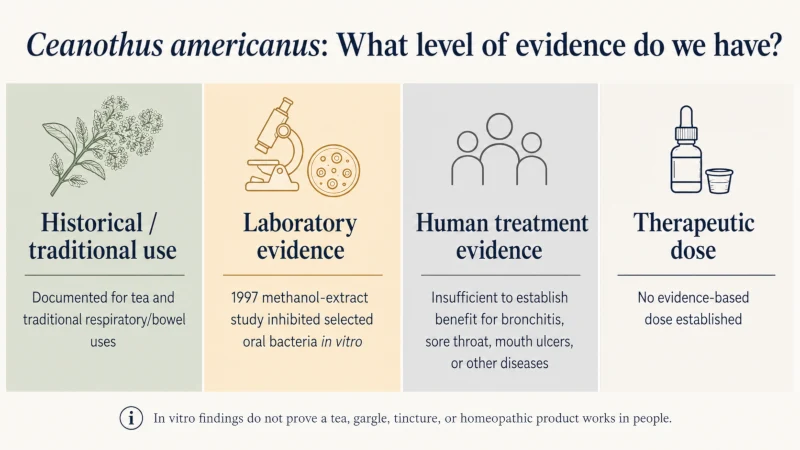
The most directly relevant modern paper located for this species is a 1997 Phytochemistry study by Li, Cai, and Wu. Researchers tested a methanol extract of Ceanothus americanus and isolated several triterpenes and flavonoids. Two compounds – ceanothic acid and ceanothetric acid – inhibited the growth of selected oral bacteria in vitro, including Streptococcus mutans, Actinomyces viscosus, Porphyromonas gingivalis and Prevotella intermedia. Reported minimum inhibitory concentrations ranged from 42 to 625 micrograms per milliliter. [Li, Cai & Wu, 1997; PMID 9276981]
What the study cannot tell us
This was a laboratory experiment, not a clinical trial in people. It used a methanol extract and purified compounds under controlled conditions. It did not test New Jersey tea as a beverage, a homemade gargle, a root decoction, or a tincture, and it did not show that the plant treats cavities, gum disease, mouth ulcers, pharyngitis, or any other condition in humans.
That distinction matters because an extract can contain different concentrations of plant chemicals than a tea or commercial supplement. NCCIH also cautions that products sold to consumers can differ in important ways from products used in research. [NCCIH supplement safety guidance]
| Claim or use | What supports it | Evidence grade |
| Use as a tea beverage | Historical and ethnobotanical records; dried leaves listed as edible tea | Documented traditional use |
| Respiratory complaints | Ethnobotanical record of traditional use | Traditional only; clinical benefit not established |
| Bowel complaints | Historical ethnobotanical record | Traditional only; clinical benefit not established |
| Oral bacteria | 1997 methanol-extract study against selected organisms | Laboratory / in vitro |
| Mouth sores, pharyngitis, bronchitis, asthma | No reliable human treatment evidence established by the sources used here | Insufficient |
| Therapeutic dosing | No evidence-based human treatment dose established | Insufficient |
Herbal Ceanothus vs. homeopathic Ceanothus
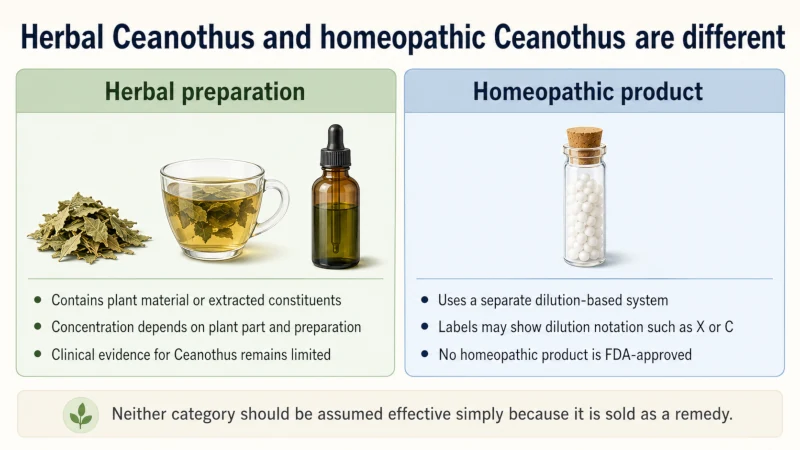
The words “herbal” and “homeopathic” are sometimes used as though they mean the same thing. They do not. An herbal tea, tincture, or extract contains plant material or extracted plant constituents. Homeopathy is a separate system based on “like cures like” and serial dilution; homeopathic labels commonly use dilution notations such as X or C. [FDA homeopathic products guidance]
FDA states that no product labeled as homeopathic is FDA-approved, and homeopathic products marketed in the United States have not been reviewed by FDA for safety and effectiveness to diagnose, treat, cure, or prevent disease. A homeopathic product labeled Ceanothus americanus should therefore not be treated as equivalent to an herbal tea or extract – and neither form should be assumed effective simply because it is sold as a remedy. [FDA]
Ceanothus Americanus tea, tincture, and dosing
New Jersey tea earned its common name for a reason: historical sources document the leaves being brewed as tea, including their use as a caffeine-free tea substitute during the Revolutionary War. [USDA NRCS, 2010] That is a food-history fact, not evidence that the tea treats a medical condition.
There is no well-established, evidence-based therapeutic dose of Ceanothus americanus for bronchitis, sore throat, mouth ulcers, or other diseases. A leaf tea also should not be assumed equivalent to a concentrated root-bark decoction or tincture. Concentration, plant part, extraction method, and product quality all change what you are exposed to.
| Practical use rule: If you are considering a commercial Ceanothus tea, tincture, or supplement, use a clearly labeled product and discuss it with a doctor or pharmacist if you take medications, have a chronic health condition, are pregnant or breastfeeding, or are preparing for surgery. Do not use a homemade concentrated preparation as a substitute for medical treatment. |
Safety, side effects, interactions, and who should avoid it
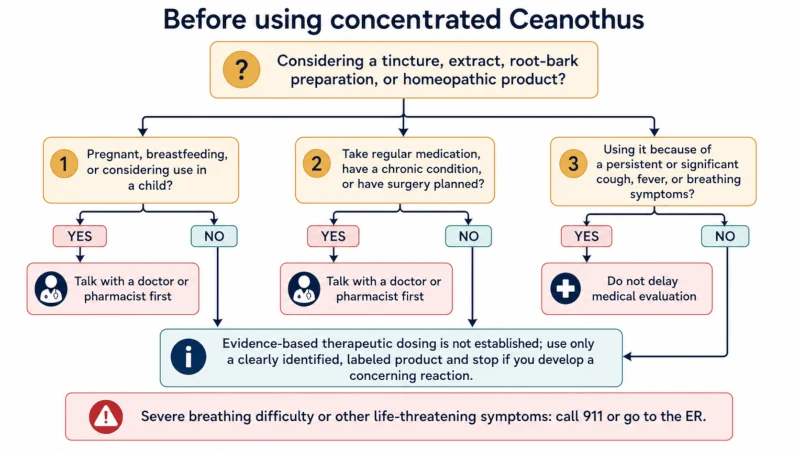
The biggest safety problem with Ceanothus is the lack of dependable human data. A well-characterized list of common side effects, interaction frequencies, and safe therapeutic doses is not established. That uncertainty deserves more weight with concentrated extracts and tinctures than with occasional food-like use of a correctly identified leaf tea.
NCCIH notes that herbal supplements can interact with prescription or over-the-counter medicines, may create problems around surgery, and often have not been adequately tested in pregnant women, nursing mothers, or children. [NCCIH]
- Medication interactions: A reliable Ceanothus-specific interaction profile is not established. If you take regular medicines, ask a pharmacist or doctor before using a concentrated product.
- Pregnancy and breastfeeding: Avoid medicinal or concentrated use unless a qualified healthcare professional specifically recommends it; many botanical supplements have not been adequately tested in these groups.
- Children: Do not give concentrated herbal products to a child without guidance from the child’s doctor.
- Surgery: Tell your surgical team about every herb or supplement you use. Follow their instructions about whether and when to stop it.
- Chronic conditions: If you have heart, lung, liver, kidney, bleeding, or other ongoing medical problems, get individual advice before using a concentrated botanical product.
- Adverse reactions: Stop the product and seek medical advice if you develop a concerning reaction. Severe swelling, wheezing, or difficulty breathing requires emergency care.
When not to self-treat respiratory symptoms
Because New Jersey tea has a history of respiratory use, some people encounter it while looking for help with cough or bronchitis. Do not let an herb delay evaluation when symptoms point to something more serious. CDC advises medical care for bronchitis symptoms that include a temperature of 100.4°F or higher, bloody mucus, shortness of breath or trouble breathing, symptoms lasting more than three weeks, or repeated episodes of bronchitis. [CDC bronchitis guidance]
For severe breathing difficulty – such as being unable to speak normally without gasping – or other life-threatening symptoms, call 911 or go to the ER. [CDC emergency triage guidance] For practical food, hydration, and symptom-support information, see what to eat when you are sick with bronchitis. If your main concern is an irritated throat, the site’s slippery elm evidence and safety guide covers a different herb with more directly relevant throat-soothing evidence.
| Health Disclaimer: This article is for general education and does not diagnose, treat, cure, or prevent disease. Ceanothus americanus has traditional uses, but reliable human evidence and standardized therapeutic dosing are limited. Talk with your doctor or pharmacist before using a concentrated herbal or homeopathic product if you take medication, have a medical condition, are pregnant or breastfeeding, are preparing for surgery, or are considering use in a child. Seek prompt medical care for significant or persistent symptoms, and use emergency services for severe breathing difficulty or other life-threatening symptoms. |
Frequently Asked Questions
What is Ceanothus Americanus used for?
Historically, New Jersey tea has been used as a beverage and in traditional practice for respiratory and bowel complaints. Modern evidence is much thinner. A laboratory study found antimicrobial activity against selected oral bacteria, but reliable human evidence does not establish Ceanothus as a treatment for those conditions.
Does Ceanothus americanus treat bronchitis or cough?
Traditional records include respiratory use, but that is not the same as clinical proof. There is no established evidence-based Ceanothus treatment or dose for bronchitis. Breathing trouble, bloody mucus, fever, prolonged symptoms, or repeated bronchitis should be medically evaluated.
Is New Jersey tea the same as homeopathic Ceanothus?
No. Herbal tea contains plant material, while homeopathic products use a separate dilution-based system. FDA states that no homeopathic product is FDA-approved and that marketed homeopathic products have not been reviewed by FDA for safety and effectiveness.
Can you drink New Jersey tea?
The dried leaves have a documented history of being brewed as tea, including as a caffeine-free tea substitute. That history does not establish a medicinal dose or prove that the tea treats disease. Correct plant identification and product quality still matter.
What are the side effects of red root?
A dependable Ceanothus-specific side-effect profile has not been established in good human studies. Stop using a product if you develop a concerning reaction, and ask a doctor or pharmacist before using a concentrated preparation with medications or medical conditions.
Is Ceanothus americanus safe during pregnancy?
There is not enough reliable safety evidence to recommend medicinal or concentrated use during pregnancy or breastfeeding. NCCIH notes that many dietary supplements have not been adequately tested in pregnant or nursing people. Ask your doctor before use.
References
- Wynia, R.L.. Plant fact sheet for New Jersey tea (Ceanothus americanus). USDA Natural Resources Conservation Service, Manhattan Plant Materials Center. 2010. View source
- North Carolina State University Extension. Ceanothus americanus (Mountain Snowbell, New Jersey Tea). North Carolina Extension Gardener Plant Toolbox. View source
- Li, X.C.; Cai, L.; Wu, C.D.. Antimicrobial compounds from Ceanothus americanus against oral pathogens. Phytochemistry. 1997;46(1):97-102. PMID: 9276981. DOI: 10.1016/S0031-9422(97)00222-7. View source
- U.S. Food and Drug Administration. Homeopathic Products. View source
- National Center for Complementary and Integrative Health. Using Dietary Supplements Wisely. View source
- Centers for Disease Control and Prevention. Preventing and Treating Bronchitis. View source
- Centers for Disease Control and Prevention. Phone Advice Line Tools: Guidelines for Children (2-17 years) or Adults (18 years and older) with Possible COVID-19. March 30, 2020. View source
